Serta Futon Mattress Review: Is It Worth It for Sleep?
Serta futon mattress is worth it for occasional guest use and small-space seating, but for nightly sleep only if you choose a thicker model with better support and a sturdy frame. Pick wrong, and you end up with sagging, weak support, or a bed that feels fine for an hour but fails overnight. This guide breaks down Serta futon comfort, fit, and value for guest rooms, daily sleep, and small apartments.
Verdict


If you are choosing between the Serta Cypress and Serta Sycamore, Cypress is the safer buy for guest-room comfort because it is 8 inches thick, uses 266 individually-wrapped Bonnel innerspring coils, and adds CertiPUR-US certified foam plus three layers of Cottonique. Sycamore is the better pick only when you want a simpler, medium-firm futon with two layers of foam, an innerspring core, and 4-inch Cottonique padding, and you are not asking it to fold as often.
📊 Serta Cypress Double Sided Innerspring is 8 inches thick. Source: Best Futon Mattress of 2026.
Specs at a glance
| Model | Build | Thickness / padding | Firmness | Other notes |
|---|---|---|---|---|
| Serta Cypress Double Sided Innerspring futon mattress | 266 individually-wrapped Bonnel innerspring coils, CertiPUR-US certified foam, three layers of Cottonique | 8 inches | Medium back support | Microfiber cover; framed as a good option for a guest room |
| Serta Sycamore futon mattress | Two layers of foam with an innerspring core | 4-inch Cottonique padding | Medium firmness | Made in the USA; lace tufting |
| Cottonique | Cotton-poly fiber blend used across Serta futon descriptions | Used as cushioning and structure support | Not a firmness rating | Chosen for durability and padding |
Two quick fit notes matter here. First, futon size must match the frame; full-size is still the most common fit point, while queen-size changes both room layout and price sensitivity. Second, frame style matters as much as the mattress fill, because a stiff, double-sided futon can feel awkward on a frame that does not open and close smoothly.

Who is the Serta futon mattress for?
Serta futon mattress is best for guest-room sleepers, small-space owners who need a sofa-bed setup, and buyers who want more structure than a thin foam pad can offer. It is less compelling for people who need a plush, hotel-like bed every night, especially if the frame is basic or the room runs warm.
Guest room sleepers
For occasional sleeping, Serta’s futon line makes more sense than it does for daily use. You can accept some tradeoff in softness and folding feel if the bed is used a few weekends a month, not every night.
Small-space owners who need a sofa-bed setup
If the mattress has to sit on a convertible frame and still work as daytime seating, medium firmness and a coil core are useful. They give the mattress more shape than low-cost foam-only options, which can flatten quickly in sofa mode.
Nightly sleepers who need more than a thin pad
Nightly sleepers should look at the Cypress first. The thicker build and wrapped-coil construction suit buyers who want a more bed-like feel, but only if the frame is supportive and sized correctly.
What works about the Serta futon mattress?
The strongest part of Serta’s futon line is the support structure. Coil cores and layered padding usually hold shape better than very thin futons, and medium firmness is a useful middle ground if you need the mattress to function as both seating and sleep surface.
Support from innerspring cores and wrapped coils
Individually-wrapped coils are support-focused by design because each coil can compress with less direct pull from the coils beside it. In the Cypress, 266 individually-wrapped Bonnel innerspring coils give the mattress more structure than a plain foam build, which is one reason it reads as the stronger guest-bed option.
Medium firmness for sit-and-sleep balance
Medium firmness is the right target for many futon buyers because very soft fill can feel sloppy on a frame, while very hard fill can be miserable in sofa mode. Serta’s Sycamore is described as medium firmness, and Cypress is described as offering medium back support, which fits that sit-and-sleep balance.
Cottonique layers for cushion and structure
Cottonique appears across Serta futon descriptions as a cotton-poly fiber blend used for cushioning and durability. On Cypress, three layers of Cottonique help round out the coil core. On Sycamore, 4-inch Cottonique padding adds more body to the mattress feel without turning it into an all-foam pad.
What does not work?
Serta futons are not automatic wins for every frame or sleeper. The main drawbacks are folding stiffness on some models, possible heat buildup over time, and the fact that heavy sleepers may outgrow the support sooner than lighter guest-room use would suggest.
Heat, stiffness, and fold behavior over time
Some customers say the Sycamore does not fold or flex easily, which matters if the mattress must open and close every day. That can create a stiff sofa action and make the frame feel harder to use. Cypress has a microfiber cover for breathability, but a breathable cover is not the same as cool sleep in a warm room.
Weight support limits for heavier sleepers
Heavier sleepers generally need more than broad “supportive” marketing language. A coil core helps, but the frame, size fit, and thickness still decide how the bed performs under load. If the mattress will carry a heavier adult every night, Cypress is the better Serta option, though a thicker innerspring mattress outside the futon category may still be wiser.
Where thinner or cheaper futons may make more sense
If you only need an emergency guest bed or a temporary setup, a cheaper futon can be enough. That is especially true when the bed stays folded most of the week and the goal is simple sleeping surface coverage, not long-term daily comfort.
Which Serta futon is the better buy?
Cypress is the better buy for most shoppers because it has more build depth, more defined support, and a clearer guest-room use case. Sycamore is the leaner pick for buyers who want a medium-firm futon with a simpler layered build and do not need the stronger nightly-sleep case that Cypress offers.
Cypress vs. Sycamore by sleeper type
Cypress fits the buyer who wants a fuller mattress feel, better back support, and a better chance of working as a guest bed without feeling flimsy. Sycamore fits the buyer who wants a more modest futon mattress, prefers medium firmness, and is comfortable with a simpler construction that may not fold as easily.
Best pick for guest rooms
Cypress is the better guest-room pick. The 8-inch thickness, wrapped coils, CertiPUR-US certified foam, and multiple Cottonique layers add up to a more convincing overnight surface, which matters when the guest bed is supposed to feel respectable for a short stay.
Best pick for regular use
If you plan to sleep on it regularly, Cypress is again the safer choice, but only with a solid frame and proper size match. Sycamore can work for lighter regular use, yet the reports about folding stiffness make it a weaker candidate for frequent conversion.
Value by use case
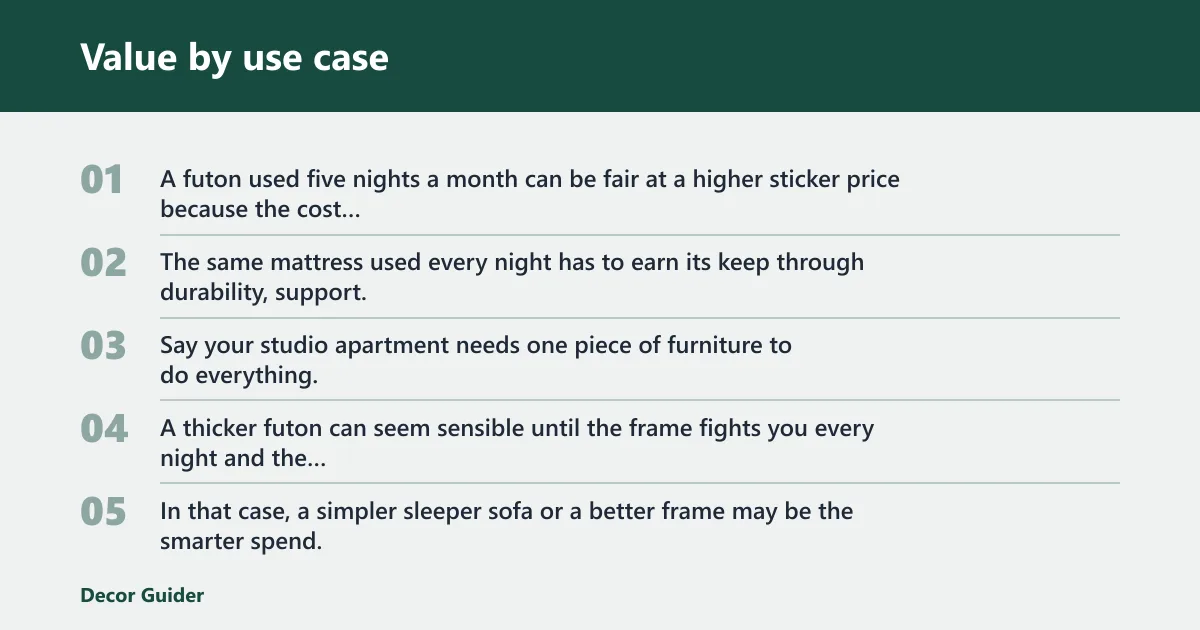
The value math changes with usage frequency. A futon used five nights a month can be fair at a higher sticker price because the cost is spread out over time. The same mattress used every night has to earn its keep through durability, support, and easier folding, not just first-week comfort.
| Use case | Value tier | What to look for | Simple cost-per-night framework |
|---|---|---|---|
| Occasional guest bed | High for Cypress | Thickness, wrapped coils, breathable cover, easy frame fit | If a mattress costs more upfront, divide it by roughly 20 to 40 guest nights a year to judge whether the comfort premium is worth it |
| Nightly sleep | Medium for Cypress, low for Sycamore | Support, folding behavior, frame stiffness, heat management | If it is used every night, divide the price by about 365 nights per year and ask whether the support still justifies the cost after the first year |
| Small-space sofa-bed | Medium | Fold action, size fit, daytime seating feel, edge stability | For a daily sofa-bed, comfort has to work in both modes, so even a moderate price can be poor value if the frame is awkward |
Say your studio apartment needs one piece of furniture to do everything. A thicker futon can seem sensible until the frame fights you every night and the mattress starts feeling warm and hard to fold. In that case, a simpler sleeper sofa or a better frame may be the smarter spend.
Suppose your spare room only gets holiday visitors and the mattress stays folded for months at a time. The Cypress can make sense because its support and padding matter more than long-term daily-flex fatigue, and you are paying for comfort in a limited number of nights, not every night of the year.
Does the Serta futon mattress work on any futon frame?
No, and this is where many buyers go wrong. Futon mattresses are sensitive to frame material, fold style, and size fit. A mattress can be a good build on paper and still feel wrong if the frame is too flexible, the slats are too wide, or the mattress size does not match the opening geometry.
Wood frame sensitivity
Wood frames vary more than shoppers expect. Some are stiff and supportive, while others flex enough to make a dense futon feel difficult to fold. If the frame already feels rigid, Sycamore’s reported folding resistance becomes a bigger problem. A firmer, thicker mattress can also reveal weak frame joints faster.
Fold style and size fit
Size fit matters because full-size futon mattresses are still the common standard, and queen-size changes how the frame opens and how much floor room you need. A tri-fold mattress, such as the D&D Futon Furniture Shikibuton used in competitor coverage, is a different category entirely from a conventional Serta futon mattress and should not be treated as interchangeable.
- Check the frame size first: full or queen.
- Check whether the frame opens in a standard bi-fold or a more unusual style.
- Measure the usable seat depth and open-bed length before buying.
- Match a thicker futon only to a frame that can hold its shape.
- Avoid pairing a stiff mattress with a weak or loose frame.
How thick is the Serta futon mattress?
The main Serta futon options in this review are not close in thickness. Cypress is 8 inches thick, which puts it in the more mattress-like group. Sycamore is built around 4-inch Cottonique padding over a two-foam-layer and innerspring-core structure, so it reads slimmer and less substantial overall.
What thickness means for daily feel
Thickness matters because it affects how much structure you feel between your body and the frame. An 8-inch futon generally has more room for coil support and padding layers. A thinner build can still work, but it gives you less margin before the frame becomes noticeable.
Is the Serta futon mattress good for back support?
It can be, especially the Cypress. Wrapped coils, medium back support, and layered Cottonique are a sensible formula for buyers who want more structure than a soft foam futon provides. Back support is still conditional on body weight, frame quality, and how long the mattress is used each night.
Why medium firmness matters
Medium firmness often hits the best middle ground for futons because it supports the spine better than very soft fill while still working as a seat. Sycamore’s medium firmness and Cypress’s medium back support both point in that direction, but Cypress has the deeper support stack.
Will a Serta futon mattress hold up for a heavy sleeper?
It may hold up better than a thin foam futon, but that is not the same as saying it is ideal for heavy sleepers. Heavy sleepers put more stress on the frame, the coil core, and the folding points, so the real question is whether the mattress and frame together can resist sagging and hinge strain over time.
Where failure usually starts
Failure often starts at the fold line or at the frame, not in the cover. If the mattress is too stiff, the frame may take more abuse during conversion. If it is too soft, the middle can sag. For heavier sleepers, Cypress is the only Serta option here that looks suitable for cautious consideration.
Does the Serta futon mattress sleep hot?
It can, depending on room temperature, bedding, and how compressed the futon is under body weight. Cypress adds a microfiber cover for breathability, which helps surface airflow, but a wrapped-coil futon still traps more warmth than a simple, open, thin pad in many setups.
How to reduce heat buildup
Use breathable sheets, leave room under the frame for air movement, and avoid placing the mattress in a closed, poorly ventilated alcove. If heat is already a complaint on the first week, that is a warning sign for nightly use, not something that usually improves with time.
How does a Serta futon mattress compare with other futon brands?
Serta compares best when you want a more structured futon than the cheapest foam options, but you should still compare it against similarly built competitors on thickness, coil count, and certification. The DHP futon mattress in the same roundup uses 522 pocket coils, which is a stronger coil-count figure on paper, though it is only available in full size. Royal Sleep Products New Replacement is available in full and queen size, which may matter more if room layout is tight.
Where Serta looks better
Serta looks better when you want a recognizable futon mattress with a clearer comfort profile, such as Cypress’s 8-inch build and CertiPUR-US certified foam. Cottonique also appears across Serta descriptions, which gives the line a consistent cushioning language that many generic futons do not spell out.
Where competitors may beat it
Some competitors may win on coil count, size options, or lower entry price. If a cheaper futon has the same thickness and a similar support story, Serta’s value depends on whether the frame fit, cover material, and build depth are better enough to justify the premium. If not, the cheaper model is the smarter buy.
Should you buy a Serta futon mattress?
Buy Serta if you want a firmer, more structured futon for guest use, light regular sleeping, or a sofa-bed setup that needs more support than a basic foam pad. Skip it if your frame is a poor match, if you need easy daily folding, or if your main goal is the lowest possible price.
Buy if these points fit your setup
Choose Cypress if guest-room comfort matters and your frame is sturdy. Choose Sycamore only if you want a medium-firm, USA-made futon with an innerspring core and you can live with a less flexible fold.
Skip if these problems apply
Skip Serta if your frame is already weak, if you need a tri-fold or specialty setup, or if you want a mattress that feels soft out of the box with little resistance. In those cases, a cheaper futon or a different sleep solution may fit better.
Frequently asked questions
Is a Serta futon mattress worth it for everyday sleeping?
It can be worth it for everyday sleeping only if you choose the thicker Cypress and place it on a sturdy, correctly sized frame. Sycamore is less convincing for nightly use because some customers say it does not fold or flex easily, which makes daily conversion more annoying over time.
Products related to this article
Sponsored / affiliate links. As an Amazon Associate I earn from qualifying purchases. I may earn additional commission from eligible campaigns.