Futon Slipcover Cost: How Much to Budget for a New One
Budget for a futon slipcover the same way you budget for any fitted textile: by size, fabric, and fit system, not by the sticker alone. A ready-made cover makes sense when the futon is standard-sized and simple in shape; custom work earns its price when the frame has arms, unusual depth, or a stretch range that will not hold the fit.
Futon slipcover price matrix
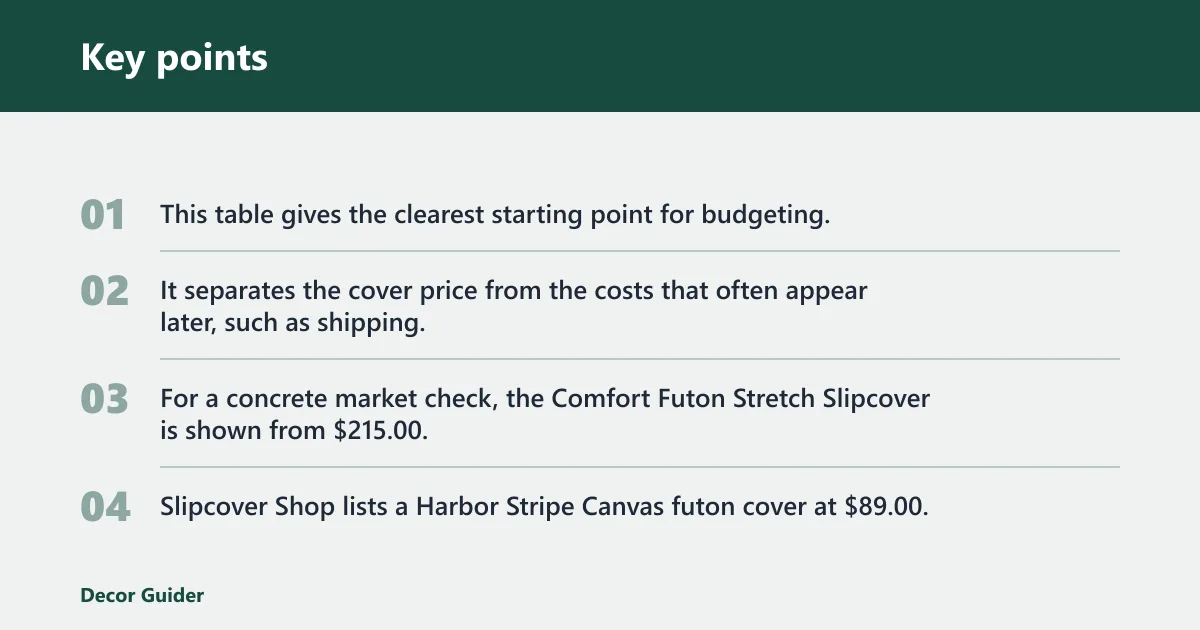


This table gives the clearest starting point for budgeting. It separates the cover price from the costs that often appear later, such as shipping, return friction, and the risk of buying the wrong fit.
| Tier | Typical price | Likely fabric | Fit type | Best use case | Hidden cost risks |
|---|---|---|---|---|---|
| Budget | $89 to $119 | Polyester, canvas, simple twill | Stretch or basic zip closure | Standard futons, quick room refresh, lower-risk color change | Shipping may erase the savings; returns may cost more than expected; fit failures are common on armrest frames |
| Mid-range | $120 to $199 | Better twill, chenille, suede, jacquard, higher-grade polyester blends | Bi-elastic stretch, reinforced zipper, better 360° coverage | Everyday use, better drape, households that want a neater look | Heavier fabric can raise shipping cost; some sellers charge for return handling or original packaging |
| Premium | $200 to $250 | Velvet, performance fabrics, heavier jacquard, specialty finishes | Tailored stretch, zipper closure, fuller coverage | High-visibility rooms, frequent use, better stain resistance, pet-friendly or water-repellent needs | Higher freight charges, more exact sizing, and more expensive returns if the measurements are off |
| Custom | $250 and up | Chosen to order, often heavier or specialty fabric | Made-to-measure, custom measurements, exact arm and depth allowance | Nonstandard futons, arm-heavy frames, unusual depth, better fit target | Measurement errors, alteration needs, longer lead time, and possible nonrefundable shipping or restocking fees |
For a concrete market check, the Comfort Futon Stretch Slipcover is shown from $215.00, discounted to $139.93, and it fits futons 59″-83″ wide. Slipcover Shop lists a Harbor Stripe Canvas futon cover at $89.00, a solid natural futon cover at $109.00 sale price, an off-white twill futon cover at $119.00 sale price, a Classic White Canvas futon cover at $139.00, and a SunReal® Pacific Blue futon cover at $199.00.
What drives the price?
Fabric, fit system, and sizing drive most of the cost. A simple cover stays within reach; heavier cloth, stronger closures, tighter shaping, or a custom cut for arms and depth push the price up fast.
Fabric differences and where each sits on the price ladder
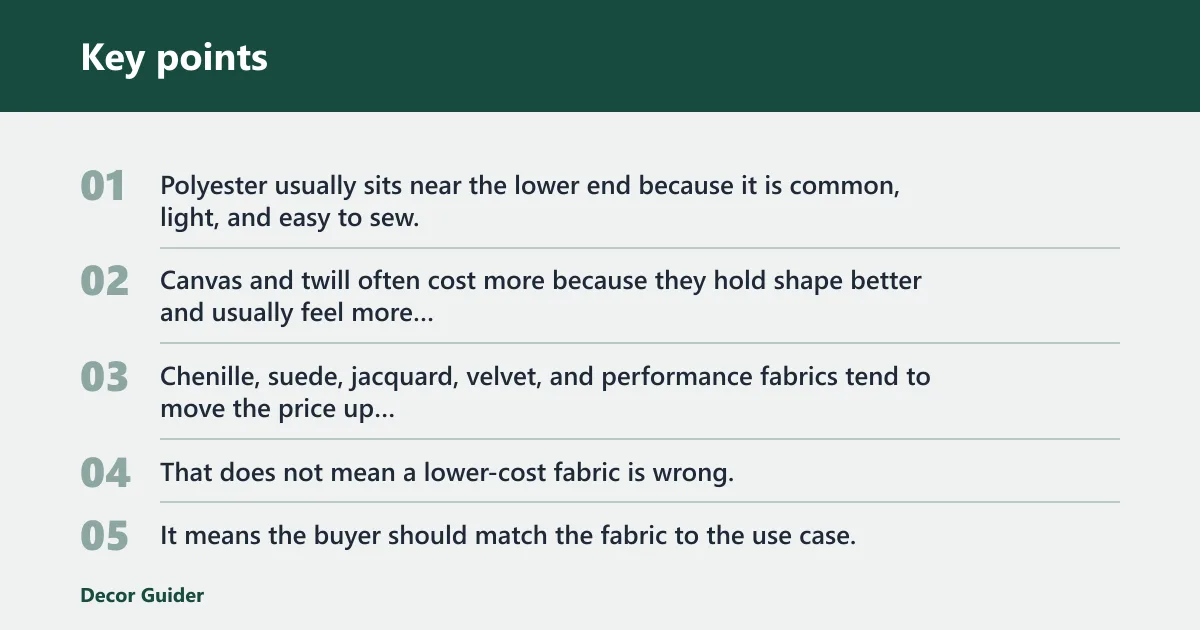
Polyester usually sits near the lower end because it is common, light, and easy to sew. Canvas and twill often cost more because they hold shape better and usually feel more substantial. Chenille, suede, jacquard, velvet, and performance fabrics tend to move the price up because they are heavier, more textural, or built for durability and stain resistance.
That does not mean a lower-cost fabric is wrong. It means the buyer should match the fabric to the use case. A guest room futon needs different wear resistance than a family room couch that doubles as a bed.
Fit system costs: stretch, zipper, and made-to-measure
Bi-elastic stretch covers usually cost less than custom sewing because they are built around a range rather than a single frame. Zipper closures can cost more when the pattern includes stronger seams, fuller coverage, or a cleaner profile. Custom measurements usually cost the most because the maker has to account for exact width, depth, arm shape, and closure placement.
360° coverage also matters. A cover that wraps the frame more fully uses more material and more labor, which pushes the price above a loose slip-on style.
Size, arm shape, and depth as price multipliers
Standard widths are the first thing to check: loveseat futons often fall in the 40″-63″ range, futons commonly span 59″-83″, sofa 3 seater frames often land in the 64″-85″ range, and sofa 4 seater frames often run 86″-120″. Wider frames need more fabric, but width is only part of the story.
Arms, extra seat depth, and nonstandard cushions can create fit failures even when the width looks right on paper. Suppose a frame is 72″ wide but has deep arms and a thick mattress. A stretch cover may fit the width and still pull short at the corners.
Care and finish details that add cost
Washable covers are easier to live with, but the care label still matters. Many sellers specify machine washable, gentle cycle, max 30°C / 86°F, and line dry only. Those instructions protect the fabric, but they also mean the owner must plan for air-drying time and a little more laundry care.
Pet-friendly and water-repellent variants usually cost more because they use tighter weaves, finish treatments, or performance textiles. Those features are worth paying for if spills, claws, or frequent cleaning are part of the real use case.
A common first-timer mistake is assuming a patterned cover will cost the same as a plain one. A white canvas cover can look right in the room, but if the frame needs a deeper seat allowance, the final fit will still fail.
How much should you budget?
For a standard ready-made futon slipcover, start with the cover price, then add shipping, tax, and a small cushion for return friction. For most buyers, that means planning for more than the lowest sale price and less than a custom quote unless the frame is unusual.
Starter budget for a standard ready-made cover
If your futon is standard-sized and has no unusual arms or deep seating, start around $90 to $140 before shipping and tax. That range covers many budget and lower mid-range options, including canvas, basic polyester, and simpler stretch fits.
Mamma Mia offers free shipping on orders over $99, which can keep the final total closer to the sticker price when the cover lands above that threshold. Mamma Mia also says orders are processed within 1-2 business days, the cover material is 100% soft and lightweight polyester, and the covers are OEKO-TEX® Standard 100 certified.
Budget for larger sizes and better fabrics
If you need a larger width, better drape, or a heavier fabric, plan for roughly $120 to $200 before extras. That is where twill, chenille, suede, jacquard, and some performance fabrics usually enter the picture, along with better closure systems and more structured coverage.
For example, the Comfort Futon Stretch Slipcover sits at $139.93 on sale from $215.00. That price makes sense if you need a wider fit band and want a cleaner stretch profile than a basic canvas cover can offer.
Budget for custom or hard-to-fit futons
Custom or hard-to-fit futons often justify a budget of $250 or more, especially when the frame has arms, unusual depth, or a width outside the common range. That budget should also leave room for shipping, possible alterations, and the risk that a remade cover still needs fine-tuning.
FutonsToGo lists a Mission Arm Futon Set from $469.00 and a Linen Innerspring Futon Mattress at $379.00 sale price. Those numbers matter because a custom cover can stop making sense if the futon itself is already near the cost of replacement.
Add-ons to include before checkout
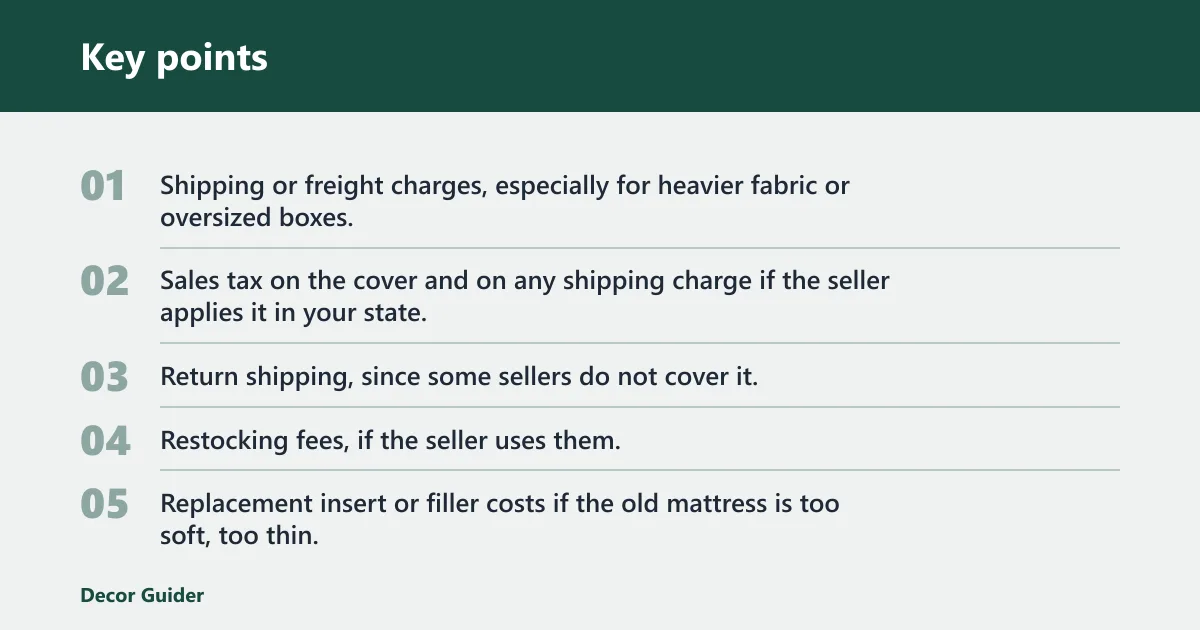
- Shipping or freight charges, especially for heavier fabric or oversized boxes.
- Sales tax on the cover and on any shipping charge if the seller applies it in your state.
- Return shipping, since some sellers do not cover it.
- Restocking fees, if the seller uses them.
- Replacement insert or filler costs if the old mattress is too soft, too thin, or misshapen.
What size futon cover do you need?
You need the cover size that matches the futon’s usable width, but you also need to check depth, arm shape, and whether the frame is a loveseat, sofa, or larger setup. A width match alone can still fail if the futon has bulky arms or an unusual mattress profile.
Match the cover to loveseat, sofa, and larger futon widths
Use the listed width range first: loveseat futons are often 40″-63″, standard futons are commonly 59″-83″, sofa 3 seater frames often measure 64″-85″, and sofa 4 seater frames often run 86″-120″. If a listing gives a fit band, stay inside it rather than choosing by appearance alone.
The Comfort Futon Stretch Slipcover fits futons 59″-83″ wide, which places it in the standard futon band. That kind of fit is useful when the frame sits squarely inside the stated range.
Why arms, depth, and seat shape change fit
Arms increase the amount of fabric needed at the sides and can block a straight pull-on fit. Extra depth changes how much fabric has to cover the front, seat, and back without pulling tight. Seat shape matters too, because a squared-off frame behaves differently from a rounded or heavily padded one.
Say your futon is 70″ wide and has shallow arms. A stretch cover may work well. If the same 70″ frame has thick rolled arms, the width number alone no longer tells the whole story.
When stretch sizing is enough and when it is not
Stretch sizing is usually enough when the futon falls near the middle of the seller’s range and the frame is simple. It is less reliable when the futon is near the edge of the size band, when the mattress is unusually thick, or when the frame has fixed arms that change the wrap path.
Custom measurement becomes the better value when a standard cover would need repeated returns or an alteration. One failed return can erase the savings of a cheaper cover.
Measuring tips before you buy
- Measure the outer width of the futon frame, not just the mattress.
- Measure the depth from front edge to back edge.
- Check arm height and arm thickness if the frame has arms.
- Look for the seller’s stated fit band, not just a single size label.
- Check whether the cover expects 360° coverage or only partial wrapping.
Pros and cons
A futon slipcover is a smart buy when you want a lower-cost refresh and the frame is close to standard size. It is a weaker buy when the futon is unusual, the seller’s return terms are strict, or the fabric choice is likely to cause cleaning or wear problems.
Pros
- Usually cheaper than replacing the futon.
- Can refresh the room without a new frame.
- Washable options make upkeep simpler.
- Pet-friendly and water-repellent versions can cut down on stain stress.
Cons
- Fit risk rises fast on arm-heavy or deep frames.
- Shipping can erase part of the savings.
- Returns may involve restocking or return shipping charges.
- Some fabrics look better than they clean in daily use.
Who it’s for
This purchase suits buyers who want a faster, lower-cost update than replacing the futon. It also fits households with pets, kids, or frequent spills, as long as they choose the right fabric and care instructions. It is less suitable for owners of nonstandard futons who need exact coverage and cannot risk a wrong-size return.
Are custom futon covers worth it?
Custom covers are worth the price when the futon has arms, unusual depth, or dimensions that land near the edge of a standard size band. They are usually not worth it when a stretch cover fits cleanly, the frame is common, and the difference in price would be better spent on a higher-grade ready-made fabric.
When custom pays off
Custom pays off when the fit problem is obvious and likely to repeat. If a standard cover would shift, sag, or expose the frame, the higher upfront price can be cheaper than buying two ready-made covers, paying return shipping, and still living with a poor fit.
When a stretch cover is the better buy
A stretch cover is the better buy when the futon sits comfortably inside the listed width range and the frame is simple. It is also the better choice when you want to spend less now and do not need a tailored look for a main living space.
How to compare custom cost against reupholstery or replacement
Start with this rough math: cover price plus shipping, tax, and possible return friction. Then compare that total to the futon’s replacement price or the cost of reupholstery, if you have a quote. If the cover total comes close to a new futon set, custom stops looking like the better value.
For a practical comparison, a $139.93 cover is easier to justify on a solid frame than on a futon that already needs a new mattress or a full replacement. If the frame itself is worn, the cover solves the look, not the underlying problem.
Frequently asked questions
How much do futon slipcovers usually cost?
Most futon slipcovers fall into a practical range of about $25 to $120 for simpler ready-made options, while heavier, better-fitted, or custom versions often run higher. A realistic budget should also include shipping, taxes, and the possibility of return costs if the size or fabric is wrong.
What makes one futon cover cost more than another?
Price usually rises with heavier fabric, better closure hardware, fuller coverage, and more exact sizing. Polyester and basic canvas tend to cost less than twill, chenille, suede, jacquard, velvet, or performance fabrics. Custom measurements, 360° coverage, and pet-friendly or water-repellent finishes can add more.
Where can I buy futon covers cheap?
Look for sale sections, simpler canvas or polyester builds, and sellers that publish a clear fit range. Lower sticker prices are useful only if shipping and returns stay reasonable. A cheap cover that does not fit usually costs more than a mid-range one that works the first time.
Are custom futon covers worth the price?
Yes, when the frame is nonstandard, arm-heavy, or outside normal width bands. No, when a standard stretch cover already fits the frame well. The right call depends on how much fit risk you are avoiding and whether a failed return would wipe out the savings.
How much is a futon bed?
Futon bed prices vary widely by frame, mattress quality, and whether the set includes arms or a heavier mattress. The same source lists a Mission Arm Futon Set from $469.00 and a Linen Innerspring Futon Mattress at $379.00 sale price, which shows how fast the total can climb before you add a cover.
Products related to this article
Sponsored / affiliate links. As an Amazon Associate I earn from qualifying purchases. I may earn additional commission from eligible campaigns.