Wood Futon Frame Cost: What You’ll Pay
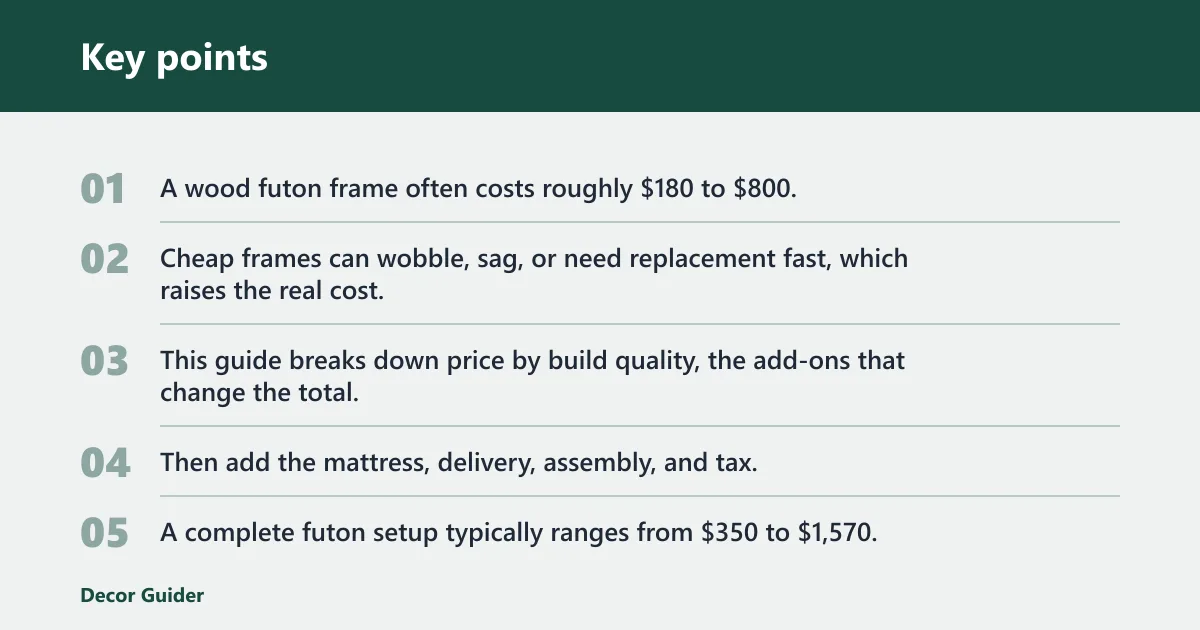
A wood futon frame often costs roughly $180 to $800, and more durable solid-wood models commonly fall around $350 to $800; budgets under about $200 may mean lighter parts and shorter life. Cheap frames can wobble, sag, or need replacement fast, which raises the real cost. This guide breaks down price by build quality, the add-ons that change the total, and how to compare true ownership cost before you buy.
For budgeting, price the frame first. Then add the mattress, delivery, assembly, and tax. A complete futon setup typically ranges from $350 to $1,570, while frame listings alone commonly run from $100 to $800 and mattresses from $150 to $500. That gap is where the hidden cost lives.
What a wood futon really costs


Frame price versus complete setup cost
A frame price tells you only part of the story. A low frame listing can still turn into a mid-range purchase once you add freight, stairs, room placement, and a thicker mattress. The total matters more than the sticker because futons are sold as parts, not a single finished package.
Many shoppers compare a wood frame to a metal one and stop there. That misses mattress fit, delivery method, and how much labor you will need at home. A frame that arrives cheap but needs a separate freight appointment can end up costing more than a better bundle.
What counts as a wood frame purchase
Wood frame pricing usually includes solid wood, veneer-faced panels, or a mixed construction that uses wood in the visible parts and less expensive material elsewhere. The frame may be sold in full or queen size, with some listings also offering sofa-width and bedroom-width options. Size changes the price because more material, longer rails, and wider slat spans cost more.
Construction details matter as much as the wood label. Joinery, hardware quality, slat spacing, and weight limit all affect durability. A frame rated for heavier daily use usually costs more because it needs stronger side rails, tighter fasteners, and better support across the mattress bed.
Why wood frames cost more than metal
Wood frames usually cost more than metal because the material, machining, and finishing steps are more expensive. Solid wood carries a higher price than veneer-faced construction, and wall-hugger mechanisms or higher weight limits add more. That premium can be worthwhile if the frame will be used daily, not only for guests.
Solid wood versus veneer construction
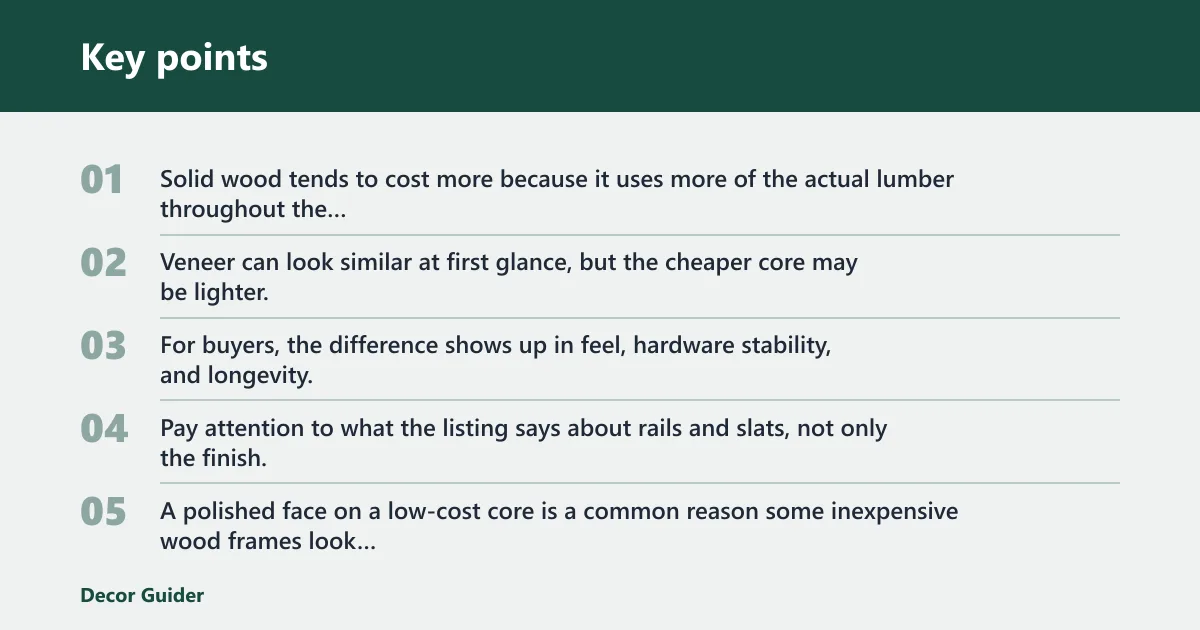
Solid wood tends to cost more because it uses more of the actual lumber throughout the frame. Veneer can look similar at first glance, but the cheaper core may be lighter, less forgiving under repeated use, and more sensitive to fastener stress. For buyers, the difference shows up in feel, hardware stability, and longevity.
Pay attention to what the listing says about rails and slats, not only the finish. A polished face on a low-cost core is a common reason some inexpensive wood frames look better than they wear. If the product page avoids details about wood species or internal structure, treat the price as a warning sign rather than a bargain.
Size, slat design, and weight capacity
Full and queen sizes push the cost up because the frame must support a larger mattress bed and wider load. Slat design matters too. Close slat spacing usually improves mattress support and lowers sag risk, but it also adds material and labor cost. Higher weight capacity often means thicker members and stronger hardware.
A common first-timer mistake is to choose the cheapest full-size frame and then pair it with a heavy mattress. Suppose a buyer wants a queen setup for a den that doubles as a sleep space. A weak frame can squeak early, and the fix is usually replacement, not a small repair.
Finish quality and hardware differences
Finish quality changes both price and upkeep. Better sanding, stain work, and protective coating usually cost more because they take time and material. Hardware matters too. Loose-fitting connectors, thin bolts, and weak hinge points create noise and movement, which is why lower-priced frames often feel fine at first and troublesome later.
Wood futon frame cost decoder
This matrix uses the price bands from the guide: frame listings from $100 to $800, mattresses from $150 to $500, delivery from $0 to $150, and assembly from $0 to $120. The totals below are practical buyer estimates built from those ranges, not fixed quotes. They help you compare listings by the full bill, not the headline price.
| Frame type | Wood construction | Size | Mechanism | Shipped cost estimate | Assembly cost | Mattress add-on | Likely total | Avoid this if |
|---|---|---|---|---|---|---|---|---|
| Budget | Veneer or mixed wood parts | Full | Standard fold-out | $100 to $180 | $0 to $40 | $150 to $220 | $250 to $440 | You need daily sleep support, high weight capacity, or quiet operation. |
| Mid-range | Solid wood with better hardware | Full or queen | Standard or wall-hugger | $250 to $450 | $40 to $80 | $220 to $350 | $510 to $880 | You are only buying for rare guest use and want the lowest possible spend. |
| Premium | Heavier solid wood | Queen | Wall-hugger | $500 to $800 | $80 to $120 | $350 to $500 | $930 to $1,420 | You have a tight budget, narrow stairs, or no need for a zero-clearance design. |
Budget scenario: frame, mattress, and total
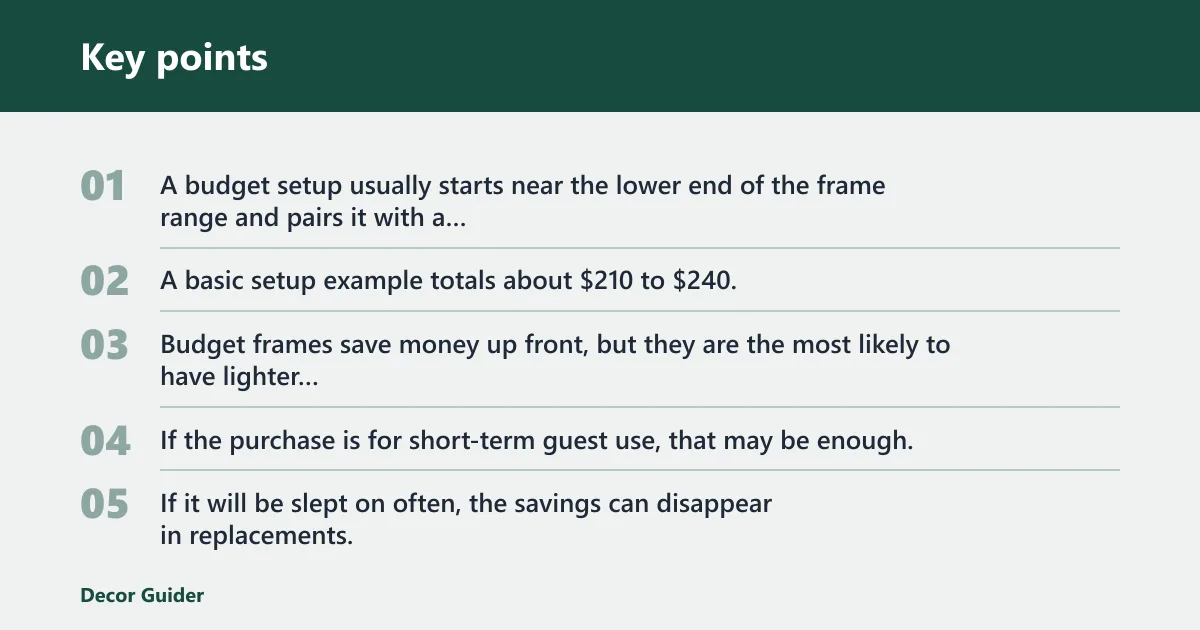
A budget setup usually starts near the lower end of the frame range and pairs it with a thinner, simpler mattress. A basic setup example totals about $210 to $240, which shows how quickly the mattress and delivery can shape the final bill even when the frame itself looks cheap.
The tradeoff is clear. Budget frames save money up front, but they are the most likely to have lighter construction, lower weight limits, and less refined hardware. If the purchase is for short-term guest use, that may be enough. If it will be slept on often, the savings can disappear in replacements.
Mid-range scenario: frame, mattress, and total
A mid-range setup often uses a wood frame with a medium-density mattress and room setup. That combination usually lands in the center of the complete setup range because the buyer pays for sturdier construction without jumping to the highest-end wood or the thickest mattress. This is the most balanced tier for many buyers.
Picture a queen frame in a den that gets used several nights a week. A mid-range frame with a medium-density mattress can cost more at checkout than a budget option, but it often avoids the squeaks and early sagging that make the cheapest wood frames expensive over time.
Premium scenario: frame, mattress, and total
Premium setups usually combine a higher-end solid-wood frame, a thicker mattress, and paid delivery or setup. That is where the total can move into the upper end of the complete setup range. The extra cost buys stronger construction, better finish work, and a more forgiving bed for repeated use.
If a listing is approaching the top of the frame range, check whether the price reflects actual value or only a polished finish. A high price should come with clear details on wood type, weight limit, mattress compatibility, and mechanism quality. If those details are missing, the premium may be cosmetic.
How much does a futon mattress add?
A futon mattress usually adds $150 to $500 to the purchase, and 6 to 8 inches is common. Thicker or denser models cost more, especially when they use latex or layered foam. The mattress often has as much impact on comfort and total price as the frame itself.
6-8 inch mattress price bands
Within the common 6 to 8 inch range, thinner models often cost less and work better for guest use or lighter sleepers. Mid-thickness models usually balance price and support better. Thicker options can improve comfort, but they also raise the total and may require a sturdier frame to keep the bed level.
Mattress fill changes the price in predictable ways. Foam usually sits in the middle, cotton can be lower in price but softer and more compressible, and latex often costs more because it holds shape better and resists long-term sagging. Density matters because low-density foam can feel comfortable at first and then break down faster.
Foam, cotton, and latex fill tradeoffs
Foam is often the easiest way to balance cost and support. Cotton tends to feel traditional and breathable, but it can pack down with use. Latex usually costs the most of the three and is the better match for buyers who want stronger resilience and less body impression over time.
Do not compare mattress prices by thickness alone. A 6-inch low-density mattress can cost less than a 7-inch higher-density model, yet the latter may support sleep better and last longer. That matters when the frame will be used every night rather than only a few weekends each month.
Do delivery and assembly change the total?
Yes. Curbside service is usually cheaper, while inside delivery, stairs, and room placement increase the bill. If the frame ships in large boxes or arrives by freight, the delivery method can change the purchase more than many shoppers expect.
Curbside versus inside delivery fees
Curbside delivery is the cheapest option because the carrier leaves the boxes at the door or curb. Inside delivery costs more because it includes moving the frame into the home. Room setup adds still more, especially if the boxes are heavy, awkward, or need to be carried up stairs.
Freight charges matter most with large boxed wood frames. These are bulky, and oversized packaging can trigger higher delivery fees even when the frame price looks low. If a seller offers free delivery, check whether that means curbside only or includes room placement.
Self-assembly versus professional setup costs
Self-assembly keeps labor cost at zero, but it still takes time and a second set of hands for some frames. Professional setup can be worth the fee if the frame is heavy, if the mechanism is complex, or if you want the delivery team to place it in a tight room. The usual labor range is $0 to $120.
A typical assembly job is not difficult, but it can be slow when hardware is poorly labeled or when slats need adjustment. Time varies by product, though many buyers should expect a short household project rather than a quick unpack-and-done task. If the seller charges extra for stairs, count that as part of the real labor bill.
How to compare listings before you buy
The smartest comparison method is to match the listing against your space, mattress, and use case. That means checking dimensions, slat spacing, weight limits, and whether the frame accepts the mattress thickness you plan to buy. A lower price is only useful if the frame actually fits the room and the sleeper.
- Measure the room and confirm the open and closed footprint.
- Check whether the mattress size is full, queen, or another fit.
- Look for slat spacing and the stated weight limit.
- Confirm whether the mechanism needs wall clearance or offers zero-clearance movement.
- Count delivery, stairs, and setup fees before comparing the final total.
Dimensions, slat spacing, and mattress fit
If the frame is too narrow for the mattress, the bed can shift and wear unevenly. If slats are spaced too far apart, the mattress may sag between supports or feel uneven. A good listing should state usable mattress size, slat details, and any special fitting notes for the backrest or arms.
Say your room can handle a queen frame only if it opens without moving furniture. That should push you toward a frame with clear conversion dimensions, not just a sale price. The frame that fits the room is the cheaper choice, even when its tag is higher.
Wall-hugger compatibility
A wall-hugger, or zero-clearance, futon changes position without needing space behind it. Strata Furniture describes one as a true wall-hugger zero tolerance futon, and the practical value is simple: the frame can convert without being pulled away from the wall. That feature often costs more because the mechanism is more complex.
Buy that design only when space is tight or when you want to avoid moving the frame each time you convert it. If you have room behind the futon, a standard mechanism may cost less and do the same job with fewer moving parts.
Wood futon sizing, brands, and regional pricing
Full and queen sizes often price differently because queen frames use more material and may require stronger support. Retail pricing also clusters by seller and collection size. Futons 4 Less shows frame prices up to $799.99, and the collection includes 54 futon frame products. That kind of spread shows how wide the market is.
Urban, suburban, and rural cost gaps
Urban areas may run 10 to 20% above or below national averages, depending on delivery density, freight access, and local labor rates. Suburban and rural areas can look cheaper on the frame itself but more expensive on delivery if the seller must route a long-haul freight shipment or add a remote-area fee.
Regional price differences are often a shipping story, not a frame story. A seller may list the same frame at the same sticker price nationwide, then change the final bill with freight, stair charges, or inside delivery rates based on ZIP code.
How retail price bands usually cluster
Many frames cluster below $800 because that is where mainstream wood futon listings tend to cap out. Below that ceiling, the biggest price jumps usually come from solid wood, larger sizes, better hardware, and wall-hugger mechanisms. Above it, you are often paying for heavier construction or a more specialized design rather than a larger sleep surface alone.
How much does a futon cost?
A futon usually costs $350 to $1,570 for a complete setup, depending on the frame, mattress, delivery, and assembly you choose. Wood frames usually cost more than metal frames, and thicker or higher-quality mattresses add to the bill. Shopping sales and bundling frame plus mattress can reduce the final amount, but tax and fees still matter.
Frequently asked questions
How much is a futon bed?
A futon bed usually means the full sleep setup, not just the frame. Most complete setups fall between $350 and $1,570 once you include the mattress, delivery, and assembly. If you see a lower frame price, check whether the mattress is included and whether shipping is separate.
How much is a wood futon frame?
A wood futon frame typically costs $180 to $800, with budget models below that often using lighter construction or simpler hardware. Solid wood, larger sizes, and wall-hugger mechanisms push the price upward. Always compare the frame price with the mattress and delivery total before deciding.
What makes a futon frame more expensive?
Solid wood, stronger hardware, tighter slat spacing, higher weight capacity, and wall-hugger movement all add cost. Finish quality matters too. A better-looking frame may cost more because sanding, coating, and assembly take time, but the real value comes from durability and stable daily use.
Does wood cost more than metal for futon frames?
Usually, yes. Wood frames generally cost more than metal because of material and finishing costs, especially when the frame is solid wood rather than veneer-faced. Metal can be a lower-cost way to get a sleeper frame, but it may not match the look or the heavy-duty feel many buyers want.
How much does delivery add to a futon purchase?
Delivery is listed at $0 to $150, depending on service level. Curbside delivery is usually the cheapest, while inside delivery, stairs, and room placement raise the total. Large boxed wood frames may also bring freight charges that change the final bill even when the listing price looks low.
How do I keep a futon purchase under budget?
Choose the lightest construction that still fits your use case, and do not pay for a wall-hugger mechanism unless you need it. Compare complete totals, not frame tags. Watch for delivery, stairs, assembly, tax, and disposal charges, then bundle frame and mattress only if the discount is real.
Products related to this article
Sponsored / affiliate links. As an Amazon Associate I earn from qualifying purchases. I may earn additional commission from eligible campaigns.