Futon Cover Bunching Problems
Futon cover bunching usually comes from one of four causes: a cover that is too large, shrinkage after washing, frame movement, or mattress compression. Fix the cause, not the wrinkles. If you leave it alone, the cover keeps sliding, the seams wear faster, and the futon looks saggy and untidy. This guide shows you how to identify the failure pattern and match it to the right fix.
Why do futon covers bunch up?
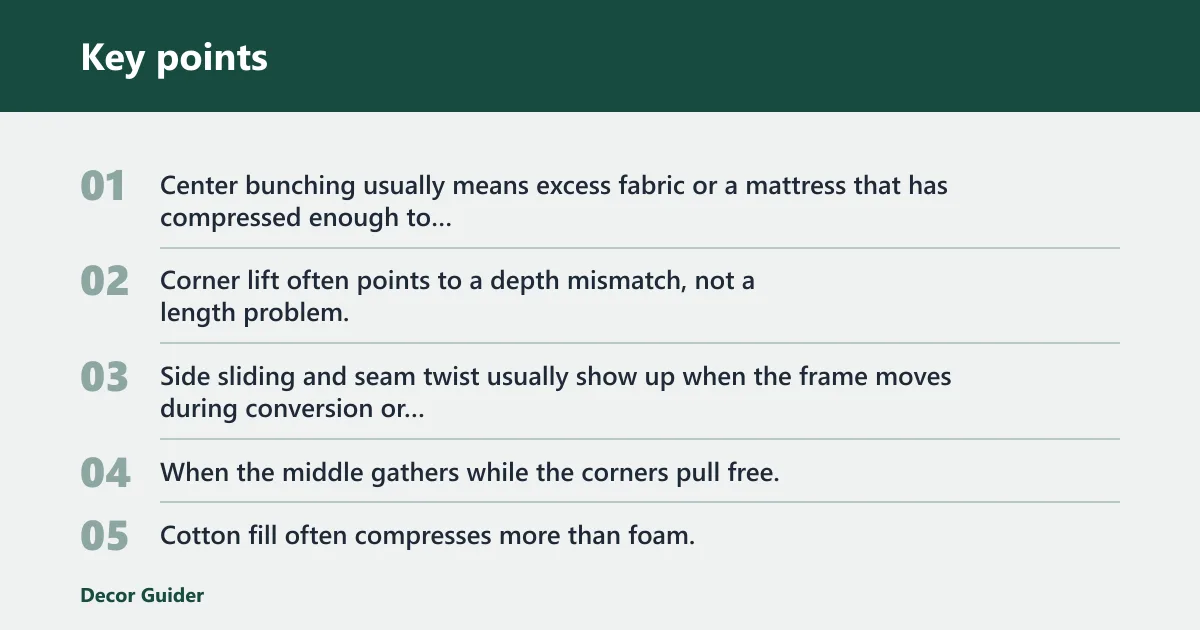


Center bunching usually means excess fabric or a mattress that has compressed enough to leave slack in the cover. Corner lift often points to a depth mismatch, not a length problem. Side sliding and seam twist usually show up when the frame moves during conversion or the cover fabric is too slick.
Center bunching and corner lift
When the middle gathers while the corners pull free, the cover is usually oversized for the mattress depth or the mattress has lost loft. Cotton fill often compresses more than foam, so it can create slack even when the nominal size looks correct. A fitted cover holds better than a loose style here.
Side sliding and seam twist
If the cover drifts to one side, check the frame first. Wood and metal futon frames move differently, but both create pressure at the folding hinge points during seat-to-bed conversion. Repeated folding can shift the mattress a few millimeters each time, which can torque the seams and make the cover walk sideways.
Wrinkles after washing
Wrinkling after laundering usually signals cotton shrinkage, heat damage, or a cover that was refit before it fully relaxed. Cotton covers can tighten after a hot wash or high-heat drying. If the seams pull diagonally after washing, the cover may have shrunk unevenly, which changes the way it sits on the mattress.
Bunching during folding
When the cover looks fine flat but bunches as the frame folds, the hinge area is the clue. The folding motion concentrates force near the center line and at the break points, so a loose cover or thin mattress can shift as the frame changes shape. A zipper closure or tie straps help only if the sizing is already close.
What does the futon cover bunching matrix show?
This matrix helps you match the symptom to the most likely cause and the fastest fix. Use it before buying a larger cover, because the real problem may be the mattress, the frame, or a topper rather than the cover itself. For laundry-related fit changes, follow textile-care guidance from sources such as the Federal Trade Commission and cotton-care guidance from Cotton Incorporated, and for size convention questions, compare the stated dimensions against the mattress itself rather than the frame label. For compression behavior, review mattress compression over time before you size up.
| Symptom pattern | Most likely cause | Fastest fix | Long-term fix |
|---|---|---|---|
| Center bunching | Cover too large or mattress compression | Refit with seams centered and add grip pads at the midsection | Choose fitted sizing or a tighter custom cover |
| Corner pull-off | Depth mismatch or loose corner tension | Secure corners with safety pins or temporary elastic | Buy a cover sized for actual mattress thickness |
| Side sliding | Frame movement or slick surface layers | Add a non-slip liner fabric under the cover | Use tie straps, Velcro, or a cover fabric with more texture |
| Wrinkling after wash | Cotton shrinkage or uneven drying | Re-stretch while slightly damp | Wash cold, dry low, then re-fit after laundering |
| Bunching when folding | Hinge pressure and conversion movement | Check hinge clearance and smooth the mattress before folding | Use a fitted cover with zipper closure and size it closer to the mattress |
Say your queen futon cover fits neatly when the frame is flat, but the center bulges after two fold-outs in a day. That pattern points more to conversion movement than to a bad cover size. A grip pad plus a refit at the hinge line usually helps more than replacing the whole futon cover.
What measurements should I check before buying or fixing a futon cover?
Check the mattress itself, not just the frame label. The most reliable fit check is a quick measurement set that includes length, width, thickness at the center and edge, topper thickness if present, hinge location, and seam-to-seam depth on the cover. That combination shows whether the problem is sizing, compression, or folding clearance.
| Measurement | How to check | Pass threshold | Fail threshold |
|---|---|---|---|
| Mattress length | Measure end to end on the flat mattress | Matches cover length within about 1 inch | More than about 1 inch short or long |
| Mattress width | Measure side to side at the widest point | Matches cover width within about 1 inch | More than about 1 inch short or long |
| Loft at center | Measure thickness at the thickest center point | Fits the cover’s stated depth with minimal slack | Leaves visible slack or pulls the seams tight |
| Loft at edge | Measure thickness near the outer edge | Edge is close enough to hold corners without lift | Edge is thin enough to create corner looseness |
| Post-topper thickness | Measure mattress plus topper together | Combined depth still fits the cover allowance | Combined depth exceeds the cover’s depth rating |
| Frame hinge location | Mark the break point where the frame folds | Cover seam clears the hinge without tension | Seam sits directly on the hinge and rubs during conversion |
| Cover seam-to-seam depth | Measure the cover’s usable depth across the seam line | Enough room to fit without gathering | Too shallow for the mattress or topper depth |
What do I need to stop a futon cover from sliding around?
Start by checking whether the cover matches the mattress thickness, then recenter it and secure the points that move first. If the cover still slides, add friction where the fabric contacts the mattress or frame. A temporary fix can work, but repeated daily conversion usually needs a more durable hold.

- Measuring tape
- Marker or removable tape for reference points
- Safety pins for temporary hold points
- Elastic for temporary corner tension
- Velcro for adjustable edge control
- Non-slip liner fabric or rubberized grip pads
- Furniture straps if the frame shifts
- Sewing machine for permanent alterations
- Measure the mattress thickness at the thickest point and compare it with the cover depth.
- Align the seams with the centerline and square the corners before fastening anything.
- Add safety pins, elastic, or Velcro at the loosest corners, then retighten after one fold cycle.
- Place grip pads or non-slip liner fabric where the cover drifts most, usually near the seat edge or hinge line.
- Open and close the frame twice, then recheck the cover before adding more tension.
If that did not work, inspect the frame. Wood slats, metal rails, and hinge points can move enough to shift the mattress. A common first-timer mistake is tightening one corner hard while leaving the opposite side loose, which creates seam twist instead of control.
Do futon covers need ties, zippers, or straps?
They help most when the fit is already close. Zippers work well for fitted covers because they hold the outline to the mattress. Tie straps help with loose covers, especially on frames that move. If the cover is oversized by more than the mattress depth allows, hardware alone will not solve the slack.
How do I make a futon cover fit after washing?
Check the wash and dry settings first, because cotton shrinkage can change the fit enough to create new bunching. Textile-care guidance generally favors following the label, avoiding high heat when shrinkage is a concern, and re-shaping while the fabric is still slightly damp. If the cover tightened after laundering, the seams may need to relax while slightly damp. If the shrinkage is more than minor, the cover may no longer match the mattress depth.
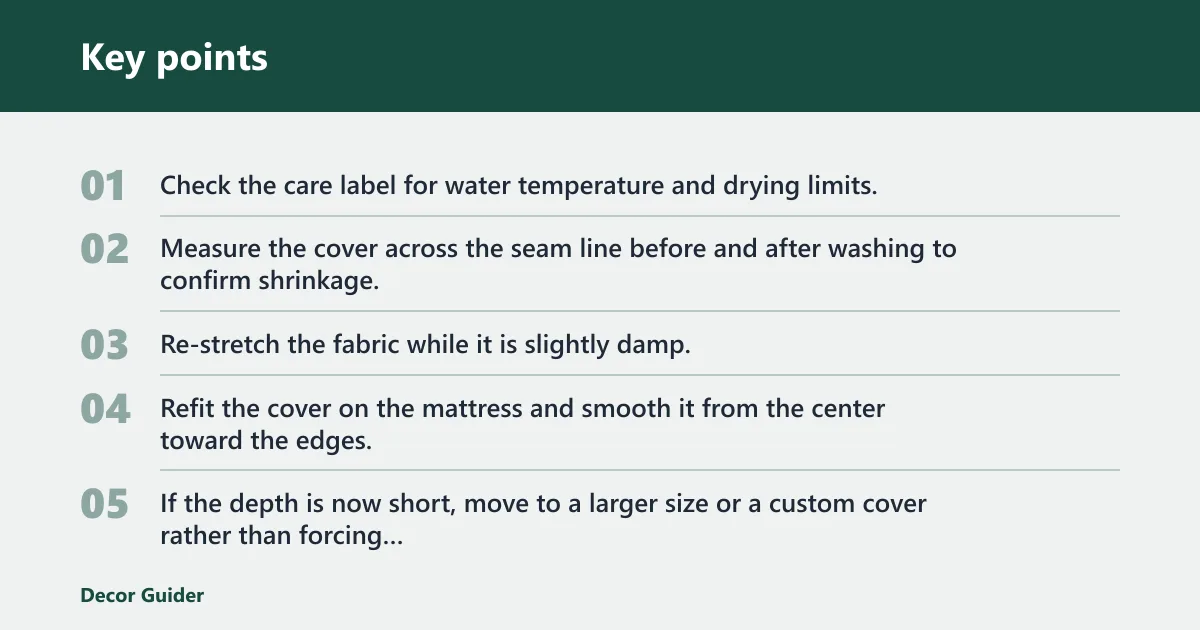
- Check the care label for water temperature and drying limits.
- Measure the cover across the seam line before and after washing to confirm shrinkage.
- Re-stretch the fabric while it is slightly damp, especially along the corners and zipper edge.
- Refit the cover on the mattress and smooth it from the center toward the edges.
- If the depth is now short, move to a larger size or a custom cover rather than forcing the fit.
Suppose a cotton cover shrinks by about 1 inch in depth after a warm wash and high-heat drying. That small change can be enough to pull the corners off a thick mattress. Re-fitting while damp may recover part of the lost ease, but not all of it. For more background on sizing, fold behavior, and fill changes, see mattress compression over time.
How do I put a futon cover on without wrinkles?
Put the cover on with the mattress centered and the seams aligned before you close the zipper or secure the ties. Work from the middle outward so the fabric tension stays even. If wrinkles form along one side, the mattress is likely shifted or the cover has too much extra depth for the fill.
Can a topper or protector cause bunching?
Yes. A topper or mattress protector can change both thickness and surface friction, which affects how the cover sits. Extra loft can make a fitted cover too tight at the corners, while a slick protector can let the fabric drift. Washability also matters, because some topper covers add bulk that changes the fit after laundering.
- Remove the topper or protector and refit the futon cover once to isolate the cause.
- Measure the new total thickness, not the base mattress alone.
- If the cover slides, add a non-slip liner fabric between the layers.
- If the corners pull off, choose a larger or custom cover sized for the combined depth.
- Keep the topper removable if you need frequent washing or daily folding.
A common setup problem is a foam topper added to a cotton futon mattress on a metal frame. The topper raises the profile, and the smoother surface reduces friction, so the cover shifts at the hinge points. Removing the topper before refitting often reveals whether the cover was sized correctly in the first place.
What are the most common mistakes when fixing futon cover bunching?
Buying by frame size alone causes the most avoidable fit problems. A 75-inch frame does not tell you whether the mattress is about 6 inches or about 8 inches thick, and that difference can change how the cover sits. Always check mattress thickness, then compare it with the cover’s stated depth.
Another mistake is using a loose cover on a thick mattress and expecting ties to solve everything. Ties, zippers, and straps help with retention, but they do not correct a depth mismatch. Ignoring folding hinge points is another common miss, especially on daily-use futons that convert often.
Overlooking post-wash shrinkage creates a second round of bunching. If the cover tightened after laundering, refit it before the next use, and follow the label’s wash temperature and drying method. When adding a topper, measure the combined thickness before you buy a replacement cover.
For a permanent change, a sewing machine can add elastic or Velcro at high-slip points. Temporary fixes with safety pins are useful for diagnosis, but they should not be the final answer on a cover that moves every day.
Prevention is simple: recheck fit after every major change to the setup, including a new topper, a different wash cycle, or a mattress that has started to compress.
What should I ask before buying a cheap futon cover online?
Compare exact dimensions, closure type, fabric weight, and thickness compatibility before you buy. Cheap listings often look similar, but the real difference is whether the cover matches your mattress depth and folding pattern. A low price is only useful if the return policy is flexible enough to handle a mismatch.
- Exact mattress length, width, and thickness listed by the seller
- Return policy and whether returns are free or limited
- Closure type, such as zipper, ties, or envelope style
- Fabric weight and whether the cloth feels likely to slip or stretch
- Thickness compatibility for the base mattress plus any topper or protector
For the safest match, use your own measurements rather than the frame label alone, then compare them with the seller’s stated cover depth. If your mattress compresses heavily, size the cover to the current loft and not just the original nominal size. If you also use a topper, measure the combined thickness before ordering.
Frequently asked questions
Why does my futon cover keep bunching up?
The usual causes are a size mismatch, shrinkage after washing, frame movement, or mattress compression. Check where the fabric gathers: center, corners, side seam, or hinge line. That pattern tells you which fix matters most, instead of replacing the cover without diagnosing the actual source.
How do I stop a futon cover from sliding around?
Measure mattress thickness, recenter the cover, then add grip pads or a non-slip liner where the drift starts. If the frame shifts during conversion, use furniture straps or a tighter fitted cover. Temporary safety pins help, but daily use usually needs a more permanent hold.
What is the best way to keep a futon cover tight?
A fitted cover with a zipper closure usually stays tighter than a loose style on a mattress with stable loft. Match the cover depth to the actual mattress thickness, not the frame size. If the mattress compresses a lot, choose sizing that leaves less slack from the start.
How do I make a futon cover fit better after washing?
Follow the label for wash temperature and drying method, then measure for shrinkage at the seams. Re-stretch the fabric while it is slightly damp and refit it before it fully dries. If the cover still pulls tight, the shrinkage may have made it too small.
Can a mattress pad or topper cause futon cover bunching?
Yes. Added thickness changes the fit, and smoother surfaces let the cover move more easily. Remove the topper or pad once, refit the cover, and measure the combined depth. If the cover now fits better, the added layer was the real cause.
What size futon cover should I buy to avoid bunching?
Buy by measured mattress dimensions and thickness, then check whether the cover is listed as full, queen, or custom. A full-size cover will not behave like a queen-size cover, even if the frame looks similar. If your mattress is thick or layered, custom sizing is often safer.
How do I make a futon cover stay in place on a folding frame?
Use a fitted cover, align the seams with the hinge line, and add grip material near the folding point. Then open and close the frame once or twice and check for drift. Repeated conversion creates pressure points, so the cover has to stay secure through movement, not only while flat.
Where can I buy futon covers cheap?
Look for full, queen, or custom listings that state thickness compatibility, closure type, and fabric content. Cheap covers can work, but only if the depth matches your mattress and the stitching holds at the hinge points. The lowest price is not useful if the cover shifts every day.
Where can I buy futon covers online?
Search for sellers that list exact measurements, closure style, and whether the cover is fitted or loose. Compare the stated mattress depth with your own measurements before ordering. If you use a topper, buy for the combined thickness rather than the base mattress alone.
Products related to this article
Sponsored / affiliate links. As an Amazon Associate I earn from qualifying purchases. I may earn additional commission from eligible campaigns.