Futon Mattress Cost: How Much to Budget by Size
A futon mattress usually costs about $100 to $800; budget cotton-filled models are often around $100 to $250, while thicker innerspring or latex options are commonly around $300 to $800, and daily-sleep use may justify choosing the higher end. Buying the cheapest option can mean faster sagging, worse support, and replacing the mattress sooner. This guide breaks down prices by size, material, and use case so you can compare total cost, not only sticker price.
Price depends on more than fill. Size changes the bill, too. Twin, full, and queen futon mattresses sit in different price bands, and foam, memory foam, innerspring, and hybrid builds do not cost the same. Thickness, cover quality, edge support, and removable covers also move the number.
Budget tiers and what they include


Budget tiers help you frame the buy. Tom’s Guide groups mattresses into budget, mid-range, and luxury tiers, and that same idea works well for futons. A lower sticker price can still cost more over time if it needs replacing sooner or if add-ons push the final bill up.
What buyers usually get at each tier
Entry-level futon mattresses usually keep construction simple: thinner foam or cotton fill, basic covers, and limited edge support. Mid-range models often add more loft, denser foam, better stitching, and a cover that handles regular folding better. Premium models tend to use heavier builds, stronger support layers, and better fabric finishes.
Tom’s Guide lists a queen-size Siena Memory Foam mattress at $399 and a queen-size DreamCloud Hybrid mattress at $665 during a sale. That comparison shows the same pattern you see in futons: hybrid builds generally cost more than all-foam models, and specialist or sustainable materials add more still.
How size changes futon mattress price

Twin, full, and queen are the main size tiers, and full and queen usually cost more than twin because they use more material. Frame size matters too. If the frame already fits a full or queen mattress, buying a smaller size can leave you with a poor fit and less usable sleep space.
Room size matters just as much. A twin suits a tighter guest room or studio corner, while a full works better when one adult wants more width. A queen makes sense when the frame and room can handle it, but it raises the purchase price and often the delivery cost as well.
Size-fit guide for common rooms
If you are replacing an existing frame, match the mattress to the frame first. A futon mattress that is too small will shift and gap; one that is too large may not fold correctly. If you are buying the whole setup, measure both the sleeping footprint and the open clearance for the frame.
- Twin: best for one sleeper, guest rooms, and narrow spaces.
- Full: a common middle choice for one adult who wants more room or two occasional sleepers.
- Queen: best when daily sleeping matters and the room can handle a larger footprint.
How material changes the price
Foam usually sits at the lower end, memory foam often costs more, and innerspring or hybrid constructions usually cost more than all-foam models. Tom’s Guide notes that hybrids generally cost more than all-foam mattresses, and specialist materials such as organic or sustainable components raise cost further. That same logic applies to futons.
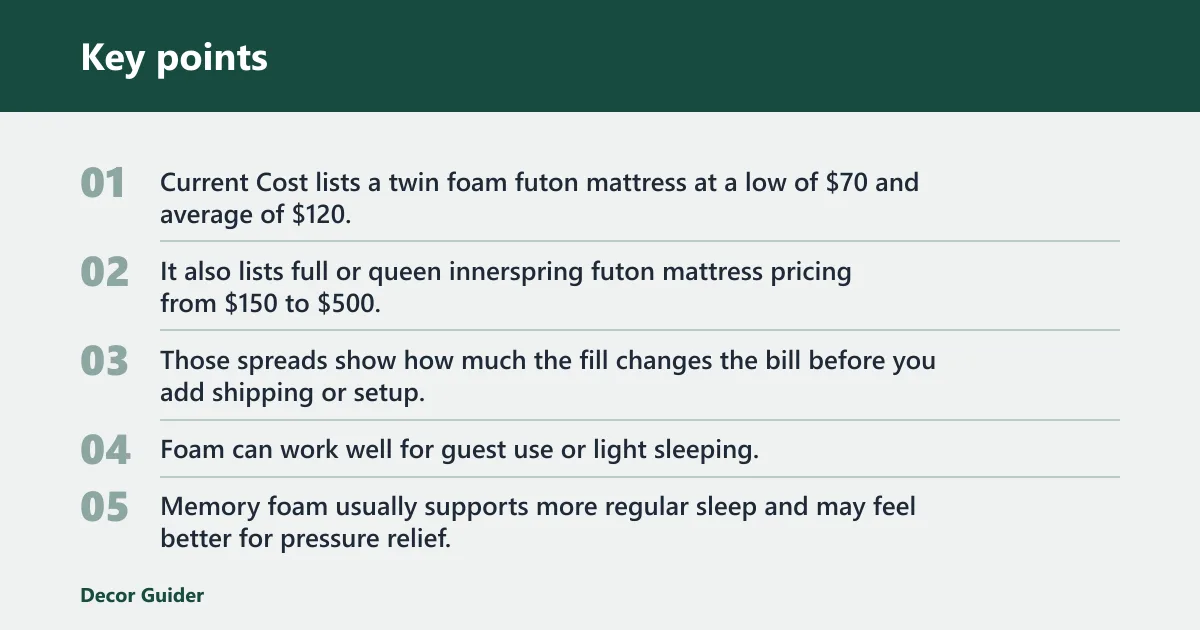
Current Cost lists a twin foam futon mattress at a low of $70 and average of $120, while twin memory foam futon mattress pricing runs from $120 to $350. It also lists full or queen innerspring futon mattress pricing from $150 to $500. Those spreads show how much the fill changes the bill before you add shipping or setup.
What the fill means for daily use
Foam can work well for guest use or light sleeping, especially when price is the main concern. Memory foam usually supports more regular sleep and may feel better for pressure relief, but it often costs more. Innerspring and hybrid builds add structure and can hold up better for daily use, which is why they sit higher on the price chart.
A common first-timer mistake is buying the cheapest twin foam mattress for nightly use, then replacing it a year or two later when it sags. The lower upfront number looks good, but the yearly cost climbs once replacement enters the picture.
What features raise the cost
Thickness, cover quality, edge support, and removable covers all affect price. Thicker mattresses usually use more fill and can feel better for sleeping, while better covers and stronger stitching add durability. Edge support matters because a futon often doubles as seating, and weak edges break down faster.
Construction matters as much as material. A thicker core can improve comfort, but only if the cover and seams hold up to folding. Removable covers can cost more up front, yet they may make cleaning easier and extend usable life. That matters most in daily-sleep setups.
When paying more makes sense
Choose a higher-spec build when the futon will be used most nights, when the frame is already in place, or when the mattress has to function as both couch cushion and bed. For occasional guest use, you can stay lighter on features and still get acceptable value.
Suppose your frame already fits a full mattress and you sleep on it every night. A thicker memory foam or hybrid option may cost more at checkout, but it can reduce the chance that you replace the mattress after a short stint of use.
Futon mattress price-to-value table
The table below separates futon mattress price from frame price and complete set cost. It also shows likely add-ons, because the final bill can move quickly once shipping, setup, disposal, or warranty charges appear.
| Futon size | Construction type | Expected use case | Likely fee add-ons | Simple cost-per-year estimate |
|---|---|---|---|---|
| Twin | Foam | Guest use, light sleeping | Shipping, basic taxes, optional setup | $35 to $60 per year |
| Twin | Foam | Daily use | Shipping, taxes, possible return cost, setup | $60 to $120 per year |
| Full | Memory foam | Daily use | Shipping, taxes, setup, possible warranty add-on | $45 to $87 per year |
| Full | Innerspring | Guest use | Shipping, taxes, disposal fee if replacing old mattress | $30 to $71 per year |
| Queen | Hybrid | Daily use | Delivery, setup, taxes, possible disposal fee | $70 to $125 per year |
| Existing frame replacement only | Basic foam to mid-range memory foam | Replace worn mattress, keep frame | Shipping, compression packaging, return cost, warranty option | $25 to $80 per year |
The yearly figures above use a simple lifespan estimate for comparison, not a promise. They are most useful when you compare guest use with nightly use. A cheap mattress that needs replacement sooner can end up with a higher yearly cost than a mid-range model that lasts longer.
What will you pay beyond the mattress?
Delivery, setup, disposal, shipping, taxes, returns, and warranty add-ons can change the final bill a lot. Current Cost estimates local delivery and setup at $20 to $150, and warranty and add-ons at $0 to $75. Those ranges can vary by distance and retailer policy.
Local delivery may include setup, but not always. Some stores charge separately for room-of-choice placement, old-mattress removal, or disposal. Online sellers may offer lower sticker prices, then add shipping or heavier-fee freight charges at checkout.
Hidden costs to check before you buy
- Check shipping for compressed or oversized packages.
- Look for setup fees if you want in-home placement.
- Ask whether disposal or haul-away is extra.
- Read return rules and who pays return shipping.
- Confirm whether a warranty is included or sold as an add-on.
- Compare total cost, not just the mattress label price.
Where should you buy one?
Online retailers and local stores both sell futon mattresses, but they do not always price them the same. Online pricing can be lower on sticker price, while local stores may bundle delivery, setup, or a frame discount. Regional differences also matter, especially where freight or store competition changes pricing.
If you only need a replacement mattress for an existing frame, buying the mattress alone often makes the most sense. If you need the frame too, compare complete set pricing against separate purchases. Package discounts can help, but only if the frame and mattress both fit your space and use case.
When replacement-only buys make sense
Replacement-only shopping works best when the frame is sound and the mattress is the worn-out part. That keeps the spend focused on support and comfort instead of repeating the whole setup cost. It also helps when you already know the exact size and fold pattern your frame needs.
Say your full-size futon frame is still solid, but the old mattress has compressed in the center. Buying a full replacement mattress only can be smarter than replacing the entire set, especially if the frame still folds correctly and the room layout has not changed.
How do you save without buying twice?
Watch for sales, discontinued stock, and package discounts, but keep the long-term cost in view. A low sale price on a thin mattress can still be poor value if it fails early. Compare the expected lifespan against the price so you can judge cost per year, not just the checkout total.
Start with the use case. Guest use can justify a lighter build, while nightly sleep usually needs more support and better construction. If a mattress must do both, bias toward better materials and stronger edge support, even if the sticker price rises.
A practical buying checklist
- Confirm whether the price includes the futon mattress only or a full frame set.
- Match the size to the frame: twin, full, or queen.
- Check thickness, fill type, and cover quality.
- Look for removable covers if cleaning matters.
- Ask about shipping, setup, disposal, and taxes.
- Read warranty terms and any extra charge for coverage.
- Compare yearly cost, not only sticker price.
Frequently asked questions
How much does a futon cost?
A futon mattress usually costs $100 to $800, but the total for a frame plus mattress can be much higher. Budget foam models sit at the low end, while thicker innerspring or hybrid builds cost more. Delivery, taxes, and warranty add-ons can push the final total up.
How much is a futon bed?
A futon bed can mean the mattress alone or the complete frame-and-mattress setup, so the price varies a lot. The mattress is usually the cheaper part. If you buy the whole unit, factor in the frame, shipping, setup, and disposal of any old mattress or frame.
How much is a futon?
If you mean the mattress, expect a wide spread based on size and build. Twin foam starts lower, while full and queen memory foam, innerspring, and hybrid models cost more. If you mean the full set, the frame price changes the total far more than many shoppers expect.
Are futon mattresses expensive?
They can be, depending on what you compare them with and how you plan to use them. A basic guest-use futon can be modest in price, but a daily-sleep mattress with thicker foam, stronger edges, and a better cover can move into the mid-range or premium tier.
How much does a futon mattress weigh?
Weight depends on size, fill, and thickness, so there is no single number that fits every model. Foam versions are often lighter than innerspring or hybrid versions. If you need to move or fold it often, check the listed weight before you buy so handling stays practical.
What mattress size is a futon?
Futon mattresses are commonly sold in twin, full, and queen sizes. The frame determines the right fit, and the mattress should match the frame rather than the room label alone. If you are replacing only the mattress, confirm the exact frame size and folding style first.
Is a futon mattress full size?
It can be, but not always. Futon mattresses are commonly sold in full size, yet twin and queen options are also common. If someone asks whether a futon is full size, the safer answer is to check the frame or product listing rather than assume one standard size.
Products related to this article
Sponsored / affiliate links. As an Amazon Associate I earn from qualifying purchases. I may earn additional commission from eligible campaigns.