Full Futon vs Queen Futon: Which Fits Best for Your Room
Choose a full futon if your room is tight or the futon is mostly for one sleeper; go queen only if you need true two-person sleep or have at least about 3 feet of clearance around the opened frame. Pick wrong and you get blocked walkways, a cramped bed, or bedding that will not fit the frame. This guide compares room fit, sleeper comfort, frame compatibility, and bedding so you can choose the right size fast.
This guide is part of our Futon mattress guide: sizes, setup, and care series.
Full futon vs queen futon: the size difference that matters
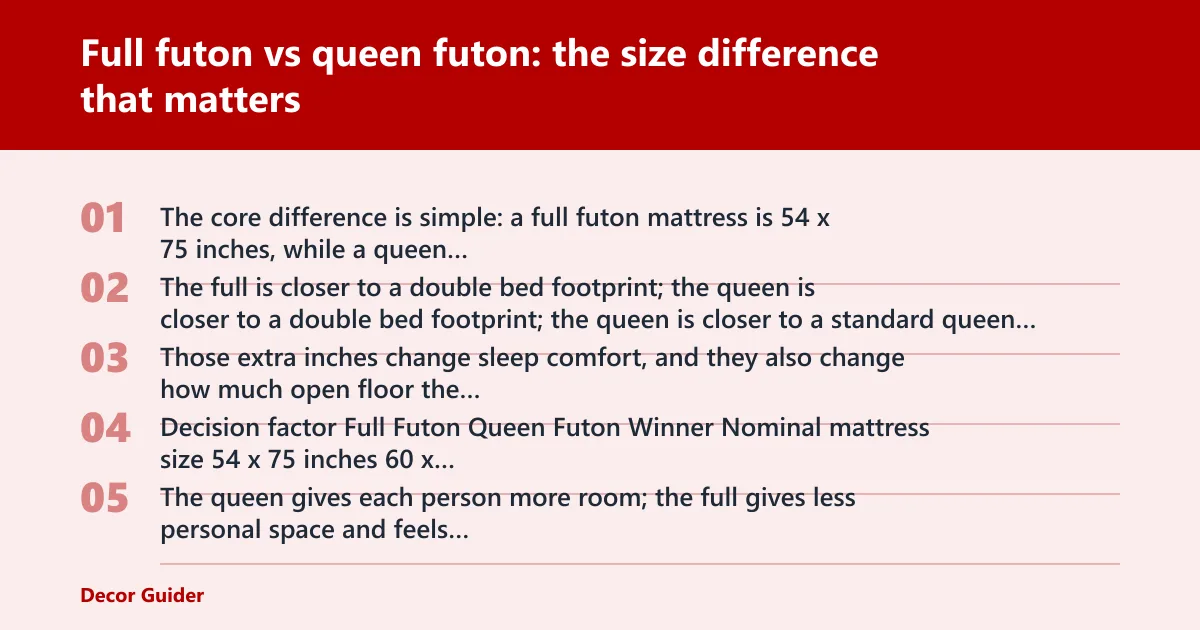


The core difference is simple: a full futon mattress is 54 x 75 inches, while a queen futon mattress is 60 x 80 inches. The full is closer to a double bed footprint; the queen is closer to a standard queen bed footprint. Those extra inches change sleep comfort, and they also change how much open floor the futon takes up.
| Decision factor | Full Futon | Queen Futon | Winner |
|---|---|---|---|
| Nominal mattress size | 54 x 75 inches | 60 x 80 inches | Queen Futon |
| Best-fit sleeper use | One adult comfortably or two in a pinch | Best for couples or side sleepers | Queen Futon |
| Small-room friendliness | Easier to place in tighter layouts | Needs more floor and swing space | Full Futon |
| Frame and bedding flexibility | More forgiving in compact rooms | More demanding on frame size and linens | Full Futon |
What the extra 6 inches of width and 5 inches of length change in daily use
Those extra inches matter most when two adults sleep on the futon often. The queen gives each person more room; the full gives less personal space and feels tighter if both sleepers spread out. For solo use, that gap is usually less important than the room footprint the futon demands.
Where a size label can mislead shoppers: mattress, frame, and bedding
Size labels can mislead when shoppers compare only the mattress. A futon frame must match the mattress size, and a thick mattress can affect how the frame closes. Bedding can also shift the answer; a queen futon takes standard queen sheets, while a full futon may need full XL or deep-pocket sheets if the mattress is 8 inches or thicker.
Side-by-side comparison: room use, sleeping space, and fit
The right pick is not only about width. Room shape, sleeper count, and how often the futon is used for actual sleep matter more than the label alone. A full wins when the room needs breathing space. A queen wins when two adults will sleep there often and the room can handle the larger open span.
Solo sleeper vs couple use
A full futon generally sleeps one adult comfortably or two in a pinch. A queen futon is the better call for couples, side sleepers, or anyone who rolls a lot during the night. If the futon is mostly a guest bed for one person, the full is usually the cleaner fit.
Guest room use vs daily sleep
For short-stay guests, a full often does the job without taking over the room. For daily sleep, the queen’s extra length and width matter more, especially when the futon is used as the main bed. Daily use punishes a cramped setup fast; a room that feels “fine” for guests can feel tight every night.
Tall sleeper needs and when Full XL is the better call
Full XL is the useful middle step for tall sleepers. It keeps the same width but adds length, which can help with legroom without requiring a move to queen width. If the sleeper needs more stretch-out room but the room cannot handle a wider bed, Full XL is often the smarter move.
Floor footprint, sofa layout, and walkway clearance
A queen futon takes more floor space and can crowd a sofa layout in a narrow room. That matters in real life because the opened bed has to leave usable walkways, side access, and room for nearby furniture. A full is easier to place when the bed sits near a door, desk, or cabinet.
Will a queen futon fit in a small room?
Sometimes, but not automatically. A queen futon can fit in a small room only if the opened frame leaves enough clearance to walk, open drawers, and live with the layout. If the futon needs to sit flush against other furniture or blocks a pathway when opened, a full is usually the safer choice.
How to judge open-position footprint, not only wall width
Measure the space with the futon open, not just the wall where the sofa sits. A futon that looks fine against one wall can fail once it drops into bed mode and reaches far into the room. The open footprint is what decides whether the room still works at night.
When a full is the safer choice for narrow rooms
Choose full when the room is narrow, when the futon opens into a path you use often, or when nearby furniture cannot move. A full is easier to live with in studios, compact guest rooms, and multipurpose rooms that still need to feel open. It is the safer default when you are unsure.
Layout problems that show up after delivery
Two common failures show up after the delivery truck leaves. The first is a queen that crowds the room and blocks traffic. The second is a mattress that technically fits the frame but leaves no working space once the futon is open and sheets, pillows, or a nearby table are added.
Do full and queen futons use the same frame?
No. Full and queen futons do not use the same frame, and the frame must match the mattress size. Inside back-rail width is the first measurement to check: about 54 inches points to a full futon frame, while about 60 inches points to a queen futon frame. Replacing only the mattress without checking the frame is a common mistake.
Why the frame must match the mattress size
A mattress that is too wide will not sit correctly, and one that is too small can slide or leave awkward gaps. The frame sets the usable sleeping platform and the sofa shape. If the frame size is wrong, the mattress choice is wrong too.
Inside back-rail width and other frame measurements to confirm
Start with the inside back-rail width. Then check rail height, closure clearance, and whether the frame is built for a bi-fold or tri-fold mattress. These measurements matter because the mattress has to sit flat in sofa mode and close properly without forcing the frame.
Bi-fold frame fit, weight limits, and thickness limits
Bi-fold futon frames are the common sofa-bed style and fold in half along the long edge. They often take a single full or queen mattress, but the mattress thickness changes how well the frame closes. In practice, thinner mattresses are usually easier to fold on some bi-fold frames, while thicker mattresses can make closure harder on some frames.
What changes when you replace only the mattress
If the frame stays, the new mattress must follow the frame’s size and folding limits. A thicker replacement can feel better on the body but fail at the hinges or refuse to close cleanly. That is where shoppers get burned: the old mattress fit, the new one does not, and the frame was never remeasured.
Choose full futon if… / Choose queen futon if…
Choose a full futon if the room is tight, the sleeper is usually one adult, or the futon is mainly for guests who stay one or two nights. Choose a queen futon if two adults will sleep on it often, the sleeper is restless, or the room can handle the added footprint without blocking movement.
Choose full futon if…
A full is the better pick when you need to preserve walkway space, the room doubles as an office or living room, or you are fitting a futon into a compact guest room. It is also the safer choice if you are replacing bedding or a mattress for a full-rated frame and want fewer fit problems.
Choose queen futon if…
A queen is worth the extra footprint when the futon is a frequent bed for two adults, when width and legroom matter, or when the room can comfortably absorb the open bed. It also makes more sense if you want standard queen sheets and a sleep surface that feels less cramped night after night.
Quick decision rule
If the futon is mostly for one sleeper or occasional guests, stay with full. If it is for two adults on a regular basis, move to queen only after measuring the open layout and confirming the frame size. If the sleeper is tall but the room is tight, Full XL is often the better compromise.
Futon size decision table and frame-measurement checklist
This is the part that prevents expensive mistakes. Use the table for the first pass, then confirm the frame with a tape measure before you buy. If the room is borderline, the frame check should decide the purchase, not the product title.
| Room type | Sleeper count | Sleeper height/use pattern | Safest size choice |
|---|---|---|---|
| Studio or narrow guest room | 1 sleeper | Average height, guest use | Full Futon |
| Guest room with one tall sleeper | 1 sleeper | Tall sleeper, occasional overnight use | Full XL |
| Bedroom used nightly by two adults | 2 sleepers | Any height, daily use | Queen Futon |
| Living room with limited walkway clearance | 1 sleeper or occasional 2 | Guest use only | Full Futon |
| Room can absorb open bed and side access | 2 sleepers | Restless sleepers, regular sleep | Queen Futon |
Frame-measurement checklist
- Measure the inside back-rail width and confirm whether it is about 54 inches or about 60 inches.
- Check whether the frame is bi-fold or tri-fold and match the mattress type to that design.
- Measure closing clearance so the mattress can fold without forcing the hinges.
- Check rail height and any stops or supports that affect how the mattress sits.
- Confirm the mattress thickness against the frame; 5- to 6-inch, 8-inch, and 10- to 12-inch options behave very differently.
- If replacing only the mattress, keep the frame size the same and verify the old mattress label before ordering.
Where the table points readers
Use full for compact rooms, guest use, and single sleepers. Use Full XL when height is the issue but width is not. Use queen when two adults will sleep there often and the room can handle the open footprint. If the frame measurements do not line up, choose a different frame rather than forcing the mattress.
Frequently asked questions
full size futon vs queen size futon
A full futon is 54 x 75 inches, while a queen futon is 60 x 80 inches. The queen gives more sleeping room and is better for two adults, but it also takes more floor space and usually costs more across the mattress, frame, and bedding. The full is easier in tighter rooms.
are futons queen or full
They can be either. The most common futon sizes are Full 54 x 75 and Queen 60 x 80, and the frame has to match the mattress size. A shopper should not assume the label alone tells the whole story; the frame dimensions and mattress thickness matter too.
is a futon the same size as a full
Sometimes, but not always. A full futon mattress follows the full size footprint, and a full futon frame is built for that mattress. Some shoppers also encounter Full XL at 54 x 80 inches, which adds length without changing width. That extra length can be useful for taller sleepers.
What is the difference between a full futon and a queen futon?
The main difference is size and use capacity. A full is 54 x 75 inches and suits one adult comfortably or two in a pinch, while a queen is 60 x 80 inches and is better for couples or side sleepers. The queen also needs a queen-rated frame and more room to open.
How much bigger is a queen futon than a full futon?
A queen futon is generally wider and longer than a full futon. That difference is enough to matter for sleep comfort, bedding, and room planning. It also means the queen can feel much larger once the frame is opened, especially in a small room.
What sheet size do I need for a full or queen futon?
A queen futon takes standard queen sheets. A full futon usually takes full sheets, but full XL or deep-pocket sheets may be needed if the mattress is 8 inches or thicker. Sheet fit depends on both size and thickness, so check the mattress depth before buying bedding.
Products related to this article
Sponsored / affiliate links. As an Amazon Associate I earn from qualifying purchases. I may earn additional commission from eligible campaigns.