How to Fix a Door Hinge with Stripped Screw Holes
Fix a door hinge with stripped screw holes by matching the repair to the damage depth: toothpicks or matchsticks for light wear, a hardwood dowel or plug for larger damage, and a hinge move to fresh wood when the hole no longer holds a screw. If you leave it alone, the door will sag, bind, or pull loose again. Thin jamb stock and hollow-core construction need especially careful matching of the fix to the material, because the screw only holds as well as the wood behind it.
This guide is part of our Interior Door Problems and Hardware Fixes: Squeaks, Sticking, Handles, Locks and Thresholds series.
What you’ll need


- Replacement hinge screws, including a longer screw option if the surrounding wood is still sound
- Wood glue
- Hardwood dowel or wood plug
- Drill and drill bits
- Counter sink bit
- Screwdriver
- Utility knife
- Sandpaper
- Wood filler for non-structural touch-ups
- DAP Plastic Wood, if you need a sandable, paintable cosmetic fill around the repair
How to fix the hinge hole
- Remove the hinge screw that spins, and take the hinge leaf off the jamb or door edge.
- Check the hole depth and shape. A round hole with light wear can take a longer screw. An oval or crushed hole usually needs wood restoration first.
- Pack a small stripped hole with toothpicks or wood slivers dipped in wood glue, then trim them flush after the glue starts to set.
- For larger damage, drill out the failed wood, glue in a hardwood dowel or plug, and let it cure fully before you re-drill.
- Re-drill a pilot hole that matches the screw you plan to use, reinstall the hinge, and tighten the screw until it seats without crushing the wood.
Repair decision table
| Hole condition | Jamb or door edge material | Hinge movement | Best repair |
|---|---|---|---|
| Slightly worn, still round | Sound softwood or hardwood | No hinge relocation | Try a longer screw first if extra thread engagement is enough |
| Small stripped hole | Solid wood | No hinge relocation | Toothpicks and wood glue, then re-drill a pilot hole if needed |
| Badly ovaled hole | Solid wood | Hinge still lands on healthy wood nearby | Drill out and glue in a hardwood dowel or plug |
| Fully blown-out hole or repeated failure | Thin jamb stock or weak wood | Hinge can move to fresh wood | Relocate the hinge to new wood and patch the old hole |
| Any large damaged hole in a load-bearing hinge spot | Wood | No reliable bite left | Use a dowel or plug repair; filler alone is not enough |
Use the table as a severity guide: mild wear may accept a longer screw, moderate damage usually needs a wood rebuild, and repeated failure means the hinge should move to fresh material. In thin jamb stock, a screw-only fix often fails because there is not enough wood thickness for long-term grip. Wood glue repairs and dowels work because they restore solid fibers where the screw threads actually bite, which aligns with common carpentry guidance on pilot holes and fastener holding power (This Old House; Fine Homebuilding).
Should you try a longer screw first?
A longer screw is a common first check only when the hole is mildly worn and the surrounding wood still feels firm. Longer screws may solve stripped holes if extra thread engagement is enough. Thin door jambs can make that fix ineffective, so do not force it if the screw still spins or the wood feels soft. Door-hinge screws are especially sensitive to pilot-hole size and remaining wood thickness, so the right pilot hole matters as much as screw length (This Old House).
Use the original hinge hole only if the screw can bite cleanly without widening the opening. Ron Hazelton notes that door hinge screws need a different solution than ordinary stripped holes, because the jamb stock is often too thin for a simple screw swap to hold for long.
When a longer screw is enough
Choose this path when the hole is only slightly worn, the hinge leaf is still aligned, and the screw grabs firm wood within the first turns. If the screw tightens and the hinge does not shift under hand pressure, that repair can be enough.
- Best for sound wood with only light wear.
- Use the same hinge position if the screw seats firmly.
- Stop if the screw cams out or spins at the end.
When to stop and step up
If the screw spins, bites only at the surface, or loosens again after a day or two, move to a wood rebuild. If a bathroom door closes fine at noon but sags by evening after one hinge screw strips twice, the wood is failing, not the hinge.
- Step up when the hole is oval, crushed, or enlarged.
- Step up when the hinge has repeated sagging or pull-out.
- Thin jambs and soft wood usually need a rebuild, not another screw.
How do you fix a badly stripped hinge hole?
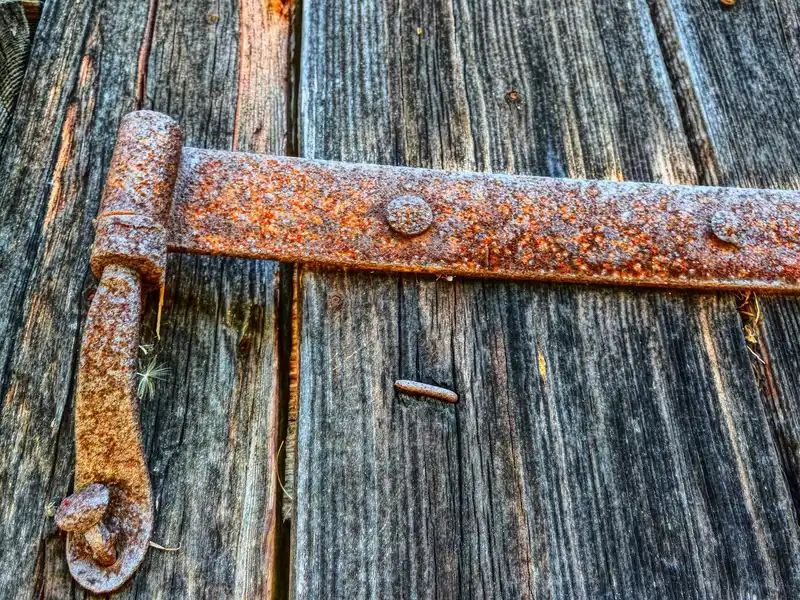
For a badly stripped hinge hole, remove the damaged wood, glue in a hardwood dowel or plug, and re-drill a fresh pilot hole after the repair cures. This is the most reliable standard fix for wood because it restores solid material where the screw actually needs to bite. Use filler only for cosmetic touch-ups; it is not a structural substitute for wood fibers in a hinge joint (Fine Homebuilding; Family Handyman).
Drill out the damaged wood
Use a drill bit matched to the dowel or plug you plan to install. Remove only the loose, crushed wood until the sides of the hole are clean and round. Keep the new hole centered on the original hinge position unless the wood is too damaged to trust.
- Drill only as large as needed to reach sound wood.
- Stay square to the surface so the hinge sits flat.
- If the damage is too broad, consider moving the hinge instead of enlarging the repair again.
Glue in the dowel or plug
Apply wood glue to the dowel or plug, insert it fully, and wipe away squeeze-out. Let it dry fully before you cut it flush. DAP Plastic Wood is useful for thin cosmetic layers after the structural repair, and it is generally better for sanding and painting than for carrying hinge load. Wood filler and wood putty are finishing materials, not structural reinforcements, so they are not interchangeable with a dowel repair (DAP; This Old House).
- Use a hardwood dowel or plug for the actual strength.
- Reserve filler for small surface voids after the repair cures.
- Do not install the hinge until the glue has fully set.
Re-drill and rehang
After cure, mark the hinge position again and drill a fresh pilot hole for the screw. If you need a final cosmetic touch-up around the repaired area, apply DAP Plastic Wood in thin layers and let each layer dry before sanding. A common first-timer mistake is rushing this step and reinstalling hardware before the glue has set.
- Match the pilot hole to the screw diameter and wood hardness.
- Reinstall the hinge without over-tightening.
- Check that the leaf sits flush before loading the door.
Can toothpicks and glue really repair a stripped hinge screw hole?
Yes, for a small stripped hole in solid wood, toothpicks and glue can rebuild enough bite for the screw to hold again. Toothpicks can rebuild a small stripped hole so the screw can grip again, and a small amount of white glue or wood glue dries quickly. This is a fast, low-cost repair, not a cure for large damage.
How many toothpicks should you use?
Use enough toothpicks to fill the hole tightly without crushing them flat. Pack the opening until it feels full, then add one more if you can still see open space. The goal is solid contact, not a loose bundle that collapses when the screw turns.
- Use this only for small, localized wear.
- Fill the void tightly, but do not force the fibers apart.
- If the opening is wide or ragged, switch to a dowel repair.
Trim, dry, and re-screw
Break or cut the toothpicks flush with the surface after the glue begins to set. Let the repair dry before reattaching the hinge. A common mistake is driving the screw too soon, which can split the softened filler and put you back at square one.
- Let the glue cure before the hinge takes load.
- Drill a small pilot hole if the screw starts to split the packed wood.
- Do not use this method for repeated sagging or blown-out holes.
When should you move the hinge?
Move the hinge when the wood seems too weak to hold again, the same screw keeps stripping after one repair, or the door sag returns quickly. Thin door jambs can make repeated screw repair less dependable. If the hinge land is damaged across a wide area, fresh wood is safer than another patch. Relocating a hinge is often the best option on weak jamb stock or some hollow-core constructions where the screw no longer has enough solid wood to grip (Fine Homebuilding; Family Handyman).
Signs the wood is too weak
If the screw hole is blown out, elongated, or crumbling at the edges, the hinge fastener has lost meaningful purchase. A longer screw may still fail if the jamb stock is thin. Repeated sag at the same hinge is another sign that the surrounding wood has reached its limit.
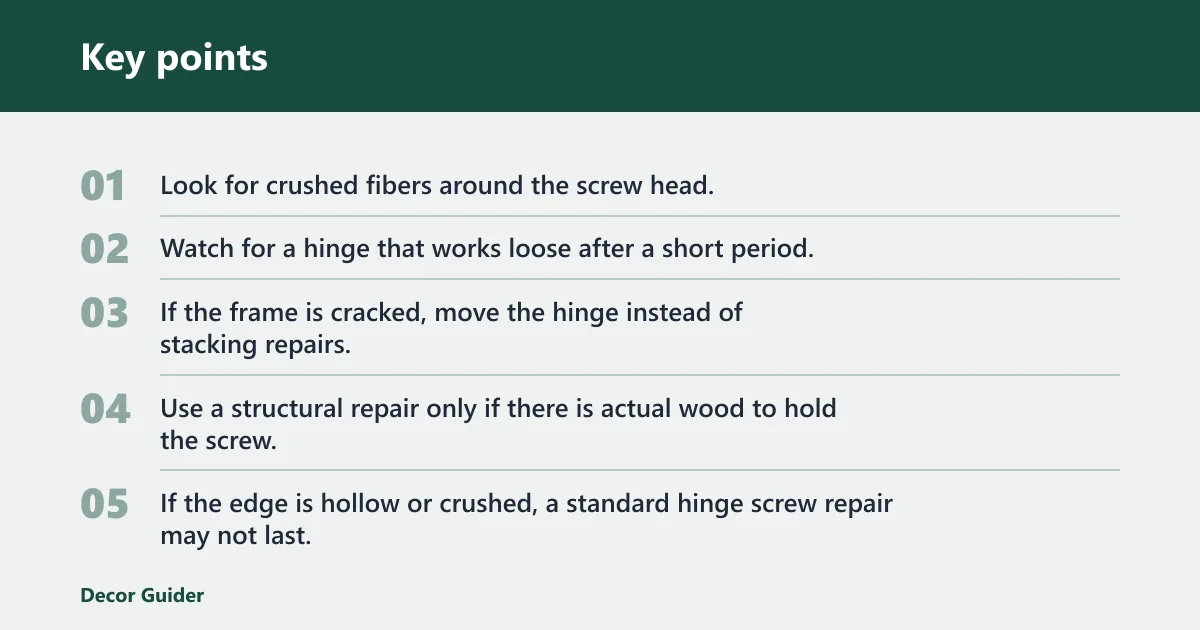
- Look for crushed fibers around the screw head.
- Watch for a hinge that works loose after a short period.
- If the frame is cracked, move the hinge instead of stacking repairs.
What to do on hollow-core interior doors
Do not treat a hollow-core door edge like a solid jamb. If the screw hole is in a thin, unsupported edge, a dowel repair may still fail unless there is enough solid material behind it. In that case, move the hinge to fresh wood where possible, or repair the edge only if the door construction allows a real wood anchor point. Hollow-core doors usually need special care because the edge material can be thin, broken, or unsupported behind the skin (This Old House).
- Use a structural repair only if there is actual wood to hold the screw.
- If the edge is hollow or crushed, a standard hinge screw repair may not last.
- When in doubt, shift the hinge to fresh material or follow a hollow-core-specific repair.
Common mistakes
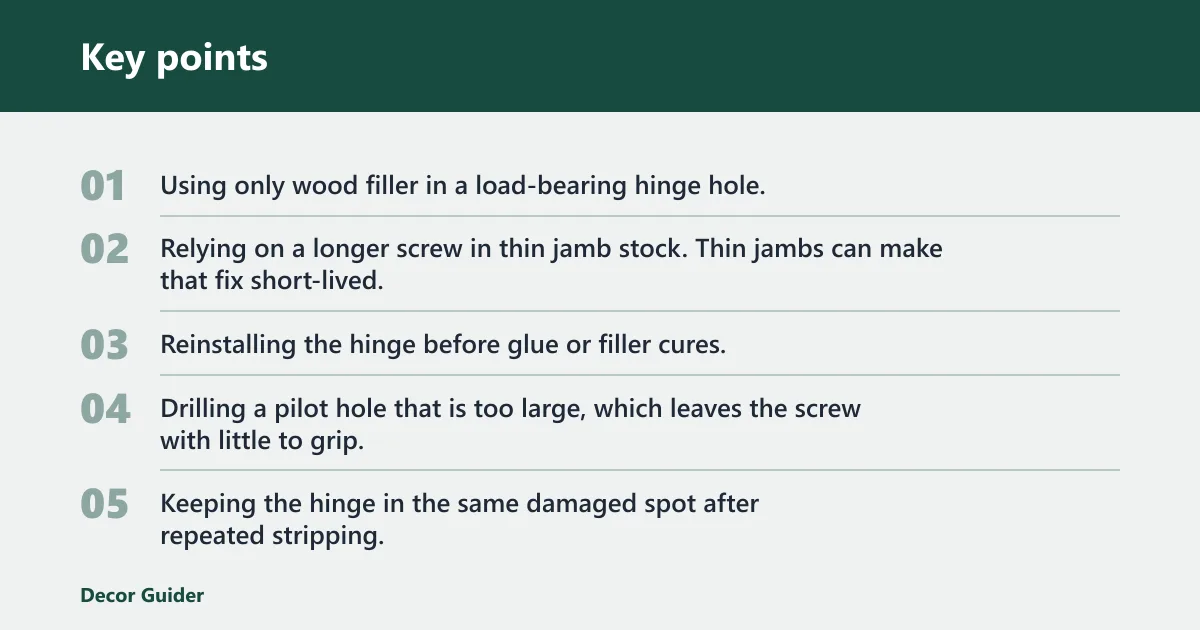
- Using only wood filler in a load-bearing hinge hole. Filler is better for cosmetic leveling than for screw bite.
- Relying on a longer screw in thin jamb stock. Thin jambs can make that fix short-lived.
- Reinstalling the hinge before glue or filler cures.
- Drilling a pilot hole that is too large, which leaves the screw with little to grip.
- Keeping the hinge in the same damaged spot after repeated stripping.
- Using plastic anchors as a default fix in wood jambs. They are not the standard structural repair for this problem.
- Using auto body filler as the main repair for a wood hinge hole. It is better suited to oversized holes as a special-case fill, not the first choice for hinge screws.
Plastic anchors: when they can work, and why they usually do not
Plastic anchors can work only when the surrounding material is thin or crumbly and the screw needs a light-duty anchor point, not true wood strength. They usually fail in hinge applications because hinges load the fastener repeatedly, and the anchor can loosen, spin, or crumble under side-to-side door movement. For wood jambs, a dowel or plug repair is usually the stronger choice.
- Best treated as a last-resort light-duty anchor, not a standard hinge repair.
- Can fail if the hole is oversized or the door keeps sagging.
- Use wood restoration first whenever the jamb is actually wood.
Auto body filler: when it can work, and why it is secondary
Auto body filler can fill an oversized void and sand smooth, but it is usually secondary to wood repairs because it is not designed to restore wood fibers for screw threads. It may help in a non-structural rebuild or cosmetic edge rebuild, yet hinge screws still depend on a real wood anchor. Use it after a dowel or plug repair, not instead of one.
- Useful for shaping and smoothing once the structural repair is done.
- Not ideal as the only material holding a hinge screw.
- Choose wood filler or wood repair products for wood-specific hinge loads.
Door hinge checklist
| Repair method | Likely failure mode | When it fails again |
|---|---|---|
| Longer screw | Still too little thread engagement | Thin jamb stock or soft wood |
| Toothpicks and glue | Packed filler crushes or loosens | Hole is too large or the hinge is carrying repeated sag |
| Hardwood dowel or plug | Poor glue bond or misdrilled pilot hole | Repair was not cured or the hinge was over-tightened |
| Wood filler alone | No structural bite | Any hinge load beyond light cosmetic use |
| Relocated hinge | Fresh hole still weak if the new location is too close to the old damage | Adjacent wood is also soft or cracked |
Frequently asked questions
How do I fix a stripped door hinge hole in a door jamb?
Start with the least invasive repair that still matches the damage. If the hole is only slightly worn, use a longer screw. If it is ovaled or blown out, drill and glue in a hardwood dowel or plug, then re-drill a pilot hole after cure.
- Mild wear: longer screw.
- Moderate damage: dowel or plug.
- Severe damage: move the hinge to fresh wood.
How do I fix a stripped hinge screw hole without replacing the door frame?
You usually do not need a full frame replacement. Rebuild the hole with toothpicks and glue for small damage, or with a dowel or plug for larger damage. If the hinge keeps pulling loose, move the hinge to fresh wood rather than keep reusing the same hole.
- Repair first if the frame wood is still mostly sound.
- Relocate the hinge if the same spot keeps failing.
What is the best way to fix stripped door hinge holes?
For damaged wood, a glued hardwood dowel or plug is a common standard fix. It restores solid material for the screw to bite, which is better than filler alone. After cure, drill a proper pilot hole and reinstall the hinge without forcing the screw.
- Use filler only for finishing.
- Use a pilot hole that matches the screw and wood density.
Can toothpicks and glue really repair stripped hinge screw holes?
Yes, if the hole is small and the surrounding wood is still sound. Pack the opening tightly with toothpicks and wood glue, trim it flush, and let it dry before re-screwing. It is fast and cheap, but not the right fix for a large or repeatedly failing hole.
- Good for small stripped holes.
- Not durable for repeated sag or blowout.
Do I need longer screws or a different repair method for door hinges?
Use longer screws only when the hole is lightly worn and the jamb is still strong. If the screw spins, the hole is oval, or the jamb is thin, move to a wood rebuild. Longer screws alone may not hold if there is not enough wood behind the hinge.
- Longer screws are a first check, not a cure-all.
- Weak jamb stock usually needs a structural repair.
How do I stop hinge screws from stripping again?
Use the correct pilot hole, keep the hinge aligned, and avoid over-tightening. If a hinge hole has already failed once, rebuild it with wood before reusing the same spot. Recheck the screw after the door has been opened and closed a few times to confirm the bite still holds.
- Drill the pilot hole before driving the screw.
- Do not overtighten after the hinge seats.
- Use fresh wood if the same hole fails again.
Products related to this article
Sponsored / affiliate links. As an Amazon Associate I earn from qualifying purchases. I may earn additional commission from eligible campaigns.