Holiday Hosting Cookware Guide: Roasting Pans, Dutch Ovens and Casseroles
Match each holiday dish to a vessel by moisture, volume, and oven time: a roasting pan for turkey or ham, a Dutch oven for stuffing, potatoes, or braises, and a casserole for sides that need broad surface area. Choose the wrong pan and you lose browning, crowd the oven, and risk dry meat or side dishes that miss the table.
Start with the menu, serving count, and oven limits before you buy anything or pull pans from storage. The right vessel depends less on the label and more on the job, drippings for gravy, wide top browning for a casserole, or a covered pot that holds heat while the turkey rests.
Start with the menu, not the pan


Build the dish list first
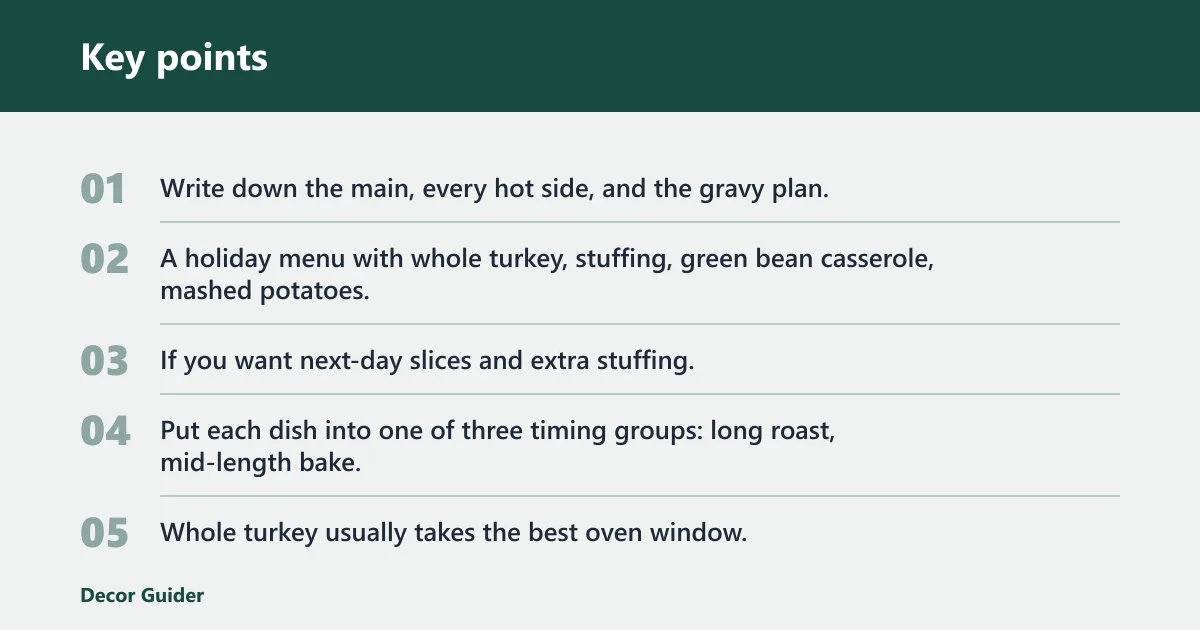
Write down the main, every hot side, and the gravy plan. A holiday menu with whole turkey, stuffing, green bean casserole, mashed potatoes, and gravy needs a very different cookware setup than one built around ham, braised greens, and make-ahead potatoes.
Volume sets vessel size. Leftovers do too. If you want next-day slices and extra stuffing, size the cookware for the larger batch now instead of forcing a second oven round once guests are seated.
Count servings and oven windows
Put each dish into one of three timing groups: long roast, mid-length bake, or reheat/hold. Whole turkey usually takes the best oven window. Sides you can bake ahead and rewarm in the same casserole dish are easier to manage than dishes that need fresh browning at the exact moment the roast comes out.
Gravy changes the plan too. If turkey drippings matter, the roasting vessel needs enough depth to catch them without sloshing when lifted, but not such tall sides that the bird traps steam and roasts poorly.
Check the oven before choosing cookware
Measure interior width, usable rack depth, and the clearance between racks. Listed appliance width is not enough. Handles affect fit and safe lifting, and a domed lid can block the rack above even when the pot diameter looks fine on paper.
Suppose your oven holds one large roast pan and one small side dish, but not two broad vessels side by side. That points to a roasting pan for the main and a deeper Dutch oven or narrower casserole for one side, with the second side made ahead and reheated after the bird rests.
Mark make-ahead dishes
Stuffing, mashed potatoes, and many casseroles can be mixed ahead, refrigerated, then baked or reheated in the same vessel. Gravy and cranberry sauce can shift to the stovetop, which frees the oven for dishes that need dry top heat.
A 3-quart saucepan is recommended for gravy, and a 2-quart saucepan is recommended for cranberry sauce. Those two stovetop jobs can take real pressure off a crowded oven schedule.
What cookware do you need for holiday hosting?
You need enough cookware to cover one roast, two hot sides, and gravy without forcing dishes to fight for the same oven space at the same time. For many hosts, that means one roasting pan, one Dutch oven or casserole for a side, one casserole dish for broad baked sides, and a saucepan for gravy.
The minimum kit
For turkey, two sides, and gravy, the leanest practical setup is:
- One roasting pan sized for the bird and drippings.
- One casserole dish for a broad baked side such as stuffing or green bean casserole.
- One Dutch oven or large pot for mashed potatoes, reheating, or braising.
- One saucepan for gravy.
This is enough for many standard menus because potatoes can hold covered, casseroles can bake ahead, and gravy belongs on the stovetop anyway.
The expanded kit
If the menu includes ham plus turkey, or several sides that need oven browning at once, add a second casserole dish and make sure one covered vessel can shift to braising or holding. A rectangular roasting dish set includes three pieces, which helps when the menu has multiple baked sides rather than one large roast.
The small-space kit
If storage and budget are tight, buy around the menu you actually host. If turkey is the centerpiece, start with the roasting pan. If a whole bird is rare and braises, potatoes, and baked sides show up more often, a Dutch oven plus one rectangular casserole dish covers more ground across the year.
A large Dutch oven can handle an 8-quart stockpot role for mashed potatoes, which makes it a smart second piece when cabinet space is limited.
When is glass bakeware safe for high-heat baking?
Glass bakeware can be a good choice for casseroles, baked pastas, and other dishes that need steady heat, but only when the pan is rated for the temperature you plan to use. The key is knowing the maker’s limit, avoiding thermal shock, and choosing a different pan when a recipe pushes the edge. For a clear breakdown of temperature limits, safety checks, and when metal is the safer swap, see glass baking dish safety.
That matters because a dish that seems “oven-safe” at one temperature may still fail at another, especially if it goes from fridge to hot oven or touches a wet/cold surface after baking.
When is a roasting pan the right call?
A roasting pan is the right call when you need exposed dry heat around a large roast, enough floor area for steady placement, and reliable drippings collection for gravy. It is usually the best vessel for whole turkey and often the cleanest option for ham when exterior browning matters.
Why whole turkey usually belongs here
A whole turkey needs room for air flow around the bird, room below for drippings, and stable support for a rack if you use one. A standard Dutch oven is too enclosed for that job, and a casserole dish is usually too shallow to control drippings safely.
Raised sides help contain rendered fat and juices, but very tall walls can cut the bird off from the oven’s dry heat. Low or flared sides brown better and make it easier to spoon, pour, or scrape drippings into a saucepan.
Rack use, pan fit, and skin browning
A rack lifts the bird so hot air can move under it. That helps browning and keeps the bottom from sitting directly in liquid. Rack fit matters: the rack should sit securely inside the pan and support the weight of the roast without tipping or bowing sharply.
The best overall turkey roaster featured a curved steel rack. That detail matters because a fitted curved rack cradles the bird and leaves channels for drippings to collect below instead of pooling against the sides.
A rack is optional for some hams and turkey breasts if the pan has a shallower bed of aromatics or sliced vegetables, but it is more useful for a full turkey where airflow under the bird affects skin quality.
Material tradeoffs
Stainless steel is the most straightforward choice for turkey if gravy is part of the plan. It browns well, tolerates scraping, and is usually easier to deglaze on the stovetop when the pan is stovetop-safe and sized for the burner.
Cast iron holds heat well and can do strong work with roasts, but the weight climbs fast once drippings fill the pan. That can make the oven-to-stovetop transfer the hardest lift of the meal. One cast iron roaster is positioned as best for lasagna, which hints at where cast iron often works more clearly: dense baked dishes that benefit from retained heat.
Non-stick can make cleanup faster, but it is less ideal if you want hard fond for gravy. Drippings release more easily, yet that same slick surface can reduce the browned bits many cooks want for deeper pan gravy.
What size roasting pan do you need for a holiday turkey?
The pan should fit the bird without crowding and still leave room for airflow and drippings. Too small, and the turkey steams or spills. Too large, and drippings can spread into a thin layer and scorch. Match the bird weight band first, then confirm handle clearance and rack fit inside your actual oven.
Turkey size bands that matter
For an 8 to 12 lb turkey, look for a compact roasting pan that still keeps the bird off the bottom if a rack is used. The risk here is often overbuying: a huge pan for a small bird spreads drippings thinly and can darken them too fast.
For a 12 to 16 lb turkey, a 16-inch pan is needed. This is the most common holiday range, and it is where many hosts learn that “fits the turkey” is not the same as “fits the oven with handles included.”
For a 16 to 20 lb turkey, an 18-inch pan is needed. Depth and handle clearance matter more here because the roast sits high, drippings volume rises, and lifting a full pan gets less forgiving.
Over 20 lb, check both the oven cavity and the pan maker’s capacity claim carefully. A 16.5-inch roaster can hold up to 20lb of turkey, which tells you where many standard home roasting setups top out. A flared 18.5-inch roasting pan is described as extra large, but “extra large” still has to clear your rack supports and door opening.
Failure points to watch
Crowding is the big one. If the bird sits close to the side walls, hot air cannot circulate well. The result is slower browning and more steaming around the lower half.
Shallow pans create the opposite problem. Drippings can splash or threaten to spill when you rotate the pan or pull the rack forward. That is especially risky if gravy depends on every bit of those juices.
Picture an over-20-pound bird in a pan that technically holds it, but only with the breast nearly level with the rim. The turkey may cook, yet basting and turning the pan become risky because the drippings have almost no safety margin below the edge.
How to size a roasting pan for a holiday turkey
If you’re choosing between pan sizes, the safest rule is to pick one that leaves about 2 inches of space on each side of the turkey, with enough room for drippings to collect without spilling over. The most useful home sizes are usually 14, 16, or 18 inches, and the right fit depends on both the bird’s weight and your oven clearance.
The roasting pan size guide breaks down what works for 12-, 16-, and 20-pound turkeys, explains how deep the pan should be, and covers rack and handle details that affect browning, drippings, and gravy-making.
Can you cook a turkey in a Dutch oven?
You can cook some turkey cuts in a Dutch oven, but a full holiday bird is usually the wrong target. A Dutch oven works far better for turkey breast, legs, and braised preparations than for whole-turkey roasting because the lid and tall walls change browning, airflow, and available capacity.
What fits realistically
A whole turkey will not fit in a standard Dutch oven. That is the cleanest rule in this guide. The pot shape is better suited to whole chicken, turkey breast, and smaller roasts where covered cooking is part of the plan.
A 3 to 4 lb roast fits in a 5.4-quart or 8-quart Dutch oven. A bone-in half ham in the 7 to 10 lb range fits in an 8-quart Dutch oven. Those examples show the scale where Dutch ovens make sense for holiday mains.
What the lid changes
With the lid on, moisture stays in the pot. That is good for braising and gentle roasting, less good for crisp turkey skin. A covered casserole is called out for gentle roasting and braising, and the same logic applies here: the lid softens the cooking environment and reduces surface drying.
With the lid off, a Dutch oven behaves more like a deep roasting vessel, but the tall sides still block some direct exposure. Browning can lag behind what a lower-sided roasting pan delivers.
Best Dutch oven jobs on a holiday menu
Enameled cast iron Dutch ovens earn their keep on holiday menus as braisers, soup pots, reheating vessels, and potato pots. They move from stovetop to oven to table well and hold heat long enough to keep side dishes serviceable while the main roast rests.
Stuffing works here if you want moister edges and a covered start. Turkey breast works here if the menu is small and you prefer a more protected roast. Mashed potatoes are another strong use because the vessel can boil, mash, hold, and rewarm.
Which casserole dish size works for holiday sides?
A casserole dish is best when the side needs broad surface area, steady oven heat, and direct serving at the table. Rectangular dishes work especially well for stuffing, green bean casserole, and layered potato dishes because shape affects browning, serving depth, and how easily the dish shares oven space.
Shape and side-dish capacity
Rectangular baking dishes are the workhorses here. They slide into crowded ovens more efficiently than round dishes, and their corners create more browned edge area in dishes like stuffing and casseroles.
For smaller gatherings, a shallower medium rectangular dish often gives better top browning and faster reheating than a deep large dish filled halfway. For larger groups, deeper dishes hold heat longer on the table, but they also slow center heating and can soften the crust on top if covered too long.
Depth, browning, and serving temperature
Depth changes how the side behaves. A shallow casserole spreads filling into a thinner layer, which gives more browned surface and a faster bake. A deep casserole holds more food and stays hot longer on the table, but the center can lag while the top looks done.
A common first-timer mistake is choosing a very deep dish for green bean casserole, then wondering why the onions brown before the center bubbles. The dish shape, not simply the recipe, caused the timing mismatch.
Stoneware versus ceramic
Stoneware and ceramic both work well for oven-to-table service. They retain heat better than many thin metal pans, which helps sides stay warm through a long meal. Their tradeoff is browning speed: metal usually colors edges and bottoms faster.
If the goal is a crisp top and quick turnover, use metal for the roast and reserve ceramic or stoneware for the sides that benefit from gentler carryover heat on the table.
Covered and uncovered use
Use a cover when the side needs moisture retention, gentler reheating, or protection during the first phase of baking. Remove the cover when you want crust, bubbling edges, or evaporation. Covered reheating is especially useful for make-ahead stuffing and potato casseroles.
How do you keep a casserole warm until dinner?
The safest approach is to hold the casserole at 140°F or higher so it stays in the USDA hot-holding range and keeps its texture as close to serving-ready as possible. The supporting guide to casserole warming tips explains which method fits your schedule, from a low oven hold to a slow cooker Keep Warm setting or a short-term insulated wrap for transport.
That matters because the right warming method depends on how long you need the dish to sit and whether you’re serving at home or bringing it elsewhere. The article also covers the common mistakes that cause casseroles to dry out, cool too fast, or fall out of the safe temperature range before guests are ready.
How to get a hot casserole to the party intact
If you need the casserole to arrive hot, the key is matching the packing method to the travel time. This guide explains when a covered, preheated insulated carrier is enough, when to use towels and a cooler for extra insulation, and when long trips mean you should treat transport as a delay rather than a warm-hold step.
It also covers the practical details that prevent mess and sogginess: how to pack the dish securely, protect toppings and texture, and avoid common mistakes that lead to spills, dry edges, or a lukewarm center. For step-by-step packing guidance, see hot casserole transport.
Holiday cookware matrix
| Dish | Serving count | Vessel type | Minimum size | Oven fit risk | Lid/rack need | Best fallback option | Notes |
|---|---|---|---|---|---|---|---|
| Whole turkey | Large gathering | Roasting pan | Match bird: 16-inch pan for 12 to 16 lb; 18-inch pan for 16 to 20 lb | High for handle width and rack clearance | Rack strongly preferred | Turkey breast in Dutch oven or smaller turkey in roasting pan | Crowding causes steaming; overlarge pan can burn drippings; shallow pan can overflow |
| Turkey breast | Small to medium gathering | Dutch oven or small roasting pan | Pot or pan with clearance around the breast | Medium for lid height | Lid optional; rack optional | Casserole dish with uncovered finish | Lid-on cooking softens skin; tall walls reduce browning speed |
| Ham | Medium to large gathering | Roasting pan or Dutch oven | 8-quart Dutch oven for a 7 to 10 lb bone-in half ham | Medium | Rack optional; lid optional | Casserole dish if cut or portioned | Dutch oven works best when glaze control matters more than broad browning |
| Mashed potatoes | Any size | Dutch oven | Large Dutch oven that can fill an 8-quart stockpot role | Low | Lid useful for holding | Large pot plus casserole for reheat | Good make-ahead candidate; covered hold reduces last-minute oven pressure |
| Green bean casserole | Small to large gathering | Rectangular casserole dish | Dish sized to keep a moderate layer depth | Low to medium | Usually uncovered for final browning | Dutch oven only if crisp topping is not the priority | Too deep a dish delays center heating and overbrowns the topping |
| Stuffing | Small to large gathering | Casserole dish or Dutch oven | Rectangular dish for more crust; Dutch oven for moister center | Low | Cover for reheating; uncover to finish | Split between two smaller dishes | Depth controls crust-to-center ratio more than vessel material alone |
| Gravy | Any size | Saucepan | 3-quart saucepan | None in oven | No lid; no rack | Roasting pan drippings transferred to saucepan | Roasting pan shape affects how easily drippings pour without spills |
How to read the matrix
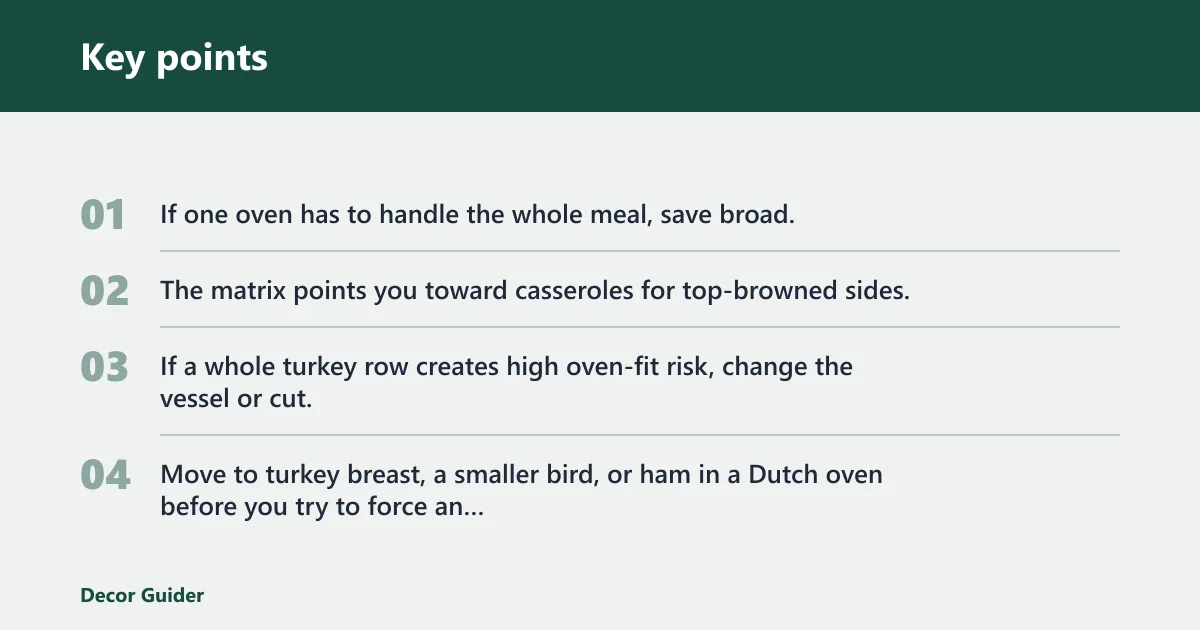
If one oven has to handle the whole meal, save broad, uncovered vessels for dishes that truly need them. The matrix points you toward casseroles for top-browned sides, the Dutch oven for covered holding and make-ahead reheats, and the roasting pan only where open roasting and drippings are required.
When the matrix points to a vessel change
If a whole turkey row creates high oven-fit risk, change the vessel or cut, not the entire menu. Move to turkey breast, a smaller bird, or ham in a Dutch oven before you try to force an oversized roast into a pan that barely clears the rack.
How do you choose cookware that fits your oven and gravy plan?
Choose cookware by measuring the oven interior, then checking how the vessel handles drippings collection and transfer. A pan that fits the roast but fails at rack position, door opening, or stovetop gravy workflow is still the wrong pan for holiday use.
Measure for real clearance
Check width at the rack level, depth from the back wall to the closed door, and vertical room above the vessel. Then account for handles, not just the base. On lidded cookware, include the knob height too.
Leave space for air circulation and safe lifting. A pan that scrapes the side rails or blocks a second rack may fit physically but still fail on the day you need to rotate it.
Plan the drippings route
If gravy starts with turkey drippings, the easiest workflow is usually roasting pan to fat separator or bowl, then saucepan. Lower or flared sides help you pour without splashing over a high rim. Stainless steel is especially handy here because browned bits release well when deglazed.
Dutch ovens can hold drippings too, but their deeper shape makes skimming and pouring less tidy. Casserole dishes rarely give enough depth or safe headroom for a large roast’s drippings, which is why they are a poor substitute for whole turkey even when the floor area looks close.
What should you buy if you only want a few holiday pieces?
Buy the vessel that solves your main dish first, then add the side dish piece that removes the most oven pressure. For turkey-centered menus, that usually means a roasting pan first. For smaller gatherings and side-heavy menus, a Dutch oven plus one rectangular casserole dish often covers more useful holiday work.
Best first purchase for turkey-focused menus
Start with a roasting pan if you host around a whole bird and make gravy from drippings. That piece is hard to fake well with other cookware because turkey needs open heat, safe drippings depth, and room for a rack.
Best first purchase for side-heavy or smaller menus
Start with an enameled cast iron Dutch oven if the main is usually turkey breast, pot roast, braised vegetables, or ham, and if mashed potatoes need a vessel that can cook and hold. Add a rectangular casserole dish next for stuffing and green bean casserole.
The two-piece setup that covers most menus
- One roasting pan for turkey or ham.
- One rectangular casserole dish for sides, plus existing stovetop pots for gravy and potatoes.
If whole turkey is rare, swap the roasting pan for a Dutch oven. That two-piece path makes more sense than buying every holiday-only vessel at once.
When borrowing or disposables make more sense
Over-20-pound birds, once-a-year double mains, and unusually wide casseroles can push you into niche cookware that spends the rest of the year in storage. In those cases, borrowing a true roasting pan or using a sturdy disposable pan inside a sheet pan for support can be the more practical move.
Frequently asked questions
Is a roasting pan better than a Dutch oven for turkey?
For a whole turkey, yes. A roasting pan gives lower sides, better airflow, easier rack use, and cleaner drippings collection for gravy. A Dutch oven works better for turkey breast or braised turkey pieces, where the lid and deeper walls help moisture retention rather than crisp, open roasting.
What dishes can go in a Dutch oven for Thanksgiving?
A Dutch oven is especially useful for mashed potatoes, stuffing, braised vegetables, turkey breast, and half ham. It also helps with make-ahead reheating because the lid holds moisture well. It is a better holiday multitasker for sides and braises than for a full turkey.
How do I choose a roasting pan that fits my oven?
Measure the oven interior at rack level and include space for handles, lid height if any, and safe air circulation. Then check whether the pan still leaves room to move the rack and lift the roast without hitting the oven walls or the second rack above.
What size casserole dish is best for holiday sides?
The best casserole dish is the one that gives the right depth for the side, not simply the biggest one. Rectangular dishes suit stuffing and green bean casserole well because they spread food for better top browning while still moving neatly from oven to table.
Products related to this article
Sponsored / affiliate links. As an Amazon Associate I earn from qualifying purchases. I may earn additional commission from eligible campaigns.