Can a Glass Baking Dish Go in a 450 Degree Oven?
Yes—many oven-safe glass baking dishes can handle 450°F, but only if the manufacturer lists that temperature and you avoid sudden temperature changes. Ignore those limits, and the dish can crack or send hot food and glass through your oven. This guide covers safe use, warning signs, and when metal is the better choice.
This guide is part of our Holiday Hosting Cookware Guide: Roasting Pans, Dutch Ovens and Casseroles series.
Can a glass baking dish go in a 450°F oven?
Yes, if the dish is labeled for that heat and you follow the maker’s care rules. 450°F is common for casseroles and lasagna, but the label matters more than the recipe. Unlabeled glass should not be treated as oven-safe at that temperature.
Why the label matters more than the recipe
Recipes tell you the oven setting. The dish label tells you what the material can handle. Some glass bakeware is rated for conventional oven use, and some is not. ATK identifies a Pyrex Easy Grab 3-Quart Oblong Baking Dish as safe for conventional oven use, though that does not mean every glass dish is equally safe.
That difference matters because 450°F sits near the top end of what many home cooks use for baked pasta, roasted vegetables, and browned casseroles. Some brands list a lower maximum. Others warn against broiler use even when the dish is fine in a standard oven.
Glass bakeware 450°F decision matrix
This table gives the practical yes-or-no answer for common situations. The safe move depends on the exact dish, the temperature swing, and the surface it touches after baking. If any part of the setup is unclear, treat the dish as unsafe until the maker confirms otherwise.
| Scenario | Go / no-go | Risk level | Exact safe-handling step |
|---|---|---|---|
| Labeled oven-safe glass at 450°F | Go | Low to moderate | Preheat normally, keep the dish dry, and place it on a dry cooling rack or dry potholder after baking. |
| Unlabeled glass | No-go | High | Do not assume it is oven-safe; verify the maker’s instructions before any 450°F use. |
| Cold dish to hot oven | No-go unless the maker allows it | High | Let the dish warm toward room temperature first if the care guide does not explicitly allow a cold start. |
| Hot dish to cold counter | No-go | High | Move it to a dry cooling rack or dry potholder instead of a cold counter, wet sink, or cool stone surface. |
| Freezer-stored dish | No-go unless the maker explicitly allows freezer-to-oven use | High | Thaw or defrost first unless the brand says the dish can go directly from freezer to oven. |
| Broiler-adjacent use | No-go unless the maker says broiler-safe | High | Keep the dish away from the broiler element; most glass baking dishes are not broiler-safe. |
That table covers the situations that cause the most damage. The oven may be fine. The transition often is not. A dish can survive steady heat at 450°F and still fail when it goes from freezer cold to a hot oven or from the oven to a damp counter.
Why glass breaks in the oven
Glass usually fails from thermal shock, which means a sudden temperature change creates stress faster than the material can spread it out. The risk rises when one part of the dish heats or cools much faster than the rest. Wet surfaces, cold counters, and freezer-cold glass all raise that risk.
Thermal shock from sudden temperature change
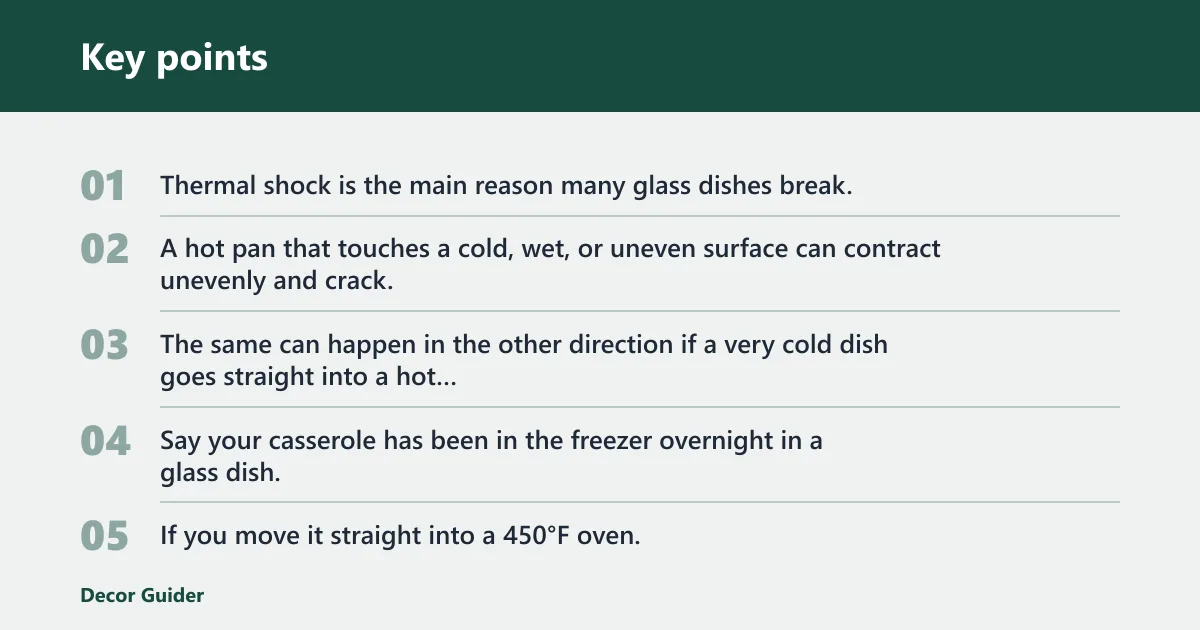
Thermal shock is the main reason many glass dishes break. A hot pan that touches a cold, wet, or uneven surface can contract unevenly and crack. The same can happen in the other direction if a very cold dish goes straight into a hot oven without the maker allowing that use.
Say your casserole has been in the freezer overnight in a glass dish. If you move it straight into a 450°F oven, the outside of the glass heats much faster than the center. That gap creates stress. If the brand does not allow freezer-to-oven use, that is a no-go.
Wet or cool surfaces after baking
A hot glass dish should not land on a wet counter, a damp towel, a cold stone slab, or another cool surface. Those surfaces pull heat away fast and unevenly. ATK notes that most glass baking dishes are not broiler-safe, and the same caution applies to fast temperature swings after baking.
A common first-timer mistake is setting a bubbling lasagna dish on a cool granite counter right after the oven. The bottom edge cools faster than the rim, and the stress can show up as a pop, a crack, or a full shatter. A dry rack or dry potholder is the safer landing spot.
Temperature swing as the main risk
The risk is not only the oven temperature itself. It is the size and speed of the change. A dish rated for 450°F can still fail if it goes from freezer cold to hot heat or from hot heat to a cold surface. Control the transition, not just the recipe setting.
What the maker’s care instructions usually say
Care instructions usually give three key rules: check the maximum temperature, avoid sudden temperature changes, and cool the dish on a dry surface. They may also warn against broilers, direct freezer-to-oven moves, or placing the dish on a wet counter. Brand guidance beats general advice every time.
Check the temperature limit on the dish or package
The safest number is the one printed on the dish, box, or care sheet. FÖLJSAM is listed as oven-safe up to 536°F, which is above 450°F. But customer reviews for that same product include a report of shattering at 400°F and another of cracking at 500°F, which shows why the exact model and handling still matter.
Follow cooling and surface warnings
Most makers say to let the dish cool on a rack, potholder, or dry cloth. That advice is not cosmetic. It responds directly to thermal shock. If the dish is hot enough to steam the air above it, do not move it to a surface that is cold, wet, or uneven.
Do not assume freezer-to-oven use
Our Everyday Life says glass baking dishes should not go straight from freezer to oven and should be allowed to defrost before cooking. It also recommends lowering the oven temperature by about 25 degrees for glass. Those are broad rules, though, not a substitute for the maker’s label on your specific dish.
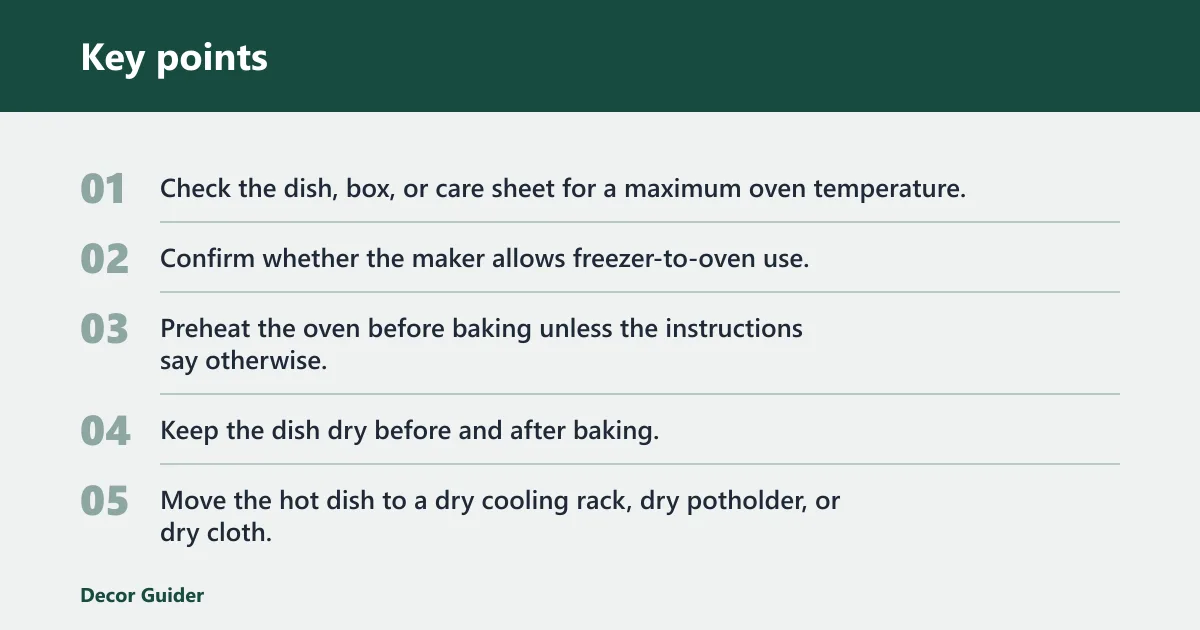
- Check the dish, box, or care sheet for a maximum oven temperature.
- Confirm whether the maker allows freezer-to-oven use.
- Preheat the oven before baking unless the instructions say otherwise.
- Keep the dish dry before and after baking.
- Move the hot dish to a dry cooling rack, dry potholder, or dry cloth.
- Avoid the broiler unless the label explicitly allows it.
Is your dish borosilicate or soda-lime glass?
The glass type matters because older borosilicate dishes and modern soda-lime dishes do not behave the same way. Borosilicate tolerates rapid temperature change better. Soda-lime expands more with heat, so it is more sensitive to sudden shifts. Brand history matters because older Pyrex and newer American Pyrex are not the same material.
Older borosilicate glass and rapid temperature changes
Older borosilicate glass has a lower thermal expansion rate, so it can handle faster temperature changes better than soda-lime glass. That is why some older glassware earned a reputation for strong thermal-shock resistance, including freezer-to-oven performance in some settings. Even so, you still need the maker’s instructions.
Modern soda-lime glass and breakage risk
Modern American Pyrex products are commonly soda-lime glass. That material is fine for conventional oven use when labeled for it, but it is more vulnerable to sudden temperature swings. The difference explains why one brand name can appear on both safer and less forgiving bakeware across different production eras.
TheCoolist cites Consumer Reports testing at 450°F on wet granite. In that test, American soda-lime dishes broke ten out of ten times. The surface was part of the failure case. The key point is simple: the oven setting alone does not tell you enough.
Does glass bakeware need different baking settings?
Often, yes. Glass can brown food differently than metal, so some cooks lower the oven temperature by about 25 degrees or watch the edges more closely. That advice is common for casseroles and lasagna. The right setting still depends on the recipe and the maker’s temperature limit.
How glass can change browning and timing
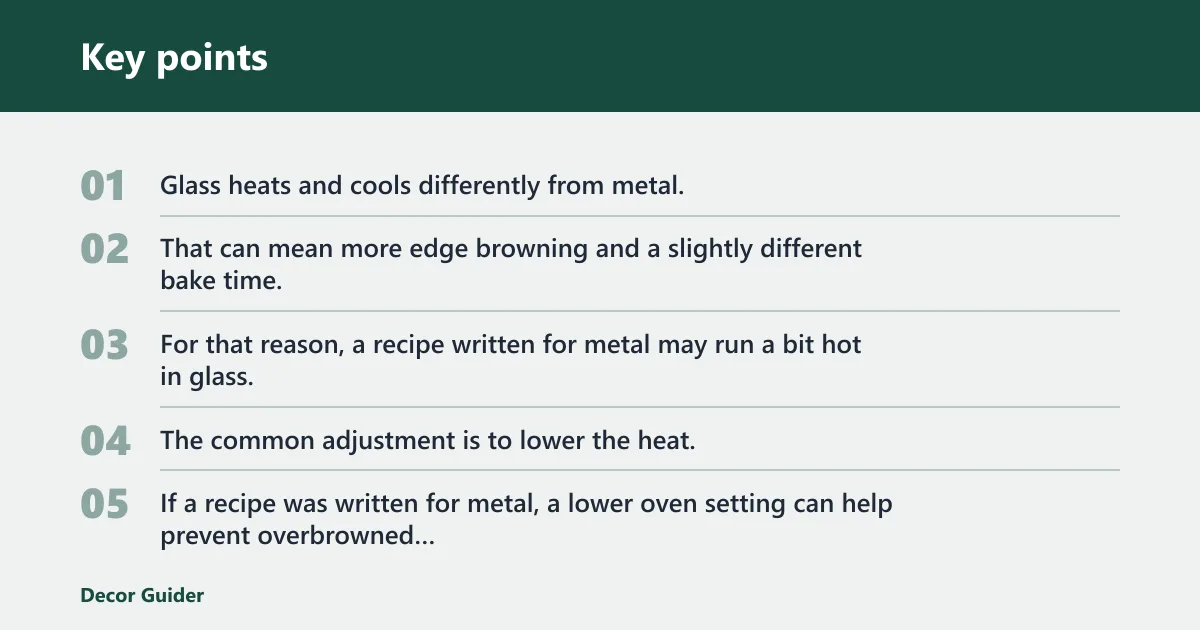
Glass heats and cools differently from metal. That can mean more edge browning and a slightly different bake time. For that reason, a recipe written for metal may run a bit hot in glass. The common adjustment is to lower the heat, then watch the food rather than the clock alone.
When to lower heat or watch the edges
If a recipe was written for metal, a lower oven setting can help prevent overbrowned edges. That matters most with tomato-heavy casseroles, layered pasta dishes, and cheese-topped bakes. Still, do not lower the temperature so much that the dish underbakes; use the recipe as the starting point, then follow the maker’s limits.
Lasagna and casseroles at 450°F
Yes, glass can be used for lasagna at 450°F if the dish is labeled for that temperature and the care instructions allow the bake. That setting is high, but not unusual for browned casserole tops or faster cooking. The dish must be rated for the heat, and the move after baking must stay gentle.
Suppose you are baking a 13 by 9-inch lasagna in a glass dish and the label allows 450°F. The oven setting is fine. The risky moment comes after baking, when the dish leaves the oven. If it goes onto a wet counter, the chance of thermal shock rises immediately.
Frequently asked questions
Can a glass baking dish go in a 450 degree oven?
Yes, if the maker lists 450°F or a higher safe maximum for that specific dish. A labeled oven-safe dish can usually handle a standard bake at that temperature. The bigger hazards are an unlabeled dish, a sudden temperature shift, or a hot dish placed on a cold or wet surface.
Is 450 too hot for a glass baking dish?
Not necessarily. For some oven-safe glass, 450°F is within the rated range. For others, it is too hot. The exact answer depends on the product label and care sheet. If the dish is unlabeled, or the brand gives a lower limit, do not assume 450°F is acceptable.
What temperature is glass bakeware safe up to?
There is no single ceiling for all glass bakeware. Some products are rated below 450°F, while others go higher; FÖLJSAM is listed as oven-safe up to 536°F. Use the dish’s own rating, not a blanket rule, because glass type and brand instructions change the answer.
Can I put a cold glass dish into a hot oven?
Only if the maker explicitly allows that use. Otherwise, a cold dish into a hot oven can trigger thermal shock, especially at 450°F. Let the dish warm up first if the care guide does not approve a cold start. The same caution applies to dishes coming from a freezer.
Does glass bakeware need a lower temperature than metal?
Often, yes. A common rule is to reduce the oven temperature by about 25 degrees for glass, especially when a recipe was written for metal. Glass can brown food differently and may run hotter at the edges. Follow the recipe and the maker’s instructions together.
Why does a glass baking dish break after coming out of the oven?
It usually breaks because of thermal shock. The dish leaves a hot oven, then meets a cold, wet, or uneven surface that cools one area much faster than another. That uneven contraction can crack the glass. A dry cooling rack or dry potholder helps avoid that failure.
Should I put a hot glass dish on the counter?
Not on a cold or wet counter. That is one of the fastest ways to create thermal shock. Put the dish on a dry cooling rack, dry potholder, or dry cloth instead. Keep it away from sinks, damp towels, and cool stone surfaces until it has started to cool safely.
Products related to this article
Sponsored / affiliate links. As an Amazon Associate I earn from qualifying purchases. I may earn additional commission from eligible campaigns.