Crescent Cookie Problems / Not Working / Troubleshooting
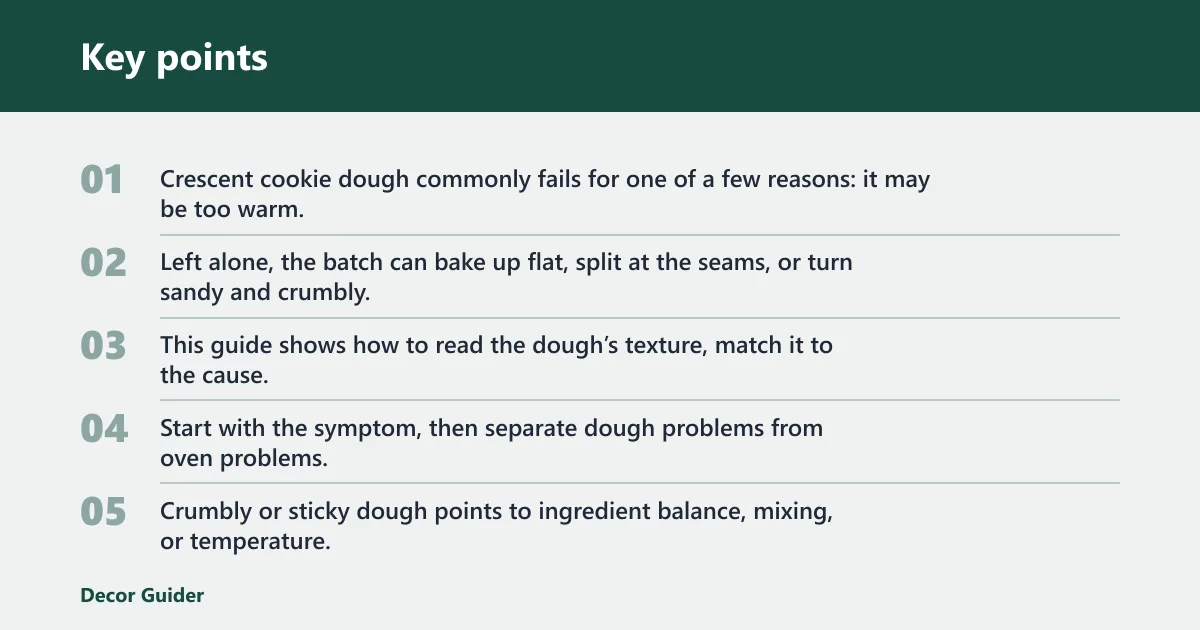
Crescent cookie dough commonly fails for one of a few reasons: it may be too warm, too dry, overmixed, or baked in an oven that runs hot; chill about 20 to 30 minutes, then bake on a cool sheet if the crescents spread or crack. Left alone, the batch can bake up flat, split at the seams, or turn sandy and crumbly. This guide shows how to read the dough’s texture, match it to the cause, and rescue the batch.
Crescent cookie problems at a glance


How to read the symptom-to-cause flow
Start with the symptom, then separate dough problems from oven problems. Crumbly or sticky dough points to ingredient balance, mixing, or temperature. Spreading, browning too fast, and lost shape often point to butter state, pan type, oven temperature, or spacing. The fastest fix is the one that matches the first bad sign you see.
When to fix the dough and when to fix the oven
If the dough feels wrong before shaping, fix the dough first. If the dough shapes well but the cookies spread, crack in the oven, or brown too fast, move to oven and pan checks. A dough that is pliable but not sticky should hold a crescent curve without slumping.
Crescent cookie troubleshooting matrix
| Symptom | Likely cause | Quick test | Fix | Batch salvageable? |
|---|---|---|---|---|
| Crumbly dough | Too much flour, flour packed into the cup, too little moisture, or overmixing after flour goes in | Press a tablespoon of dough; if it cracks and will not hold a smooth ball, it is too dry | Mix in 1 teaspoon milk or softened butter at a time, then chill 10 minutes | Usually yes |
| Sticky dough | Butter too warm or melted, too little flour, or not enough chill time | Touch the dough; if it smears on your fingers and loses shape fast, it is too soft | Chill for about 15 to 20 minutes, or freeze for about 5 to 10 minutes before shaping. | Usually yes |
| Spreading cookies | Butter too warm, pan too hot, oven running hot, or dough not chilled enough | Shape one cookie and bake a test piece; if it flattens early, the dough or oven is the issue | Chill longer, use parchment on a light pan, and verify oven temperature | Usually yes |
| Cracked crescents | Dry dough, cold dough shaped too soon, or too much flour | Roll a small piece; if the surface splits at the bend, the dough needs more moisture or rest | Let the dough sit for about 5 to 10 minutes, then add about a teaspoon of milk only if needed. | Usually yes |
| Overbrowned cookies | Oven too hot, dark pan, rack too high, or bake time too long | Check color at the earliest bake window; if edges darken before centers set, heat is too aggressive | Lower the rack, use a light-colored sheet, and shorten the bake by about 1 to 2 minutes next round. | Partial rescue only |
What you’ll need
- Measuring cups or a kitchen scale for flour measurement
- Mixing bowl and spoon or hand mixer
- Parchment paper
- Light-colored baking sheet
- Refrigerator space for chilling
- Freezer space for short firming
- Spatula for lifting and reshaping
- Timer for chill and bake windows
- Oven thermometer if the oven browns unevenly or too fast
Ingredients and pan setup
Butter should be soft enough to press with a finger, yet it should still hold its form. Melted butter makes the cookies spread. Butter that is too cold leaves dry pockets and makes shaping harder. Powdered sugar gives tenderness and a fine crumb, but too much can push the dough toward spread. A light pan with parchment slows bottom browning compared with a dark sheet.
What to check before you start
Measure flour by weight if you can. If you use cups, spoon the flour into the cup and level it, rather than packing it down. Check the recipe for the intended butter ratio, then confirm the dough should feel pliable but not sticky before shaping. If the dough is already soft, chill it before you touch it again.
Why is my crescent cookie dough crumbly or sticky?
Crumbly dough usually means too much flour, too little moisture, or dough that has been overmixed after flour went in. Sticky dough usually means the butter was too warm, the chill was too short, or the dough needs a brief firming step. The quickest fix is to correct the texture before shaping so the crescents can hold a curve.
Check butter temperature first
Softened butter should give slightly when pressed, but it should not look glossy or oily. Melted butter weakens structure and raises spread. Butter that is too cold can leave dry pockets that break apart when you roll the dough. If the dough smears, chill it; if it fractures, let it rest at room temperature for a few minutes.
Check flour measurement next
Too much flour is a common cause of dry, crumbly dough. High-protein flour can absorb more liquid than a softer flour, which changes the texture quickly. If the recipe depends on a low-protein flour and you use a stronger one, the dough may need a bit more fat or a shorter mix time to stay tender.
Use a short chill or a brief freeze to firm the dough
If the dough is soft, refrigerate it for about 20 to 30 minutes before shaping. If it is still slack, freeze it for about 5 to 10 minutes, then shape again. For a dry dough, do not jump straight to a long chill; first test whether a teaspoon of milk or softened butter brings it back to pliable.
Say your dough breaks when you roll a 2-inch crescent. Add 1 teaspoon milk, mix once, and wait 5 minutes before testing again. Suppose the dough gets sticky after 25 minutes on the counter; 10 minutes in the freezer often firms it enough to shape without adding extra flour.
Why are my crescent cookies spreading too much?
Spreading usually comes from butter that is too warm, dough that was not chilled enough, or a pan and oven setup that lets the butter melt before the cookie sets. If the shape disappears early in the bake, focus on temperature, sheet choice, and spacing before you add more flour.
Review butter state and mixing time
Softened butter is normal, but melted butter or a batter-like mix will spread. Cream the butter and powdered sugar only until light and blended, then stop as soon as the flour is combined. Overmixing can warm the dough and toughen it at the same time.
Check oven temperature and pan type
Preheat the oven fully. If the oven runs hot, the outside can brown before the structure sets; if it runs cool, the butter has more time to spread. A dark pan speeds browning, so use a light sheet when possible and line it with parchment. Leave space between cookies so heat can move around each piece.
Adjust spacing, parchment, and chill time
Chill the shaped crescents before baking, then rechill between batches if the dough softens on the counter. If the first tray spreads, return the next shaped tray to the refrigerator for 10 to 15 minutes before baking. That short rest often helps the dough keep its crescent curve.
Why do crescent cookies crack or brown too fast?
Cracking usually means the dough is too dry, too cold, or shaped under too much pressure. Fast browning usually points to oven heat, a dark baking sheet, or a rack position that exposes the cookies to too much direct heat. Treat those as separate problems, because the fix is different for each one.
Fix shaping stress and dry dough
Warm the dough slightly if it cracks during shaping. Let it sit 5 to 10 minutes, then try again. If the surface still splits, the dough likely needs a touch more moisture or a shorter mix. Use gentle pressure when bending the crescent so the outside does not tear at the curve.
Look at flour load and chill time
Too much flour makes the dough stiff and fragile. Powdered sugar also affects tenderness, so a heavy hand can make the dough seem dry even when the butter amount is correct. If the dough was chilled for a long time, let it sit briefly before shaping instead of forcing it straight from the refrigerator.
Separate oven heat issues from dough issues
If the cookies crack after they enter the oven, the dough may be dry, but if they brown too fast on the bottom while the top stays pale, the oven or pan is the problem. Move the rack to the center, switch to a light sheet, and check the oven with an accurate thermometer if browning looks uneven.
Step-by-step rescue plan
Use the smallest fix first, then retest one cookie before changing the whole batch. The goal is to move the dough back to pliable, not sticky, and able to hold shape. If the dough already bakes into good crescents from one test piece, keep the next adjustment minor.
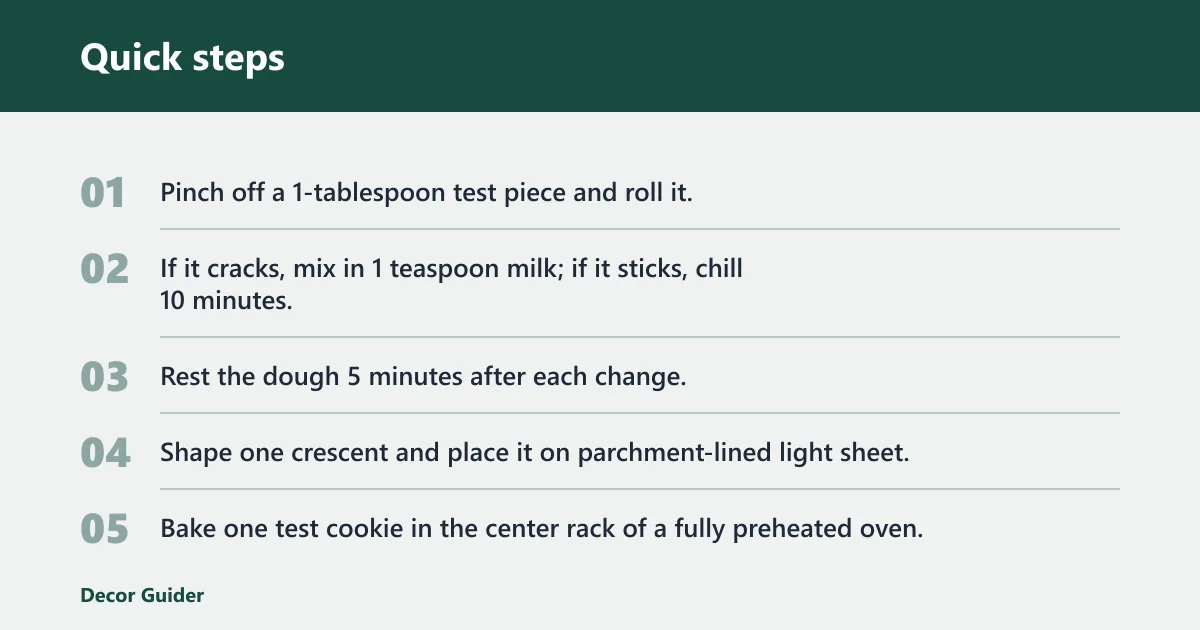
- Pinch off a 1-tablespoon test piece and roll it.
- If it cracks, mix in 1 teaspoon milk; if it sticks, chill 10 minutes.
- Rest the dough 5 minutes after each change.
- Shape one crescent and place it on parchment-lined light sheet.
- Bake one test cookie in the center rack of a fully preheated oven.
- Check spread, browning, and edge cracks before baking the full tray.
- If needed, rechill the shaped tray 10 minutes between batches.
If that did not work, freeze the shaped tray for 5 minutes, then bake again. If the second test still spreads or browns too fast, the oven temperature or pan choice is more likely than the dough. At that point, adjust the oven setup before changing the recipe again.
Common mistakes
Overmixing after flour goes in can make the dough tough and dry. Baking on a dark sheet without shortening the bake can brown the bottoms before the centers set. Skipping a full preheat can cause spread, because the butter melts before the dough firms. Skipping rechilling between batches often turns a good first tray into a bad second tray.
Another common first-timer mistake is adding flour every time the dough feels soft. That can turn a fixable sticky batch into a crumbly one. Add only 1 teaspoon flour at a time, then recheck the texture after a short rest.
Frequently asked questions
Why do my crescent cookies crack when I shape them?
Cracking points to dry dough, cold dough, or flour that was measured too heavily. Let the dough rest 5 to 10 minutes, then shape again with lighter pressure. If the dough still splits, add 1 teaspoon milk, mix briefly, and test another piece before shaping the full batch.
Why is my crescent cookie dough too crumbly to roll?
Crumbly dough often has too much flour or too little moisture. Press a small piece together first; if it will not hold, add 1 teaspoon milk or softened butter, then rest the dough for 5 minutes. If the dough becomes smooth after that, it is ready to shape.
What if crescent cookie dough is too sticky?
Sticky dough usually needs time in the refrigerator. Chill it 15 to 20 minutes, then test a small piece. If it still clings to your hands, freeze it 5 to 10 minutes. Do not add flour first unless the dough also feels loose and cannot hold a mound.
How do I fix crescent cookies that won’t hold their shape?
Start with the butter state, then check chill time and pan type. Soft butter and a warm sheet both encourage spread. Shape the dough, chill the tray 10 to 15 minutes, and bake on parchment over a light pan. If the shape still slumps, verify that the oven is fully preheated.
What causes crescent cookies to brown too fast?
Fast browning usually comes from an oven that runs hot, a dark baking sheet, or a rack set too high. Move the tray to the center rack, switch to a light pan, and shorten the bake by 1 to 2 minutes next round. If the bottoms darken first, the sheet is likely the main issue.
Products related to this article
Sponsored / affiliate links. As an Amazon Associate I earn from qualifying purchases. I may earn additional commission from eligible campaigns.