5 Best Meal Prep Containers for Iftar Planning (2026): we compared
Choose stackable, leakproof containers in a few sizes: small portions for suhoor, medium containers for iftar leftovers, and a shallow set for batch cooking or freezer use. This setup fits most Ramadan prep plans. Wrong sizing wastes fridge space, lets sauces leak, and turns reheating into a daily search for matching lids. This guide compares the best meal prep containers for Ramadan iftar planning by food type, household size, and cabinet or fridge space.
Best overall: rectangular borosilicate glass set
The best overall option is a rectangular borosilicate glass set because it handles reheating, resists stains and odors, and stacks well for mixed Ramadan leftovers. For iftar planning, that matters more than chasing one material for every task.
Rectangular borosilicate glass works especially well when you move from curry to rice to soup within the same week. Glass holds up to microwave reheating better than most plastics, and borosilicate usually handles sudden temperature changes better than standard glass when you go from fridge to reheating. It is also the cleaner choice for tomato-based dishes and spiced sauces.
The trade-off is weight and break risk. If you carry lunch to work or pack many containers for one family, glass adds bulk fast. It also costs more up front, though the replacement cycle is usually driven by breakage rather than lid wear.
📊 A useful starting range is 600 ml to 1.4 l containers. Source: Ramadan Food Storage Container Review Guide.
This guide is part of our Ramadan recipes and meal ideas series.
Quick comparison
| Product | Badge | Best for | Price | ||
|---|---|---|---|---|---|
 |
Skroam 10 Pack Glass Meal Prep Containers, 22 OZ GlassSkroam | Budget pick | 10-pack glass containers, 22 oz each | $31.34
Price as of 10 Oct 2026
|
View |
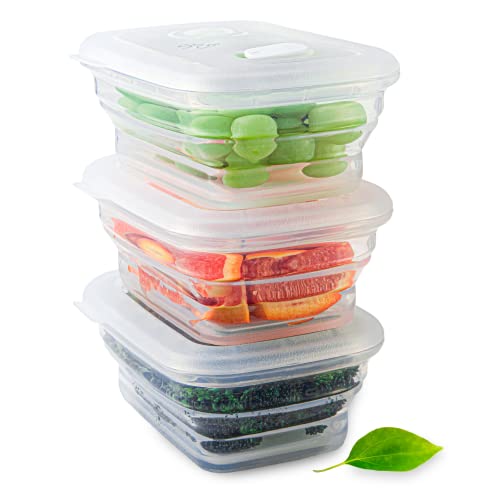 |
Premium Silicone Collapsible Food Storage Containers withSustainable Containables | Also great | Collapsible silicone containers, 2.8 cups each | $39.99
Price as of 10 Oct 2026
|
View |
 |
HIBINO Stainless Steel Bento Box | 1200ml Leakproof LunchHIBINO | Our pick | 1200ml stainless steel bento box with divider | $29.99
Price as of 10 Oct 2026
|
View |
 |
Insulated Meal Prep Lunch Box with 6 Containers, 2 IceThinkFit | Upgrade pick | Insulated lunch box with 6 containers | $47.95
Price as of 10 Oct 2026
|
View |
 |
Snuvid 4 Pack 8 Cups/ 63oz Large Glass Storage ContainersSnuvid | Pair with it | 4-pack glass containers, 63 oz each | $29.99
Price as of 10 Oct 2026
|
View |
The core trade-off is simple: glass gives you better reheating and stain control, while plastic gives you lower weight and lower upfront cost. For Ramadan, the right answer is usually a mixed system, because suhoor, iftar leftovers, and soup storage do not ask for the same container.
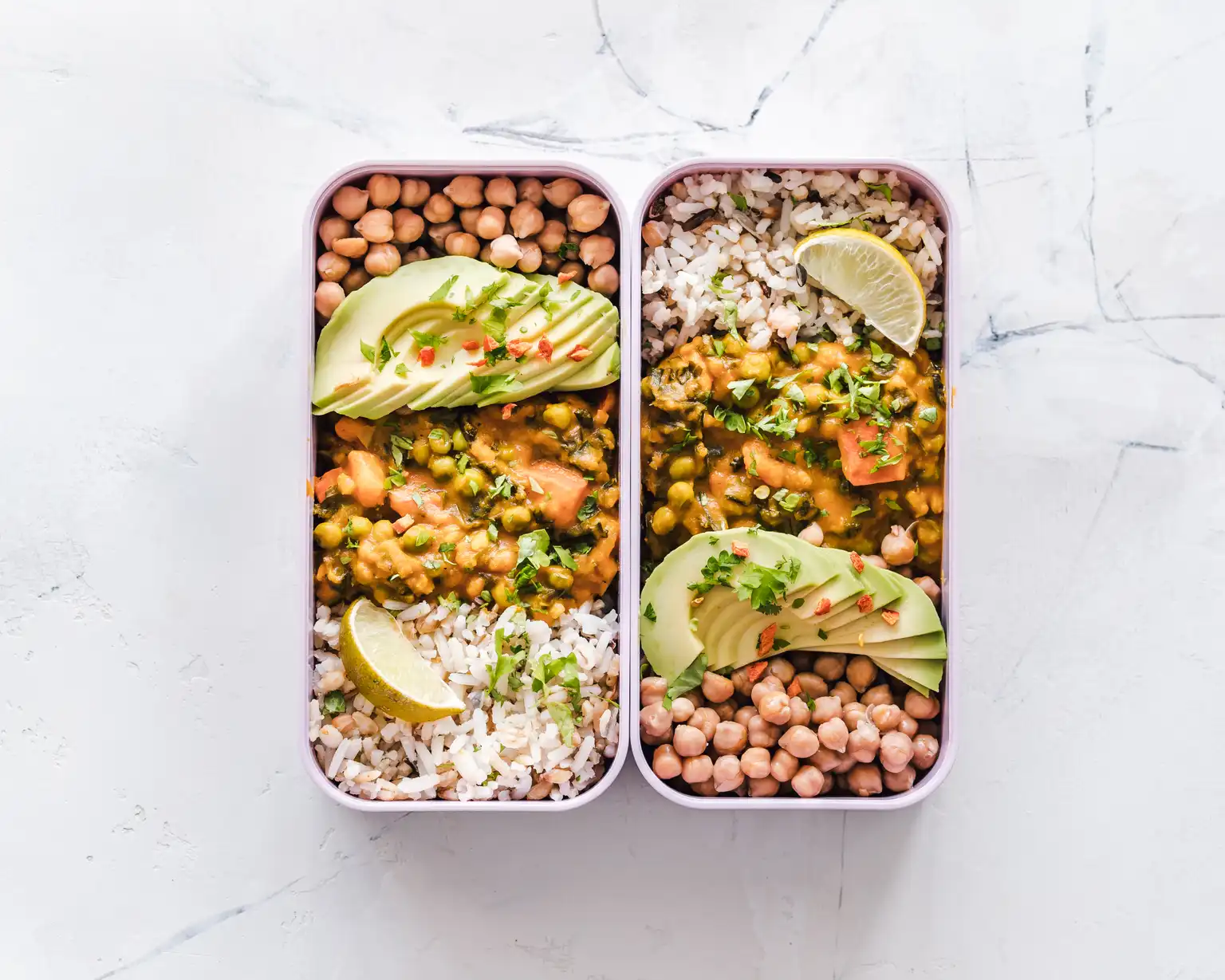
How we chose
The shortlist is built around the parts of Ramadan prep that fail first: leaking curry, lid fatigue, fridge crowding, and containers that do not fit the menu. The main filters were airtight sealing, size range, stackability, reheating compatibility, and how well each option handles repeated wash cycles.
Airtight seal and leak resistance
Curries, soups, and sauces punish weak lids. A good seal keeps liquid from spreading across shelves and stops rice from drying out too quickly.
Size range for Ramadan foods
A useful range may start around 200 ml and go up to about 2.0 L. That covers dates, sauces, rice, soup, and family leftovers without forcing you into one oversized shape.
Stackability and fridge fit
Rectangular and square containers save more shelf space than round ones. Flat lids and clear bases make it easier to stack, spot contents, and avoid forgotten leftovers.
Reheating compatibility and cleanup
Glass is easier for microwave reheating and usually resists odor and stain buildup better. Plastic still matters when you need lighter weight or lower replacement cost.
Are glass or plastic containers better for Ramadan leftovers?
Glass is better for Ramadan leftovers if you reheat often, store tomato-heavy curries, or want cleaner odor control. Plastic is better if you need lighter containers, a lower starting cost, and a set that is easier to carry in larger numbers.
Glass: stain control, odor resistance, and microwave use
Borosilicate glass is the practical choice for curry, tomato sauces, and rice because it resists staining and does not hold onto odor the way some plastics do. It is also microwave-friendly, and many glass sets are oven-safe when the lids are removed.
The downside is weight. Glass is heavier than plastic, and break risk matters if you stack too high, place containers near the sink, or send food along with a busy household.
Plastic: lighter weight, lower upfront cost, and wear over time
BPA-free polypropylene or Tritan plastic works well for light storage, snack portions, and school or work lunches. It is easier to carry and cheaper to buy in larger counts, which helps when you need many pieces for a family.
The weak points are warping, clouding, and odor retention over time. Repeated microwave use or high heat can shorten the life of the lid and body, especially if the plastic is thin.
What size containers do you need for Ramadan meal prep?
For Ramadan meal prep, many people use small containers for dates, sauces, and snacks, medium containers for rice and chopped vegetables, and larger containers for soup and family leftovers. That spread covers the common food types without wasting headspace.
200 ml to 500 ml for dates, sauces, and snack portions
Dates, chutneys, mint sauce, yogurt dips, and small snack portions fit best in the small range. A 250 ml to 500 ml container is usually enough for a few dates or a single dip portion.
700 ml to 1.4 L for rice and chopped vegetables
Rice needs a medium rectangle, not a tiny deli cup. The useful range is about 700 ml to 1.4 L, which gives enough room for cooked rice, roasted vegetables, and mixed salad prep without squashing the contents.
1.0 L to 2.0 L for soup and family leftovers
Soup needs depth, not a shallow lid profile. A 1.0 L to 2.0 L container is the safer pick for broth, lentil soup, and larger curry portions because it reduces spill risk and gives you room for reheating.
Rectangular glass containers: best for iftar leftovers
Rectangular glass containers are the workhorses for iftar leftovers because they stack cleanly, reheat well, and handle sauces without taking on stains or odor. They are the most reliable choice for curries, rice, and other mixed mains that move from fridge to microwave often.
Best foods
Use rectangular glass for curry, rice, tomato sauces, cooked vegetables, and mixed mains. Glass is especially useful when a dish has oil, spice, or acidity that can leave a mark on plastic.
Watch-outs
The main drawback is weight. Break risk is also real, especially for deep containers filled with soup or for shelves packed too tightly.
BPA-free plastic containers: best for budget batch cooking
BPA-free polypropylene or Tritan plastic is the practical pick when cost, weight, and quantity matter more than long-term stain control. It works well for suhoor prep, chopped produce, and lighter leftovers that do not need oven use.
Best foods
Plastic is useful for chopped cucumbers, herbs, fruit, dry snacks, and lighter meal-prep portions. It is also easier to buy in larger counts if you cook for several people.
Watch-outs
Plastic can warp, cloud, or hold odors after repeated heat and wash cycles. Lid fit can also loosen sooner than the container body, which matters when the same box is used for soup one night and rice the next.
Ramadan container sizing matrix
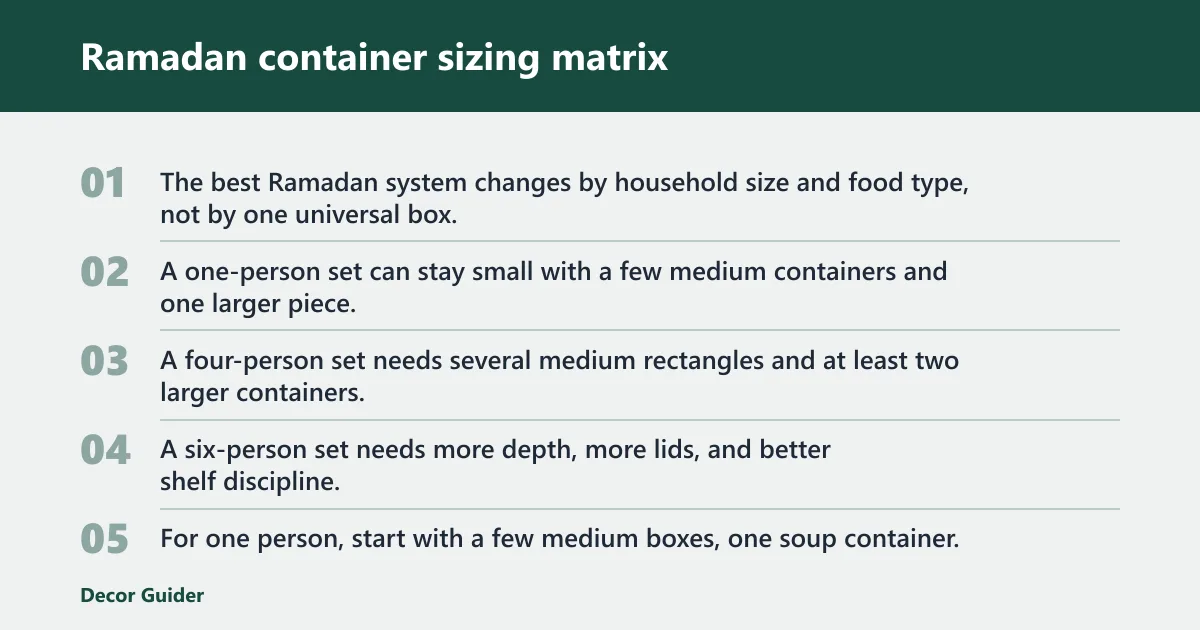
The best Ramadan system changes by household size and food type, not by one universal box. A one-person set can stay small with a few medium containers and one larger piece. A four-person set needs several medium rectangles and at least two larger containers. A six-person set needs more depth, more lids, and better shelf discipline.
| Food | Recommended volume | Recommended shape | Lid style | One-person household | Four-person household | Six-person household | Likely failure point |
|---|---|---|---|---|---|---|---|
| Dates | 250 ml to 500 ml | Small square or rectangle | Flat airtight lid | 1 to 2 small boxes | 2 to 3 small boxes | 3 to 4 small boxes | Lid looseness after frequent opening |
| Sauces | 200 ml to 400 ml | Small rectangular cup | Tight seal with low-profile lid | 1 to 2 cups | 3 to 4 cups | 4 to 6 cups | Leak at corners or rim |
| Rice | 700 ml to 1.4 L | Medium rectangle | Stackable flat lid | 2 boxes | 4 to 6 boxes | 6 to 8 boxes | Drying if lid does not seal tightly |
| Soup | 1.0 L to 2.0 L | Deeper rectangle | Leak-resistant lid with durable seal | 1 large box | 2 to 3 large boxes | 3 to 4 large boxes | Spill risk from shallow walls |
| Family leftovers | 1.4 L to 2.0 L | Large rectangle | Matching lid, flat profile | 1 large box | 2 large boxes | 3 to 4 large boxes | Fridge overflow and lid mismatch |
| Chopped vegetables | 600 ml to 1.0 L | Square or rectangle | Standard airtight lid | 1 to 2 boxes | 2 to 4 boxes | 4 to 6 boxes | Clutter from too many odd sizes |
One-person household map
For one person, start with a few medium boxes, one soup container, and one small set for sauces and dates. That keeps the fridge from filling with half-used sizes.
Four-person household map
A four-person household needs several medium rectangles for rice and curry plus at least two larger boxes for soup or family leftovers. This is the point where matching lids and flat stacking matter most.
Six-person household map
A six-person setup benefits from a mixed system with more large containers and more shallow medium rectangles. Without that, fridge turnover gets messy fast, and leftovers start competing for shelf height.
Likely failure points by food type
Soup fails when the container is too shallow. Rice fails when the seal is loose and the surface dries out. Curry fails when the lid warps or the plastic keeps the smell. Dates and snacks fail when you buy boxes that are too large and waste space.
What are the best meal prep containers for Ramadan iftar planning?
The best meal prep containers for Ramadan iftar planning are a mixed set built around rectangular glass, supported by smaller plastic or glass pieces for snacks and sauces. The best system is the one that matches how you actually cook: daily iftar leftovers, weekly batch prep, or guest-service overflow.
Why workflow matters more than material alone
Nightly iftar cooking needs quick fridge turnover and easy reheating. Weekly batch prep needs larger boxes and lid durability. Guest-service storage needs clean presentation and enough size to hold extra portions without cramming.
A common first-timer mistake is buying one large box size for everything. A 2.0 L container is wrong for dates. A 250 ml cup is wrong for soup.
What the best system looks like
The strongest Ramadan setup includes glass, plastic, and deeper soup containers. That mirrors the actual menu: rice, curry, soup, dates, and a few smaller snack boxes.
How many containers should you buy for Ramadan batch cooking?
A good Ramadan set is usually 12 to 18 pieces with three sizes. That gives you enough room for suhoor prep, iftar leftovers, and a few backup boxes without filling every cabinet shelf. If you cook for more people, the count should rise with the number of repeated dishes.
Use the menu to set quantity
Soup-heavy kitchens need more deep containers. Rice-heavy kitchens need more medium rectangles. Snack-heavy kitchens need more small boxes for dates, sauces, and cut fruit.
Plan for replacements
Lids usually fail before the container body. Replacing a lid is cheaper than replacing a full set, but only if the lid is still available. Matching lids matter for that reason, especially in mixed systems.
Do airtight lids matter for Ramadan meal prep containers?
Yes. Airtight lids matter because curry, soup, and sauces are the foods most likely to leak, dry out, or spread smell through the fridge. A tight seal with a flat profile saves space and reduces the chance of spill cleanup.
What to look for in a lid
A good lid should lock tightly, sit flat for stacking, and survive repeated wash cycles without bending or cracking. If the seal weakens after a few weeks of use, the container stops being reliable for soup and curry.
Common lid failures
Lid fatigue shows up as loose corners, warped edges, or a seal that no longer clicks into place. The result is often a leaking soup container or a fridge shelf with curry drips underneath the box.
What containers work best for small Ramadan kitchens?
Small Ramadan kitchens need rectangular or square containers with flat lids, clear bases, and nesting when empty. Those features save shelf height, make stacking easier, and stop the fridge from filling with awkward gaps.
Space-saving features that matter most
Rectangular containers are easier to line up than round ones. Clear bases help you see what is inside. Nesting helps when the containers are empty and waiting for the next batch cook.
When compact storage beats volume
If you have a small fridge, a few well-sized rectangles work better than a drawer full of mismatched shapes. Flat lids matter because they let you stack another box on top instead of losing vertical space.
Choose Skroam if… / Choose Snuvid if…
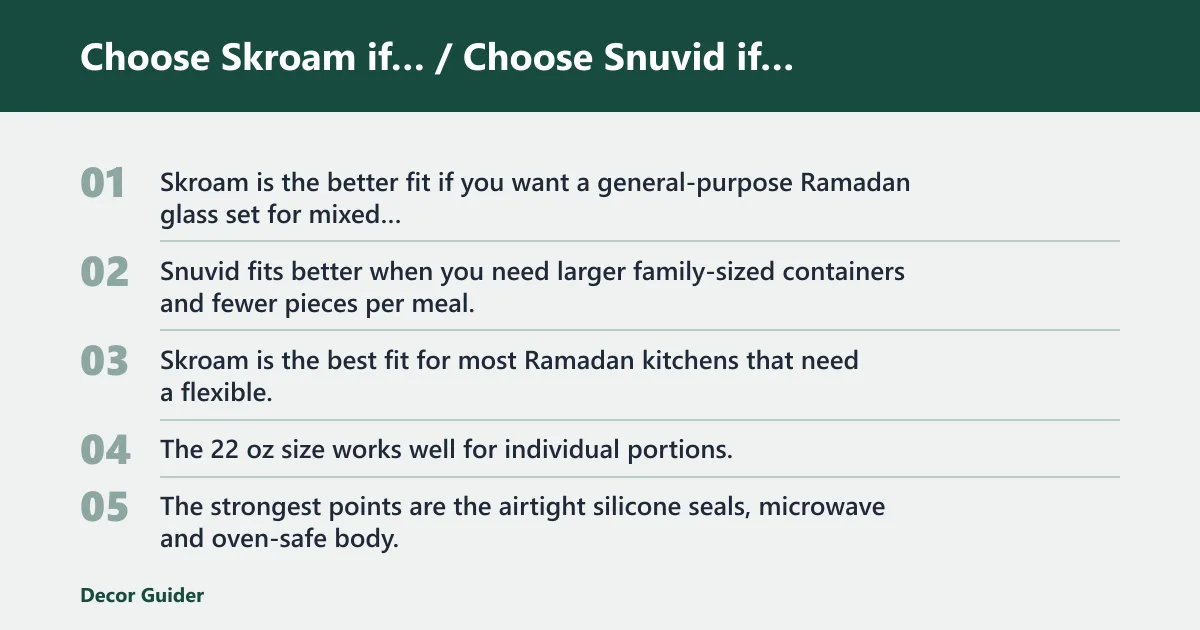
Skroam is the better fit if you want a general-purpose Ramadan glass set for mixed leftovers, rice, and smaller meal-prep portions. Snuvid fits better when you need larger family-sized containers and fewer pieces per meal.
| Criterion | Skroam 10 Pack Glass Meal Prep Containers | Snuvid 4 Pack 8 Cups Large Glass Storage Containers |
|---|---|---|
| Best use | Mixed iftar leftovers, lunches, smaller portions | Family leftovers, batch cooking, larger reheats |
| Capacity profile | 22 oz each | 63 oz each |
| Space efficiency | Stackable design saves fridge space | Larger boxes use more shelf area per piece |
| Reheating | Microwave and oven-safe, lids excluded | Oven, microwave, and dishwasher-safe |
| Honest drawback | Smaller size can mean more pieces for soup-heavy plans | Fewer pieces and larger footprint can be awkward in small fridges |
Skroam 10 Pack Glass Meal Prep Containers: best for mixed iftar leftovers
- Stackable design saves fridge space
- Airtight silicone seals prevent leaks
- Microwave and oven-safe (lids excluded)
Skroam is the best fit for most Ramadan kitchens that need a flexible, rectangular glass set for rice, curry, and everyday leftovers. The 22 oz size works well for individual portions, and the stackable design helps with fridge turnover after iftar.
The strongest points are the airtight silicone seals, microwave and oven-safe body, and the space-saving shape. Based on the spec sheet and reviews, this is the most balanced option when you want a glass-first system without jumping straight to oversized family tubs.
The drawback is capacity. One 22 oz container is not enough for soup-heavy households or for large family leftovers, so you may still need deeper pieces alongside it.
Sustainable Containables Premium Silicone Collapsible Food Storage Containers: best for compact storage
- Collapses to 50% size for compact storage
- BPA-free, food-grade platinum silicone
- Wide temperature range compatibility
This set is for kitchens where empty storage space matters as much as filled storage space. The collapsible design cuts down cabinet clutter, and the BPA-free, food-grade platinum silicone build helps when you want a compact lunch or snack box.
Its clear strength is folding down to half size, which is useful in a small kitchen with limited drawer space. It is also microwave safe and light to carry.
The drawback is that collapsible containers are not the best primary choice for rice-heavy or soup-heavy Ramadan menus. They are better as support pieces than as the main iftar system.
HIBINO Stainless Steel Bento Box: best for dry bento-style suhoor
- Large capacity for varied iftar meals
- Leakproof design with silicone seal
- Dishwasher-safe and durable
HIBINO is a workable pick for dry, divided suhoor meals, especially when you want one box for multiple items. The 1200 ml capacity is enough for a filling lunch-style meal, and the divider helps keep components separate.
The strength here is durability and a leakproof silicone seal. Dishwasher-safe stainless steel also appeals if you want a hard-wearing box for repeat use.
The drawback is obvious for Ramadan leftovers: stainless steel is not microwave-friendly, so it is a weaker fit for curry and rice that you plan to reheat in the same container.
ThinkFit Insulated Meal Prep Lunch Box with 6 Containers: best for transport-heavy schedules
- Double insulation keeps meals hot/cold
- Includes ice packs and shaker cup
- Portion-controlled containers with tight seals
ThinkFit makes sense when the food needs to travel and stay at temperature. The insulated outer box and included ice packs are useful for carrying multiple portions, not for stacking a full Ramadan fridge.
It is the most transport-oriented option in this list. The portion-controlled containers and tight seals help if you pack suhoor or iftar for work, travel, or long commutes.
The drawback is bulk. Insulated systems take more room than simple stackable glass containers, so they are less efficient for a small Ramadan kitchen that depends on fridge turnover.
Snuvid 4 Pack 8 Cups Large Glass Storage Containers: best for family leftovers
- Large family-sized storage capacity
- Oven, microwave, and dishwasher-safe
- Airtight lock prevents spills
Snuvid is the right glass set when your Ramadan cooking leans toward large family portions, extra curry, or soup that needs depth. The 63 oz size is much better for bulk leftovers than a small lunch box.
Its strengths are family-sized capacity, oven and microwave compatibility, and the airtight lock that helps prevent spills. That makes it useful for batch-cooked iftar trays and heavier dishes.
The drawback is size. Four large containers can be too much for small fridges or single-person meal prep, and the larger footprint makes spacing more important.
What is the best container system for batch-cooked iftar and suhoor?
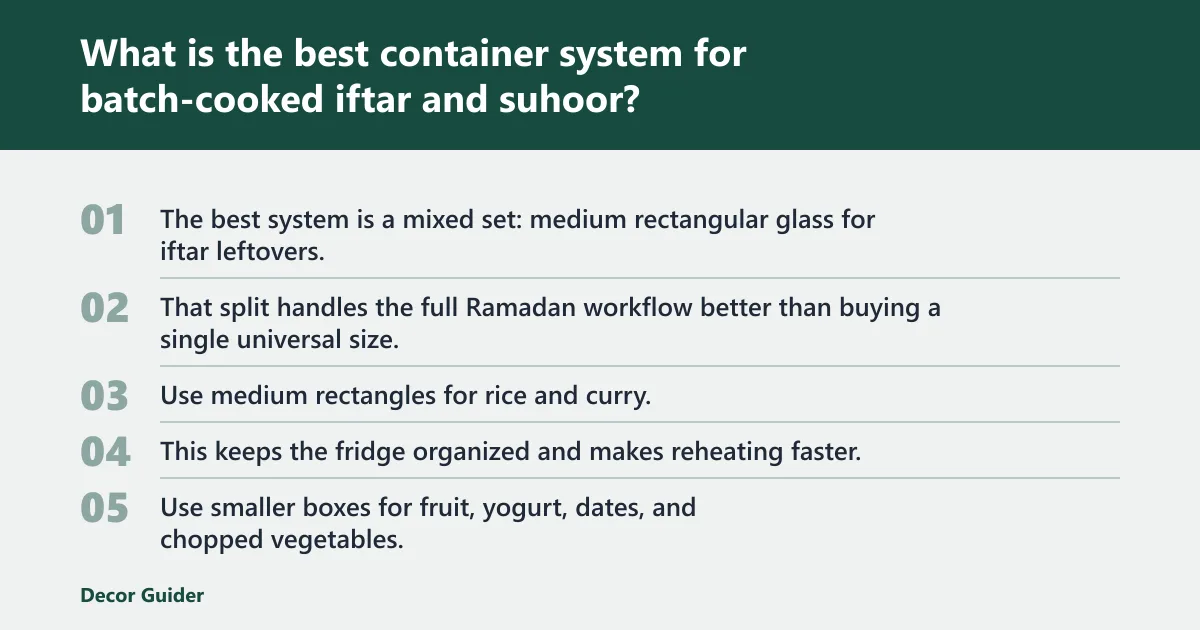
The best system is a mixed set: medium rectangular glass for iftar leftovers, small containers for dates and sauces, and one or two deeper containers for soup. That split handles the full Ramadan workflow better than buying a single universal size.
For batch-cooked iftar
Use medium rectangles for rice and curry, then reserve deeper containers for soup and extra gravy. This keeps the fridge organized and makes reheating faster.
For suhoor
Use smaller boxes for fruit, yogurt, dates, and chopped vegetables. Suhoor portions are usually lighter, so smaller containers reduce waste and keep the fridge from clogging.
For guest-service storage
Keep at least one large rectangle ready for overflow. Guest portions often need a box that is larger than a normal dinner portion but still flat enough to stack.
Which one should you buy
Buy glass if you reheat leftovers often, cook tomato-based curry, or want better stain and odor control. Buy plastic if you need light, low-cost storage and plan to buy in larger counts. Buy a mixed set if your Ramadan week includes rice, curry, soup, dates, and snack prep in the same fridge.
If you have a small kitchen, start with rectangular glass in the medium range and add a few small plastic boxes for sauces and dates. If your menu is soup-heavy, prioritize deeper containers before buying extra snack boxes. If your family size is four or more, increase the count of medium rectangles before adding specialty pieces.
Frequently asked questions
What are the best meal prep containers for Ramadan iftar planning?
The best containers for Ramadan iftar planning are rectangular, airtight, stackable boxes with matching lids and clear bases. A mixed set works better than one universal size because rice, curry, soup, dates, and snacks all need different volumes and different lid heights.
What size containers do I need for Ramadan meal prep?
Use 250 ml to 500 ml for dates and snacks, 200 ml to 400 ml for sauces, 700 ml to 1.4 L for rice, and 1.0 L to 2.0 L for soup or larger leftovers. That range covers most iftar and suhoor prep without filling the fridge with oversized boxes.
Are glass or plastic containers better for Ramadan leftovers?
Glass is better for reheating, stain control, and odor resistance. Plastic is better if you need lighter containers and a lower upfront cost. For most Ramadan kitchens, glass should handle the core leftovers, while plastic can cover lighter prep and extra portions.
How many containers should I buy for Ramadan batch cooking?
A practical starting point is 12 to 18 pieces in three sizes. That count gives you enough room for repeated iftar cooking, suhoor prep, and leftovers without forcing you to wash and reuse the same box before the next meal is ready.
What container size is best for rice, curry, and soup?
Rice fits best in medium rectangles around 700 ml to 1.4 L. Curry usually does well in similar medium boxes if the lid seals tightly. Soup needs deeper containers, roughly 1.0 L to 2.0 L, to reduce spill risk and leave room for reheating.
Do airtight lids matter for Ramadan meal prep containers?
Yes. Airtight lids matter because they reduce leaks, keep curry and soup from spreading smells, and help food stay covered in the fridge. Look for a tight seal, a flat profile for stacking, and lids that keep working after repeated wash cycles.
Products related to this article
Sponsored / affiliate links. As an Amazon Associate I earn from qualifying purchases. I may earn additional commission from eligible campaigns.