Glass Cookware vs Ceramic Bakeware
Choose Glass Cookware when you want to watch browning and often get faster, more direct heat at the edges; choose Ceramic Bakeware when you want steadier baking and a better presentation at the table. Pick the wrong pan, and you can get overbrowned edges, underdone centers, or a dish that cracks from thermal shock. This guide compares Glass Cookware and Ceramic Bakeware by dish type, bake result, and safe temperature limits.
Heat response and retention differences
| Decision factor | Glass Cookware | Ceramic Bakeware | Winner |
|---|---|---|---|
| Heat response | Faster heat response; edges can brown sooner | Slower, steadier heating; less abrupt edge browning | Glass Cookware |
| Heat retention | Loses heat sooner after removal | Retains heat well and keeps food warm longer | Ceramic Bakeware |
| Visibility and serving | Clear sides let you monitor some doneness cues | Usually chosen for oven-to-table presentation | Tie |
| Thermal shock risk | Sensitive to sudden temperature changes | Also sensitive to sudden temperature changes | Tie |
| Best-fit use case | Brownies, fruit crisps, fridge-cold bakes you can manage carefully | Lasagna, casseroles, table-serving dishes, reheats that need warmth | Depends on dish |
Heat response
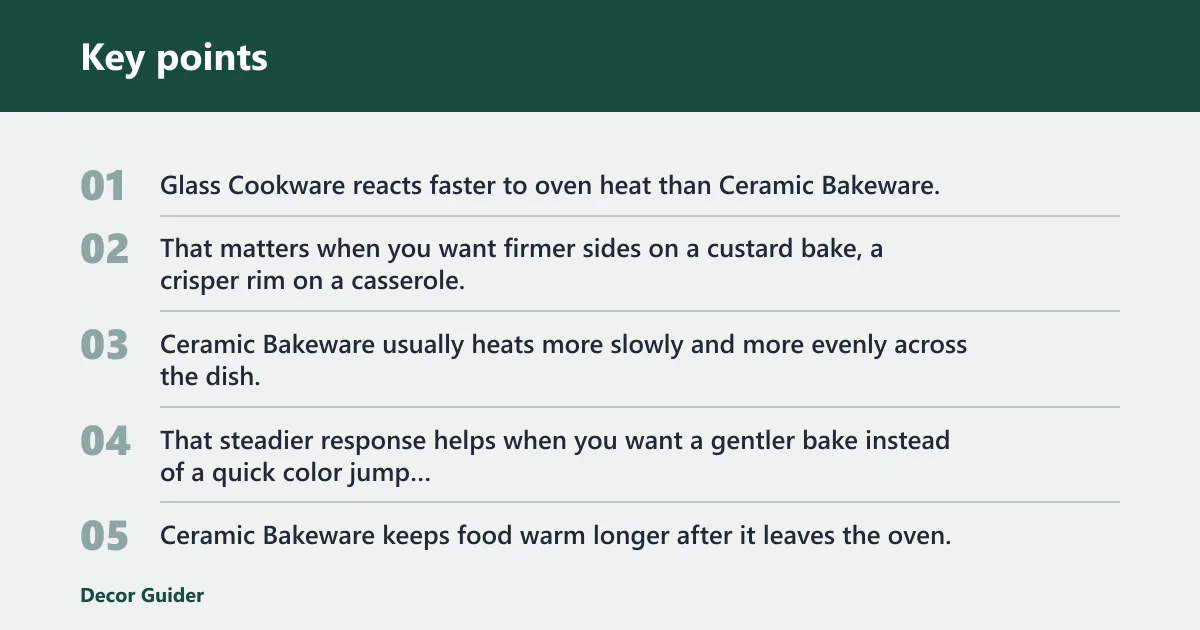
Glass Cookware reacts faster to oven heat than Ceramic Bakeware, so it can push edge browning sooner. That matters when you want firmer sides on a custard bake, a crisper rim on a casserole, or a clearer read on how fast the surface is setting.
Ceramic Bakeware usually heats more slowly and more evenly across the dish. That steadier response helps when you want a gentler bake instead of a quick color jump at the perimeter.
Heat retention
Ceramic Bakeware keeps food warm longer after it leaves the oven. That makes it a better fit for dishes that go straight to the table or sit for a few minutes before serving.
Glass Cookware cools sooner, which can help stop cooking sooner, but it gives you less carryover warmth. For a dish where continued heat matters, ceramic usually has the edge.
Visibility and serving
Glass Cookware is clear, so you can see the food through the sides, which helps with some bake cues. That is useful for checking how far the edges have set without opening the oven as often.
Ceramic Bakeware usually wins on presentation. It comes in many colors and patterns, and it is often the natural choice when the same dish moves from oven to table.
Thermal shock risk
Both materials can crack with sudden temperature changes. That includes taking a cold dish straight into a very hot oven, moving a hot pan to a cold sink, or setting heated bakeware into a cold water bath.
The practical rule is simple: avoid abrupt temperature swings unless the maker explicitly allows that use. For Glass Cookware, that warning matters most with freezer-to-oven and wet-sink cooling mistakes.
How each material affects bake outcomes
The real difference is not “good” versus “bad.” It is whether you want faster edge color, steadier heat, or a warmer finish at serving time. That choice changes the failure mode you are most likely to avoid.
Glass Cookware
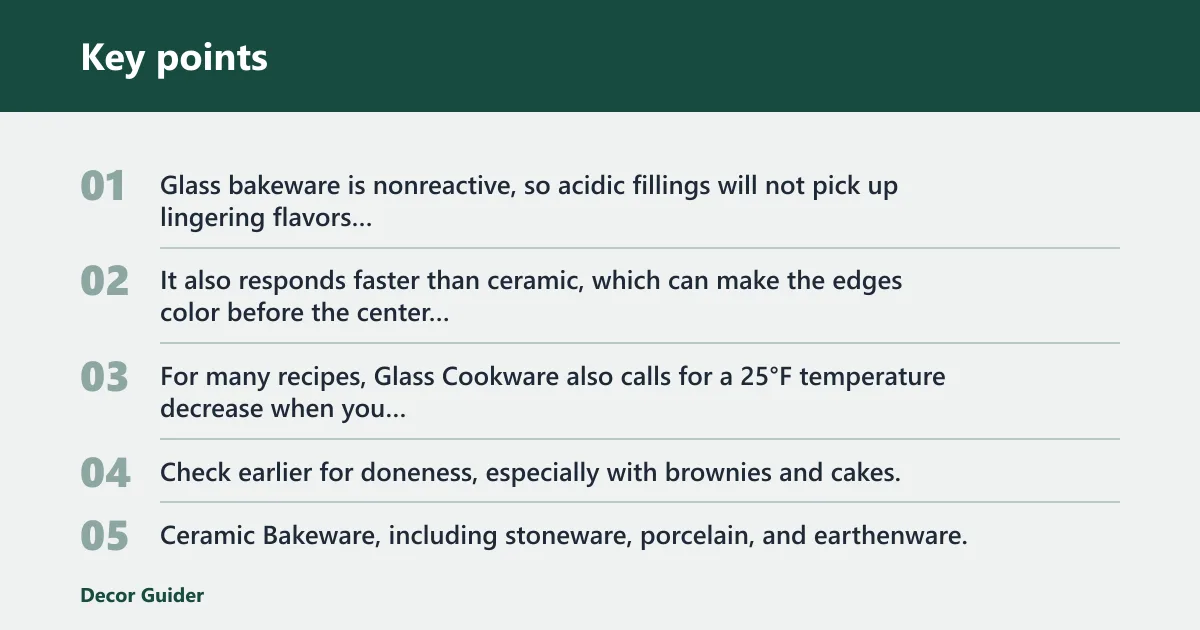
Glass bakeware is nonreactive, so acidic fillings will not pick up lingering flavors from the pan. It also responds faster than ceramic, which can make the edges color before the center is fully set if the recipe already runs hot.
For many recipes, Glass Cookware also calls for a 25°F temperature decrease when you substitute it for metal bakeware. Check earlier for doneness, especially with brownies and cakes, because the faster heat response can change timing.
Ceramic Bakeware
Ceramic Bakeware, including stoneware, porcelain, and earthenware, tends to bake with a slower, steadier heat pattern. That can reduce abrupt edge browning and support a more even finish on casseroles, lasagna, and baked pasta dishes.
It also holds heat well after baking, which helps with carryover cooking and table service. The trade-off is weight and sensitivity to sudden temperature changes, so the maker’s guidance matters more than any generic rule.
Why that matters for doneness and crust texture
If your main problem is overbrowned edges, the slower response of Ceramic Bakeware often helps. If your main problem is a pale surface or an under-read bake, Glass Cookware can give you a quicker visual cue and a faster color change.
Suppose a 9×13 lasagna goes into Glass Cookware and the top browns before the center is hot. That is a heat-response issue, not a sign that glass is always better or worse; it means the dish and the recipe need a better match.
Which one browns better?
Glass Bakeware usually browns faster than ceramic, especially at the edges where heat transfer is most direct. Ceramic can brown more steadily, but it is less likely to push color as quickly. The better choice depends on whether you want to avoid pale spots or avoid overbrowned edges.
When Glass Cookware browns faster
Glass Cookware is the better pick when a recipe benefits from earlier browning feedback, such as brownies or a fruit crisp with a topping that should color before the filling overcooks. The clear sides also help you notice when the edges have started to set.
When Ceramic Bakeware gives steadier browning
Ceramic Bakeware is the better fit when you want a more even, slower color change. That matters for casseroles and lasagna, where a too-fast edge can leave the middle behind.
Best material by dish type
- Brownies: Glass Cookware if you want earlier edge set and color; Ceramic Bakeware if your edges usually overbrown.
- Casseroles: Ceramic Bakeware for steadier heating and table service.
- Fruit crisps: Glass Cookware if you want to watch the topping brown; Ceramic Bakeware if the fruit tends to bubble unevenly at the edges.
- Lasagna: Ceramic Bakeware for warmth and serving; Glass Cookware if you want a clearer read on edge color and layering.
What temperature limits should you follow?
Follow the product label first. A generic ceiling is less useful than the maker’s limit, because bakeware construction, thickness, and glaze or tempering details vary by brand. A competitor guide may cite about 250°C, but that is not a universal instruction for every pan you own.
Broiler, microwave, and direct flame limits
Glass Cookware should never be used on the stovetop or under the broiler. That is a hard stop, not a gray area. Microwave use depends on the specific product label, so check the pan before putting it in a microwave oven.
Ceramic Bakeware is also label-dependent for microwave and broiler use. Some pieces are suitable for microwave heating, but that does not mean they are safe under direct broiler heat or sudden temperature shifts.
Glass substitution rule
When replacing metal bakeware with Glass Cookware, reduce the recipe temperature by 25°F and start checking earlier for doneness. That rule is especially useful for brownies, cakes, and other bakes that can dry out or brown too quickly at the edges.
- Check the pan label for the maximum allowed temperature.
- Lower the recipe temperature by 25°F if you are switching from metal to glass.
- Set a doneness check earlier than the recipe suggests.
- Stop using the pan if the recipe requires broiler heat or direct flame.
How do I use glass bakeware without thermal shock?
Use Glass Cookware only within its temperature limits and avoid sudden shifts. The main risk is not ordinary oven heat; it is the abrupt change from one extreme to another, such as freezer to hot oven or hot pan to cold sink.
Hot-to-cold and cold-to-hot transitions to avoid
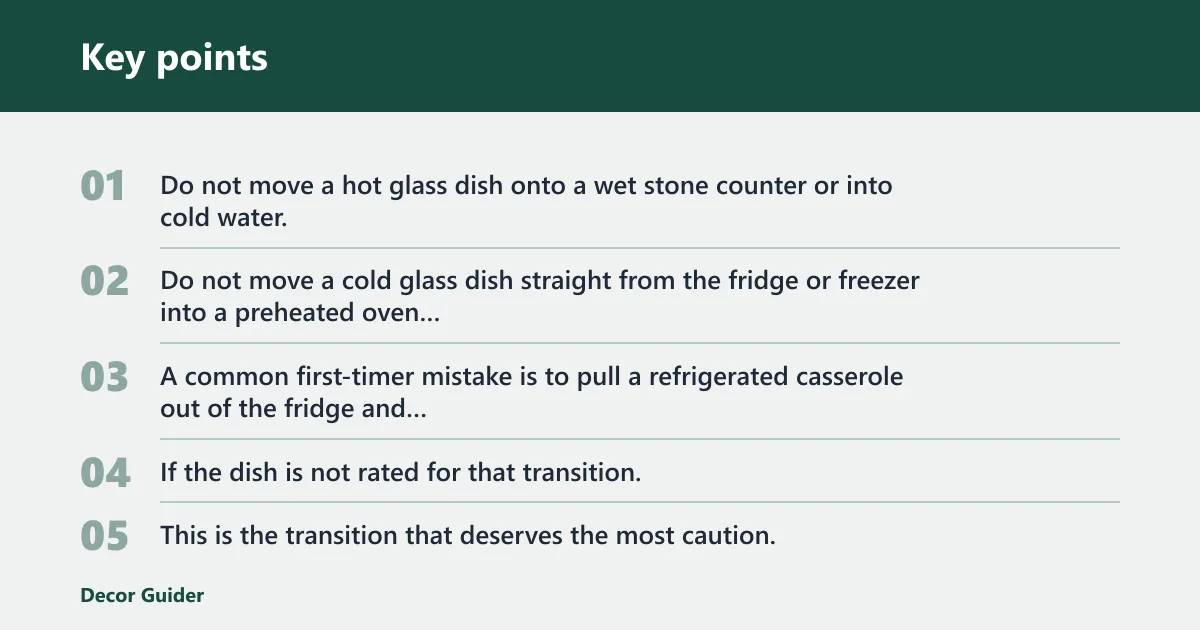
Do not move a hot glass dish onto a wet stone counter or into cold water. Do not move a cold glass dish straight from the fridge or freezer into a preheated oven unless the maker specifically allows that sequence.
A common first-timer mistake is to pull a refrigerated casserole out of the fridge and place it into a very hot oven without a brief temperature check. If the dish is not rated for that transition, cracking can happen before the center even warms.
Fridge-cold or freezer-cold dish going into a hot oven
This is the transition that deserves the most caution. Glass can shatter with extreme temperature changes, and that warning applies to both refrigerator-cold and freezer-cold starts.
Ceramic Bakeware is not automatically safe here either. Only use freezer-to-oven, fridge-to-oven, or similar shortcuts if the manufacturer states that the dish is rated for them.
Wet-sink cooling and other handling mistakes
Do not put heated Ceramic Bakeware in a cold water bath after baking. The same basic caution applies to Glass Cookware: sudden cooling can crack either material.
If you need to cool a dish quickly, let it lose heat gradually on a dry, room-temperature surface. That is slower, but it is far safer than forcing a sharp temperature drop.
Ceramic types that change the choice
Ceramic Bakeware is not one single thing. Stoneware, porcelain, and earthenware behave differently enough that the subtype can change the best pick for a dish.
Stoneware
Stoneware is a high-fired clay type that is dense and durable for normal oven use. It is a strong choice when you want good heat retention and a sturdier feel for casseroles or baked pasta.
Porcelain
Porcelain is finer, smoother, and usually more decorative and serving-friendly than the other ceramic types. It is often the best ceramic pick when the pan will stay on the table after baking.
Earthenware
Earthenware is lower-fired and tends to feel more rustic. It can chip more easily than denser ceramic types, so it is less forgiving in busy kitchens or in storage where pans bump together.
Glass bakeware types and limits
Most modern U.S. glass pans are soda-lime glass, according to one competitor guide. Vintage glass is often described as borosilicate, which handles heat changes better than soda-lime glass, but it still has temperature limits and should be treated carefully.
Tempered soda-lime glass
Tempered soda-lime glass is common in modern U.S. bakeware. It still carries thermal-shock risk, so freeze-to-oven claims need to come from the manufacturer, not from the material name alone.
Borosilicate glass
Borosilicate glass appears in some vintage or European pieces and is better at handling heat changes than soda-lime glass. Even so, it is not a license to ignore temperature limits or to use the pan under a broiler.
Common shapes
Glass Cookware often comes as 9×13 pans, pie dishes, and loaf pans. Those are the formats most home bakers reach for when the goal is a clear view of the sides and a bake you can monitor easily.
Choose Glass Cookware if… / Choose Ceramic Bakeware if…
Choose Glass Cookware if you want to watch browning, need a quicker heat response, or want a clear-sided pan for cakes, brownies, pies, and some casseroles. Choose Ceramic Bakeware if you want steadier heat, longer warmth at the table, or a more presentation-ready dish for lasagna and casseroles.
- Choose Glass Cookware if you need earlier edge browning, want a nonreactive pan for acidic fillings, or are making a bake where doneness cues matter early.
- Choose Ceramic Bakeware if you want heat retention, oven-to-table service, or a gentler bake that is less likely to color the rim first.
- Choose Glass Cookware if you are willing to lower the oven temperature by 25°F when substituting for metal and check doneness sooner.
- Choose Ceramic Bakeware if the dish will sit out for serving and the maker approves the temperature and handling you plan to use.

Glass Cookware vs Ceramic Bakeware decision matrix
| Dish type | Likely failure mode | Best material |
|---|---|---|
| Lasagna | Top browns before the center is hot | Ceramic Bakeware |
| Brownies | Edges overbake before the middle sets | Glass Cookware |
| Fruit crisps | Topping colors unevenly or filling stays pale at the edges | Glass Cookware |
| Casseroles | Heat feels uneven or dish cools too fast at the table | Ceramic Bakeware |
| Reheats | Food loses warmth too quickly after removal | Ceramic Bakeware |
| Fridge-cold bakes | Thermal shock from a cold pan entering a hot oven | Tie; only use the pan if the maker allows that transition |
| Table-serving dishes | Pan looks plain or food cools too quickly | Ceramic Bakeware |
If/then rule: If you most want to avoid overbrowned edges, choose the material with the steadier heat pattern; if you most want to avoid a cool, fast-losing finish at the table, choose the material with stronger heat retention.
Frequently asked questions
Is glass or ceramic better for baking?
Glass Cookware is better when you want faster heat response and clearer side visibility. Ceramic Bakeware is better when you want steadier heat and longer warmth after baking. The right pick depends on whether your biggest problem is edge browning, carryover cooking, or table service.
What is the difference between glass vs ceramic baking dish?
Glass is nonreactive, clear, and usually faster to react to oven heat. Ceramic is clay-based with a glaze, heavier, and better at holding heat. Ceramic also includes stoneware, porcelain, and earthenware, which are not identical in weight or chip resistance.
Will glass bakeware brown faster than ceramic?
Yes, Glass Cookware often browns faster than Ceramic Bakeware. That can help with color and doneness cues, but it can also push edge browning ahead of the center. If you switch from metal to glass, a 25°F temperature drop is the common rule of thumb.
Does ceramic bakeware hold heat better than glass?
Yes, Ceramic Bakeware generally holds heat better than Glass Cookware and keeps food warm longer. That makes it useful for casseroles, lasagna, and serving dishes where the food will sit at the table. It does not mean the dish is safe for sudden temperature changes.
Can I use ceramic bakeware like glass bakeware?
Not always. Ceramic Bakeware may look similar in the oven, but it is not automatically safe for the same temperature swings, broiler use, or fridge-to-hot-oven moves. Follow the maker’s instructions for microwave, oven, and serving use before treating it like glass.
Products related to this article
Sponsored / affiliate links. As an Amazon Associate I earn from qualifying purchases. I may earn additional commission from eligible campaigns.
 Ipetboom Heavy Duty Secure Lock for Glass Doors and Drawers, Stainless Steel Cabinet Lock Kit with Sturdy Structure and Efficient Use, for Home and Office Security
 Christmas Tree Forest Ornament Round Ceramic Ornament Star Snowflake Xmas Keepsake for Christmas Tree Winter Holiday Xmas Gift for Women Men Xmas Hanging Ornament 3"