Pedestal Vs Table Fan: Which Cools Better?
It’s a hot day. You’re trying to get some relief. You look at your fans.

Amazon Basics
Amazon Basics 16" Pedestal Fan with Remote…
- OPTIMIZED DESIGN FOR MEDIUM TO LARGE ROOMS: This 16-inch pedestal fan with remote effectively circulates air in spaces like living…
- ENERGY-EFFICIENT QUIET OPERATION: Featuring an advanced AC motor, this electric fan delivers airflow using only 60 Watts
- CUSTOMIZED COMFORT WITH 3 SPEEDS: Enjoy personalized comfort with 3 speed settings and 3 breeze modes on this cooling fan(nature,…
As an Amazon Associate I earn from qualifying purchases.
For a closely related home or decor topic, How To Repaint A Ceiling Fan: Effortless gives readers a useful next step.
You have a pedestal fan. You have a table fan. Which one will do a better job?
This is a common question. Many people wonder about the difference. They want to know which fan cools best.
Let’s break it down.
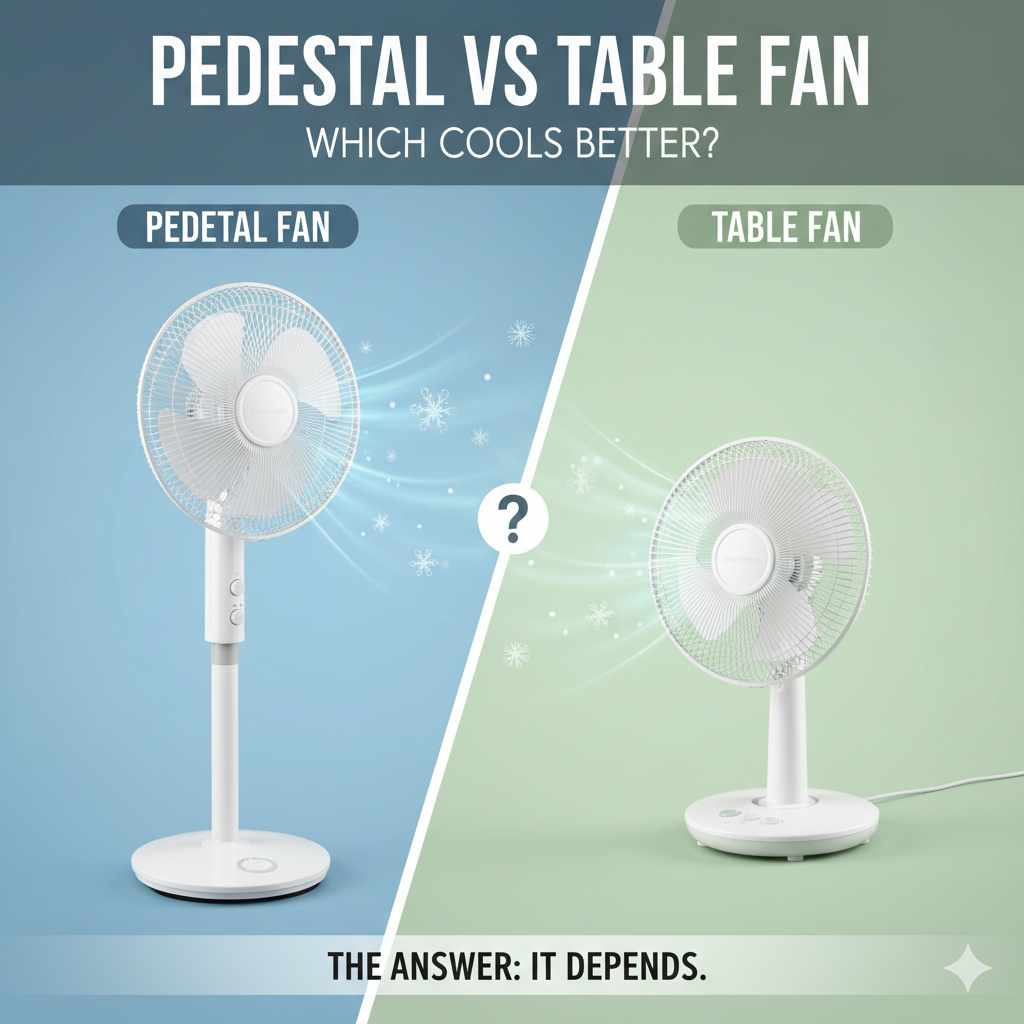
The best fan for cooling depends on your specific needs, space, and desired airflow. Pedestal fans generally offer wider coverage and better air circulation for larger rooms, while table fans are ideal for personal cooling and smaller spaces. Both are effective in their own right.
Pedestal Fan vs. Table Fan: Understanding the Basics
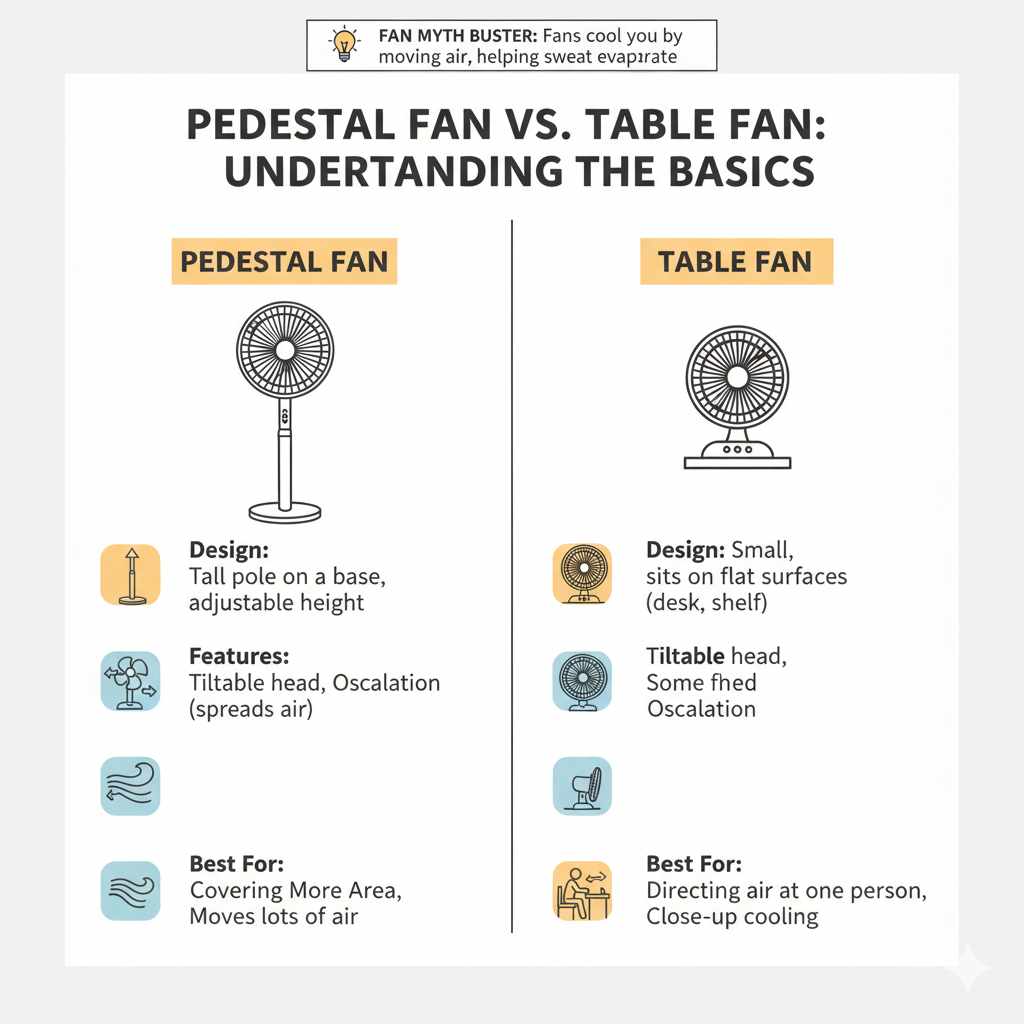
Fans don’t actually make the air cooler. That’s a common myth. They help you feel cooler.
They do this by moving air around. This moving air helps sweat evaporate from your skin. Evaporation is a cooling process.
The faster your sweat evaporates, the cooler you feel. So, a fan’s job is to create airflow. This airflow makes your body’s natural cooling work better.
A pedestal fan stands on a tall pole. This pole sits on a base. The fan head is at the top of the pole.
This design lets you adjust the fan’s height. You can also usually tilt the head. Many pedestal fans have oscillation.
This means the fan head turns back and forth. This spreads the air around a room. They are good for covering more area.
They can move a lot of air.
A table fan is much smaller. It sits on a flat surface. This could be a table, desk, or shelf.
The fan head is usually mounted on a short, sturdy base. Like pedestal fans, many table fans can tilt. Some also oscillate.
Because they are smaller, they are best for directing air at one person. They are good for close-up cooling. Think of cooling just you at your desk.
Or cooling yourself on the couch.
How Airflow and Coverage Differ
The main difference in cooling ability comes down to airflow and coverage. This is where the design really matters. Let’s look at the numbers and feel of it.
Fan Specs to Watch
Blade Size: Bigger blades often move more air. This means more cooling effect.
Motor Power: A stronger motor can spin blades faster. Faster spinning means more wind.
Oscillation: This feature spreads the air. It helps cool a wider area. A wider swing means better room coverage.
CFM Rating: This means Cubic Feet per Minute. It measures how much air the fan moves. Higher CFM is better for cooling a space.
Pedestal fans generally have larger blades. They also have more powerful motors. This means they can push more air.
They can push it further. The height of a pedestal fan is key. It lets the air flow at head height or higher.
This is often the most effective level for cooling people. It helps the air circulate throughout the room. Imagine a gentle breeze filling a whole space.
That’s what a good pedestal fan aims for.
Table fans have smaller blades. Their motors are usually less powerful. This limits how much air they can move.
They also move it a shorter distance. They are designed to blow air in one general direction. You sit or stand directly in front of it.
This makes them perfect for personal cooling. You feel the breeze right on you. It’s like a focused personal air conditioner.
You don’t get the whole room cooled. But you get a strong, direct cool feeling.
So, for cooling a whole room, a pedestal fan is usually better. Its design allows for wider air distribution. For cooling just yourself, a table fan might be all you need.
It’s more direct and uses less space. Think about the size of the area you need to cool. This is the first big clue.
Energy Use and Efficiency
When we talk about cooling, we also think about power. How much electricity do these fans use? This is important for your bill.
It’s also good for the planet.
Generally, pedestal fans use more power than table fans. This is because they have bigger motors. They have larger blades to spin.
This takes more energy. However, they are also moving much more air. They are trying to cool a larger space.
So, the power usage is often justified by the job they do.
Table fans are small. They don’t need much power. They are very efficient for personal cooling.
If you just need a little breeze to feel comfy at your desk, a table fan is a great choice. It uses very little electricity for that job. It’s like using a small lamp instead of a big overhead light.
You use what you need.
It’s important to compare the CFM rating to the wattage. A fan with a high CFM rating that uses moderate wattage is very efficient. This means it moves a lot of air for the power it uses.
You can often find this info on the fan’s box or in its manual. Look for fans that are Energy Star certified. These are designed to be very efficient.
Energy Star Tips
Look for the Label: Energy Star certified fans meet strict energy efficiency guidelines.
Compare CFM/Watt: Higher CFM per watt means better efficiency.
Use a Smart Plug: This can help you track energy use. You can also set timers.
In many cases, a pedestal fan might use more watts per hour. But if it cools a whole room so you don’t need the air conditioner as much, it could save energy overall. A table fan uses very little energy.
But it only cools one person. So, the “best” choice for energy depends on what you need the fan to do.
Noise Levels: A Comfort Factor
Noise is a big factor for comfort. Some fans can be quite loud. This can be annoying.
It can disrupt sleep or work. Both pedestal and table fans can make noise. But the type of noise and how loud it is can differ.
Pedestal fans, especially powerful ones, can be louder. They have bigger motors and faster blades. The sound is often a deeper hum or a rushing wind noise.
Some people find this white noise soothing. Others find it distracting. The oscillation mechanism can also add a clicking or whirring sound.
Higher-end models often have quieter motors. They might also have blade designs that reduce noise.
Table fans can also be noisy. Smaller fans might have a higher-pitched whine. This can be more irritating to some ears.
Again, motor quality and blade design play a role. A well-made table fan can be very quiet on lower settings. On higher settings, even small fans will make some noise.
Quiet Fan Features
Brushless Motors: These are often much quieter than traditional motors.
Blade Shape: Aerodynamic blade shapes can reduce wind noise.
Multiple Speeds: Lower speeds are naturally quieter.
“Sleep” or “Whisper” Modes: Some fans have specific settings for very quiet operation.
If quiet operation is a top priority, look for fans that advertise “quiet” or “low noise” features. Read reviews from other users. They often comment on the noise level.
You can also use a sound meter app on your phone to get an idea of decibel levels if you’re really concerned.
For bedroom use, a quieter fan is usually preferred. For a workshop or garage, noise might be less of an issue. Think about where you will use the fan most often.
This will help you decide which noise level is acceptable.
Space and Portability
Where will the fan live? How often will you move it? These practical things matter.
Space and portability are big differences between these two fan types.
Pedestal fans take up more floor space. The base needs room. The tall pole means they are a visual presence.
They are not usually meant to be moved around a lot. While they have a base, moving them from room to room can be a bit of a chore. They are better suited for one location.
They can stand in a corner or by a couch.
Table fans are much more portable. They are small and lightweight. You can easily pick them up and move them.
This makes them super flexible. You can use one at your desk in the morning. Then move it to your bedside table at night.
You can take it to the kitchen while you cook. They fit on small surfaces. This is great if you live in an apartment or dorm.
Or if you have limited floor space.
Portability Checklist
Weight: How heavy is the fan? Can you lift it easily?
Size: Will it fit on your surfaces? Will it be in the way?
Cord Length: Is the power cord long enough to reach an outlet without an extension cord?
Handle: Some portable fans have a built-in handle for easier carrying.
If you need to cool different spots in your home at different times, a table fan is likely the better choice. If you just need one fan for one main area, a pedestal fan can be a great, space-efficient (on the floor) option. Consider the footprint of the fan.
The space it occupies on the floor or on a table.
Features to Consider
Beyond the basic function, fans come with lots of features. These can make them more useful and convenient.
Remote Control: This is a huge plus for pedestal fans. You can change speed or turn it off without getting up. This is great for movie nights or when you’re settled in bed.
Timers: Many fans have timers. You can set them to turn off after a certain amount of time. This saves energy.
It’s also nice if you tend to fall asleep with the fan on.
Adjustable Height and Tilt: Most pedestal fans offer this. It lets you aim the airflow precisely. Table fans usually just tilt.
Oscillation: As mentioned, this feature is common on both. It helps spread the air. Pedestal fans often have a wider oscillation range.
Different Fan Head Types: Beyond the standard blade fan, you see bladeless fans and tower fans. These are also types of fans that move air. But they have different designs and cooling patterns.
Bladeless fans are safer for kids and pets. Tower fans are tall and slim, taking up less floor space than pedestal fans. They often have good oscillation.
Advanced Fan Features
Smart Home Integration: Some high-end fans connect to Wi-Fi. You can control them with an app or voice commands.
Air Purifier Combo: Certain fans have built-in air purifiers. They both move air and clean it.
Nature Modes: Some fans mimic natural wind patterns. They vary speed to feel more realistic.
When choosing, think about what features would make your life easier. Do you want to get out of bed to turn off the fan? A remote is great.
Do you worry about leaving the fan on all night? A timer is your friend. Prioritize the features that matter most to you.
When is a Pedestal Fan the Better Choice?
You’ve read the pros and cons. Now, let’s pinpoint when a pedestal fan really shines. It’s often about circulation and coverage.
Cooling a Room: This is the primary strength of a pedestal fan. Its height and wider oscillation help move air across a larger area. If you want to cool a living room, bedroom, or dining area, a pedestal fan is likely your best bet.
Air Circulation: If you have a stuffy room or poor ventilation, a pedestal fan can really help. It brings in fresh air and pushes stale air out. It can make a big difference in how fresh the air feels.
Targeting Above Head Height: Sometimes, you want air to flow over you. This can be more comfortable than a direct blast. The height of a pedestal fan makes this easy.
You can aim it right where you want the breeze.
Larger Spaces: For rooms that are 150 square feet or more, a pedestal fan often has the power to make a real impact. Smaller fans just can’t move enough air to make a big difference in a large space.
Guests: If you have people over and want to ensure everyone feels comfortable, a pedestal fan offers more widespread cooling. It’s less about individual cooling and more about general comfort.
Pedestal Fan Use Cases
Living Rooms: For general comfort while watching TV or socializing.
Bedrooms: To circulate air and create a cool sleeping environment.
Home Offices: To keep a larger workspace comfortable.
Basements/Garages: To improve air flow in areas that can get stagnant.
Think of it this way: if you want to feel a breeze throughout the room, choose a pedestal fan. It’s designed for this broad effect. It’s like turning on a whole-house fan, but on a smaller, more manageable scale.
When is a Table Fan the Better Choice?
Table fans have their own sweet spot. They are champions of personal comfort and efficiency.
Personal Cooling: This is their main job. If you need a cool breeze right on you, a table fan is perfect. Use it at your desk while you work.
Put it by your side while you read. Aim it at yourself while you sleep.
Small Spaces: Apartments, dorm rooms, small bedrooms, or kitchens often benefit most from table fans. They provide comfort without taking up much room. They are great for personal space cooling.
Portability: Need to move your cooling? Table fans are easy to carry. You can take them from room to room.
This flexibility is a huge advantage for many people.
Energy Savings: For focused cooling, table fans use very little electricity. If you only need to cool one person, it’s much more energy-efficient than running a large fan for the whole room.
Desk/Workspace Cooling: They are the ideal companion for a computer desk. They keep you cool and focused without blowing papers around or taking up too much space.
Table Fan Use Cases
Home Offices: To stay cool while working at a desk.
Bedside Tables: For comfortable sleep without cooling the whole room.
Kitchens: To create a breeze while cooking or doing dishes.
Small Apartments: For general personal comfort when space is limited.
Think of a table fan as a personal air conditioner. It’s for when you need direct, focused relief. It’s efficient, portable, and takes up minimal space.
It’s the go-to for many individual needs.
Real-Life Scenarios: Which Fan Wins?
Let’s imagine some common situations. This might help you see which fan fits your life.
Scenario 1: The Home Office Worker. You spend hours at your desk. You need to stay focused. The rest of the house might be cool enough.
But your personal workspace gets warm. A table fan is perfect here. It can sit on your desk.
It blows a cool breeze directly on you. It won’t disturb papers on your desk too much. And it uses very little energy.
A pedestal fan might be too much for just you. It might cool areas you don’t need cooled.
Scenario 2: The Living Room Lounger. It’s a hot summer evening. You’re watching a movie with your family. You want everyone to feel comfortable.
The whole room needs some air movement. A pedestal fan is the clear winner. It can stand in a corner.
Its oscillation will send a gentle breeze around the whole seating area. It creates a shared sense of comfort. A table fan would only cool one or two people.
The others would still be warm.
Scenario 3: The Small Apartment Dweller. You live in a studio apartment. Space is precious. You need to cool your whole living area and sleeping space.
But you don’t have room for a big fan. A compact pedestal fan might work if placed strategically. But a powerful table fan or even a slim tower fan might be better.
You could move it from your couch area to your bed area. You get flexible cooling without clutter.
Quick Comparison Table
| Feature | Pedestal Fan | Table Fan |
|---|---|---|
| Best For | Room cooling, air circulation | Personal cooling, small spaces |
| Coverage | Wide, room-wide | Narrow, direct |
| Portability | Limited | High |
| Space Needed | Floor space | Table/desk space |
| Energy Use | Moderate to high | Low |
Scenario 4: The Bedroom Cooler. You get too hot at night. But you don’t want to cool the whole house. You just need a breeze near your bed.
A table fan on your nightstand is ideal. You can aim it at your face or body. You can set a timer to turn it off.
It’s quiet and efficient for your personal comfort. A pedestal fan might be too strong and too noisy for a small bedroom at night.
These scenarios show that the “better” fan isn’t universal. It’s about matching the fan to the task and the space. Think about your daily routine.
Where do you spend most of your time? What kind of cooling do you need there?
Can You Use Both?
Absolutely! Many people find that having both types of fans is the most effective strategy. This gives you flexibility for different situations.
Imagine this: You have a pedestal fan in your living room. It keeps the main area comfortable during the day. When you move to your bedroom to read before bed, you grab your small, portable table fan.
You place it on your nightstand. You get your personal cool breeze. When you’re working from home, the table fan sits on your desk.
When you have guests, the pedestal fan is in full effect.
This “dual-fan” approach means you’re never stuck. You can adapt your cooling to your exact needs at any moment. It also allows you to use fans more efficiently.
You’re not running a large fan for one person. You’re not trying to cool a whole room with a tiny fan.
Maximizing Fan Use
Strategic Placement: Put the pedestal fan where it can circulate air best. Use the table fan for direct cooling.
Combine with AC: Fans help distribute cool air from an air conditioner. This lets you set the AC thermostat higher, saving energy.
Cross-Ventilation: Open windows and use fans to create a cross-breeze. This is very effective for cooling.
Having both types of fans means you’re prepared. You can tackle any cooling challenge your home throws at you. It’s about smart, targeted comfort.
Not just about having a fan, but having the right fan for the job.
When to Consider Other Fan Types
While pedestal and table fans are very common, other types exist. They might be even better for certain needs. It’s good to know about them.
Tower Fans: These are tall and slim. They take up very little floor space. They often have a wide oscillation range.
They are a good middle ground between pedestal and table fans for room cooling. They are often quieter than pedestal fans too.
Box Fans: These are simple, square fans. They are usually placed in windows to pull air in or push air out. They are very effective for whole-room air exchange.
They are also quite affordable.
Ceiling Fans: Installed on the ceiling, these fans move a lot of air. They are excellent for circulating air in an entire room. They are a permanent solution.
They don’t take up floor or table space.
Personal Neck Fans: These small, wearable fans hang around your neck. They are for very personal, on-the-go cooling. They are great for outdoor activities or very hot environments.
Other Cooling Options
Evaporative Coolers (Swamp Coolers): These use water evaporation to cool air. They work best in dry climates. They add humidity to the air.
Air Purifiers with Fan Function: Some devices do both. They clean the air and move it around.
Understanding these different types helps you make an informed choice. If neither a pedestal nor a table fan seems quite right, explore these other options. Each has its own strengths.
Maintaining Your Fan for Best Performance
No matter which fan you choose, keeping it clean is important. This ensures it runs efficiently and lasts longer. It also means the air it blows is cleaner.
Dust Regularly: Dust builds up on fan blades and grilles. This makes the fan work harder. It can also blow dust around your room.
Use a soft cloth or a duster to wipe the blades and grille. Do this when the fan is unplugged!
Clean the Grille: The protective grilles can trap a lot of dust and pet hair. You might need a vacuum cleaner with a brush attachment. Or you can carefully wash them with mild soap and water.
Make sure they are completely dry before reassembling.
Check the Cord: Ensure the power cord is not frayed or damaged. If it is, stop using the fan immediately and consider replacing it.
Lubrication (Rarely Needed): Some older fans might require occasional lubrication of the motor. Most modern fans are sealed units and don’t need this. Check your fan’s manual.
Cleaning Safety First
ALWAYS unplug the fan before cleaning.
Never spray liquids directly onto the motor housing.
Ensure all parts are completely dry before plugging it back in.
A well-maintained fan will move air more effectively. It will make less noise. And it will last for many hot seasons to come.
Think of it like caring for any appliance. A little care goes a long way.
Making Your Final Decision
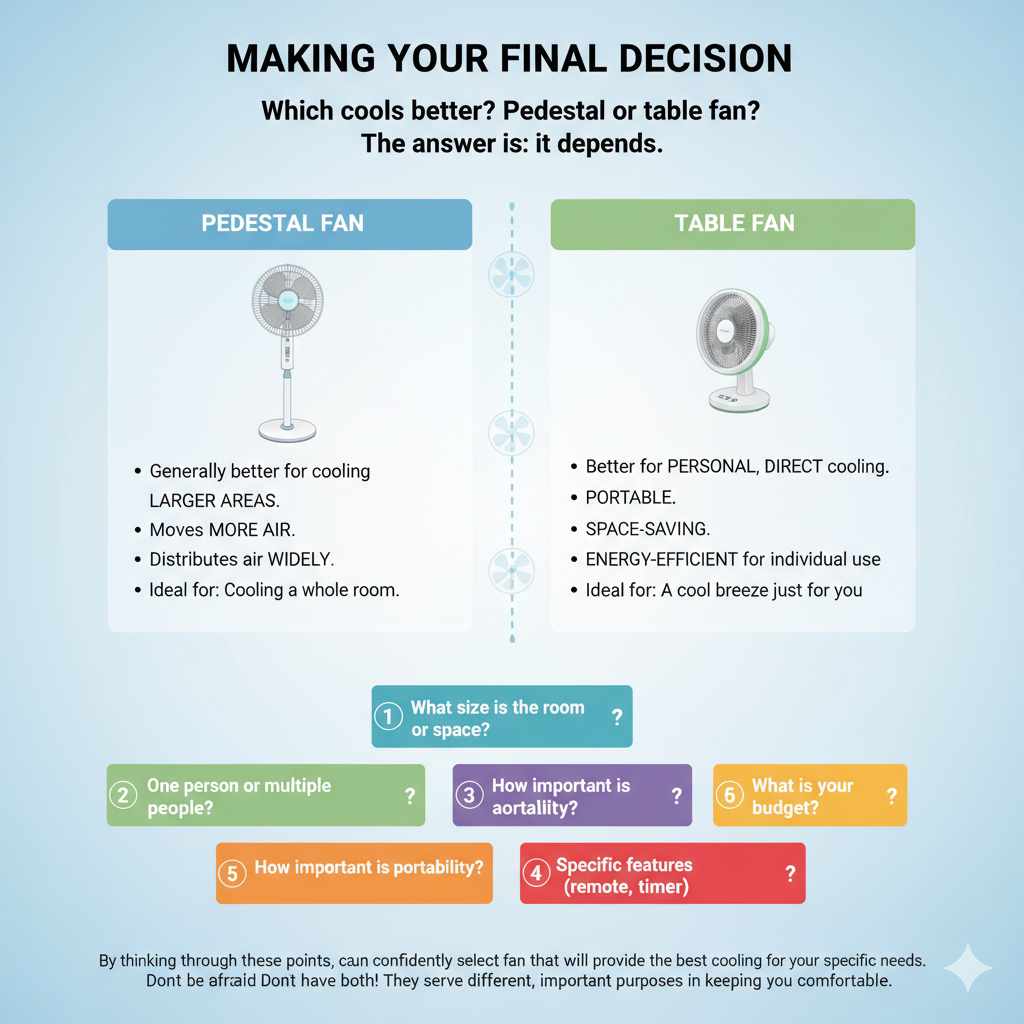
So, which cools better? Pedestal or table fan? The answer, as we’ve seen, is: it depends.
A pedestal fan is generally better for cooling larger areas. It moves more air and distributes it widely. If you want to cool a room, choose a pedestal fan.
A table fan is better for personal, direct cooling. It’s portable, space-saving, and energy-efficient for individual use. If you need a cool breeze just for you, choose a table fan.
Consider these questions:
- What size is the room or space you need to cool?
- Do you need to cool one person or multiple people?
- How much space do you have available?
- How important is portability to you?
- What is your budget?
- Are there specific features you need, like a remote or timer?
By thinking through these points, you can confidently select the fan that will provide the best cooling for your specific needs. Don’t be afraid to have both! They serve different, important purposes in keeping you comfortable.
Frequently Asked Questions About Fans
Do fans really help cool a room?
Fans don’t lower the room’s temperature like an air conditioner. They help you feel cooler by creating a breeze. This breeze makes your sweat evaporate faster.
Evaporation is a natural cooling process. So, yes, they help you feel cooler and more comfortable.
Is a pedestal fan or a table fan more energy efficient?
Generally, table fans are more energy efficient for personal cooling because they use less power. However, a powerful pedestal fan might be more energy efficient overall if it cools a whole room so well that you don’t need to run your air conditioner as much.
Can I leave a fan on all night?
Yes, most fans are designed for continuous operation. However, it’s a good idea to use a timer if your fan has one. This saves energy and is safer in case of any malfunction.
Also, ensure the room has some ventilation. You don’t want to recirculate stale air constantly.
How far away should I place a table fan?
For personal cooling, a table fan is most effective when placed about 3 to 5 feet away from you. This provides a noticeable breeze without being too strong or noisy. You can adjust this distance based on the fan’s power and your comfort level.
What does CFM mean on a fan?
CFM stands for Cubic Feet per Minute. It measures how much air a fan can move. A higher CFM rating means the fan moves more air.
This is important for cooling larger spaces. For a fan to cool a room effectively, it needs a good CFM rating.
Are bladeless fans better than traditional fans?
Bladeless fans are safer, especially for homes with children or pets, as they have no exposed blades. They are also often easier to clean. Performance can vary, but many bladeless models offer good airflow and a more consistent, diffused breeze compared to the direct wind from traditional fans.
Conclusion: Your Cool Comfort Choice
Choosing between a pedestal and a table fan comes down to your specific needs. Do you need to cool a whole room, or just yourself? Consider space, portability, and desired features.
Both types offer effective ways to feel cooler. Select the one that best fits your lifestyle and enjoy a more comfortable environment.
Related pick: Check today's price on Amazon
Products related to this article
Sponsored / affiliate links. As an Amazon Associate I earn from qualifying purchases. I may earn additional commission from eligible campaigns.