How to Stop a Door From Sticking in Winter
Find the rub point first, then tighten the hinges, then check the strike plate. Sand or plane the edge only if those fixes fail. Winter sticking can come from seasonal frame movement, humidity history, paint buildup, loose hardware, or hinge sag, so the best fix is the least invasive one that matches the symptom. Wood and trim can move with seasonal moisture changes, and a small amount of movement can be enough to turn a normal gap into a bind (U.S. Department of Energy, wood moisture and seasonal movement guidance; International Residential Code clearances are also sized to allow for movement).
This guide is part of our How to Make Your Home Cozy for Winter: Rooms, Doors, Drafts and Warmth series.
Diagnose the source of your sticking door


A sticking door can damage flooring and the door frame if you force it shut. Many fixes take a screwdriver and a few minutes before any sanding. The goal is to find which part changed: the hinge side, the latch side, the jamb/frame, or the edge against the stop. If the door suddenly changes behavior after weather shifts, the diagnosis is often seasonal movement rather than a single bad hinge.
What you’ll need
- Hand screwdriver
- 3-inch wood screw
- Light lubricant for hinges
- Card or sheet of paper
- Fine sandpaper or a file
- Pencil or masking tape
Why does my door stick in winter?

Winter sticking usually means the door, jamb, or trim has changed enough to shrink the clearance. Dry indoor air can change wood dimensions, and house movement can shift the frame. A loose hinge, a slightly off strike plate, paint buildup, or weatherstripping that is now too compressed can turn a small seasonal change into a hard bind. Wood movement across the grain is normal, and even modest humidity swings can alter how tightly a door meets its frame (North American Wood Flooring Association and Wood Handbook guidance on dimensional change with moisture).
Do not assume swelling is the only cause. If the door closes better after you tighten screws, the problem was likely hardware movement rather than the wood itself. If the door rubs in the same spot every year, seasonal movement is part of the pattern. If the rub changes after a few weeks of cold weather, the frame or weatherstripping may be contributing more than the door slab.
Door diagnosis table
| Symptom | Likely cause | Easiest test | Safest fix |
|---|---|---|---|
| Top latch-side corner drags | Hinge sag from loose top hinge screws | Open the door and check for play at the top hinge | Tighten screws by hand; add a 3-inch wood screw on the jamb side of the top hinge if a hole is stripped |
| Latch hits but will not click in | Latch misalignment | Close the door slowly and watch whether the latch misses the strike opening | Tighten strike plate screws and adjust the opening only enough for the latch to catch securely |
| Edge feels gritty or marked | Paint buildup on the door edge or jamb | Look for shiny or worn paint at the rub point | Lightly sand only the marked area, then seal the trimmed edge |
| Door binds before it closes fully | Swollen edge, seasonal wood movement, or compressed weatherstripping | Slide a card or paper around the edge to find the tight spot | Try hinge correction first; sand only if the tight spot remains after alignment checks |
| Latch misses the plate even when the door looks square | Loose strike plate screws or frame shift | Press on the strike plate and see if it shifts | Tighten the screws; if the miss remains, adjust the plate slightly |
| Door suddenly rubs after a season change | Frame movement, settlement, or weatherstripping compression | Compare the gap around the door from top to bottom | Reinforce screws where the jamb has loosened; call for assessment if the gap keeps changing |
Renters vs homeowners: Tightening screws, checking alignment, and using a card test are fine for most renters. Longer screws, sanding, filing, and sealing trimmed edges are better suited to homeowners because they can leave a more permanent change. If a lease limits repairs, stop at reversible fixes. If the door already needs multiple adjustments every season, the problem may be moving beyond a simple DIY correction.
Should you tighten the hinges first?
Yes. Check the top hinge first, then the lower hinge, because sag usually shows up at the top and latch side. Loose top hinge screws are a common cause of rubbing. A hand screwdriver gives better control than a driver that can strip the head or over-tighten the hole. If the hinge screws are loose, tightening them can correct the door’s alignment more reliably than lubricant, which does not fix a door that is rubbing because the slab has dropped.
- Open the door and inspect the top hinge screws.
- Tighten each screw by hand until snug.
- Check the lower hinge, then repeat the same hand-tightening.
- If a screw spins or will not bite, replace it with a longer screw in the jamb side of the top hinge.
If a shorter screw has pulled out, a 3-inch wood screw can often reach into wall framing and pull the jamb back into position. That fix often corrects sag quickly when the hinge side has loosened. For deeper alignment problems, the issue is usually the door’s geometry or the frame, not lubrication, so oil should be used only for squeaks or gritty hinge motion, not for a door that is physically rubbing on the jamb.
How do I know where a door is rubbing on the frame?
Use a card or sheet of paper around the edges to find the bind point before you change hardware or remove material. Move the card where the gap feels tight. Mark the spot on the door edge or jamb with pencil or masking tape so you do not sand the wrong area.
If the door closes almost fully, then stops at the top latch-side corner, that usually points to hinge sag or latch misalignment, not a need to plane the whole edge. If the paper drags along one short section, that section is the one to fix first. If the drag is on the stop or weatherstripping rather than the slab itself, the issue may be compression rather than a warped door.
How do I fix latch and edge binding?
Start with the strike plate first when fixing latch and edge binding. It sits inside the frame and meets the latch when the door closes. Tighten loose strike plate screws first, because a small shift there can stop the latch from entering cleanly. If the latch misses the opening, adjust the plate a little; do not enlarge it so much that the latch no longer catches securely.
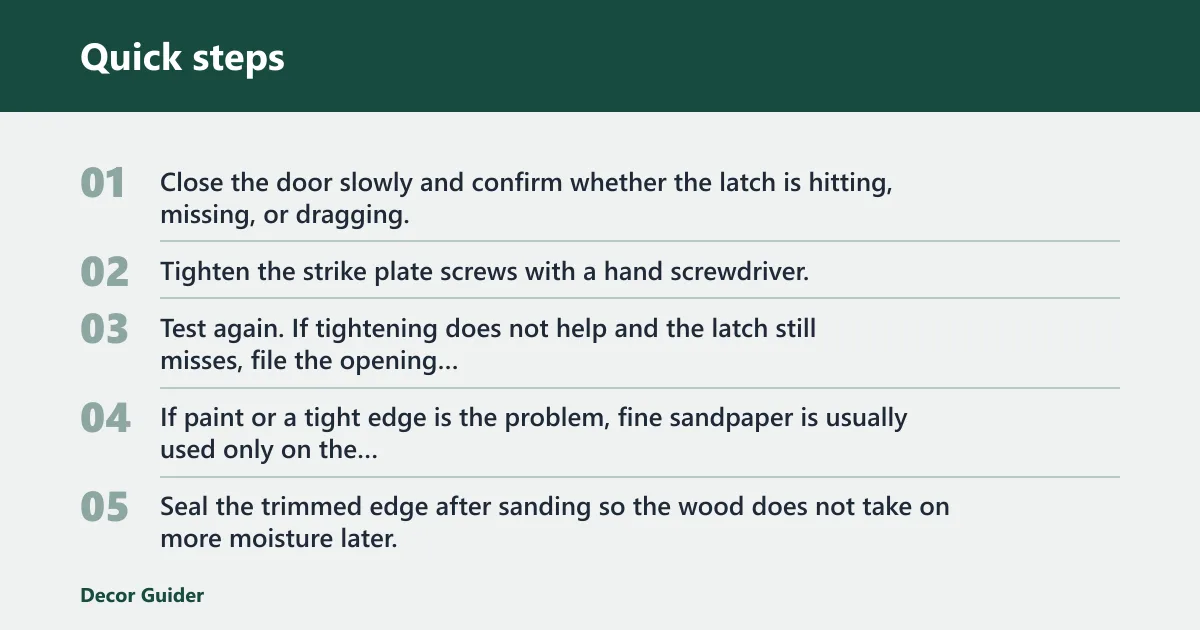
- Close the door slowly and confirm whether the latch is hitting, missing, or dragging.
- Tighten the strike plate screws with a hand screwdriver.
- Test again. If tightening does not help and the latch still misses, file the opening slightly and recheck after each pass.
- If paint or a tight edge is the problem, fine sandpaper is usually used only on the marked spot.
- Seal the trimmed edge after sanding so the wood does not take on more moisture later.
Use lubricant on hinges only if the movement feels gritty rather than out of square. Light oil can reduce hinge noise and friction in the pivot, but it will not correct rubbing between the door edge and the frame when the slab has sagged or the jamb has shifted. Excess oil can attract dust and grime, so use only a small amount and wipe away residue.
What if that did not work?
If tightening hinges and adjusting the strike plate do not hold, move to the edge material last. Sanding or planing belongs at the end of the process, not the start, because it removes material permanently. Stop as soon as the door clears the tight spot and closes without rubbing. For a finish that lasts, sanded or planed wood should be sealed again so the exposed edge does not absorb moisture unevenly (U.S. Department of Energy moisture-control guidance; general finishing practice for cut wood edges).
- Mark the exact rub line again with paper or card.
- Remove a thin amount from the tight edge only.
- Recheck the swing after each pass.
- Seal the cut edge once the door closes cleanly.
A common first-timer mistake is to plane the full edge when only a small corner is binding. Another is to file the strike opening so wide that the latch no longer holds the door tightly shut. Another is to keep sanding after the door already clears, which can create a visible gap that is harder to reverse than the original rub.
What about car doors that stick in winter?
Car doors can stick in winter for different reasons than interior doors. The usual causes are frozen weatherstripping, ice in the latch, or a rubber seal that has stiffened in the cold. If the door is frozen shut, do not force it with repeated yanks, because that can tear the seal or damage the latch. Gentle de-icing, warm air, and a rubber-safe protectant are the typical first steps; if the latch or lock is frozen, the problem is usually moisture and ice rather than hinge sag.
If the car door opens but then feels hard to close, check the weatherstripping for ice or compression and inspect the latch area for frozen buildup. A door that only sticks after washing, snowfall, or freeze-thaw cycles is more likely dealing with moisture and ice than frame movement. If the door will not latch securely after thawing, the weatherstrip or latch assembly may need service.
When is a sticking door a sign of a bigger framing problem?
Repeated sticking in the same season can suggest jamb or frame movement. Repeated sticking can also point to a threshold issue on exterior doors or a latch that no longer lines up because the frame has settled.
If tightening screws and small edge fixes do not last, stop and look at the frame as the reference surface. A door that suddenly needs more than one correction often has movement, not just a local rub point. At that stage, professional assessment may be the safer choice. Call a pro if the gap is visibly uneven top to bottom, if the strike side has shifted enough that the latch barely engages, if the jamb is cracked or separating from the wall, or if the door still sticks after hinge, strike, and weatherstripping checks.
Prevention
Check the top hinge screws before winter sets in, and mark any spot that starts to shine or wear. If the door was already close to the frame, a quick adjustment now is easier than a repair after the edge begins to scrape. For exterior doors, also inspect weatherstripping for hardening, flattening, or gaps, because compressed seals can change how the door closes when temperatures drop.
Frequently asked questions
Why do doors stick in the winter?
Doors stick in winter because clearances change. Seasonal wood movement, humidity history, small frame shifts, paint buildup, and loose hardware can make a door rub at the hinge side, latch side, or edge. Start with hinges and alignment before you remove material from the door.
How do I stop a door from sticking without planing it?
Tighten the hinge screws, check the strike plate, and use a card to find the rub point. If the latch misses, adjust the strike opening only slightly. A thin lubricant on the hinges can help if the motion is rough, but do not rely on oil alone. If the issue is weatherstripping compression, easing the seal or replacing a hardened strip may solve the close without planing the slab.
Should I tighten the hinges first on a sticking door?
Yes. Start at the top hinge, then check the lower hinge. Loose screws are a common cause of sagging, and a longer 3-inch wood screw in the jamb side of the top hinge can fix stripped holes. Recheck the door before changing the edge.
Can weatherstripping or paint buildup make a door stick more in cold weather?
Yes. Paint buildup can create friction, and weatherstripping can make an already tight door harder to close when the room cools. Look for shiny or worn paint at the contact point, then trim only the marked area and seal it after sanding. If the seal is too thick or compressed, the door may need weatherstripping adjustment instead of edge removal.
When should I use longer screws in a door hinge?
Use a longer screw when a hinge screw spins, pulls out, or no longer bites into the jamb. The 3-inch wood screw belongs in the jamb side of the top hinge, where it can pull the frame back into alignment and reduce sag without removing material from the door.
Products related to this article
Sponsored / affiliate links. As an Amazon Associate I earn from qualifying purchases. I may earn additional commission from eligible campaigns.