How to Stop a Door From Hitting the Wall
Stop a door by measuring the swing gap and installing a stop that leaves about 1/2 to 1 inch of clearance from the wall, trim, or hardware. Without the right stop, doors can chip drywall, dent trim, crack handles, and strain hinges. For placement and suitability, use the door’s actual swing path and follow manufacturer installation guidance for the stop type you choose, especially where the wall surface, flooring, or hinge geometry changes the contact point.
What is the thing that stops a door from the wall?


The thing is a door stop, also called a door stopper. It limits how far the door swings so the knob, lever, or edge does not hit drywall, trim, tile, or cabinetry. The right type depends on where the door contacts, what surface needs protection, and whether you can drill.
Door stop types at a glance
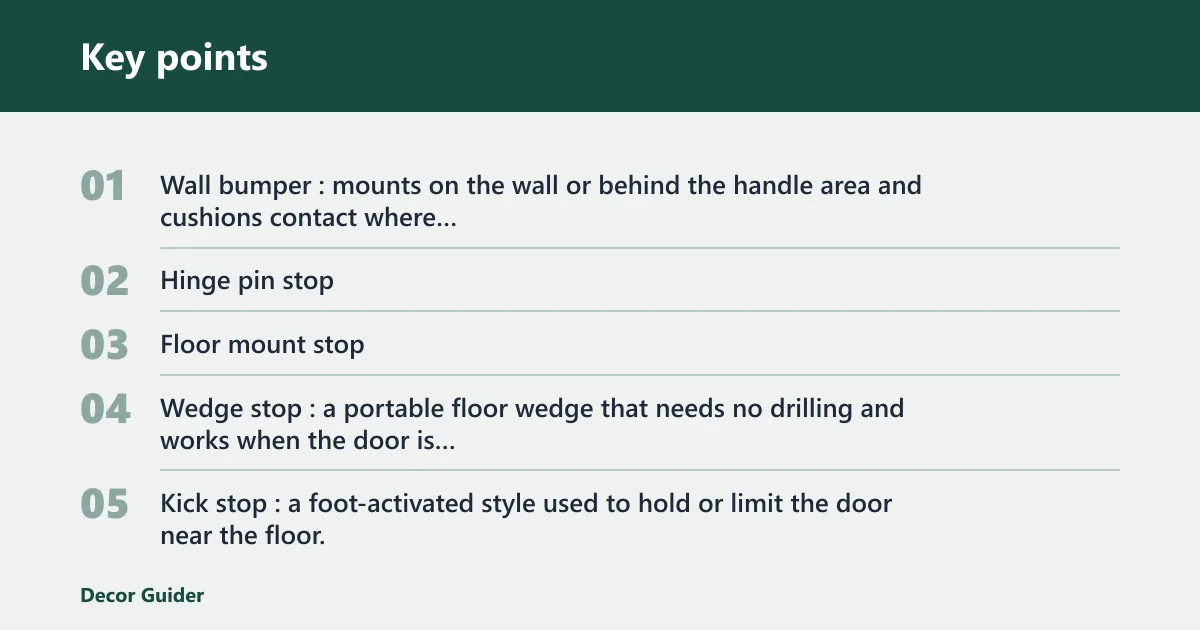
- Wall bumper: mounts on the wall or behind the handle area and cushions contact where the knob or lever would strike.
- Hinge pin stop: fits onto the hinge pin and limits swing with an adjustable projection.
- Floor mount stop: screws into the floor or baseboard area and stops the door before it reaches the wall.
- Wedge stop: a portable floor wedge that needs no drilling and works when the door is open or closed.
- Kick stop: a foot-activated style used to hold or limit the door near the floor.
Where each stop mounts
A wall bumper is typically installed on the wall or on the trim where the handle would strike. A hinge pin stop mounts to the hinge itself. A floor stop sits on the floor or at the floor line. A wedge stop stays loose and portable, so it suits temporary control or rentals.
What each stop protects
Wall bumpers protect painted drywall, baseboards, and the door handle finish. Hinge pin stops protect the wall when you do not want to drill into it. Floor stops protect the wall too, but they shift the load to the floor or baseboard area. Wedge stops mainly prevent the door from moving further.
Door stop decision matrix
Use the door type, wall surface, and installation limit together. A light interior door on painted drywall often points to an adhesive bumper. A heavier door, or a door that opens hard, may need a hinge pin stop or floor stop. If drilling is off-limits, start with a no-drill option. For a more reliable match, use the contact point and clearance rather than the room type alone.
| Door type | Drilling allowed? | Baseboard height conflict? | Door weight | Wall surface | Contact point | Recommended stop type | Failure cases |
|---|---|---|---|---|---|---|---|
| Bedroom or hall interior door | Yes | Low to moderate | Light | Painted drywall | Handle or lever hits wall face | Wall bumper | If the handle still reaches the wall, the bumper is too small or set too far from the strike point. |
| Interior door with no-drill limit | No | Low | Light | Drywall or trim | Hinge-side swing limit | Hinge pin stop | Can fail on very heavy doors or where hinge wear lets the door sag and change the swing path. |
| Heavy interior or entry door | Yes | Moderate to high | Heavy | Tile, masonry, or solid flooring | Door edge or handle approaches wall with strong impact | Floor mount stop | Can become a trip hazard or damage flooring if placed in a traffic path or on an unsuitable surface. |
| Temporary control | No | Any | Light | Any floor | Door bottom or leading edge | Wedge stop | Not a fixed limit; can slip on smooth flooring or fail if the door is repeatedly forced open. |
| Handle lands close to wall | Yes or no | Moderate | Light to moderate | Trim or drywall | Knob, lever, or escutcheon plate | Wall bumper or strike pad | Fails if the baseboard or trim changes the strike height and the pad misses the true contact point. |
| Rental or finished wall where holes are not wanted | No | Low | Light to moderate | Painted drywall or finished trim | Handle-to-wall strike point | Adhesive bumper | Adhesive may fail on dusty, textured, glossy, or damp surfaces, or if the load is too strong. |
Simple clearance checklist
- Measure handle-to-wall distance at full open.
- Check baseboard height and trim depth.
- Note whether drilling is allowed.
- Confirm the door’s full-open path.
- Choose a stop that leaves 1/2 to 1 inch of clearance.
How do you stop a door handle from hitting the wall?
Measure the gap from the handle or knob to the wall at full swing, then choose a stop that intercepts contact before the handle reaches the wall. For most interior doors, the stop must protect both the wall surface and the hardware finish, because the handle usually causes the damage first.
Measure handle-to-wall clearance
Open the door fully and note the shortest distance between the outer edge of the handle and the wall. If the handle shape is large, include the lever tip or escutcheon plate in that measurement. A stop that mounts too close can still let the handle kiss the wall.
Check baseboard and trim height
Baseboards can change where a bumper lands. A tall baseboard may place a wall bumper too low or too high for the handle line. Deep trim can also block a floor stop or shift the contact point, so the stop needs to match the actual path, not just the flat wall area.
Choose projection before buying
The stop’s projection must match the swing, not guess at it. If the handle barely clears the wall, a small bumper may be enough. If the door swings farther or the handle is bulky, a hinge pin stop with adjustable projection or a floor stop may fit better. Manufacturer installation instructions commonly emphasize setting the stop from the actual strike location, not from a generic wall distance.
Wall bumper vs hinge pin stop vs floor stop
Use a wall bumper for a simple wall strike, a hinge pin stop when wall mounting is undesirable, and a floor stop when the door is heavier or the wall face should stay untouched. The best choice depends on how much swing you need to limit and where the contact point lands.
Best use for wall bumpers
Wall bumpers work well for painted drywall and light interior doors. A self-adhesive or screw-mounted bumper can sit where the knob or lever hits. Building and hardware guidance generally treats this as a wall-protection solution, not a correction for a door that is over-swinging because of hinge position or poor layout.
Best use for hinge pin stops
Hinge pin stops are useful when drilling into the wall is not wanted. They fit on the hinge pin and let you adjust how far the door can travel. These stops are best when the door’s swing is close to correct and you only need to trim the final travel. On heavy doors, or on doors with loose hinges, the stop may need frequent readjustment if the swing path changes.
When a floor stop is better
A floor mount stop is usually the stronger choice for heavier doors or repeated full-swing strikes. It can keep the wall clear and handle more force, but it needs careful placement because floor-mounted hardware can create a trip hazard if it sits in a walking line. It also depends on a floor surface that can hold fasteners securely.
Which stop fits each door type?

Door type matters because the movement, weight, and mounting surface change the best solution. A bedroom door, cabinet door, shower door, and front door do not need the same stop. The goal is always the same: stop the contact before the wall, trim, or hardware takes the hit.
Interior doors and bedroom doors
For standard interior doors, a wall bumper is the simplest starting point when the wall is drywall or painted trim. If the wall cannot be drilled, a hinge pin stop is usually the cleaner option. If the door is heavy or swings hard, move up to a floor stop instead of stacking multiple bumpers.
Cabinet and fridge doors
For a cabinet door, the fix is often a small bumper or a strike pad at the exact contact point. If you need a quick, no-drill answer, an adhesive bumper is often the first move. For a fridge door, check the hinge side and swing path first, because the cabinet face or adjacent wall may be in the way rather than the door itself.
Say your pantry cabinet door opens into a side wall and leaves only a narrow gap at full swing. A small adhesive bumper on the cabinet face may stop the knock, but if the door still overtravels, a hinge check or hinge repositioning may be needed before adding more pads.
Shower doors
Shower doors need a stop that works with the enclosure hardware and the wet environment. Use a solution the manufacturer allows for that glass, frame, or hinge system, and avoid anything that depends on weak adhesive alone in a damp area. Soft-contact parts can reduce impact noise, but the stop must not interfere with seals, rollers, or a door that should close fully against the enclosure.
Do not use a floor stop where it can collect water, corrode quickly, or create a slip point at the bathroom entrance. Avoid oversized bumpers that keep the door from sealing or that force the door out of alignment with the track or jamb.
Front doors
Front doors usually need a sturdier solution than a light interior door because they are heavier and receive stronger impact. A floor mount stop is often the better fit when the door must not reach the wall or adjacent trim. If the door closes with significant force, a properly set stop should work with the closer, not against it.
Do not rely on a small adhesive pad for a heavy front door. It can peel, compress too much, or fail to protect the wall when the door is pushed open quickly. Also avoid placing a floor stop where it becomes a trip hazard at the main entry path.
How to stop a door from hitting the wall without drilling
Without drilling, your main options are adhesive bumpers, strike pads, hinge pin stops, and wedge stops. These work best when the wall is in good shape and the door only needs modest travel control. If the swing is severe, a no-drill fix may help, but it may not fully solve the geometry problem.
Adhesive bumpers and strike pads
Adhesive bumpers are best for painted drywall, light interior doors, and rental settings where screw holes are not allowed. They are fast to place and easy to replace. Use them as wall protection where the handle contacts, not as a cure for a door that opens too far because of hinge position or swing angle. On textured, dusty, damp, or uneven surfaces, adhesive products are more likely to loosen, so the surface has to be clean and suitable before you count on them.
Wedge stops for temporary use
A wedge stop works when you want a portable barrier with no hardware changes. It is useful for temporary control, but it only helps when the door is open or held open. It will not solve a full-swing wall strike on its own if the door must regularly open all the way. Smooth flooring can also let a wedge slip if the material does not grip well.
Limits of no-drill fixes
No-drill products generally do not correct a wrong swing direction, a bad hinge side, or a door that travels too far because of hardware wear. They also do little for a door that needs a stronger physical stop. If the handle still reaches the wall after a bumper is added, the door needs a different stop type or a hinge fix.
How to install each main stop type
Use the measured clearance and the actual strike point to set the stop before tightening anything. The goal is to intercept the handle or edge before it reaches the wall, trim, or adjacent surface.
Wall bumper install
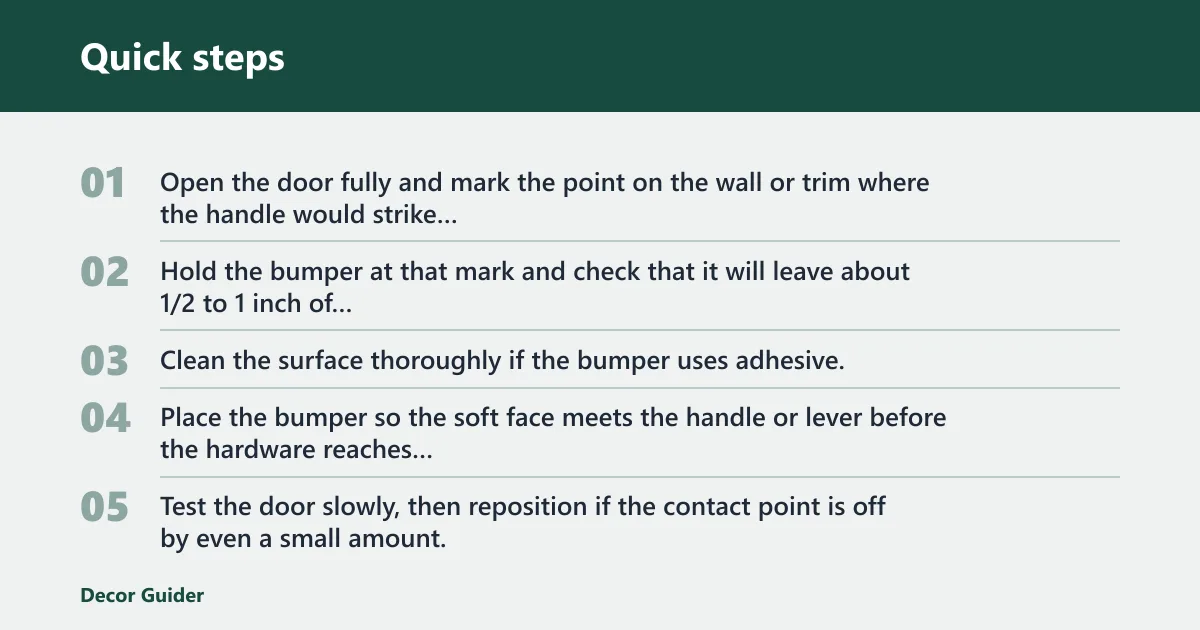
- Open the door fully and mark the point on the wall or trim where the handle would strike first.
- Hold the bumper at that mark and check that it will leave about 1/2 to 1 inch of clearance when the door is open.
- Clean the surface thoroughly if the bumper uses adhesive, or predrill if the bumper uses screws and the wall material allows it.
- Place the bumper so the soft face meets the handle or lever before the hardware reaches the wall.
- Test the door slowly, then reposition if the contact point is off by even a small amount.
Hinge pin stop install
- Open the door and note how far the handle still needs to travel before the wall would be hit.
- Remove the hinge pin according to the stop manufacturer’s instructions.
- Fit the stop onto the hinge pin and set the projection so the door will stop before the handle reaches the wall.
- Reinstall the pin and swing the door open slowly to confirm the stop hits at the planned angle.
- Fine-tune the projection only as much as needed to keep the clearance consistent.
Floor stop install
- Mark the spot on the floor where the door edge or hardware should stop before contacting the wall.
- Confirm the stop will not sit in a walking path or catch a foot when the door is open.
- Check the floor material so the fastener can hold securely.
- Install the stop at the marked location and keep the bumper face aligned with the door’s leading edge or strike point.
- Open the door fully and verify the wall, trim, and handle all clear the contact zone.
Adhesive pad install
- Clean and dry the wall, trim, or cabinet face where the pad will sit.
- Mark the exact strike point using the handle or edge at full open.
- Press the pad in place without shifting it once it contacts the surface.
- Hold firm pressure long enough for the adhesive to bond.
- Test the door gently first, then recheck after the adhesive has had time to set.
Wedge install
- Place the wedge on a clean, dry floor where the door bottom or edge will meet it first.
- Angle it so the door stops before the wall or trim is reached.
- Test the door slowly and move the wedge if the contact point is off.
- Make sure the wedge is not placed where someone will trip over it when the door is open.
- Use it as a temporary or movable control, not as a permanent swing correction.
When the stop is not the real fix
Sometimes the door is not the real problem. If the hinges are loose, the strike point shifts. If the door swings the wrong way, a stop only cushions a bad path. If the door is already hitting hard enough to damage trim, you may need hinge adjustment, swing correction, or repair before adding a stop.
Loose hinges and minor adjustment
Loose hinges can let the door sag or swing farther than intended. Tightening screws or correcting a bent hinge may reduce travel slightly. That helps, but it is usually not a substitute for a true stop on most interior doors. A door closer can also change motion, but it is not the main fix for a door that only hits the wall at full open.
Wrong swing direction or hinge side
If the door opens into the problem wall because the swing direction is wrong for the space, a stop alone will not create better clearance. The door may need a different handing, a changed hinge side, or a different opening solution. This is common when a room layout was altered after the door was installed.
Damage that needs repair first
Repeated impacts can leave paint dents, drywall marks, and trim scuffs. A wall protector or strike pad can prevent more damage, but it will not rebuild the surface. Fix the damage, then add a real stop so the repaired area does not fail again at the same point.
Suppose a bedroom door has already left a crescent dent in the drywall and the lever hits the same spot every time. A wall protector can help cover the contact point, but the door still needs a bumper or hinge pin stop set for the actual swing path.
Frequently asked questions
How do I stop a door from hitting the wall?
Measure the full-open clearance first, then pick a stop that keeps 1/2 to 1 inch between the door hardware and the wall. For most interior doors, that means a wall bumper, hinge pin stop, or floor stop. If the swing path is wrong, fix the hinge or handing first.
What do you call the thing that stops the door from hitting the wall?
It is usually called a door stop or door stopper. Specific types include wall bumpers, hinge pin stops, floor mount stops, wedge stops, and kick stops. The name changes with where it mounts and how it limits the swing.
How to stop a door handle from hitting the wall
Place the stop at the exact strike point where the handle contacts the wall or trim. A wall bumper is usually the simplest option. If the handle shape is large or the door opens hard, a hinge pin stop or floor stop may give better control than a small pad.
Which door stop works best for interior doors?
For standard interior doors, a wall bumper is often the easiest starting point because it is simple and protects drywall well. If you cannot drill into the wall, a hinge pin stop is often the better choice. Heavier interior doors usually need a floor mount stop instead.
How do I stop a front door from hitting the wall?
A front door usually needs a sturdier solution than a light interior door. A floor mount stop is often the better fit because it handles more force. Check the floor material and trip risk first, then place the stop so the door cannot reach the wall or trim.
Products related to this article
Sponsored / affiliate links. As an Amazon Associate I earn from qualifying purchases. I may earn additional commission from eligible campaigns.
 20PCS Home Decor Brick Hook, Metal Brick Wall Hanger for 2 - 1/4 to 2 - 2/5 Inch Bricks, No Drill Heavy Duty Alloy Steel Clip with 20 lbs Capacity for Indoor Outdoor Use20PCS Home Decor Brick Hook, Metal Brick Wall Hanger for 2 - 1/4 to 2 - 2/5 Inch Bricks, No Drill Heavy Duty Alloy Steel Clip with 20 lbs Capacity for Indoor Outdoor Use