How Much Does a Custom TV Stand Cost by Size and Materials?
A custom TV stand usually costs $1,500 to $8,000, with simple painted units near the low end and built-ins or premium hardwoods pushing higher. Budget too low, and you can end up with a stand that wobbles, misses storage needs, or blows past your quote. This guide breaks down design, materials, labor, and installation so you can estimate a realistic budget before you request bids.
Custom TV stand pricing basics
A true custom TV stand is built to fit your dimensions, storage needs, finish choice, and room layout. Modified retail furniture is different: the builder may trim, repaint, reface, or join store-bought pieces. That usually cuts labor, but it also limits design freedom and fit.
Most of the price comes from four places: cabinet box and face materials, shop time for build and finish work, hardware inside doors and drawers, and delivery plus installation. Larger and more detailed units cost more because each step takes longer and uses more material.
Typical budget tiers at a glance
| Tier | Typical total | Best fit | Main cost drivers |
|---|---|---|---|
| Entry-level custom | $1,500 to $2,800 | Simple freestanding unit with basic storage | Plywood or MDF, painted finish, simple doors, limited install work |
| Mid-range custom | $2,800 to $5,500 | More storage, better hardware, cleaner built-in look | Mixed materials, soft-close hardware, cable management, higher finish time |
| Premium built-in | $5,500 to $8,000+ | Full wall treatment or integrated media wall | More carpentry hours, trim work, site fitting, lighting, heavier installation |
What drives the price?
Size, materials, finish level, storage layout, and install difficulty drive most quotes. A narrow stand with two open shelves is far cheaper than a long unit with drawers, doors, hidden wiring, and a site-fit install around outlets or uneven walls.
Size, footprint, and TV load
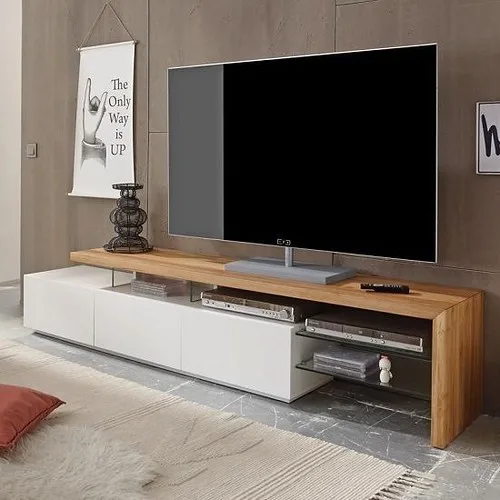
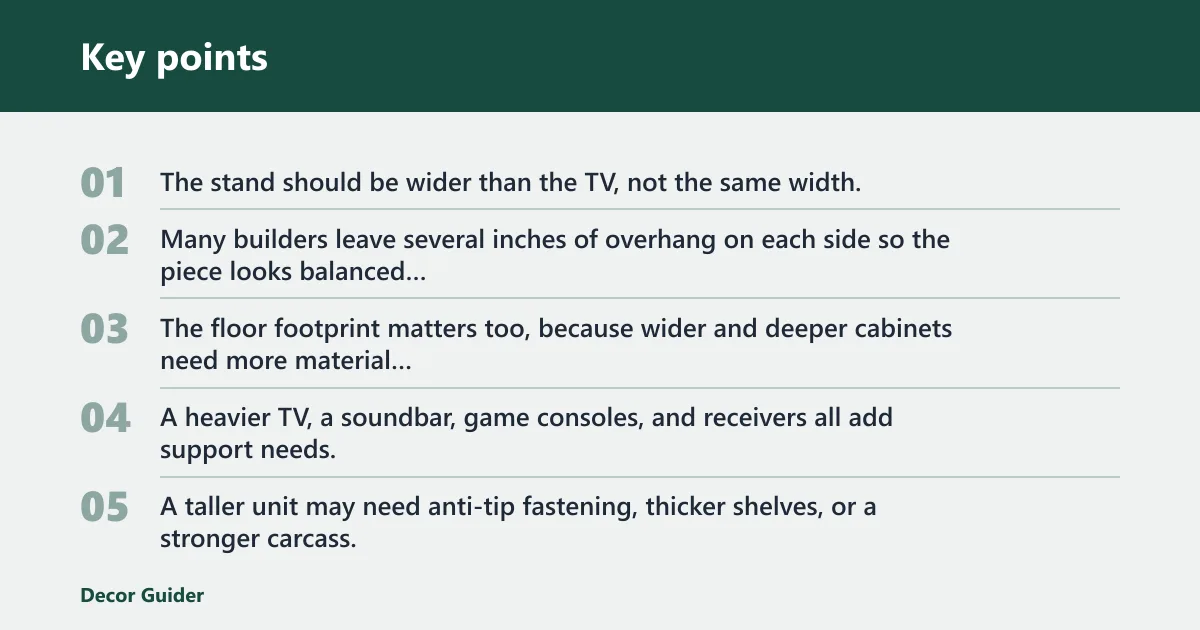
The stand should be wider than the TV, not the same width. Many builders leave several inches of overhang on each side so the piece looks balanced and the screen does not crowd the edges. The floor footprint matters too, because wider and deeper cabinets need more material and stronger support.
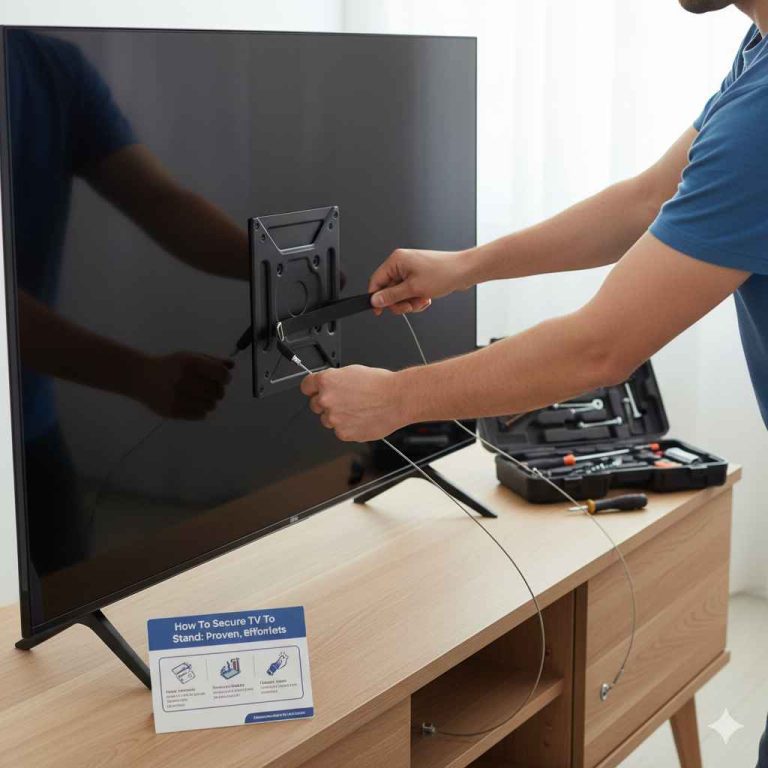
Load capacity is another pricing factor. A heavier TV, a soundbar, game consoles, and receivers all add support needs. A taller unit may need anti-tip fastening, thicker shelves, or a stronger carcass, which adds labor and hardware cost.
Material choice and finish level
Solid wood usually costs more than MDF or plywood because the raw material is pricier and needs more careful milling. Plywood often lands in the middle for strength and stability. MDF can be cost-effective for paint-grade projects, but it is less forgiving around moisture and impact.
Veneer can raise the price when you want a wood look without solid-wood cost. Finish type matters too. A stained hardwood finish often takes more prep and color matching than a simple painted finish, while a high-build lacquer or hand-finished surface adds shop time.
Storage layout and hardware
Open shelving is usually cheaper than closed cabinets because it needs fewer parts and less hardware. Doors, drawers, and adjustable shelves add cutting, fitting, and assembly time. Soft-close hinges and drawer slides also increase the hardware line.
Cord management seems small, but it can change the bid. Cutouts, pass-throughs, vent slots, and hidden channels take planning and add labor. If the stand needs a clean front with no visible cables, expect the quote to move upward.
Built-in features and install complexity
Floating designs cost more than simple floor-standing units because wall anchoring and hidden mounting support add time and risk. Built-in lighting, trim matching, and site scribing around baseboards or uneven floors also raise labor. The more the unit has to fit the room exactly, the larger the labor share gets.
Say your 75-inch TV needs a 78-inch-wide stand with two drawers, one cabinet, and a cable chase. That project will cost more than a 60-inch floating shelf with open storage, even if both use the same paint finish, because the larger unit needs more material and more assembly time.
Custom TV stand cost calculator
This calculator is a budgeting tool, not a quote. The shares below show where the money usually goes so you can compare bids in a smarter way. They also help you see when a design starts to look more like furniture and when it starts to behave like cabinetry work.
Entry-level custom budget breakdown
| Line item | Estimated share | What it usually includes |
|---|---|---|
| Materials | 30% | MDF or plywood carcass, basic shelves, simple face frames |
| Labor | 35% | Cutting, assembly, sanding, basic install prep |
| Finish | 15% | Paint-grade finish or basic stain and clear coat |
| Hardware | 10% | Standard hinges, basic pulls, shelf pins, fasteners |
| Delivery/install | 10% | Local delivery and simple placement |
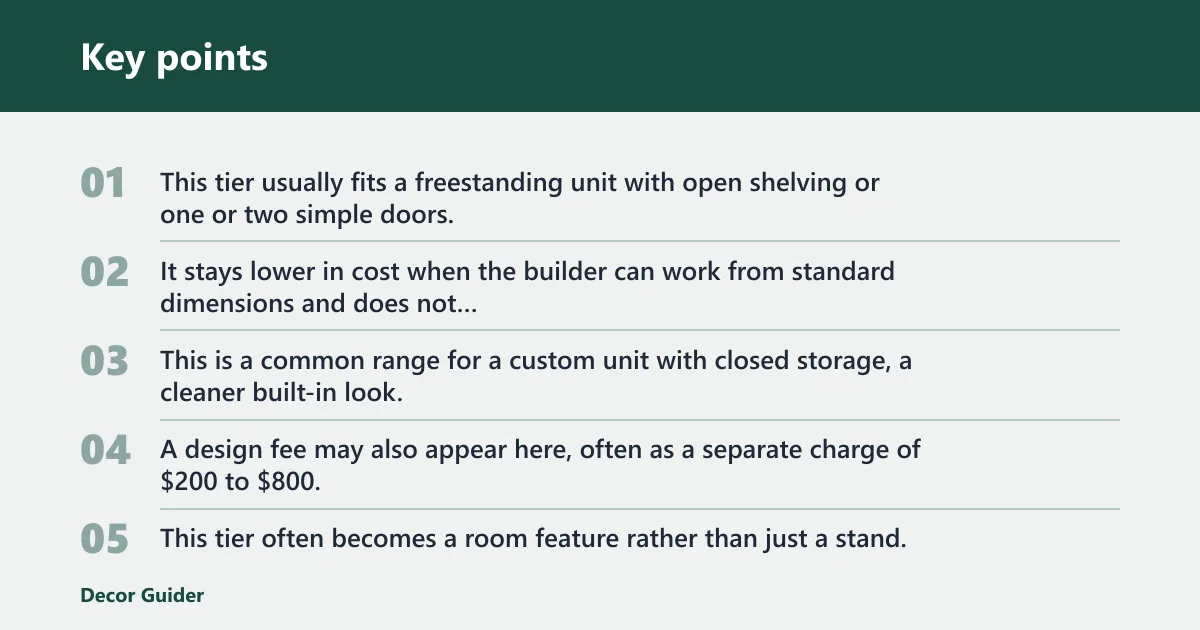
This tier usually fits a freestanding unit with open shelving or one or two simple doors. It stays lower in cost when the builder can work from standard dimensions and does not need trim, lighting, or a complex wall fit.
Mid-range custom budget breakdown
| Line item | Estimated share | What it usually includes |
|---|---|---|
| Materials | 28% | Plywood or hardwood parts, thicker shelving, better backing |
| Labor | 38% | More joinery, drawer fitting, door alignment, site adjustments |
| Finish | 14% | Multi-step paint or stain process, better surface prep |
| Hardware | 12% | Soft-close hinges, drawer slides, cable pass-throughs |
| Delivery/install | 8% | Transport and moderate installation work |
This is a common range for a custom unit with closed storage, a cleaner built-in look, and better hardware. A design fee may also appear here, often as a separate charge of $200 to $800, especially when the shop drafts shop drawings or revises measurements before build time starts.
Premium built-in budget breakdown
| Line item | Estimated share | What it usually includes |
|---|---|---|
| Materials | 24% | Higher-grade plywood or hardwood, trim stock, backing, reveals |
| Labor | 42% | Custom fitting, wall integration, more assembly and scribing |
| Finish | 12% | More prep, touch-up time, matching adjacent millwork |
| Hardware | 10% | Soft-close hardware, lighting parts, heavier-duty mounts |
| Delivery/install | 12% | Two-person delivery, leveling, fastening, trim-out, cleanup |
This tier often becomes a room feature rather than just a stand. It may cost more than a simple media cabinet because the work includes wall integration, trim matching, and more site labor. If the project starts to span an entire wall, it can approach media-wall pricing faster than many homeowners expect.
Material and construction choices
Material choice changes both the look and the quote. Solid wood brings a higher material cost and often a higher finish cost. MDF and plywood can keep the budget in check, but they behave differently during cutting, fastening, and finishing.
Solid wood, MDF, plywood, and veneer
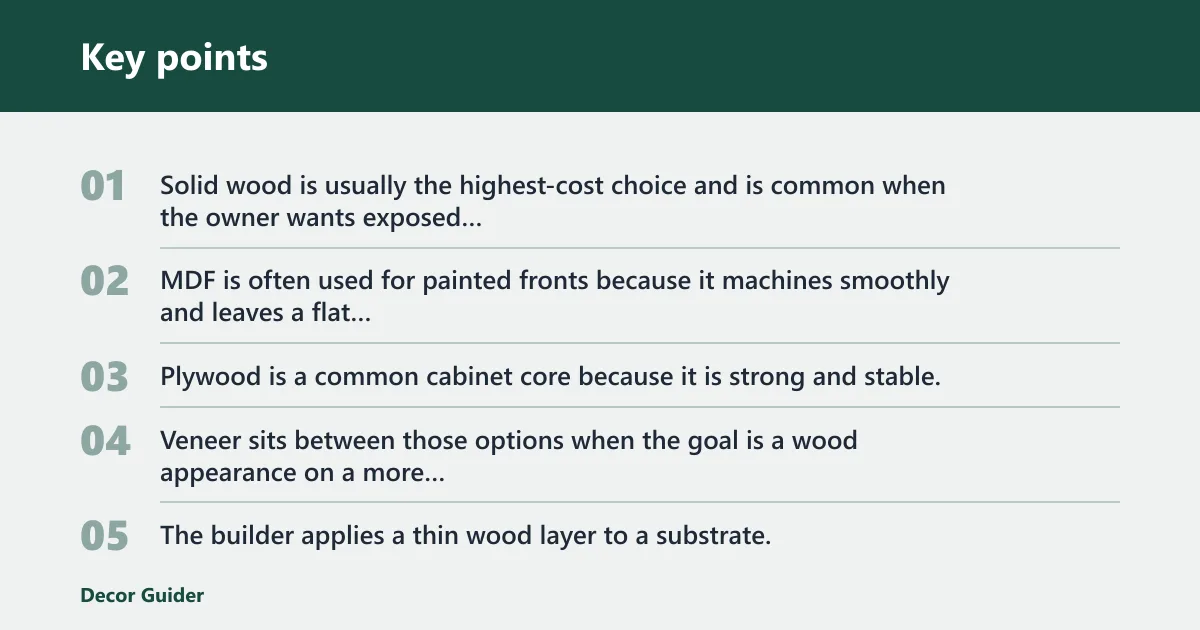
Solid wood is usually the highest-cost choice and is common when the owner wants exposed grain, stained surfaces, or premium joinery. MDF is often used for painted fronts because it machines smoothly and leaves a flat finish. Plywood is a common cabinet core because it is strong and stable, especially for larger spans.
Veneer sits between those options when the goal is a wood appearance on a more controlled budget. The builder applies a thin wood layer to a substrate, which can lower material cost compared with all-solid construction while still allowing a better-looking face.
Hardware choices that change the total
Standard hinges and simple pulls cost less than soft-close hinges, touch-latch doors, or full-extension drawer slides. Hidden cable ports, vented back panels, and appliance cutouts also add cost because the hardware list grows and the assembly takes longer.
A small hardware upgrade can be worth it on a daily-use unit. The jump from basic slides to soft-close hardware is often modest compared with the total project, but it becomes visible when the stand has several drawers or doors.
Frame, carcass, and shelf construction
The carcass is the box structure, and it carries a large part of the cost. Thicker panels, hardwood edging, and reinforced shelves add material and labor. Floating units may need hidden cleats or wall anchors, which increases both design time and installation time.
How much do add-ons cost?
Add-ons can shift a budget quickly because they affect both parts and labor. A quote that looks affordable at first may rise once you add storage hardware, lighting, or a more finished face. The line items are usually small individually, but together they can change the total by hundreds of dollars.
Soft-close hinges and drawer slides
Soft-close hinges and slides are among the most common upgrades. They usually add a modest hardware premium, but the larger cost is often the time spent fitting and adjusting them so doors and drawers line up cleanly.
LED lighting and cable pass-throughs
LED strips, puck lights, transformers, and switches can add a meaningful amount to the bill, especially if the builder hides wiring inside the cabinet. Cable pass-throughs are cheaper than lighting, but they still require planning and careful drilling.
Paint-grade finish and decorative trim
Paint-grade finishes are often chosen when the goal is a clean, built-in look. They can cost less than a showy stained finish, but the prep still matters. Decorative trim, base molding, crown details, and filler strips raise both material and labor cost because each piece needs fitting and finishing.
DIY, carpenter, or cabinet shop?
DIY usually has the lowest cash outlay, but it shifts risk to your time, tools, and skill. A carpenter may charge less than a cabinet shop for simpler work, while a cabinet shop is better suited to precise joinery, specialty finishes, and complex storage layouts.
DIY vs pro-built cost tradeoff
DIY can save labor charges, but it can cost more if you need to buy tools, redo parts, or fix finish problems. Pro-built work costs more upfront because you are paying for shop labor, fitting, and install time. The budget choice depends on whether you want to save money or reduce project risk.
Cabinet shop vs carpenter pricing
A cabinet shop often charges more for detailed millwork, matching finishes, and repeated revisions because its pricing reflects shop time and overhead. A carpenter may be a better fit for a simpler freestanding unit or a site-built piece with straightforward dimensions. For highly customized cabinetry, the cabinet shop usually has the stronger process.
Freestanding vs built-in cost comparison
Freestanding units are easier to build and install, so they are usually cheaper. Built-ins add wall fitting, trim, leveling, and more finishing work, which pushes the project into a higher labor bracket. The extra cost makes sense when you want the stand to look like part of the room rather than separate furniture.
Is a custom built-in worth the extra cost?
A built-in makes sense when you want exact room fit, larger storage, hidden wiring, or a design that blends with other millwork. It is less attractive when the room may change soon, the budget is tight, or the TV size might change again in a year or two.
When a built-in makes sense
If the wall is wide, the room is used daily, and the stand needs to hide cords, components, and uneven edges, a built-in can be the better spend. It also makes sense when the project is part of a larger remodel and the finish can match other cabinetry in the room.
When a freestanding custom stand is smarter
A freestanding unit is the better choice when you want custom dimensions without full wall work. It is usually cheaper, easier to move, and simpler to replace if the TV changes size. That makes it a smart middle ground between store-bought furniture and a built-in wall system.
How to compare the project to a media wall
Once a stand grows into full wall storage, panels, lighting, and integrated trim, the cost can approach a media wall. At that point, compare the project line by line against a built-in wall quote, not just against a furniture quote. The labor difference can be larger than the material difference.
How to budget before you get quotes
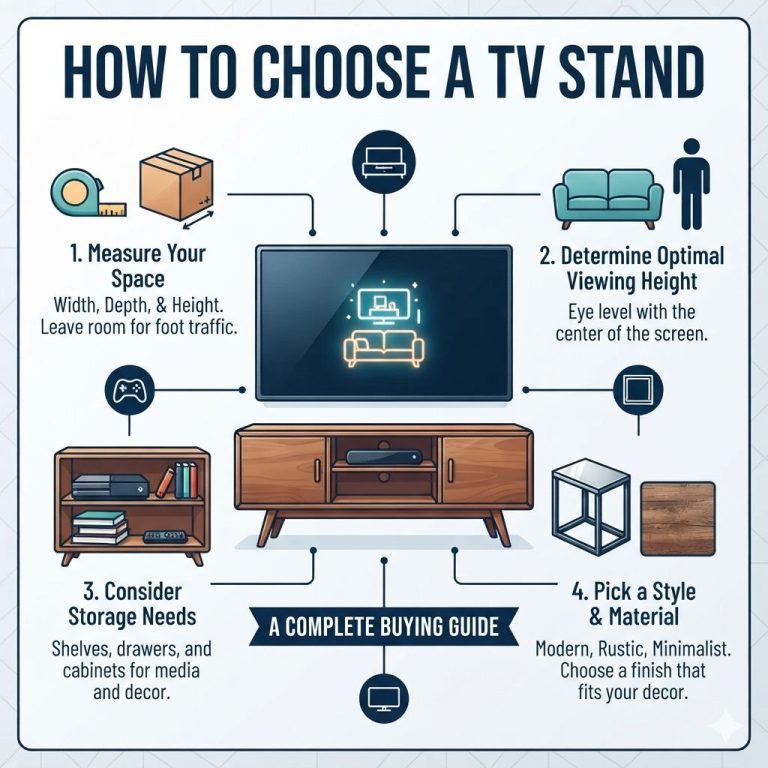
Good budgeting starts with measurements and a clear spec list. The more detail you give a shop, the easier it is to compare bids fairly. Without that, one quote may include finish upgrades or install work that another omits.
- Measure the TV width, the wall space, the floor footprint, and the depth you can spare.
- Write down the storage you want: open shelves, doors, drawers, or a mix.
- Choose the finish level before shopping: paint-grade, stained wood, or veneer.
- List hardware needs, including soft-close hinges, cable pass-throughs, and lighting.
- Ask whether delivery and installation are included or billed separately.
- Request a design-only fee up front if drawings or revisions are expected.
Suppose you want a 70-inch TV stand for a living room with one soundbar, two drawers, and hidden cords. A clean design with plywood, paint, and standard hardware may stay near the lower end of the custom range. Add floating mounting, integrated lighting, and trim, and the quote can move into the mid-range or higher.
One common first-timer mistake is comparing a custom cabinet quote to a flat-pack price without accounting for install. That comparison misses delivery, leveling, wall fastening, and finish work, which are often the exact items that push a project over budget.
Frequently asked questions
How much does a custom TV stand cost?
A custom TV stand usually costs about $1,500 to $8,000. Simple painted units with basic storage sit near the low end, while larger hardwood pieces, built-ins, and lighting push higher. The final price depends on size, materials, finish, hardware, and how much installation is needed.
What is the average cost of a custom built TV stand?
A practical working estimate for a custom built TV stand is about $2,800 to $5,500 for many mid-range projects. That range usually covers a mix of plywood or hardwood parts, better hardware, a finished face, and moderate delivery or installation work.
How much more does a custom TV stand cost than a store-bought one?
Custom work usually costs more than store-bought furniture because it is built to fit your room and storage needs. A ready-made stand may be a few hundred dollars, while a true custom piece often starts above $1,500 once labor, finish, and install are included.
What affects the price of a custom built TV stand?
The main price drivers are size, material choice, finish level, storage layout, hardware, and installation difficulty. Hidden details matter too. Cable management, soft-close hardware, drawer fitting, lighting, and wall mounting can all raise the quote even when the exterior looks simple.
How much does a custom TV stand with storage cost?
Custom storage usually adds cost because doors, drawers, shelves, and internal dividers increase labor and hardware. A practical range is often $2,000 to $6,000 depending on whether the storage is open, closed, or built into a larger wall unit with a higher finish level.
How much does a custom TV stand with lights cost?
Lighting can add a few hundred dollars or more, depending on the fixture type, wiring method, and how hidden the components need to be. LED strips and simple accent lighting cost less than integrated, switched, or concealed lighting tied into a built-in cabinet.
Is a built-in TV stand worth the extra cost?
A built-in is worth the extra cost when you want a precise fit, hidden wiring, and a finished look that blends with the room. It is less sensible if you need flexibility, have a tight budget, or do not want the added install time and wall work.
Products related to this article
Sponsored / affiliate links. As an Amazon Associate I earn from qualifying purchases. I may earn additional commission from eligible campaigns.