High-End TV Stand Price
High-end TV stand prices often start around $500 and can go past roughly $2,000. Pay extra for solid hardwood, higher weight capacity, built-in cable management, and durable hardware, not glossy finishes alone. This guide breaks down the features that justify the jump in price and which premium add-ons are worth skipping.
What actually drives up the cost of premium media stands


A high-end TV stand is usually priced for materials, storage design, hardware, and finish quality rather than looks alone. In practice, that means solid wood or high-grade engineered wood, sturdy joinery, and a layout that fits your devices without crowding them.
Premium materials and finish quality
Wood species, veneer quality, and finish work drive cost quickly. Solid hardwood usually costs more than basic particleboard, while higher-grade engineered wood can still make sense when the finish is durable and the edges are well sealed. Better finish work also helps a stand resist scuffs on high-touch surfaces.
Surface style matters, but only to a point. A stained oak look, woodgrain texture, or fluted front can raise the sticker price, yet those upgrades do not automatically improve storage, airflow, or stability. If the finish is the main upgrade, treat it as a style choice, not a performance upgrade.
Hardware, joinery, and assembly complexity
Cabinet hinges, drawer slides, door hardware, and fasteners often separate a premium media console from a basic one. More parts can mean more assembly time and more chances for misaligned doors if the hardware is cheap. A complicated build can also raise delivery and return risk if pieces arrive damaged or need careful adjustment.
Storage layout versus decorative upgrades
Closed cabinets, drawers, and open cubbies change how useful a stand is day to day. Decorative lighting, high-shine fronts, or oversized trim may look upscale, but they do little if the layout cannot fit a console, router, and soundbar without clutter.
A common first-timer mistake is paying for LED accents and mirrored doors, then discovering there is no practical spot for a game console or streaming box. If your devices need airflow and easy access, storage layout matters more than decorative framing.
How much is a TV stand at each price band?
For this guide, use the bands below as working comparison ranges, not universal market rules. Wayfair groups TV stands into price bands from Under $150 to $700 & Above, and those bands are useful because the mix of materials, storage, and finish quality changes as the price climbs.
Under $150 and $150 to $200
At the low end, you usually see simpler materials, lighter-duty hardware, and fewer finish options. The main value is basic support and simple storage. Best for a small room, temporary setup, or a buyer who needs the lowest upfront cost more than long-term refinement.
In the $150 to $200 band, expect more choice in style and a better chance of drawers, shelves, or wider cabinets. This is often the point where a stand starts to feel less like emergency furniture and more like a planned purchase.
$200 to $350 and $350 to $500
This is where many shoppers begin looking for a better balance of size, storage, and finish. You can see more intentional hardware, deeper shelves, and cleaner door alignment. For many households, this is the best value zone if the stand needs to hold several devices and still look finished.
The $350 to $500 range often adds heavier construction, better joinery, and more polished fronts. That does not guarantee better stability, but it does increase the chance that the stand is built for repeat use rather than occasional display.
$500 to $700 and $700 and above
Premium pricing usually begins around here when the stand uses better wood, more complex cabinetry, or added features such as lighting or a fireplace insert. Wayfair shows a premium-style stand priced at $549.99 and another listed stand at $499.99, which shows how fast premium styling can move a listing upward.
At $700 and above, you are often paying for larger scale, more refined materials, or specialty features. That can be worth it for a large living room or a wall of equipment, but it is easy to overpay if the extra cost goes only into appearance.
How high should a TV stand be?
Height affects viewing comfort and the amount of storage you can fit underneath. Wayfair includes a tall category for stands over 32 in. high, which is a useful cutoff when comparing consoles. Standard stands often sit between about 21 and 32 in., while low stands are usually under about 21 in.
Low stands under 21 in
Low stands work best when you want the screen to sit lower in the room or when the seating is already high. They also suit minimalist layouts and wall-mounted TVs that need only a base for components. The tradeoff is less enclosed storage and less clearance for larger devices.
Standard stands 21 to 32 in
This is the most flexible height band for many living rooms. It usually gives you enough storage without pushing the screen too high. If you want a balanced look and average seated eye line, standard height is the safest starting point.
Tall stands over 32 in
Tall stands can work well when you need more visual presence, extra storage, or a slightly higher screen position. They are often useful in larger rooms or when the TV has to sit above a low sofa back. They are less ideal if the screen already sits high on the wall.
Picture a 65-inch TV in a room with deep seating and a lower sofa. A standard-height stand may keep the center of the screen closer to a natural viewing line, while a tall stand could push the image too high and make the setup feel top-heavy.
How big should a TV stand be?
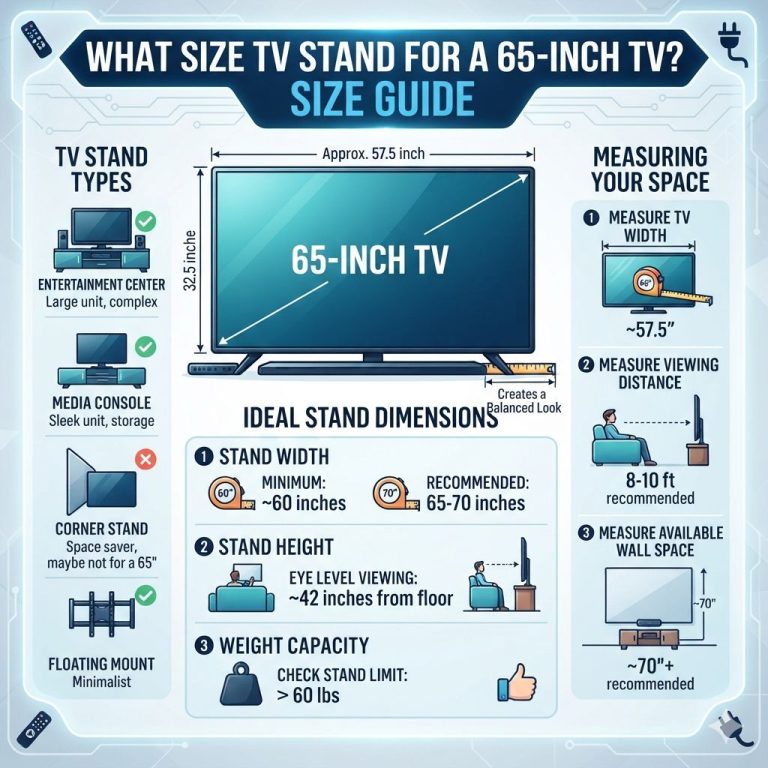
Width matters more than screen size alone because the stand has to support the TV footprint, leave room for components, and still look proportionate. Wayfair classifies small TV stands as under 48 in. wide and long TV stands as over 67 in. wide. The middle width band, about 48 to 67 in., is a common comparison range for many households.
Width classes and common TV fit
Small stands under 48 in. are usually best for a 50 inch TV or a compact 55 inch TV if the screen base is narrow. Standard stands at 48 to 67 in. often fit a 55 inch TV, 60 inch TV, 65 inch TV, and many 70 inch TV setups. Long stands over 67 in. are the safer pick for 75 inch TV models and for 80 inch TVs and larger.
Wayfair also lists common TV sizes up to 75 inch TV and filters for 80 inch TVs and larger, which helps show how closely width and screen class track together in shopping tools. Bestier lists a 60-inch TV stand for 65" TV at $159.99, which is a useful reminder that the label on the listing may reflect the stand’s intended TV fit, not the stand’s own exact width.
Why width matters more than screen size alone
The screen size tells you the diagonal, not the base span. Two 65-inch TVs can have slightly different feet positions and stand footprints, so you still need to check the product page for actual top surface width and any overhang guidance. The TV should not crowd the edges of the cabinet.
For a media console that also has a soundbar, leave enough top surface for the speaker and a little space at the sides. If the stand is too narrow, the setup can look cramped even when the TV technically fits.
TV stand value matrix
The table below shows where premium money tends to matter most. It compares features by price impact, functional value, and the use case where each upgrade is easiest to justify.
| Feature | Price impact | Functional value | Best-fit use case | Threshold to look for |
|---|---|---|---|---|
| Solid wood or high-grade engineered wood | High | High | Main living room, long-term use | Best when the stand is in the $500+ range |
| Width under 48 in. | Low to moderate | Moderate | Small room, 50 inch TV, tight layouts | Choose only if your TV footprint and devices fit comfortably |
| Width 48 to 67 in. | Moderate | High | Most 55 inch to 65 inch TV setups | Best all-around size band for common households |
| Width over 67 in. | High | High | 75 inch TV and 80 inch TVs and larger | Useful when the room can support a larger visual scale |
| Height under 21 in. | Low to moderate | Moderate | Low seating, wall-mounted TV, minimalist look | Best when you want a lower screen line |
| Height 21 to 32 in. | Moderate | High | Most living rooms | Good balance of storage and viewing comfort |
| Height over 32 in. | Moderate to high | High | Extra storage, larger room, higher eye line | Best when you need more enclosed storage |
| Open shelving | Low | Moderate | Easy access to devices | Works when dust control is not the main concern |
| Drawers and closed cabinets | Moderate | High | Living rooms that need hidden storage | Worth paying for when you want a cleaner visual field |
| Built-in LED lighting | Moderate | Low to moderate | Modern decor, display-heavy setup | Worth it when atmosphere matters more than storage |
| Fireplace insert | High | Moderate | Rooms where the warm look matters | Best if you will use the heat and flame effect regularly |
| Stronger cable management | Low to moderate | High | Gaming setups, multi-device consoles | Pay for it when you have several cords and power bricks |
Which premium features are worth paying for?
Pay more for features that improve use every day. LED lighting, charging, better cable control, and a well-built storage layout can justify a higher price when they solve a real setup problem. Decorative upgrades are harder to defend if they do not change function.
LED lighting and charging stations
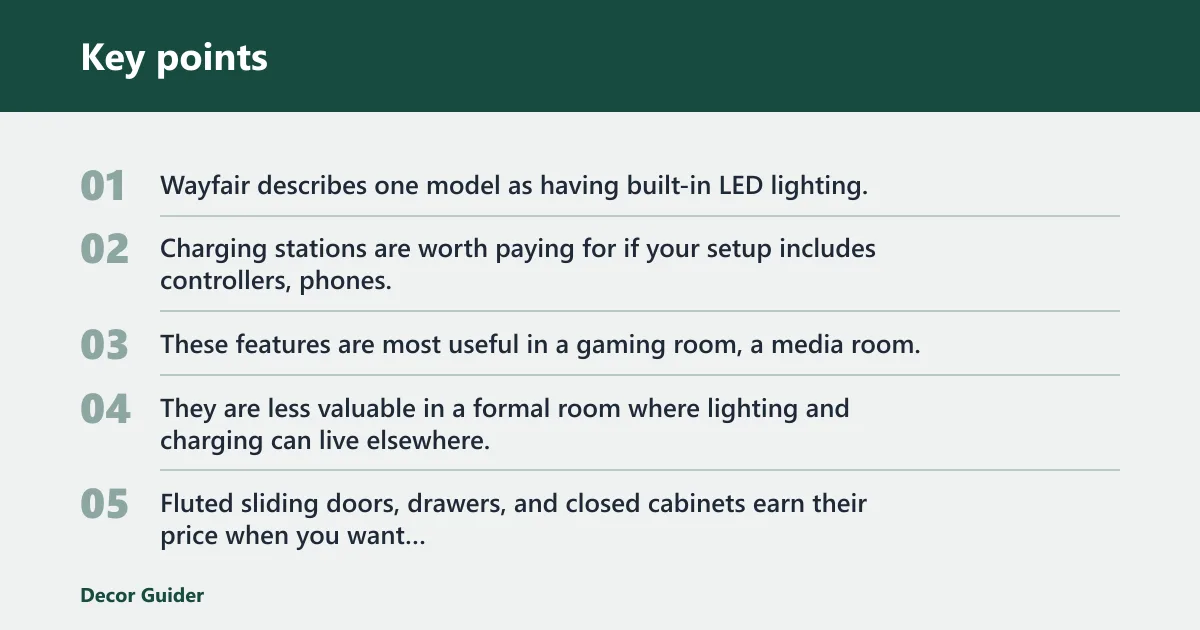
The same source describes one model as having built-in LED lighting, and that feature can make sense in a modern entertainment center with LED lights when the room needs ambient glow or a display-focused look. Charging stations are worth paying for if your setup includes controllers, phones, or tablets that always need a home.
These features are most useful in a gaming room, a media room, or a space that stays dark at night. They are less valuable in a formal room where lighting and charging can live elsewhere.
Fluted doors, closed storage, and cable control
Fluted sliding doors, drawers, and closed cabinets earn their price when you want equipment hidden from view. The same source lists a stand with two drawers and open storage, which is a useful reminder that storage style changes how the stand works, not just how it looks.
Choose better cable management if you are running a console, streaming box, modem, soundbar, and game system at once. That matters more than a decorative front panel because the cables are what create clutter and handling problems.
Fireplace inserts versus TV stand-only options
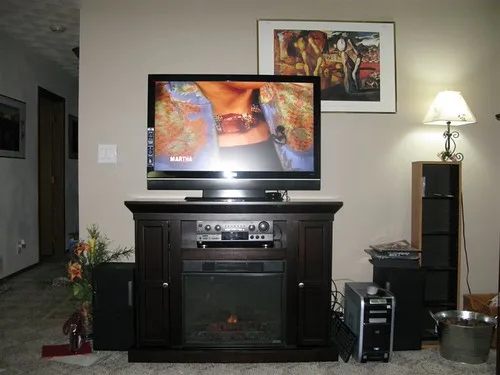
Fireplace TV stand options can make sense, but only when the heat and flame effect are features you will actually use. The same source notes a fireplace option with customizable warmth and realistic flame effects. That can be worth the premium in a family room where ambiance matters and the stand will stay in one place.
Choose the TV stand-only option if you mainly need storage and a stable base. A fireplace insert adds cost, complexity, and usually more weight, so it is not a good buy if you only want a cleaner cabinet with no need for heat or flame visuals.
Suppose you are comparing two stands at similar size. One has drawers, good cable cutouts, and a plain front. The other has LED light strips, a fireplace insert, and glossy trim. If your goal is to hide devices and keep cords under control, the plainer model may be the better premium buy.
What makes a high-end TV stand worth the price?
A high-end TV stand is worth the price when the extra money changes how you use the piece, not only how it looks. The strongest reasons to pay more are better material quality, stronger hardware, a storage layout that fits your devices, and size proportions that suit the room and TV.
Use case filters that matter
- For gaming, prioritize cord management, shelf access, and ventilation over decorative fronts.
- For large TVs, move up to a wider stand so the screen and devices do not crowd the edges.
- For small apartments, choose a width and height that do not dominate the room.
- For a living room that needs closed storage, pay for drawers or cabinets before paying for lighting.
- For style-first rooms, buy the finish you want only after the fit and storage checks pass.
Total ownership cost matters
Sticker price is only part of the bill. Delivery fees, assembly time, and the risk of returns all matter, especially on large or heavy pieces. A lower-priced stand that is hard to assemble or expensive to send back can cost more in practice than a better-built model with clearer instructions.
Check the manufacturer’s instructions for anchoring and load limits whenever the design calls for it. Do not assume the same rules apply across floating, wall-attached, and floor-standing designs.
Premium-style stands and listings with limited lifetime warranty messaging often appear in the upper price range. Galaxy Displays lists the Timberline TV Stand at MSRP: $1,499.99, which shows how a specialty SKU can sit far above the middle of the market when materials and positioning move up.
Frequently asked questions
How much is a tv stand?
For this guide, the comparison bands run from under $150 to $700 & Above. Basic stands can sit below $200, but high-end pricing usually begins around $500 when better materials, hardware, storage design, and finish quality start to drive the cost.
What makes a high-end tv stand worth the price: the best reasons
The best reasons to pay more are solid wood or higher-grade engineered wood, better hardware, a useful storage layout, and cleaner cable management. Decorative trim alone is a weaker reason to spend more unless the finish is a top priority and the fit still works.
How high is a tv stand
Wayfair includes a tall category for stands over 32 in. high. Standard stands usually sit between 21 and 32 in., while low stands are under 21 in. The right height depends on your seating, screen placement, and how much storage you need below the TV.
How big is a tv stand?
Width matters most. Wayfair classifies small stands as under 48 in. wide and long stands as over 67 in. wide. The middle band, 48 to 67 in., fits many 55 inch to 65 inch TV setups, while 75 inch TV and 80 inch TVs and larger usually need wider support.
What price range is considered high-end for tv stands
High-end usually starts around $500 and can climb well past $2,000 depending on materials and features. The jump is easier to justify when the stand uses premium construction, offers better storage, or includes specialty features such as a fireplace insert or built-in lighting.
Are LED and fireplace TV stands more expensive?
Yes, they usually cost more because they add parts and complexity. The same source notes built-in LED lighting and a fireplace option with customizable warmth and realistic flame effects. Those features are worth paying for when you will use them often; otherwise, they are mainly visual upgrades.
Products related to this article
Sponsored / affiliate links. As an Amazon Associate I earn from qualifying purchases. I may earn additional commission from eligible campaigns.