HexClad Cookware Review: Is It Worth It?
HexClad is worth it if you cook with the same pan for eggs, sautéing, and browning, and you want easier cleanup plus metal-utensil tolerance. If your goal is the lowest price per pan or the best pure nonstick, skip it. A poor fit means premium pricing for features you may not need, and replacement costs rise when expectations miss the mark. This guide breaks down who benefits, who should skip it, and the full ownership cost.
This guide is part of our Cookware materials and safety guide series.
HexClad value: when the hybrid surface makes sense
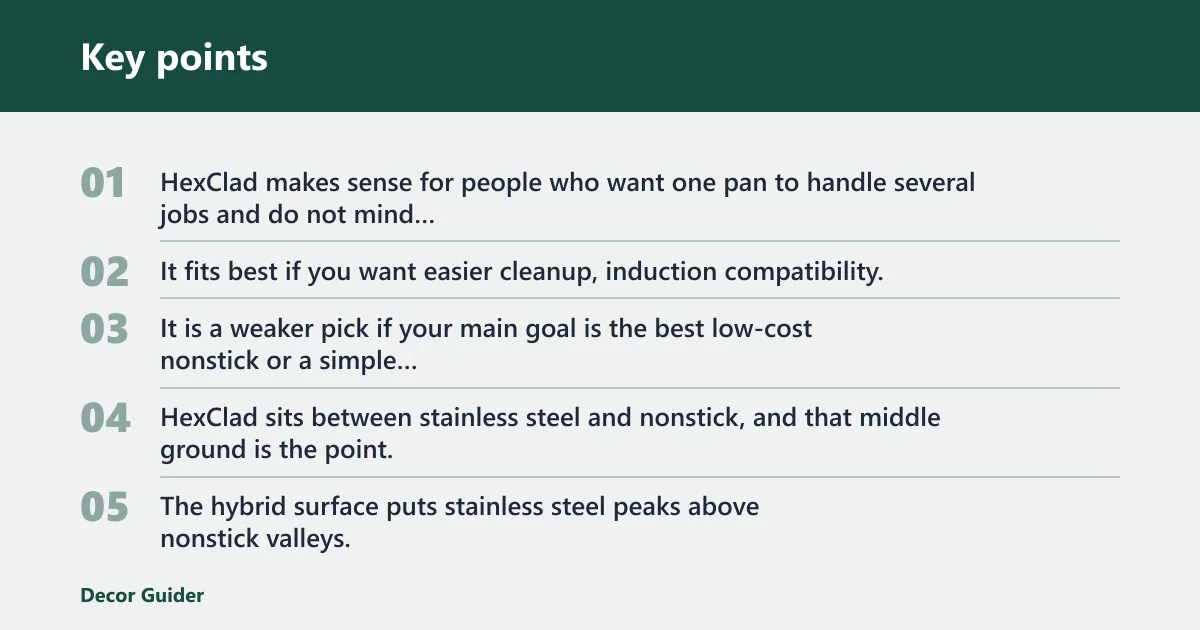


HexClad makes sense for people who want one pan to handle several jobs and do not mind paying for that flexibility. It fits best if you want easier cleanup, induction compatibility, and a surface that holds up better to metal utensils than standard nonstick. It is a weaker pick if your main goal is the best low-cost nonstick or a simple stainless pan.
Bottom line on value
HexClad sits between stainless steel and nonstick, and that middle ground is the point. The hybrid surface puts stainless steel peaks above nonstick valleys, so you get more browning than a traditional nonstick pan while keeping some release benefits. That tradeoff can work well, but it is not free.
The brand also says its cookware is dishwasher safe, metal utensil safe, PFAS-free, and covered by a lifetime warranty. Those claims help explain the price, yet they do not change the fact that the pans are still coated cookware and not a full substitute for every stainless or cast-iron use case.
What HexClad is and how it works
HexClad cookware uses a hybrid surface: stainless-steel peaks sit above nonstick valleys. That design aims to give you more direct contact for browning while keeping some release and easier cleanup. It also puts the pans between all-stainless cookware and traditional coated nonstick, not above both.
What the TerraBond coating changes
That matters for buyers avoiding PFAS-based cookware. It does not remove the basic tradeoff of coated pans: release is usually better with enough oil and proper preheating, while durability still depends on use and care.
Review coverage has also noted concern around coating changes and the settlement context tied to marketing claims about nonstick chemistry. For a cautious buyer, the key point is simple: if you avoid coating-based cookware entirely, HexClad should not be your first choice even with the PFAS-free claim.
Cooktop compatibility and induction
HexClad says its cookware works on all cooktops, including induction. Good Housekeeping also reports all-cooktop compatibility, which makes the brand easier to fit into mixed kitchen setups. That broad compatibility is a real advantage if you may move from gas to induction later.
Pros and cons
Pros
- Good searing for a hybrid pan, especially compared with standard nonstick.
- Dishwasher-safe positioning makes cleanup simpler than many stainless options.
- Metal utensil tolerance is useful for people who do not want to baby a pan.
- All-cooktop compatibility, including induction, gives it broader utility.
- The lifetime warranty adds value if you plan to keep the pans a long time.
Cons
- Price is high for a coated pan line.
- Eggs can still stick without enough oil or proper preheating.
- Round handles can feel slippery when greasy or wet.
- Some review coverage notes scratch risk on glass cooktops.
- The coating is still a wear item, so it is not a no-maintenance purchase.
Who is HexClad for?
HexClad is for you if you want one pan that can move between eggs, sautéing, and browning without switching materials every time. It also fits kitchens that need induction compatibility and cooks who want a pan that asks less from their utensils. It is not the best pick if you want the cheapest path to reliable nonstick.
Best for limited-space kitchens
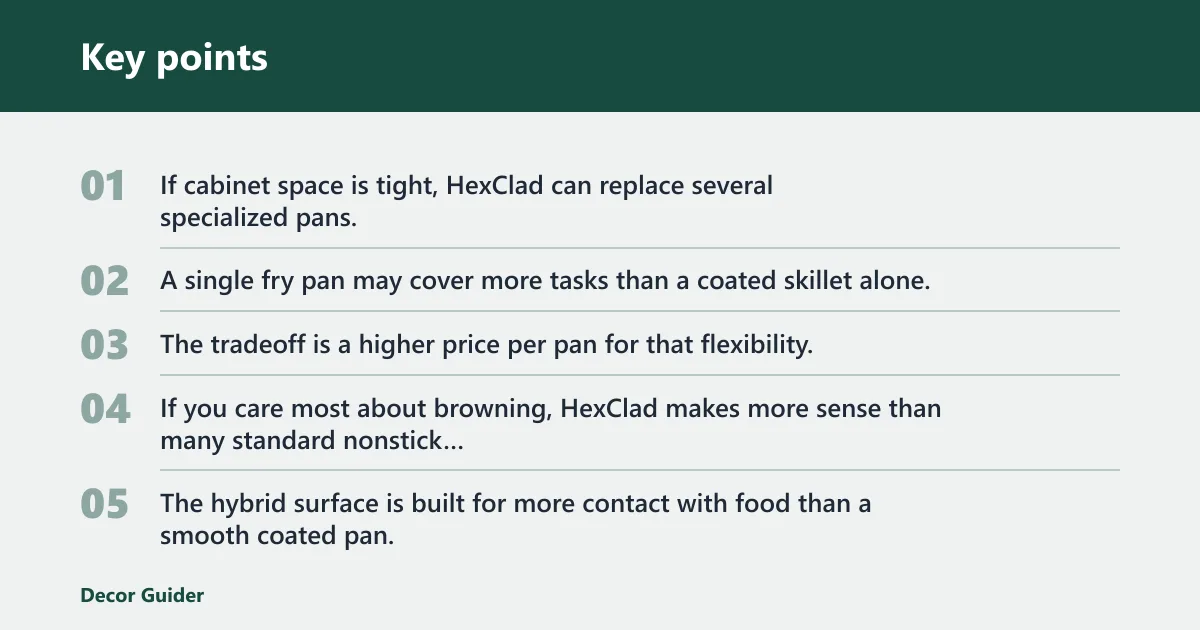
If cabinet space is tight, HexClad can replace several specialized pans. A single fry pan may cover more tasks than a coated skillet alone, and the all-cooktop compatibility helps if your kitchen setup changes. The tradeoff is a higher price per pan for that flexibility.
Best for high-heat searing
If you care most about browning, HexClad makes more sense than many standard nonstick pans. The hybrid surface is built for more contact with food than a smooth coated pan. That said, stainless steel still remains the better choice for cooks who want the most direct sear and the least coating concern.
Best for buyers who want one pan that can do many jobs
This is the buyer who gets the most value. Suppose you want a 12-inch pan for chicken thighs, a fried egg breakfast, and a quick pan sauce, all on an induction cooktop. HexClad can cover that spread better than a brittle nonstick pan, but you still need to accept a higher entry price.
HexClad cookware decision table
| Buyer profile | Cooking priority | Buy? | Reason | Tradeoff |
|---|---|---|---|---|
| Apartment cook with one skillet and little storage | Best for limited-space kitchens | Yes | One hybrid pan can cover browning, sautéing, and easy cleanup in a small setup. | You pay a premium for versatility. |
| Home cook who wants steakhouse-style browning | Best for high-heat searing | Yes, with limits | The hybrid surface gives better searing than standard nonstick. | Stainless steel still wins for pure sear control. |
| Buyer who wants the easiest egg release with minimal fat | Best for low-oil egg cooking | No | Eggs can stick unless you use enough oil and preheat properly. | Traditional nonstick is a better fit. |
| Kitchen with induction or mixed cooktops | Best for glass cooktops | Yes, but use care | It works on all cooktops, including induction, and fits more kitchen setups. | Review coverage notes possible scratching on glass surfaces. |
| Buyer avoiding coated cookware altogether | Best for buyers avoiding coated cookware | No | Even with PFAS-free claims, it is still a coated hybrid pan. | Stainless steel or cast iron is the cleaner fit. |
Does HexClad work on induction?
Yes. HexClad says its cookware is compatible with all cooktops, including induction, and Good Housekeeping reports the same. That makes it a practical option if you already cook on induction or may switch later. The bigger buying question is not compatibility, but whether the hybrid surface fits your cooking style.
Glass cooktops and scratch risk
Glass cooktops deserve special attention because Prudent Reviews says HexClad can scratch them. That does not make the pans unusable on glass, but it does mean you should move them carefully, avoid dragging, and keep the bottom clean. If you are very concerned about visible wear on a glass top, stainless or lighter pans may be safer.
Handle design and heat proximity
Prudent Reviews says HexClad’s pans have a round handle design, and it also notes that the 12-inch fry pan handle is 8 inches long. The shape can feel slippery when wet or greasy, and the shorter handle on a large pan can put your hand closer to heat. That matters more on a hot burner than on a cool counter.
Picture a 12-inch skillet on a front burner with a full handle grip and a wet towel. The round profile makes control less secure than a flatter handle, so the pan can feel awkward during a quick toss or move to the oven.
Price, warranty, and ownership cost
HexClad is expensive, and the entry prices make that clear. The 12-piece set is priced at $699, and the 6-piece hybrid fry pan set is priced at $399. Competitor pages also show single-pan prices in roughly the $109 to $229 range, so buying pieces one by one can still add up fast.
Set prices versus single-pan prices
Those numbers matter because value depends on how many pieces you actually need. If you only want a fry pan, a large set may not be the best path. If you need a multi-pan setup for induction and want one product family, a set may be easier to justify than piecing together separate cookware from different brands.
Cost per year and replacement scenarios
Most reviews stop at sticker price, but ownership cost is about lifespan too. If a $699 set lasts around ten years, the set cost works out to about $70 per year before replacement or wear. If it lasts around five years, that works out to about $140 per year. That is why the price only makes sense if you actually use the hybrid features.
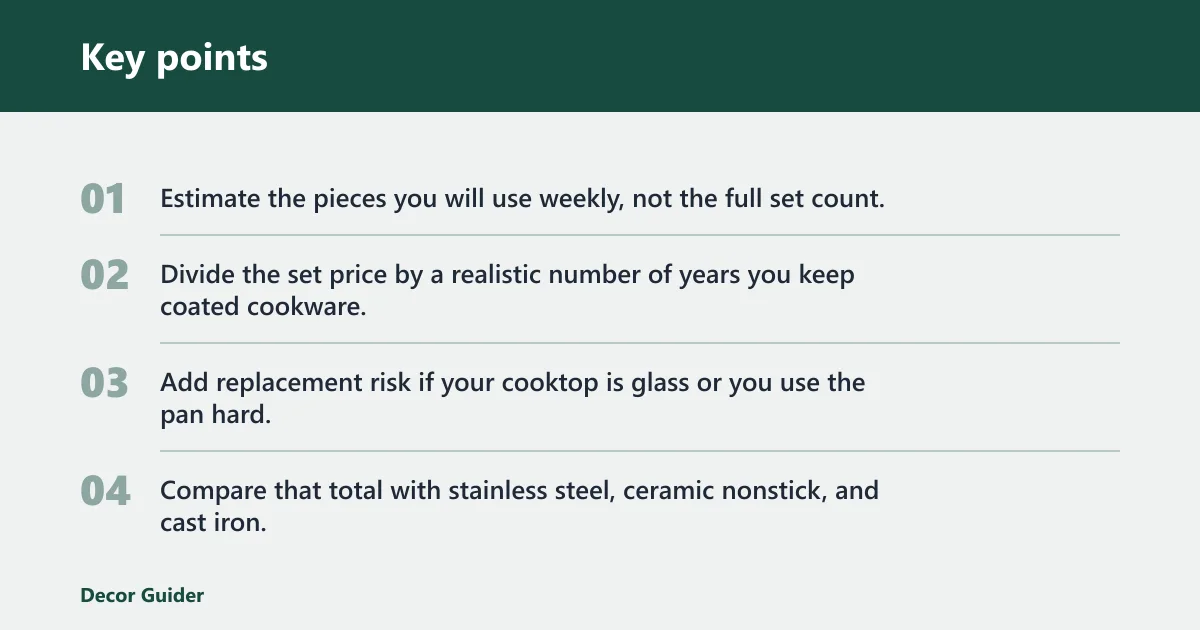
- Estimate the pieces you will use weekly, not the full set count.
- Divide the set price by a realistic number of years you keep coated cookware.
- Add replacement risk if your cooktop is glass or you use the pan hard.
- Compare that total with stainless steel, ceramic nonstick, and cast iron.
Say you cook eggs three mornings a week and also need a pan for searing salmon twice a week. A single HexClad fry pan may be worth the premium if it replaces two separate pans. If you only make eggs once a week, the math usually points elsewhere.
Warranty, durability, and the lawsuit context
HexClad says its cookware has a lifetime warranty, which helps if a defect shows up. That claim should not be confused with indestructibility. Metal-utensil-safe positioning does not mean the pan will never wear, and it does not remove the possibility of scratches on glass cooktops or gradual coating change over time.
Metal-utensil-safe claims versus real wear
The brand’s metal-utensil-safe message is useful for everyday use, especially if you switch between spatulas and tongs. It is still smart to avoid sharp scraping and hard contact on delicate surfaces. Compared with traditional nonstick, HexClad should generally hold up better, but compared with stainless steel, it still has a coating layer to think about.
What the settlement context means for cautious buyers
Good Housekeeping says the lawsuit alleged misleading claims about nonstick coating chemistry. The brand says its cookware is PFAS-free and that the TerraBond coating update applies across its lineup. For cautious shoppers, the practical takeaway is not to treat marketing language as a substitute for the cookware category itself.
If you want to avoid coating-based cookware altogether, no settlement context changes that decision. Stainless steel, cast iron, and carbon steel remain the more direct choices. HexClad is for buyers who accept a coated hybrid pan and want the performance tradeoffs that come with it.
Frequently asked questions
Is HexClad a good cookware brand?
HexClad is a good cookware brand for buyers who want a hybrid pan that can sear, clean up fairly easily, and work across cooktops, including induction. It is less appealing if you want the cheapest cookware or a true nonstick replacement with the fewest tradeoffs.
Is HexClad cookware good?
HexClad cookware is good for mixed-use cooking, especially if you want more browning than standard nonstick and you value dishwasher-safe and metal-utensil-safe positioning. It is not the best choice for every kitchen task, and eggs still need oil and proper preheating.
Is HexClad cookware healthy?
HexClad says its cookware is PFAS-free, which is the main health-related claim many shoppers are checking. That said, “healthy” is not a performance label. If you want to avoid coated cookware altogether, stainless steel or cast iron is a cleaner fit for that preference.
What is special about HexClad cookware?
What is special is the hybrid surface: stainless steel peaks over nonstick valleys. That setup tries to split the difference between stainless and coated pans. The appeal is versatility, not perfection, so the cookware is most useful when you want one pan to do several jobs well enough.
HexClad vs Made In cookware
HexClad vs Made In comes down to priorities. HexClad gives you hybrid convenience, induction compatibility, and easier cleanup. Made In is the more straightforward choice if you want stainless steel performance without a coating layer. If you dislike coating questions, Made In is the simpler buy.
How long does HexClad last?
HexClad says it has a lifetime warranty, but warranty and lifespan are not the same. A well-kept pan can last far longer than traditional nonstick, while hard use on a glass cooktop or heavy scraping can shorten that life. The coating is still the part you are managing over time.
Products related to this article
Sponsored / affiliate links. As an Amazon Associate I earn from qualifying purchases. I may earn additional commission from eligible campaigns.