How to Store Large Roasting Pans After the Holidays
Sort large roasting pans and oversize bakeware by size and material, then store the flattest pieces vertically and the heaviest flat pieces in a low cabinet, keeping lids and inserts with their matching pan. Poor storage scratches nonstick and enamel surfaces, bends rims, and turns deep cabinets into a pile-up. This guide shows how to choose a storage method for the exact space you have after the holidays.
Why large roasting pans and oversize bakeware get hard to store
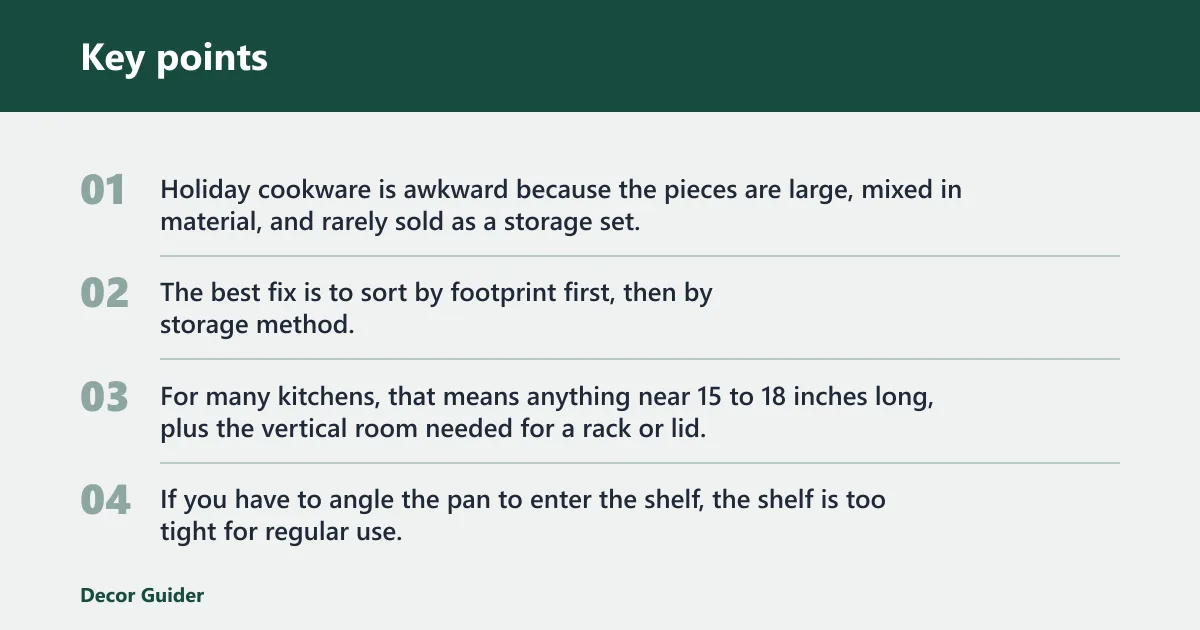


Holiday cookware is awkward because the pieces are large, mixed in material, and rarely sold as a storage set. A 16-by-13-inch roasting pan can need a deeper shelf than a standard 12-by-9-inch casserole dish, while a removable rack, lid, or insert adds one more part to misplace. The best fix is to sort by footprint first, then by storage method.
“Oversize” in storage terms usually means a pan that is wider or deeper than your everyday cabinet opening can take without tilting. For many kitchens, that means anything near 15 to 18 inches long, plus the vertical room needed for a rack or lid. If you have to angle the pan to enter the shelf, the shelf is too tight for regular use. If a rim is warped, the piece may also wobble, scrape adjacent bakeware, or fail to nest cleanly, so treat damaged rims as a storage problem, not just a cosmetic one.
What you’ll need
- Measuring tape
- Felt or silicone dividers
- Cabinet shelf liner
- Vertical pan organizer with slots sized for rectangular bakeware
- Lidded storage bin for seasonal cookware
- Labels or masking tape and marker
- Soft drying cloth
- Rust-free, fully dry storage space
What should you measure first?
Measure the pan footprint, then measure the cabinet or pantry opening that has to receive it. If the pan is 16 by 13 inches, the shelf needs more than that in clear width and depth, plus enough height for the rim, handles, or a stacked rack. Those numbers decide whether you store the piece flat, upright, or offsite.
Pan footprint and depth
Record the outside length and width, not the cooking surface alone. A large roasting pan often has high side handles or a domed cover, and those parts change the true storage footprint. For oversize bakeware, also note whether the piece is straight-sided, tapered, or warped, because that affects nesting and stacking. Domed lids need extra vertical clearance even when the pan itself fits, and glass or ceramic casseroles need more protection from chips than plain metal pieces do.
Cabinet or pantry clearance
Measure usable shelf depth and vertical clearance, then leave room for safe access. A shelf that is only about 14 inches deep will not hold many roasting pans flat without overhang. Deep cabinet and pantry shelves work best when the pan slides in without force, and when the weight sits low enough that the shelf does not bow. If you have to lift the front edge high to enter the shelf, vertical storage is usually the better choice.
Racks, lids, and inserts
Store the rack with the pan if the rack is removable. That keeps the set complete and prevents a missing rack next season. Add the lid or insert to the same storage plan only if it fits without pressure; if it does not, use a divider or a separate labeled slot so parts do not scrape each other. Bare metal should not contact nonstick, enamel-coated, glass, or ceramic surfaces without padding, because those finishes chip and scratch more easily than unfinished steel.
- Measure every piece. Write down length, width, and stack height for each roasting pan, sheet pan, lasagna pan, casserole dish, lid, and rack. If a lid adds about 1 to 2 inches of height, count that in the total.
- Match the storage space. Compare those numbers with your cabinet shelf, pantry shelf, organizer slot, or bin. If the fit requires forcing, pick another method instead of compressing the piece into place.
- Group matching parts. Put each pan with its rack, lid, or insert before you store anything. Use a label or a paper note inside the bin so related pieces stay together.
How should you store large roasting pans?
Large roasting pans store best flat in a deep cabinet or pantry shelf when you have enough room, or upright in a pan organizer when cabinet width is tight. Stainless steel and aluminized steel tolerate closer contact if they are fully dry, but nonstick pans need separation to avoid abrasion. If the piece is bulky or seasonal, a labeled bin can be the safer choice.
Store flat in deep shelves
A deep cabinet or pantry shelf works well when the pan lies fully supported and does not overhang. Flat storage is the simplest option for a heavy pan because it avoids rim pressure and makes retrieval easy. Use a shelf liner if the pan slides around, and place the heaviest pieces on a lower shelf to keep weight controlled. Flat storage is also the better choice when a domed lid would otherwise force the pan to lean.
Use vertical storage when width is limited
A vertical pan organizer helps when the shelf is deep but narrow. Look for a unit with slots that fit rectangular bakeware and enough height for the tallest piece you own. Keep similar weights together in adjacent slots so a heavy roasting pan does not press against a thin sheet pan and bend it. If the pan has a warped rim, vertical storage still works only when the slot supports the piece without making it twist.
Use a bin for seasonal cookware
If you only use the pan once or twice a year, a lidded storage bin can protect it from dust. This is useful for offsite storage, an overhead closet, or under-bed space. Add a label on the outside with the pan size, material, and any matching rack or lid that goes inside. Under-bed storage is usually better for lighter pieces and flatter profiles, while an overhead bin works only if the cookware is light enough to lift safely and the container can be lowered without bumping the lid or handle.
- Clean and dry completely. Wash the pan, then dry the rim, corners, and handles until no moisture remains. Trapped moisture encourages rust on steel bakeware and can leave spots on steel finishes.
- Separate the surface. Place felt or silicone dividers between stacked pans, lids, or inserts. Use nonstick-safe separators so metal edges do not scrape the coating.
- Store by weight. Put heavier roasting pans and casserole dishes on the lowest shelf or in the deepest slot. Keep lighter sheet pans above them so the stack does not tip.
- Add the matching rack. Slide the roasting rack into the same slot, bag, or bin as the pan. That avoids hunting for a missing piece next season.
Where does oversized bakeware fit best?
Oversized bakeware fits best where the shelf depth and vertical clearance match the piece, not where there happens to be a gap. Deep cabinet and pantry shelves work for flat storage, a vertical pan organizer works for rectangular pieces with similar footprints, and a lidded bin works when you need dust protection or seasonal offsite storage.
Deep cabinet and pantry shelves
Sheet pans, lasagna pans, and casserole dishes often fit a deep shelf better than a standard cabinet. Nesting works only when the pieces are the same shape and fully dry. If the piece rocks, warps, or catches on a lip, do not force it into the stack. That pressure can worsen bend marks and chip edges. Glass and ceramic casseroles should not sit directly against bare metal edges, since even a small bump can leave a chip.
Vertical pan organizer
Vertical organizers are useful for sheet pans, roasting pans, and baking trays that are rectangular and easy to grasp by the edge. Check slot width before you buy one. The organizer should hold the pans upright without making them lean, and it should fit the cabinet height with enough room to remove one pan without dragging the others. Vertical storage fails when the slot is so tight that the pan scrapes as it enters or exits, or when the pan is too heavy for one-handed removal without tipping the organizer.
Lidded seasonal storage bin
Use a lidded bin when the cookware is holiday-only or when kitchen cabinets are full. Choose a bin that allows the pan to lie flat with a divider between each piece. If you store the bin in a garage, attic, or closet, label it clearly and keep it away from damp floors or heat sources. For domed lids, store them separately if the bin lid or side walls press on the dome; pressure can crack glass lids and chip enamel edges.
Suppose a 16-by-13-inch nonstick roasting pan includes a removable rack and a domed lid. A flat shelf can still work, but only if the lid sits separately with a felt pad between it and the pan. If the shelf is too shallow, the same set is better in a vertical organizer with the rack stored beside the pan, not under it.
Holiday bakeware storage map
| Item type | Approximate footprint | Best storage orientation | Protection needed | Ideal location |
|---|---|---|---|---|
| Large roasting pan | About 15 to 18 in. long; 11 to 14 in. wide | Flat in a deep shelf or upright in a vertical organizer | Felt or silicone divider; dry surface; rack stored with it | Low cabinet, deep pantry shelf, or labeled seasonal bin |
| Roasting rack | Matches the pan footprint | Stored with the pan, either stacked flat or beside it in a slot | Divider or wrap to prevent scratches and loss | Same cabinet slot or same bin as the pan |
| Sheet pans | Commonly 18 by 13 in. for full size | Upright in a slot organizer or flat in a deep shelf | Space between pieces; no tight squeeze for warped pans | Vertical organizer or wide pantry shelf |
| Lasagna pans | Often 13 by 9 in. to 16 by 12 in. | Flat when nesting is stable; upright if cabinet height is limited | Divider between glass, ceramic, or metal pieces | Cabinet shelf with enough vertical room |
| Casserole dishes | Usually 9 by 13 in. or similar | Nested only if edges align and no piece is warped | Soft liner between stacked dishes | Mid-level cabinet or pantry shelf |
| Lids | Usually slightly larger than the dish opening | Vertical in a divider or flat on top of a matched set | Padding to prevent chips, scratches, or rattling | Same organizer lane or same labeled bin |
Common mistakes
The biggest storage mistakes are easy to avoid once you know the failure points. Nonstick coatings scratch when they rub against bare metal, so do not stack coated pans without a divider. Heavy cookware on an upper shelf can sag the shelf over time, and a warped pan should not be forced into a narrow slot because that bends the rim further.
Another problem is splitting a set. A pan in one cabinet and the rack in another cabinet becomes a lost part by next season. Keep the set together in one labeled place. For steel bakeware, dry storage matters more than clever stacking; if moisture is trapped between pans, rust can form in seams and corners. Enamel-coated pans and glass or ceramic casseroles need extra padding at contact points because bare metal edges can chip or scratch them during storage.
A common mistake is putting about a 17-inch roasting pan in an oven cavity because it seems convenient. That can work only if the oven is completely cool, empty, and dry, and the pan does not block airflow or touch heating elements. For most kitchens, a dedicated shelf or bin is a safer storage choice. Oven storage is also a poor long-term solution when the pan has a domed lid, since the lid can slide, rattle, or collect grease and dust.
- Do not stack nonstick pans bare. Use felt or silicone dividers to prevent coating damage.
- Do not overfill a shelf. Leave enough room to remove the pan without dragging metal edges across it.
- Do not store damp metal. Dry seams, corners, and handles before closing a bin or cabinet.
- Do not force warped pieces. If a pan no longer sits flat, give it extra room or keep it upright.
How do I organize holiday cookware so it is easy to find next year?
Group the pan, rack, lid, and any insert into one labeled location, then store the set by size or holiday use. Put the label on the shelf edge, bin lid, or organizer front so you can spot it quickly. Keep the heaviest pan low, the lighter bakeware above it, and the seasonal pieces in one repeatable place. If you keep both everyday and holiday cookware together, group by frequency of use so the most-used pieces stay easiest to reach.
Frequently asked questions
How do I keep lids, racks, and bakeware inserts together?
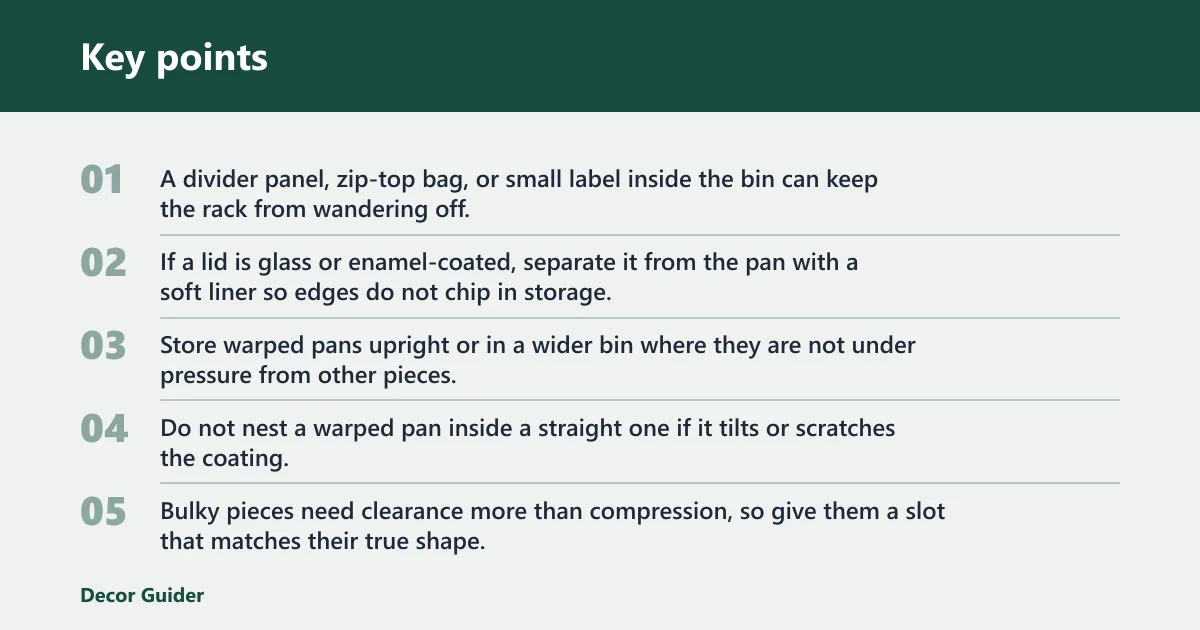
Use one storage lane per set. A divider panel, zip-top bag, or small label inside the bin can keep the rack from wandering off. If a lid is glass or enamel-coated, separate it from the pan with a soft liner so edges do not chip in storage. Domed lids need enough room to sit without pressure; if they touch the bin top, move them to a flatter lane or separate container.
What is the best way to store warped or bulky bakeware?
Store warped pans upright or in a wider bin where they are not under pressure from other pieces. Do not nest a warped pan inside a straight one if it tilts or scratches the coating. Bulky pieces need clearance more than compression, so give them a slot that matches their true shape. If the rim has lost its shape, flat storage may cause rocking, while vertical storage can reduce contact stress.
Can I prevent rust on metal roasting pans during storage?
Yes. Dry the pan completely, including seams, rivets, and handles, before storage. Stainless steel resists rust better than plain steel, and aluminized steel also holds up well when kept dry. A lidded bin helps only if moisture is not trapped inside, so never close in a damp pan. Bare metal should also stay off damp concrete, since moisture transfer can start corrosion even when the pan looks dry.
Can I store roasting pans in the oven when they are not in use?
Only if the oven is cool, clean, and empty, and the pan does not press against racks or heating elements. Oven storage is best for a short hold, not as a primary system. If you bake often, a cabinet or organizer is usually safer and easier to access. Do not use oven storage for pans that are heavy, warped, or paired with lids that could shift unexpectedly when the oven is reopened.
Can roasting pans be stacked without scratching the nonstick coating?
Yes, but only with protection between each contact point. Use felt or silicone dividers, and keep metal racks or lids from rubbing directly against the coated surface. If the pan is scratched already, reduce further wear by storing it separately from rough-edged bakeware. For a coated pan, a nonstick roasting pan should never rest directly against bare metal if you want the coating to last longer.
What storage solutions work for extra-large sheet pans and lasagna pans?
Use a deep shelf, a vertical pan organizer, or a seasonal bin with dividers. Extra-large sheet pans often fit upright better than flat if your cabinet is short on depth. Lasagna pans fit flat only when the shelf is wide enough to support the full base without overhang. If the pans are too tall for a standard shelf, split the set so the heaviest pieces stay low and the lighter ones move to a higher lane.
If your kitchen has one deep shelf, start there. If that shelf is crowded, use a vertical organizer for the pans you reach most often and move the holiday-only pieces into a labeled bin. That keeps the collection easy to sort next year without rebuilding the whole system.
Products related to this article
Sponsored / affiliate links. As an Amazon Associate I earn from qualifying purchases. I may earn additional commission from eligible campaigns.