Small Space Cookware Safety: Compact Sets That Cook Safely
For small kitchens, a 3- to 5-piece set is a common fit, with oven-safe riveted handles, a flat base, and coatings or metals rated for medium to medium-high heat. The wrong set can warp, run too hot, or waste storage space you do not have. This guide compares safety by material, heat limits, handle and lid design, and storage-friendly features.
Best default setup: A stainless steel skillet plus a stainless saucepan is the safest all-purpose compact setup for most small kitchens. It handles browning, boiling, and acidic foods well, and it stores easily.
Best for medium heat: Stainless steel or anodized aluminum works best for steady medium-heat cooking. Stainless is the broadest choice; anodized aluminum is lighter if the maker’s heat guidance stays within limits.
Avoid for acidic foods: Skip long cooking or storage of acidic foods in uncoated cast iron and in scratched or uncoated copper. Some damaged glazed ceramics and glass pieces also deserve caution.
What makes compact cookware safe?


Compact cookware is safest when the cooking surface suits the food, the handles stay easy to move, and the pieces fit your storage without risky stacking. In a small kitchen, safety also depends on a flat base, a lid that fits, and clear maker instructions for heat, utensils, and cleaning.
Nonreactive surfaces and acid foods
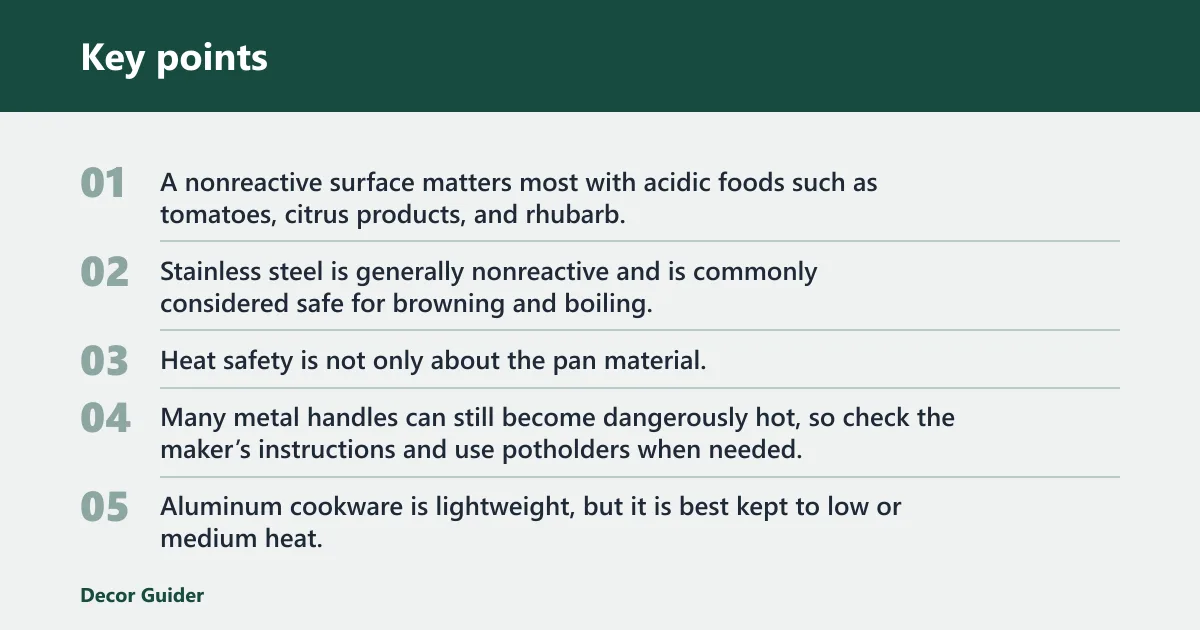
A nonreactive surface matters most with acidic foods such as tomatoes, citrus products, and rhubarb. Stainless steel is generally nonreactive and is commonly considered safe for browning and boiling. Cast iron can work well for many tasks, but long cooking or storage of acidic foods in uncoated cast iron is not a good idea.
That distinction matters more in a small kitchen because one pan often has to cover several jobs. If you only have room for a few pieces, one safe general-purpose pan is more useful than a larger set with weak lids or a coating that wears fast.
Heat limits, handles, and lids
Heat safety is not only about the pan material. Handles that are designed for safe gripping, lids that fit without rattling, and oven-safe parts all affect whether a compact set works in a tight cooking area. Many metal handles can still become dangerously hot, so check the maker’s instructions and use potholders when needed. Aluminum cookware is lightweight, but it is best kept to low or medium heat.
For small-space cooks, that can be a useful limit rather than a drawback. A medium-heat set that stacks well and has secure handles is often safer than a bulky set that invites overload on a burner or reaching over hot, loose pieces.
Wear signs that change safety
Wear changes the safety profile of almost every material. Scratched nonstick, worn anodized surfaces, uncoated copper, cracked enamel, warped bases, loose lids, and hot handles all deserve attention. If a piece no longer sits flat or its coating is breaking down, treat that as a safety problem, not only a cosmetic one.
Wear also matters because small kitchens ask more from fewer pieces. A pan used daily for eggs, sauces, and reheats needs a longer useful life than a specialty pan that comes out once a month.
Stainless steel, cast iron, and anodized aluminum
These three materials make the strongest compact-core choices for many cooks, but they do different jobs. Stainless steel is strong and long-lasting, cast iron retains heat and is durable and versatile, and anodized aluminum is lightweight, durable, and easier to store.
Stainless steel for browning and boiling
Stainless steel is usually the safest all-purpose choice when you want one pan to handle browning, boiling, and acidic sauces. Its nonreactive surface makes it a strong fit for tomatoes and citrus, and its resistance to rusting and staining helps in kitchens where storage is tight and drying space is limited.
It is also the easiest material to justify in a compact set because it does not depend on a fragile coating. A stainless skillet and a small saucepan can cover much of daily cooking without special storage conditions.
Cast iron for heat retention and seasoning
Cast iron is best when you want steady heat and a durable pan that can move from stovetop to oven. It retains heat well, which helps with searing and shallow baking. The tradeoff is care: seasoning matters, and acidic foods should not sit in uncoated cast iron for long periods.
That makes cast iron a strong secondary pan rather than a universal answer. In a small kitchen, the weight also matters because a heavy pan stored above shoulder height is harder to handle safely.
Anodized aluminum for light, hard-wearing use
Anodized aluminum fits small kitchens well when you want a lighter pan that cleans easily and resists scratches. It is durable and easier to move in and out of tight cabinets. If the pan also has a separate nonstick coating, treat that coating according to the maker’s heat and utensil limits.
Use it with care if the anodized surface is scratched or worn. Wear to the anodized body is different from damage to a separate nonstick coating, so inspect both before you keep using the pan.
Are nonstick pans safe for apartment cooking?
Nonstick pans can be suitable for apartment cooking when used within the maker’s temperature limits, kept from overheating, and replaced before the coating is scratched or flaking. They are often useful for eggs, quick reheats, and low-fat cooking, but they are not the best choice for high heat or rough utensils.
When nonstick fits eggs and quick cooking
Nonstick works best for eggs, pancakes, delicate fish, and fast reheats that do not need strong browning. In a small apartment kitchen, that can be useful because it cuts cleanup and lets you cook on a smaller burner without much sticking. It is a convenience pan, not a cure-all pan.
Suppose you have room for only one skillet and cook eggs most mornings. A small nonstick pan can be a practical choice, but only if you keep the heat moderate and the surface intact. If the coating starts to wear, the pan stops being a safe shortcut.
Heat damage, scratches, and coating wear
The main failure mode for nonstick is damage. Nonstick coatings can degrade at high heat, and scratched coatings should be avoided. Once the surface is damaged, food contact becomes less predictable and cleanup gets harder, which matters more when you rely on one pan for multiple meals.
Metal utensils, stacking without protection, and overheating all shorten useful life. In a cramped kitchen, those risks are common because pans get piled together and used on busy burners with limited airflow.
How to read the maker’s care limits
Manufacturer instructions are part of the safety decision. Check the maximum heat rating, whether the pan is dishwasher safe, which utensils are allowed, and whether lids or handles have separate limits. If the maker says hand wash only, use that guidance even if the pan looks tough.
Also check whether the nonstick surface is meant for stovetop only or oven use as well. A pan that is safe for eggs at medium heat may still fail if you use it under a broiler or with a hot empty burner.
Copper, ceramic, enamel, and glass cookware
Copper, ceramic, enamel, and glass can all have a place in a compact kitchen, but they fail in different ways. Copper cookware conducts heat well, and ceramic, enamel, and glass each have maker-specific heat limits and handling requirements. The safest choice depends on lining, glaze quality, and wear.
Why lined copper matters
Copper gives excellent heat control, which is useful for sauces and delicate cooking. The main concern is the cooking surface: lined copper is safe when the lining is intact, while scratched or uncoated copper should not be used. If the inner coating is damaged, the pan should be replaced or re-lined.
That makes copper a specialized buy rather than a default compact-set piece. It can be excellent for control, but it demands close inspection and more careful maintenance than a simple stainless pan.
Where ceramic and enamel can fit
Ceramic, enamel, and glass are often easy to clean, and they can work well for baking dishes, some skillets, and serving pieces that move from oven to table. For small kitchens, their main advantage is multi-use convenience when storage space is limited.
Still, glaze quality matters. Damaged, poorly labeled, or heavily worn pieces are not a safe default.
When glass works and when it does not
Glass works well for oven use, reheating, and visual monitoring of food. It is less useful for fast stovetop browning, sharp temperature swings, or cramped burners where weight and breakage are concerns. A glass piece can be safe, but it is not usually the best daily stovetop pan in a small apartment.
Use it where its strengths matter most: baking, storage, and reheating. Skip it if you need a pan that moves often between burners, sink, and cabinet in a narrow workspace.
Compact cookware safety matrix
The matrix below turns material safety into small-space decisions. Scores use a 1-to-5 scale, with 5 indicating better fit on the factor named in each column. The ratings are practical judgments for compact kitchens, not lab measurements, and each material is weighed against the same set of small-kitchen needs.
| Configuration | Safety | Storage efficiency | Heat tolerance | Acid-food suitability | Maintenance burden | Burner size fit | Weight / handling risk | Stackability | Keep or skip | Rationale |
|---|---|---|---|---|---|---|---|---|---|---|
| 1 stainless skillet + 1 stainless saucepan | 5 | 4 | 5 | 5 | 3 | Good on small or medium burners | Moderate | Good with nested lids | Keep | Broad-use, nonreactive, and dependable for most small kitchens. |
| 1 stainless skillet + 1 seasoned cast iron skillet | 5 | 3 | 5 | 4 | 2 | Better on medium burners | High | Fair | Keep | Strong for searing and oven use, but heavier to store and lift. |
| 1 anodized aluminum skillet + 1 saucepan | 4 | 5 | 3 | 4 | 3 | Good on small burners | Low | Excellent | Keep | Lightweight and easy to store, but not the best choice for higher heat. |
| 1 ceramic nonstick skillet + 1 stainless saucepan | 4 | 4 | 3 | 4 | 3 | Good on small burners | Low to moderate | Good | Keep | Useful for eggs and low-fat cooking when paired with a more durable saucepan. |
| 1 nonstick skillet + 1 nonstick saucepan | 3 | 5 | 2 | 3 | 4 | Best on small burners | Low | Excellent | Skip for high heat | Easy to store, but too limited if you need stronger heat or longer life. |
| 1 lined copper saucepan + 1 stainless skillet | 4 | 3 | 5 | 4 | 2 | Good on medium burners | Moderate | Fair | Keep if lined copper is sound | Excellent control, but only a smart buy when the lining is intact. |
| 1 enamel Dutch oven + 1 stainless skillet | 4 | 2 | 4 | 5 | 3 | Best on medium burners | High | Fair | Keep if storage allows | Very useful for acidic braises and soups, but bulky for tight cabinets. |
| 1 glass casserole + 1 nonstick skillet | 3 | 3 | 3 | 4 | 3 | Best for oven use | Moderate | Fair | Keep for oven use only | Works well for baking and reheating, but is not a daily stovetop foundation. |
| 1 scratched nonstick skillet + 1 aluminum saucepan | 1 | 5 | 2 | 2 | 4 | Best on small burners | Low | Excellent | Skip | Damage and heat limits make this a poor safety choice despite the compact size. |
| 1 warped base skillet + 1 loose-lid saucepan | 1 | 2 | 2 | 3 | 4 | Poor fit on small burners | Moderate | Poor | Skip | Rocking bases and loose lids undermine heat control and safe handling. |
What is the best compact set for your cooking habits?
The best compact set is the one that fits your usual heat level, your food, and your cabinet space. For many small kitchens, a safe 3-piece or 4-piece set beats a larger bundle because every piece has a job. The safest baseline is stainless steel, with seasoned cast iron as another durable option.
3-piece, 4-piece, and 5-piece setups
A practical 3-piece set is often one stainless skillet, one saucepan, and one lid that fits the pan used most often. A 4-piece set can add a second pan, often a small nonstick or a cast iron skillet. A 5-piece set usually works best when one piece handles sauces or reheats and another handles browning.
A small safe set can include one stainless skillet, one cast iron, and one ceramic nonstick skillet. That mix covers browning, eggs, and acidic sauces without forcing you into a bulky bundle.
Best picks for medium-heat cooking
If you cook mostly on medium heat, stainless steel and anodized aluminum are usually the easiest compact choices. Stainless steel handles browning, boiling, and acidic foods well. Anodized aluminum is lighter and easy to store, but it still needs respect for heat limits and surface wear.
For the same cooking style, ceramic nonstick can be a good egg-and-reheat pan if the maker’s limits are clear and you keep the heat controlled. That is a narrower job than stainless steel, but it can still be a smart part of a compact set.
Storage checks before you buy
- Measure cabinet clearance. Check the height, width, and depth of the cabinet or drawer where the set will live. Stackable pieces with nested lids save space and reduce the chance of dents and scratches.
- Check handle shape. Look for handles that do not lock the pieces apart when stacked. Long, bulky handles waste space and can catch on shelves or other cookware.
- Confirm lid fit. Choose lids that sit securely and do not rattle. A loose lid is harder to move safely and less useful for simmering or steaming.
- Match the pan to your heat. If you cook at medium heat most of the time, avoid buying a set that only makes sense at high heat. The right set should match the heat you already use, not the one you may never need.
Say your main burner is small and the cabinet above it is shallow. A tall, heavy pot with a loose lid becomes awkward fast, while a flat stainless saucepan with a snug lid stays safer and easier to reach.
How to know when cookware is worn out and unsafe
Cookware is worn out when its surface, shape, or fit no longer matches safe use. That can mean coating damage, a warped base, a loose handle, a cracked glaze, or a lid that no longer sits properly. Safety changes before the pan looks completely ruined.
- Inspect the cooking surface. Look for scratches, flakes, cracks, or exposed metal where a coating should be intact. Replace or retire the piece if the surface is broken or peeling.
- Check the base for flatness. Set the pan on a level surface and see whether it rocks. A warped base can heat unevenly and create unsafe hot spots on a small burner.
- Test the handles and lid. Wiggle the handle and lid to see whether anything is loose. A handle that shifts or a lid that fits poorly makes a compact set harder to use safely.
A common first-timer mistake is keeping a scratched nonstick pan because it still “works.” It may still cook food, but the safer move is to replace it before the coating keeps degrading under heat and washing.
Frequently asked questions
What cookware is safest for a small kitchen?
For most small kitchens, stainless steel is the safest all-around choice because it is strong, long-lasting, and nonreactive. A compact set with one stainless skillet and one saucepan gives you broad use without much storage demand. Cast iron is also safe if you can handle the weight and keep acidic foods out of uncoated surfaces for long periods.
What cookware should I avoid for acidic foods?
Avoid long cooking or storage of acidic foods in uncoated cast iron, and avoid scratched or uncoated copper. Damaged coatings and worn glaze on some ceramic or glass pieces also raise concern. Stainless steel is the safer default for tomatoes, citrus, and rhubarb because it is nonreactive.
Is stainless steel or cast iron safer for everyday use?
Stainless steel is usually safer for everyday use in a small kitchen because it is nonreactive, lighter to handle, and easier to fit into a compact set. Cast iron is also safe and very durable, but it needs seasoning and more care. For daily acidic cooking, stainless steel is the easier choice.
Can ceramic cookware be safer than nonstick?
It can be, depending on the piece. Ceramic-coated nonstick can be a better fit than standard nonstick if you want a surface that holds up at moderate heat, but it still depends on coating care. True ceramic bakeware is different, and glaze quality matters because some glazed ceramics can transfer lead or cadmium.
What is the safest cookware for small apartments with limited storage?
The safest compact setup is usually 3 to 5 pieces: a stainless skillet, a saucepan, and either a seasoned cast iron or a ceramic nonstick pan if that matches your cooking. Choose stackable pieces with secure lids and oven-safe handles. A small set with flat bases and clear instructions is easier to store and safer to use.
Products related to this article
Sponsored / affiliate links. As an Amazon Associate I earn from qualifying purchases. I may earn additional commission from eligible campaigns.