Cookware Size Chart: Choose the Right Pots and Pans
For many home cooks, a 10- to 12-inch skillet and a 3- to 5-quart saucepan fit everyday meals. Use about 8-inch pans for one or two servings, and about 12-inch pans plus 5- to 8-quart pots for families of four. Too-small cookware crowds food and spills over; too-large pieces waste burner space and heat unevenly. This guide maps inches, quarts, servings, and meal examples into a practical cookware size chart.
Why cookware size matters
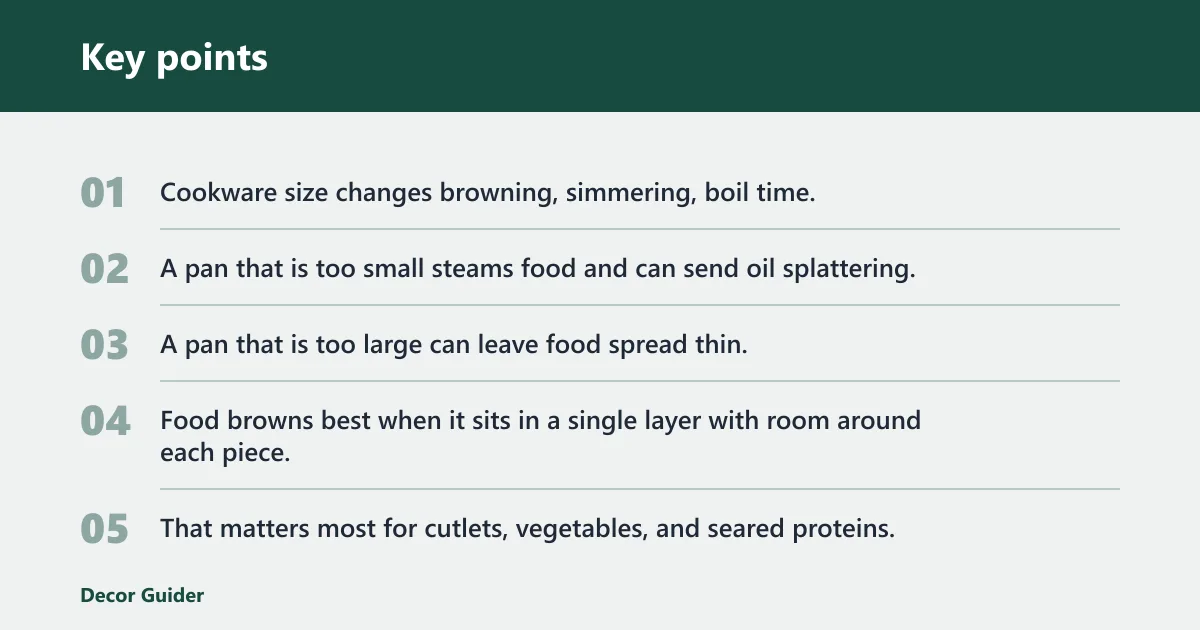


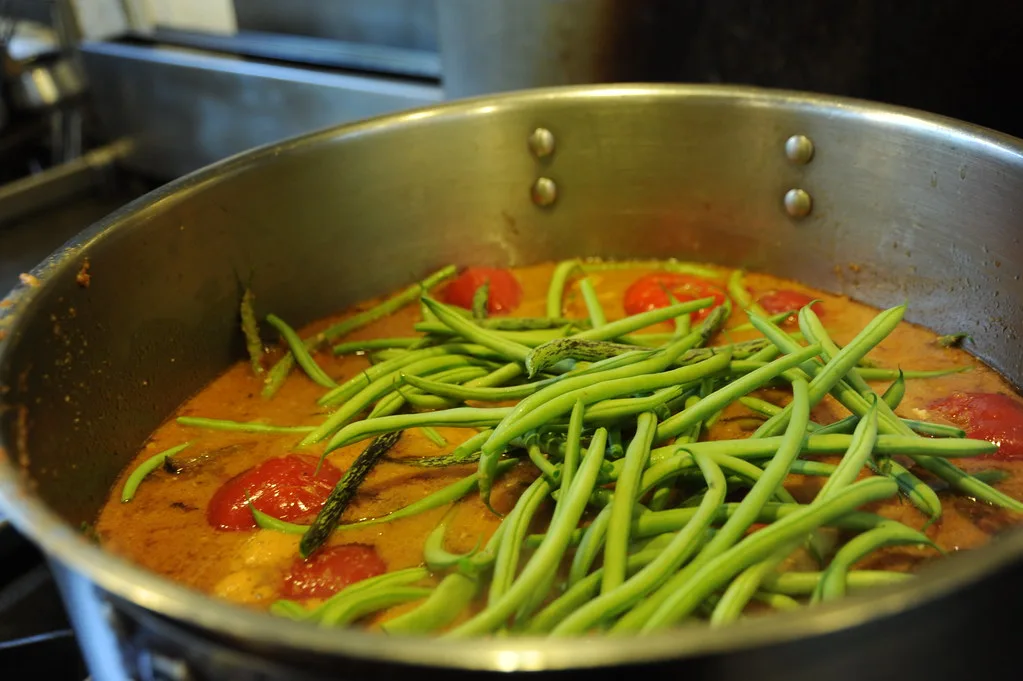
Cookware size changes browning, simmering, boil time, and how much food can sit in the pan without crowding. A pan that is too small steams food and can send oil splattering. A pan that is too large can leave food spread thin, with weak contact to the cooking surface and more heat loss around the edges.
Even heating and browning
Food browns best when it sits in a single layer with room around each piece. That matters most for cutlets, vegetables, and seared proteins. If the pan is oversized for the portion, the burner may heat more metal than the food can use, which slows recovery after you add cold ingredients.
Capacity versus cooking surface
Diameter tells you how wide a pan opens at the top. Capacity tells you how much food or liquid it can hold. Two pans can both be 10 inches across and still have very different usable volume if one has deeper walls. Depth matters for sauces, one-pan meals, and recipes that start on the stove and finish in the oven.
What happens when a pan is too small or too large
Too-small cookware packs food in tightly, so moisture stays trapped and browning stalls. Too-large cookware can waste energy, especially on a burner that does not cover the full base. Vintage cast iron cookware was once cast in sizes to fit wood cook stoves, which is a useful reminder that fit has always mattered.
How do you measure cookware size?
Measure skillets by diameter and pots by volume. A diameter in inches describes the top opening, while quarts or cups describe holding capacity. Straight-sided pots usually offer more usable volume than sloped pans of the same diameter, and deeper pieces hold more liquid without crowding the burner edge.
Diameter in inches versus quart capacity
Diameter is the easiest number to see on a pan tag, but it does not tell the whole story. A 10-inch skillet may be shallow or relatively deep. By contrast, a saucepan listed as 3 quarts tells you much more about how much soup, rice, or pasta water it can handle.
Cup volume and usable depth
Some bakeware gives a useful conversion view. A 13-by-9-by-2-inch rectangular cake pan holds 14 cups, while a 10-inch round cake pan holds 11 cups. That same logic applies to cookware: depth changes volume even when the top diameter stays the same. Deeper cookware gives more room for liquid, splatter control, and stirring.
Straight-sided and sloped-sided cookware
Straight-sided pans maximize usable depth, which helps for sauces and stovetop-to-oven dishes. Sloped sides make it easier to slide a spatula under eggs or pancakes and expose more surface for evaporation. When you compare sizes, check both the diameter and the wall shape, especially if you cook a lot of sauces or shallow-fry foods.
Cookware sizing matrix
This sizing matrix links common cookware types to real meal formats, burner fit, and what to buy first for different households. Use it as a short list, not a shopping rule. Storage height, cabinet depth, and sink size can change what is practical in a small kitchen.
| Cookware type | Common sizes | Capacity | Ideal servings | Best dishes | Burner-fit risk | What to buy first |
|---|---|---|---|---|---|---|
| Skillet / frying pan | 8-inch, 10-inch, 12-inch, 14-inch+ | Capacity varies by depth; a 10-inch skillet can still differ a lot in usable volume | 1 to 4, depending on size | Eggs, seared chicken, vegetables, pan sauces | Higher with 12-inch and larger pans on small burners | Singles: 8-inch; couples: 10-inch; families of 4: 12-inch |
| Saucepan | 2 qt, 3 qt, 4 qt | 2 to 4 quarts | 1 to 4 | Sauces, grains, oatmeal, small boils, reheating | Low to moderate | Singles: 2 qt; couples: 3 qt; families of 4: 4 qt |
| Stockpot | 6 qt, 8 qt, larger common sizes | Typical everyday range starts around 6 quarts | 4 to batch-size portions | Soup, pasta, broth, boiling, batch cooking | Moderate on compact burners because of base size | Families and batch cooks: 8 qt is common |
| Dutch oven | 4 qt, 6 qt, 8 qt; round or oval | 4 to 8 quarts | 2 to 8 | Braise, stew, bread, stovetop-to-oven meals | Moderate, especially for heavy cast iron | Singles: 4 qt; couples: 4 to 6 qt; families of 4: 6 qt |
What size skillet do you need?
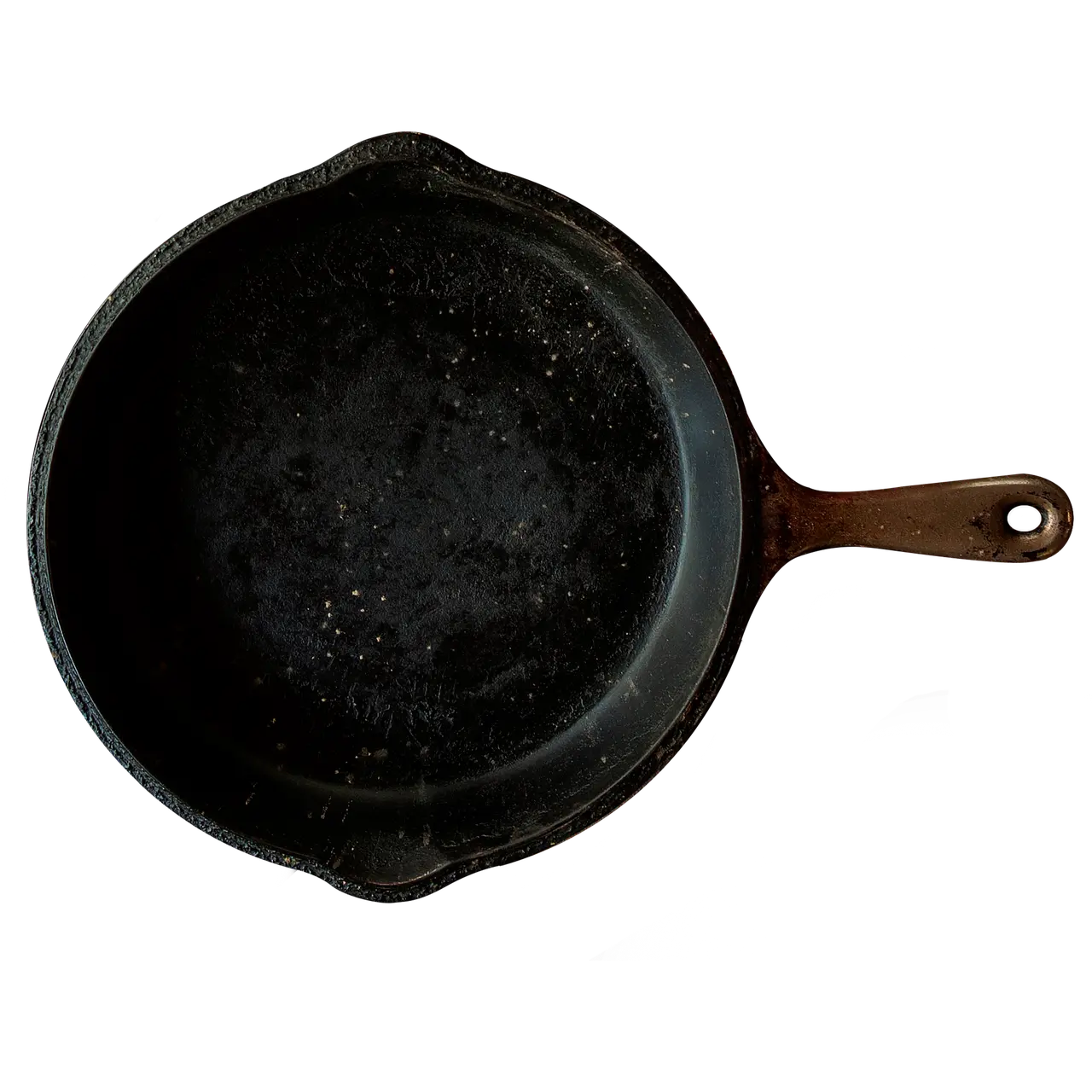
Most home cooks do well with a 10-inch skillet, but the right size depends on portion count and burner width. An 8-inch pan suits smaller servings and quick eggs. A 12-inch pan is better for families or when you need more browning space. A 14-inch-plus pan is best for large batches, not cramped kitchens.
8-inch skillet for small portions
An 8-inch skillet is a good fit for one-person meals, two eggs, grilled sandwiches, or a single chicken breast. It heats a small area efficiently and is easier to store. The tradeoff is capacity: once you add more ingredients, the pan fills fast and can crowd the food.
10-inch skillet as the everyday standard
A 10-inch skillet is the common middle ground for many households. It handles omelets, two portions of vegetables, and most weeknight searing without feeling oversized. A standard household can be covered by a 10-inch skillet, 2-quart saucepan, and 6-quart Dutch oven; that core set is often enough for most tasks.
12-inch and 14-inch pans for larger meals
A 12-inch skillet gives more surface area for families of four, sheet-pan-style stovetop meals, and recipes that need room for moisture to escape. A 14-inch-plus pan is useful for batch cooking, but it can overhang a small burner and lose heat around the edges. That is a real issue on compact stoves.
Picture a 12-inch skillet sitting on a small front burner with only part of the base covered. The center may brown, but the outer ring of food can soften instead of sear because the burner footprint does not match the pan. In that case, a 10-inch pan often cooks better even if the recipe looks large.
What size pots do you need for cooking?
For most kitchens, a 2-quart saucepan, 3-quart saucepan, and 6-quart or 8-quart stockpot cover the widest range of daily cooking. Add a 4-quart saucepan if you make larger batches of grains or soups. Dutch ovens in 4-, 6-, and 8-quart sizes fill the gap between stovetop pots and oven-safe braisers.
2-quart, 3-quart, and 4-quart saucepans
A 2-quart saucepan is enough for sauces, small side dishes, oatmeal, and reheating liquids. A 3-quart saucepan gives more room for grains, vegetables, and small boils. A 4-quart saucepan is the better choice if you regularly cook rice, soup for several people, or dishes that foam and need extra headroom.
Everyday stockpot sizes
Stockpots are for volume, not precision. Everyday use usually starts around 6 quarts, which is enough for soup, pasta, and broth for a small household. An 8-quart stockpot is more comfortable for batch cooking and pasta water because it leaves more room for boiling and stirring without overflow.
4-quart, 6-quart, and 8-quart Dutch ovens
Dutch ovens earn their place because they move from stovetop to oven with no fuss. The sizes map cleanly to common uses: 4 quarts for couples or small braises, 6 quarts for families of four, and 8 quarts for larger stews or bread. Round models suit most soups and braises; oval models are useful for longer cuts of meat.
Concrete size-to-capacity examples help when labels are inconsistent. An 8-inch by 3-inch Dutch oven equals 2 quarts. A 10-inch by 3.5-inch Dutch oven equals 4 quarts. A 12-inch by 3.75-inch Dutch oven equals 6 quarts, while a 12-inch by 5-inch Dutch oven equals 8 quarts. Depth changes volume fast.
What cookware fits a small kitchen?
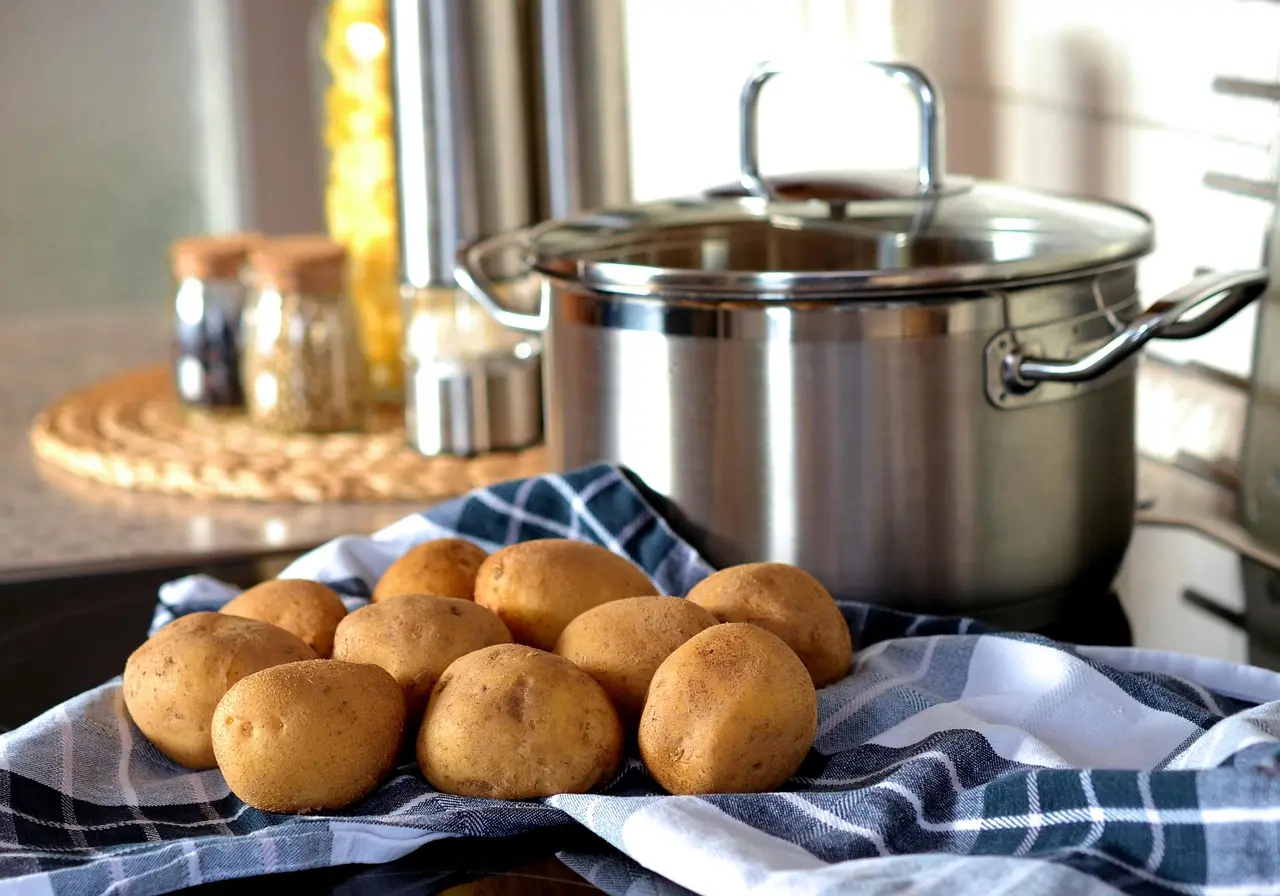
Small kitchens reward restraint. Choose sizes that sit fully on your burners, fit inside your cabinets, and can be lifted without strain. A compact stove, shallow cabinet shelf, or small sink changes what is practical more than any recipe does. Heavy cast iron and large stainless steel pieces also matter here because weight affects handling and storage.
Burner-fit risk and overhang
Oversized pans lose efficiency when the base extends past the burner. That overhang leaves edges cooler, which slows browning and can create hot and cold zones in the same pan. If your burner is modest, start with a skillet and pot size that match it closely rather than chasing the largest available diameter.
Storage height and cabinet depth
Cabinet height decides whether a 4-quart or 8-quart pot is realistic. Deep Dutch ovens and tall stockpots may fit on the stove but not in overhead storage. Check lid knobs, handle spans, and nesting clearance. A pot that barely fits the shelf is annoying to remove and can become a daily barrier to cooking.
Material weight and handling limits
Cast iron holds heat well, but that same mass makes larger sizes harder to lift, wash, and store. Stainless steel is lighter than cast iron in many designs, yet large multi-ply pots still feel heavy when full. If you cook in a small apartment kitchen, a slightly smaller pan is often more practical than a heavyweight piece that stays in the cabinet.
- Match the pan to the burner, not just the recipe.
- Choose the smallest size that still leaves room for stirring and browning.
- Check cabinet height and sink depth before buying larger pots.
- Buy one everyday skillet, one saucepan, and one larger pot before duplicates.
- Add specialty sizes only if your meal pattern truly needs them.
Suppose you cook for two in a compact rental kitchen. A 10-inch skillet, 3-quart saucepan, and 4-quart Dutch oven will cover most dinners without crowding storage. A 14-inch skillet would be harder to heat well on a small burner and harder to wash in a shallow sink.
Frequently asked questions
What size cookware do I need?
Start with the meals you cook most often. For many homes, that means a 10-inch skillet, a 3-quart saucepan, and a 6-quart Dutch oven. If you cook for one or two, smaller pieces are fine. If you batch cook or feed four, move up one size in the skillet and pot categories.
What size pans do I need?
For general use, a 10-inch skillet covers most stovetop tasks, with an 8-inch pan for small portions and a 12-inch pan for larger meals. Keep one saucepan in the 2- to 4-quart range. Add a stockpot only if you make soup, pasta, or broth often enough to justify it.
What are the sizes of frying pans?
Common frying pan sizes are 8-inch, 10-inch, 12-inch, and 14-inch-plus. Smaller pans suit eggs and single servings. A 10-inch pan is the everyday middle ground. A 12-inch pan works better for family cooking, while 14-inch-plus pans are usually for larger batches and broader burner coverage.
How many quarts is a 10 inch pan?
There is no single quart value for every 10-inch pan. Depth changes capacity. A 10-inch by 3.5-inch Dutch oven equals 4 quarts, which shows how much volume a 10-inch footprint can hold when it is deep. A shallow 10-inch skillet may hold far less.
What size saucepan is best for everyday cooking?
A 3-quart saucepan is the best everyday choice for many households because it handles grains, sauces, vegetables, and small boils without feeling cramped. A 2-quart pot is enough for one or two people, while a 4-quart saucepan is better if you often cook for a family or like extra headroom.
What size dutch oven do I need?
A 4-quart Dutch oven is a practical pick for singles and couples. A 6-quart Dutch oven suits a family of four and most braises. An 8-quart model is better for soup, bread, and batch cooking. Round shapes suit general use; oval shapes help with longer cuts of meat.
What cookware sizes fit in a small kitchen?
Small kitchens usually do best with one 8- or 10-inch skillet, one 2- or 3-quart saucepan, and one 4- or 6-quart Dutch oven. Avoid oversized stockpots unless you truly need them. Prioritize pieces that fit your burners fully and store without blocking cabinets or the sink.
Products related to this article
Sponsored / affiliate links. As an Amazon Associate I earn from qualifying purchases. I may earn additional commission from eligible campaigns.