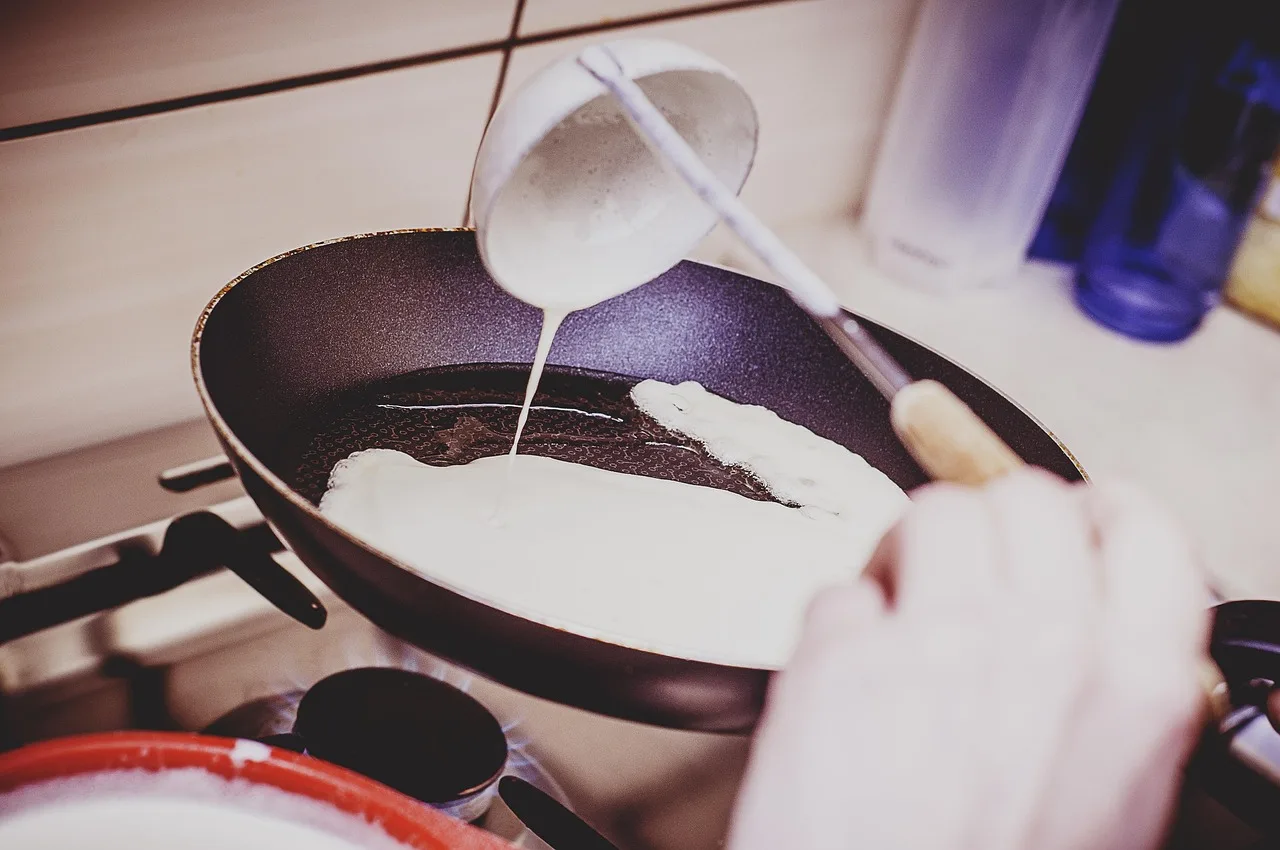
Cookware Coating Comparison Chart
For most home cooks, choose PTFE for eggs and low- to medium-heat stovetop use, ceramic for short-term nonstick at lower heat, and stainless or cast iron when heat tolerance and lifespan matter more than release. Pick the wrong surface, and you can get flaking coatings, stuck food, warped pans, or cookware that wears out far sooner than expected. This chart compares common coatings by safety, heat range, durability, likely failure mode, and best uses for eggs, searing, baking, and low-fat cooking. (FDA; NIH/ATSDR; manufacturers for product-specific limits)
Choosing coating chemistry for heat, wear, and cooking style
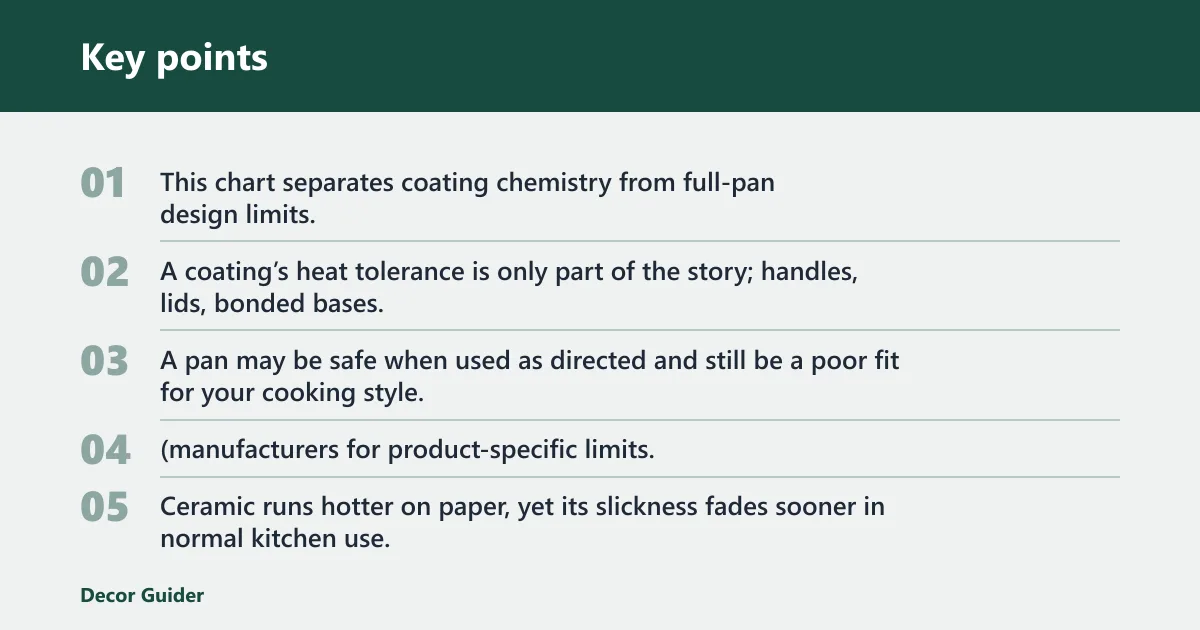


This chart separates coating chemistry from full-pan design limits. A coating’s heat tolerance is only part of the story; handles, lids, bonded bases, and substrate materials can lower the real oven rating. A pan may be safe when used as directed and still be a poor fit for your cooking style, especially if you sear hard, use metal tools, or rely on a nonstick pan every day. (manufacturers for product-specific limits; independent cookware guidance on heat abuse and coating wear)
| Cookware surface | Non-stick release | Heat tolerance | Scratch and wear risk | Replacement expectation | Safest routine heat range | First failure signal | Metal utensil tolerance | Replacement trigger | Best for | Avoid if |
|---|---|---|---|---|---|---|---|---|---|---|
| PTFE non-stick coating | Strongest release for delicate foods | Best below about 230°C/450°F; many brands advise lower routine heat to extend life (FDA; manufacturers) | Higher risk if scrubbed hard or scraped with metal | About 1–2 years in regular use, often less with high heat or abrasive cleaning (consumer durability guidance; manufacturers) | Low to medium stovetop heat | Food starts sticking where it used to release | Low; soft tools recommended | Persistent sticking, visible scratches, peeling, or rough patches | Eggs, fish, low-fat frying | You cook on high heat or use metal scrapers |
| Ceramic nonstick coating | Good at first, then slickness fades faster than PTFE | Some ceramic-coated pans are oven-rated high, but real limits vary by substrate, handle, and brand; sustained high stovetop heat still shortens life (manufacturers; independent cookware care guidance) | Moderate wear risk; surface can lose glide sooner | Usually 1–3 years before slickness drops in normal use, sometimes sooner with high heat or aggressive cleaning (consumer durability guidance) | Low to medium heat | Sticking rebound, dulling, or patchy release | Low to moderate; use depends on brand guidance | Loss of glide that no longer improves with careful use | Moderate-heat cooking, quick sautés, short-term nonstick use | You want the longest glide under daily, heavy use |
| Titanium coating or titanium-reinforced finish | Variable; often depends on the base layer and top finish | Often positioned for heavy-duty use and corrosion resistance, but the true limit depends on the full pan build and any added nonstick layer (manufacturers; independent cookware guidance) | Lower wear risk when the reinforced layer is well made | Longer-term option when the surface is built for durability, though lifespan varies widely by construction | Low to medium heat unless the brand specifies more | Gradual loss of glide or uneven release | Usually low to moderate; follow brand guidance | Sticking rebound, visible wear, or a rougher feel | Frequent use, tougher cleaning, long service life goals | You want a fully nonstick feel like fresh PTFE |
| Uncoated triply stainless steel | No coating; release depends on technique | Very high heat tolerance; limited more by the pan’s handle and bonded construction than the cooking surface itself (manufacturers; independent cookware guidance) | Low coating wear risk; can still discolor or scratch | No coating to wear out | Medium to high heat for browning and searing | Discoloration or sticking from poor preheat/temperature control | High | Warping, loose handles, or structural damage rather than coating failure | Searing, browning, sauces, oven finishes | You need easy release without practice |
| Enameled cast iron | Moderate release; better with fat and proper preheat | Stovetop and oven safe; tolerates higher oven temperatures than PTFE, but exact limits vary by brand and pieces with knobs or handles may be lower-rated (manufacturers) | Enamel can chip or wear with repeated use | Long-lived, but the coating can age | Low to medium heat for routine stovetop use | Chipping, crazing, or duller release | Low; avoid metal tools if the brand warns against them | Chips, cracks, exposed iron, or recurring sticking from surface wear | Braising, bread, slow cooking | You want a light, fast-moving pan |
| Hard-anodized aluminum | Depends on whether a light non-stick layer is added | Good heat spread; not a traditional coating system, and any added nonstick layer sets the practical limit (manufacturers) | High scratch resistance compared with soft aluminum | Often durable; surface behavior depends on finish | Low to medium heat unless otherwise labeled | Cosmetic wear or loss of any added nonstick layer | Moderate if bare hard-anodized; lower if a nonstick layer is present | When added nonstick begins to fail or the finish becomes rough | Even heating, everyday cooking, lighter maintenance | You need true bare-metal searing performance |
PTFE gives the slickest release. It is also the least forgiving at high heat. Ceramic runs hotter on paper, yet its slickness fades sooner in normal kitchen use. Stainless steel and cast iron skip the coating problem entirely. (FDA; consumer cookware guidance)
Which cookware coating is safest for your cooking style?
The safest choice depends on heat, food, and care. PTFE is a strong choice for low- to medium-heat eggs and fish when you stay below its heat limit. Ceramic and enamel tolerate higher oven temperatures, while stainless steel and cast iron make more sense when you need heat tolerance more than easy release. For coated pans, the safest routine use is usually lower than the maximum brand rating. (FDA; manufacturers)
Eggs and low-fat breakfast cooking
For eggs, pancakes, and low-fat breakfast food, PTFE is the easiest option because it has the strongest non-stick performance. That matters when you want food to slide without much oil. Use soft utensils, avoid high heat, and replace the pan when sticking returns even after careful cleaning. (FDA; manufacturers)
Searing and high-heat cooking
For hard searing and hotter pans, stainless steel or cast iron is usually the better fit. PTFE can break down around 230°C/450°F, and ceramic loses slickness faster when pushed hard on the burner. A pan that handles heat well is often the safer value if you brown meat often. (FDA; independent cookware guidance)
Braising, baking, and oven finishes
For braises, bread, and oven finishes, enameled cast iron stands out because it is heavy, heat-retentive, and non-reactive. Ceramic-coated pans can also handle higher oven temperatures than PTFE, but they are still a surface finish with a shorter nonstick life than bare stainless or enameled cast iron. Exact oven limits vary by brand and by the whole pan, not just the coating. (manufacturers; independent cookware guidance)
Picture a 10-inch skillet used for eggs every morning. If the surface starts needing extra oil after a year and a half, that is not a cleaning problem alone; it is often the point where PTFE has reached its practical end for that cooking pattern. (consumer durability guidance)
PTFE, ceramic, or titanium: what changes in real use?
The same source gives the best release, ceramic handles heat better on paper, and titanium-reinforced surfaces aim for longer service life and corrosion resistance. The practical difference shows up in how fast each surface loses glide, how it reacts to heat spikes, and whether wear appears as sticking rebound, discoloration, or roughness. Titanium wording is not standardized, so the full construction matters more than the label. (manufacturers; independent cookware guidance)
Release performance
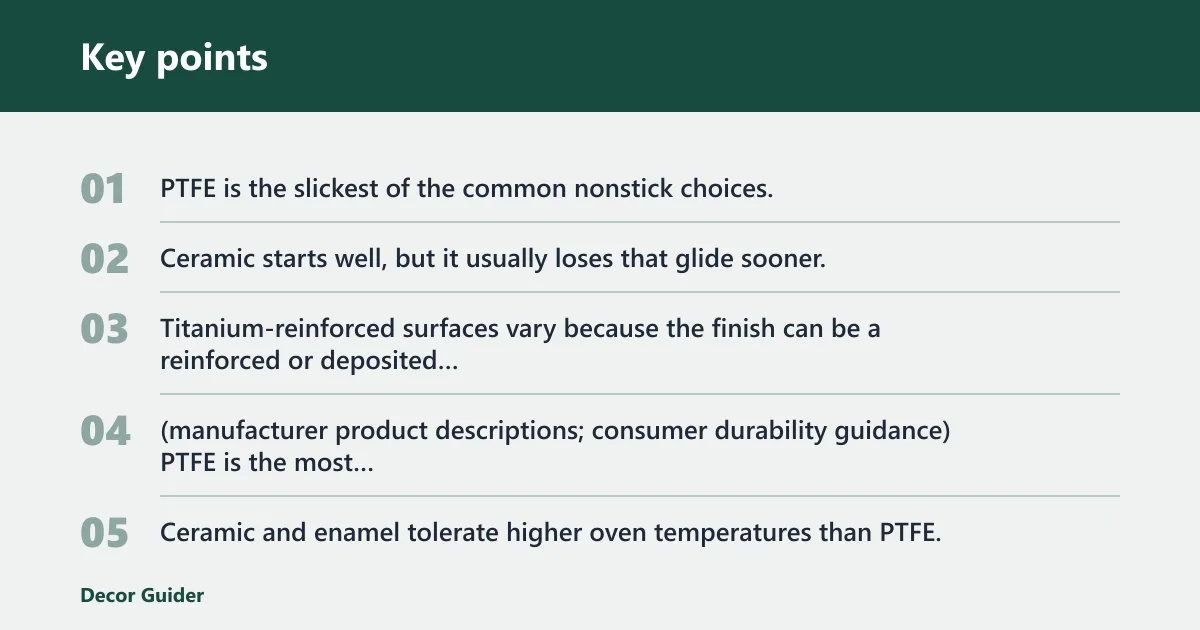
PTFE is the slickest of the common nonstick choices. Ceramic starts well, but it usually loses that glide sooner. Titanium-reinforced surfaces vary because the finish can be a reinforced or deposited layer over another base; the final feel depends on the full build, not just the label. (manufacturer product descriptions; consumer durability guidance)
Heat limits and damage risk
PTFE is the most sensitive to heat abuse. Ceramic and enamel tolerate higher oven temperatures than PTFE, and that makes them easier to use for hotter finishing. Even so, heat alone is not the only issue; repeated overheating can shorten any coated surface and speed up wear. (FDA; manufacturers; independent cookware care guidance)
Likely failure mode
PTFE usually fails by losing slickness first, then showing scratch sensitivity and uneven release. Ceramic often fails through slickness fade, then patchy sticking and discoloration. Titanium-reinforced finishes are sold for toughness, but they can still wear if the top layer is thin or the base finish is abused. Abrasion or “wear” testing can help compare surfaces, but kitchen performance still depends on heat, detergent, utensils, and preheat habits. (consumer testing guidance; manufacturers)
A common first-timer mistake is choosing ceramic for daily fried eggs, then running it hard on medium-high heat because the pan says it can take more. The coating may still be intact, but the surface can turn sticky long before the pan looks visibly damaged. (independent cookware care guidance)
How do stainless steel and enameled cast iron compare?
Stainless steel and enameled cast iron solve different problems. Stainless steel gives you a zero-coating, metal-utensil-compatible pan that can handle high heat and repeated use. Enameled cast iron gives you heavy, heat-retentive cooking with a non-reactive interior, but the enamel itself can wear or chip over time. (manufacturers; independent cookware guidance)
Triply stainless steel
Triply stainless steel is a three-layer bonded build: inner 18/8 food-grade stainless steel, a middle aluminum core, and an outer magnetic stainless steel layer. It has no coating to wear out, so it is the strongest choice when you want a pan that can take metal tools and high heat. The exact alloy stack can vary by brand, but triply generally refers to this bonded three-ply structure. (manufacturer construction guides; stainless steel industry references)
Enameled cast iron
Enameled cast iron is non-reactive and works well on the stovetop and in the oven. It is especially good for braising and bread because it holds heat well. Many pieces are dishwasher safe, but repeated use can still wear the enamel surface, and chips are a real failure point. (manufacturers; independent cookware care guidance)
When coating-free cookware makes more sense
If you sear often, simmer acidic sauces, or want cookware that will not lose a nonstick layer, coating-free options make more sense. Stainless steel is lighter than cast iron, easier to handle, and more forgiving if you want metal utensils. Cast iron gives more thermal mass and oven stability. (independent cookware guidance)
What should you look for on the label?
Label language matters because coating names alone do not tell you how the surface will age. Look for thickness, test claims, and care instructions. Those details help you compare a pan built for short-term slickness with one built for more wear. (consumer testing guidance; manufacturers)
Thickness in microns
Thickness is often measured in microns, or μm. One common guide is ceramic at 15–40μm, with 25–40μm as an ideal range; PTFE at 35–60μm, with 40–60μm as an ideal range; and titanium functional layers at about 10–20μm. Thicker layers generally last longer when the build is sound, but thickness alone does not guarantee durability. (manufacturer specs; independent materials references)
Abrasion test claims
Abrasion claims may commonly mention the Taber test, Martindale test, or reciprocating tests. Those methods compare scratch and wear resistance under repeated rubbing. They do not guarantee kitchen life by themselves, but they are more useful than marketing terms like “ultra-durable” with no test method attached. Results can also vary by load, abrasive medium, and substrate. (ASTM/industry test references; consumer testing guidance)
Care instructions that matter
Care directions are part of the product, not an afterthought. Soft utensils, hand washing, and low to medium heat are common instructions for ceramic nonstick. PTFE also lasts longer with soft tools and lower heat. If the label says nothing about care, expect less support for long life. (manufacturers; FDA)
Which coating lasts the longest?
Coatings do not fail all at once. The longest-lasting option in daily use is often the one with the least coating dependence at all: uncoated stainless steel or cast iron. Among coated pans, titanium-reinforced finishes often aim for longer wear, while ceramic and PTFE usually have shorter practical lifespans. Lifespan depends on heat, utensils, cleaning, and how often the pan is used. (consumer durability guidance; manufacturers)
What wear looks like
Replacement is usually driven by symptoms, not the calendar alone. Watch for flaking, sticking rebound, discoloration, rough spots, and coating wear that no longer improves with normal cleaning. PTFE typically lasts 1–2 years in regular use. Ceramic coatings usually last 1–3 years before losing slickness. Those are common real-world ranges, not guarantees. (consumer durability guidance)
When to replace instead of repair
If food sticks where it used to release, the surface feels rough, or flakes appear, replace the pan. Do not try to “fix” a failing coating with harsher scrubbing or stronger heat. That often speeds up the damage and makes the pan less predictable at the burner. (FDA; independent cookware care guidance)
Cost per year of use
Long-term value depends on how often you cook and what you cook. A cheap PTFE pan can be reasonable for occasional eggs if it lasts its full useful life. A pricier stainless or cast-iron pan often costs less per year when you cook daily and do not need a slick coating. (consumer cookware value guidance)
How to choose cookware by budget and upkeep
Choose by use case first, then by budget. If you cook eggs most mornings, a PTFE pan may give the best day-to-day result. If you want a pan that handles heat, metal tools, and long service, stainless steel or cast iron usually makes more sense than chasing a short-lived nonstick finish. (FDA; independent cookware guidance)
Low-maintenance buyers
If you want the least fuss, stainless steel and enameled cast iron are the better long-term picks. They do not depend on a delicate release layer. Hard-anodized aluminum is another practical choice because it offers a hard, non-porous surface and high scratch resistance, especially when paired with a light nonstick layer. If there is no added nonstick coating, it behaves more like a durable substrate than a slick pan. (manufacturer construction guides; independent cookware guidance)
Frequent egg cookers
If eggs and delicate fish are your main use, PTFE still wins on release. Keep expectations realistic. It is not a forever pan, and it should not be pushed into high-heat territory. Ceramic can work here too, but it usually loses slickness faster than PTFE. (FDA; consumer durability guidance)
Long-term durability buyers
If durability matters most, look at stainless steel first, then cast iron, then a well-built titanium-reinforced finish if you still want some coated convenience. Titanium is best treated as a strengthened surface system, not a miracle layer. The full construction matters more than the word on the box. (manufacturer specs; independent cookware guidance)
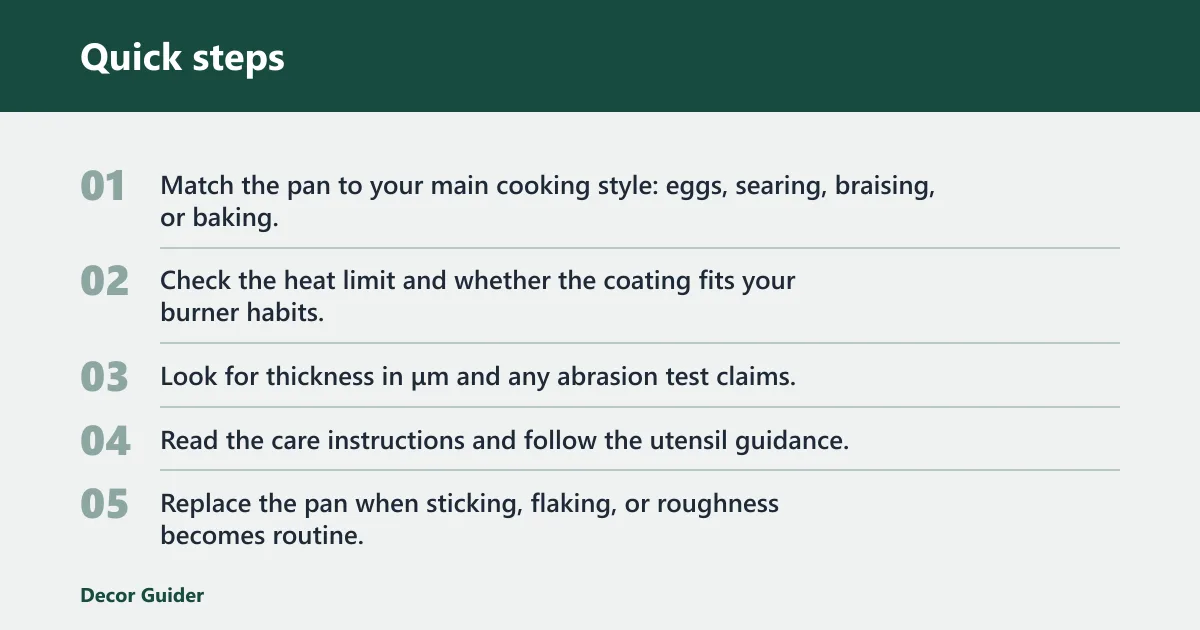
- Match the pan to your main cooking style: eggs, searing, braising, or baking.
- Check the heat limit and whether the coating fits your burner habits.
- Look for thickness in μm and any abrasion test claims.
- Read the care instructions and follow the utensil guidance.
- Replace the pan when sticking, flaking, or roughness becomes routine.
Suppose you cook salmon twice a week and finish pans in the oven. A ceramic skillet may handle the oven step, but a stainless skillet gives you more heat margin and no coating to lose, which often makes it the better long-term buy for that pattern. (manufacturers; independent cookware guidance)
Frequently asked questions
What are the safest cookware coatings?
The safest coating is the one matched to the way you cook. PTFE is a strong choice when used below about 230°C/450°F. Ceramic is PFAS-free in coating form and tolerates higher oven heat, while stainless steel and cast iron avoid coating concerns altogether. Heat and care still decide the result. (FDA; manufacturers; independent cookware guidance)
Stainless steel vs ceramic coated cookware
Stainless steel is coating-free, durable, and metal-utensil compatible, but it needs technique for release. Ceramic-coated cookware is easier for early nonstick performance and is often PFAS-free, yet it usually loses slickness faster. Pick stainless for searing and longevity; pick ceramic for short-term nonstick at moderate heat. (consumer cookware guidance; manufacturers)
Enamel vs ceramic coated cookware
Enameled cast iron is heavy, heat-retentive, and good for braising and bread, with a non-reactive surface that tolerates stovetop and oven use. Ceramic-coated cookware is lighter and more nonstick at first, but it usually wears faster. Enamel is better for heat retention; ceramic is easier to handle. (manufacturers; independent cookware guidance)
Ceramic vs ceramic coated cookware
People often use these terms loosely, but they are not always the same thing. A ceramic pan may refer to a ceramic-coated surface, while some cookware is only marketed with ceramic language. Check whether the product is a coated pan, a ceramic interior, or a different build entirely before buying. (manufacturer labeling guidance)
What is the best non stick coating for cookware?
For pure release, PTFE is still the best nonstick coating for many home cooks. It performs especially well for eggs, fish, and low-fat frying. If you want higher heat tolerance and do not mind faster loss of slickness, ceramic is the next option. Stainless steel is not a nonstick coating at all. (FDA; consumer cookware guidance)
How do cookware coatings affect lifespan?
Coatings affect lifespan by changing how the pan reacts to heat, abrasion, and cleaning. PTFE usually lasts 1–2 years in regular use, while ceramic usually lasts 1–3 years before slickness fades. Thicker, well-built layers often last longer, but wear signs still matter more than the label. (consumer durability guidance; manufacturers)
Which cookware coating lasts the longest?
Among coated options, titanium-reinforced finishes are often positioned for the longest service life, though the exact result depends on the build. If you want the longest practical lifespan overall, uncoated stainless steel or cast iron avoids coating wear entirely. Replace coated pans when sticking, flaking, or roughness shows up. (manufacturers; independent cookware guidance)
Is ceramic coating worth it on cookware?
Ceramic coating can be worth it if you want PFAS-free nonstick, higher oven heat tolerance than PTFE, and easy cleanup for moderate-heat cooking. It is less worth it if you expect long-lasting slickness under daily heavy use. It works best when you follow low to medium heat and soft-utensil care. (manufacturers; consumer durability guidance)
Products related to this article
Sponsored / affiliate links. As an Amazon Associate I earn from qualifying purchases. I may earn additional commission from eligible campaigns.