Cookware Safety Chart: Materials, Risks, and Uses
For the safest cookware choice, match the material to the heat level: stainless steel, cast iron, and carbon steel fit high-heat cooking best, while uncoated aluminum and damaged nonstick carry more failure risk. Using the wrong pan can mean warped bases, flaking coatings, or unsafe metal leaching. This cookware safety chart compares materials by cooking method, stability, and failure risk so you can choose the right pan for each task.
What safe cookware means


Safe cookware has three parts: food-contact safety, heat safety, and hardware stability. A pan can be fine for serving acidic tomato sauce on the stove and still be a poor choice for the broiler if the coating softens, the handle loosens, or the base warps.
Material matters, but condition matters too. A scratched nonstick skillet, a rusted cast iron pan, or a pot with a wobbly handle can move from convenient to questionable even if the label still looks reassuring.
Food-contact safety versus heat safety
Food-contact safety asks whether the cooking surface stays stable when it touches food. Heat safety asks whether the pan and its hardware hold up at stovetop, oven, broiler, grill, or direct fire temperatures. Those are related, but they are not the same check.
That split matters most with acidic foods, long simmering, broiling, and searing. Tomato sauce is one question. A very high-heat broiler session, such as about 500°F, is another.
Why condition matters as much as material
Material alone does not tell you whether the pan is still safe to use. Coating wear, loose rivets, rust, chips, cracks, and warped bases can all change the answer.
A pan that once fit the job may no longer fit it. Safety is a condition check, not a brand promise.
Cookware safety matrix
This matrix ranks common cookware by how it behaves in use, how it reacts with acidic foods, how it handles heat, and how likely failure becomes when damage appears. Use it as a method guide, not a popularity contest.
| Material | Heat limit behavior | Acidic-food reactivity | Oven or broiler compatibility | Coating failure risk | Handle stability risk | Best-use scenarios |
|---|---|---|---|---|---|---|
| Cast iron | Strong at high heat; can be used on stovetop, oven, broiler, grill, and direct fire | Reactive metal; seasoning helps, but bare food contact can still affect flavor and surface care | Very good for oven, broiler, grill, and direct fire | No coating to fail, but seasoning can wear off | Depends on the handle and weight; heavy pieces raise drop risk | Searing, stove-to-oven recipes, baking, roasting, frying |
| Enameled cast iron | Strong for stovetop and oven use; better suited to controlled heat than abrupt direct flame changes | Non-reactive ceramic enamel lining | Safe for stovetop and oven | Enamel can chip or crack if abused | Usually sturdy, but heavy lids and handles still matter | Stew, chili, braising, baking bread |
| Stainless steel | Stable for high-heat cooking on stove, oven, and broiler | Generally a good fit for most foods; use judgment with very acidic sauces and long holds in damaged pans | Safe for stove, oven, and broiler | No coating to break down | Usually good; rivets and welded joints still need inspection | Searing, sautéing, braising, sauces, canning |
| Nonstick | Best at lower to moderate heat; overheating shortens life and raises failure risk | Depends on coating stability, not on the food alone | Varies by model; many are not broiler-safe | High if scratched, flaked, overheated, or worn | Light pans can feel stable, but loose handles are still a stop sign | Eggs, delicate fish, low-stick reheating, quick cleanup tasks |
| Ceramic | Safety depends on coating stability and use temperature | Depends on the coating, finish, and wear | Varies by model; check exact temperature limits | Medium to high if the coating dulls, chips, or loses release quickly | Usually similar to nonstick; inspect rivets and handles | Low- to moderate-heat cooking when the coating is intact |
| Aluminum | Used at normal household temperatures; surface condition matters | Bare aluminum is treated differently from coated aluminum; damage raises concern | Depends on construction and surface condition | Coated aluminum can fail when the coating wears | Lightweight pans can tip or flex if hardware is weak | Everyday pots and pans when the surface is intact and appropriate for the food |
Best-use scenarios by material
Cast iron is the strongest fit when you want a pan that can move from stovetop to oven to broiler. It is also the most direct option for grill heat and even direct fire, which is why it fits searing and roasting so well.
Enameled cast iron is better when the recipe is acidic or long simmered. That makes it a strong choice for stew, chili, braising, and baking bread, especially in the common 4-, 6-, and 8-quart Dutch oven sizes.
Stainless steel is the practical pick for searing, sautéing, braising, sauces, and canning. A good stainless-steel sauté pan is often suggested between two and six quarts, and a 10- or 12-inch skillet is also a common choice.
Nonstick and ceramic belong in the lower-heat lane. Use them when intact coatings matter more than extreme heat, and replace them when the surface starts to fail.
Is stainless steel cookware safe?
Yes, stainless steel cookware is one of the safest everyday choices when you want a pan that tolerates high heat and repeated use. It is safe for stove, oven, and broiler use, and it is a strong fit for searing, sautéing, braising, sauces, and canning.
It is often a better pick than coated cookware when you want heat tolerance without a coating that can wear out. It is also useful when you need a pan that can move from burner to oven without changing material behavior mid-recipe.
Where stainless steel is the safest fit
Choose stainless steel when you cook with heat, not just with low-stick convenience. It handles browning, deglazing, and long sauce work well, and it avoids the coating-failure problem that affects nonstick and many ceramic pans.
It is a good default for kitchens that need one pan to do several jobs. That matters in small kitchens, apartment kitchens, and households that do not want to replace pans often.
Common size and shape choices
A 2- to 6-quart sauté pan covers a wide share of daily cooking. A 10- or 12-inch skillet is also a practical shape for searing and shallow cooking, especially when you want enough surface area for browning.
If you can only choose one stainless pan, the safest general choice is usually the shape that matches your stove burners and storage space, with a handle that stays rigid when the pan is full.
Is ceramic cookware safe?
Ceramic cookware can be safe, but the answer depends on the coating system and the temperature you use. It is often marketed as non-toxic or PTFE-free, yet that claim does not replace a check for coating stability, oven limits, or visible wear.
Compared with PTFE-coated pans, ceramic can be a good low- to moderate-heat option when the surface is intact. It becomes a weaker choice when the coating loses release quickly, chips, or is used hotter than the maker intended.
Ceramic-coated versus bare ceramic cookware
Ceramic-coated cookware is the version most people mean when they ask about everyday skillets or saucepans. Bare ceramic is a different category and may behave more like a bakeware or serving piece depending on its build.
The safety question stays the same either way: does the surface stay stable under the heat and food you plan to use? If the answer is no, the cookware is not a good fit for that task.
When ceramic is better or worse than PTFE-coated pans
Ceramic can make sense if you want a PTFE-free label and plan to stay in a moderate heat range. PTFE-coated pans can also be fine when used within their heat limits and kept in good condition; the coating choice alone does not settle the question.
What matters most is whether the coating remains intact. If the surface turns uneven, loses release quickly, or shows wear that keeps growing, replace the pan rather than working around it.
When should you replace nonstick cookware?
Replace nonstick cookware when the coating is scratched, flaking, peeling, blistering, or worn enough that food starts sticking more than it did before. PTFE-free and PFOA-free claims do not stop physical breakdown, and a damaged surface is the replacement trigger.
Heat abuse matters too. If a pan has been overheated, warped, or has a softening or chalky surface, the safer move is to retire it rather than keep guessing.
What coating wear means
Minor cosmetic marks are not the same as coating failure, but repeated scratches, chips, and flaking are different. Once the coating no longer behaves as a stable food-contact surface, the pan is past its useful point for safe nonstick cooking.
Warped bases also matter. A pan that rocks on the burner can cook unevenly and stress the coating and handle hardware.
How PTFE and PFOA-free claims fit
PFOA-free means the pan was not made with that specific compound. PTFE-coated means the nonstick surface uses a PTFE coating. Neither label means the pan is indestructible, and neither one replaces a wear check.
Think of those labels as material information, not a permanent safety guarantee. Condition still decides whether the pan should stay in rotation.
Signs that point to replacement
- Flaking, peeling, or visible coating lift.
- Deep scratches that expose the base material.
- Warping that makes the pan rock on the burner.
- Loose handle screws or rivets.
- Persistent sticking after normal use and care.
Choose cast iron if… / Choose stainless steel if…
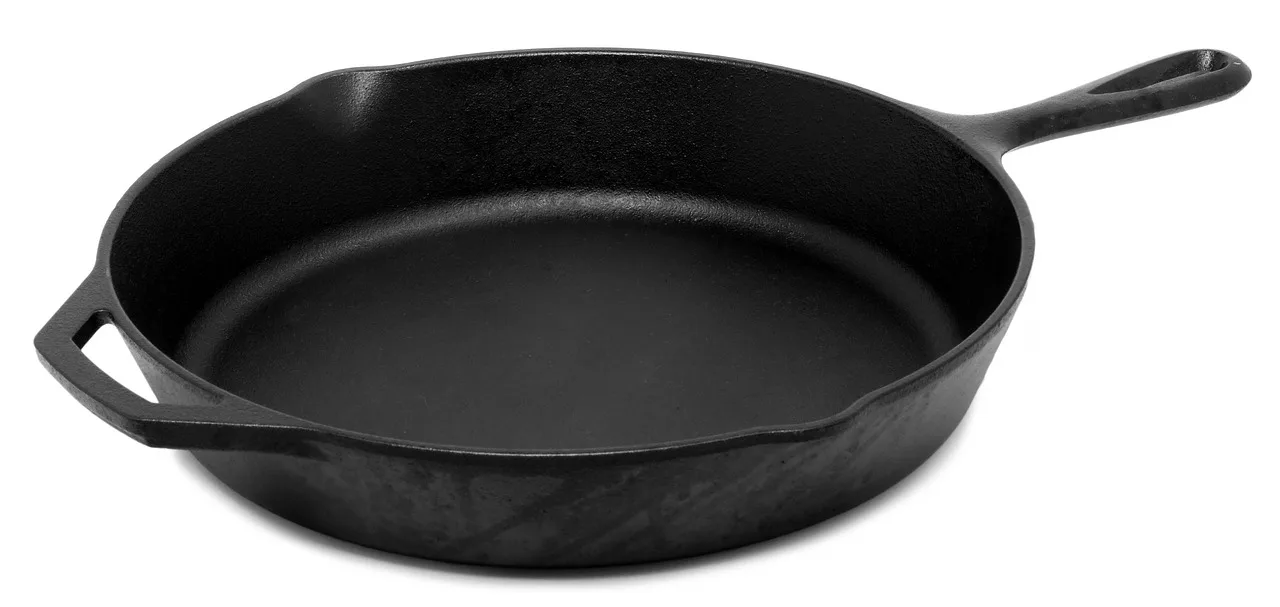
Choose cast iron if you want one pan that can move from stovetop to oven, broiler, grill, and direct fire. Choose stainless steel if you want a broad-use pan for searing, sautéing, braising, sauces, and canning without a coating to monitor.
Choose cast iron if…
- You cook steak, skillet breads, roasted chicken, or stove-to-oven dinners.
- You want safe use on stovetop, oven, broiler, grill, and direct fire.
- You do not mind seasoning with polymerized oil and checking for rust.
- You can handle weight and keep an eye on chips or cracks from poor care.
Choose stainless steel if…
- You make sauces, seared proteins, sautéed vegetables, or braises often.
- You want a pan that is safe for stove, oven, and broiler.
- You want a common everyday shape such as a 2- to 6-quart sauté pan or a 10- or 12-inch skillet.
- You need a durable option for canning and repeated high-heat use.
Choose enameled cast iron if…
- You cook acidic stews, chili, or braises often.
- You want the non-reactive enamel lining of a Dutch oven.
- You plan to bake bread in a 4-, 6-, or 8-quart pot.
- You want stovetop and oven use without seasoning upkeep.
Choose nonstick or ceramic only if…
- You cook at low to moderate heat.
- The coating is intact and still releases food evenly.
- You are willing to replace the pan when wear appears.
- You do not need broiler-level heat or heavy searing.
If a 12-inch skillet rocks slightly on the burner and the coating has started to flake near the rim, it is a good candidate for replacement. That pan should leave the nonstick rotation, even if the box once said PFOA-free. The safer answer is to replace it, not keep using it for eggs.
Picture a 6-quart enameled Dutch oven used for tomato braise on the stove and then moved to the oven. That is a strong use case because the enamel is non-reactive, the shape suits long simmering, and the pot is built for oven work. A chipped enamel edge, though, changes the answer fast.
Cookware certifications and warnings
Labels can help, but they do not replace a condition check. FDA-compliant, PFOA-free, PTFE-coated, LFGB-tested, and Prop 65 warnings each tell you something different, and none of them tells the whole safety story by itself.
What common labels usually mean
FDA-compliant usually means the product or its food-contact materials are intended to meet U.S. food-contact rules. PFOA-free means that specific chemical was not used in the product’s coating process. PTFE-coated identifies the coating type, not a warranty against wear.
LFGB-tested is often used to signal testing under a European food-contact framework. A Prop 65 warning does not automatically mean the pan is unsafe for normal use; it means the product carries a warning label under California rules and needs closer reading, not blind trust or automatic rejection.
How to read labels in practice
Use labels as a starting point, then inspect the pan. Ask whether the surface is intact, whether the handle is tight, whether the base sits flat, and whether the cooking method fits the material.
That order matters. A label cannot fix a loose rivet or a blistered coating.
Frequently asked questions
What is safe cookware?
Safe cookware is cookware that matches the heat level, food type, and hardware demands of the task. It stays stable under cooking conditions, does not show coating failure or dangerous wear, and keeps the handle and base secure. Material, condition, and method all have to line up.
What are the safest cookware sets?
The safest cookware sets are the ones that fit your cooking method without relying on fragile coatings for every job. A stainless steel set is a strong all-purpose choice, while enameled cast iron is excellent for Dutch oven cooking. For low-stick needs, choose a set only if the coating is intact and the heat limits are clear.
What’s the safest cookware for everyday cooking?
For most everyday cooking, stainless steel is the safest general-purpose pick because it handles stove, oven, and broiler use and avoids coating wear concerns. Cast iron is also very safe when you want high heat and can manage the weight. Nonstick is best reserved for lower-heat, intact-surface use.
How do I pick cookware that is safe for my kitchen?
Start with your cooking method, then check the pan’s condition. For searing, sauces, and oven use, stainless steel or cast iron is usually the better fit. For acidic braises, choose enameled cast iron. For low-stick cooking, use nonstick or ceramic only if the surface is intact and the handle is solid.
What cookware is unsafe to use?
Cookware becomes unsafe when the material no longer matches the task or the pan is physically damaged. Look closely at flaking coatings, rust on bare cast iron, warped bases, loose handles, cracked enamel, or severe wear on aluminum surfaces. Those are practical stop signs, not cosmetic issues.
When should you replace non-stick cookware?
Replace nonstick cookware when the coating flakes, peels, scratches deeply, or starts failing in everyday use. Warping and loose hardware also matter. Claims such as PFOA-free or PTFE-free do not cancel visible damage, and they do not make a worn pan safe to keep using.
Products related to this article
Sponsored / affiliate links. As an Amazon Associate I earn from qualifying purchases. I may earn additional commission from eligible campaigns.
 RISOON Solar Strobe Warning Safety Flashing Light:Ceiling Strobe Lamp with Strong Magnetic Base Waterproof for Construction, Traffic, Factory, Crane Tower, Boat Navigation (Red+Blue Light)
 QWORK Butt Hinges Stainless Steel Ball Bearing Hinges, 40Pcs 1.73"/44 mm Thickened Inner Door Hinges with Screws for Home Door, Window, Storage Box Repair