How to Make Ahead Holiday Side Dishes and Reheat Them
To make holiday side dishes ahead and reheat them in the same pan, use oven-safe pans, cool food quickly, cover tightly, and reheat at about 300°F to 350°F with a little added moisture until the center reaches about 165°F. Skip those steps and you get dry casseroles, split sauces, scorched edges, and sides that spend longer in the oven than they should. This guide covers which dishes work, how to store them safely, and how to reheat and finish them in one pan without overbrowning.
Reheat in the same pan with a cover, then finish uncovered
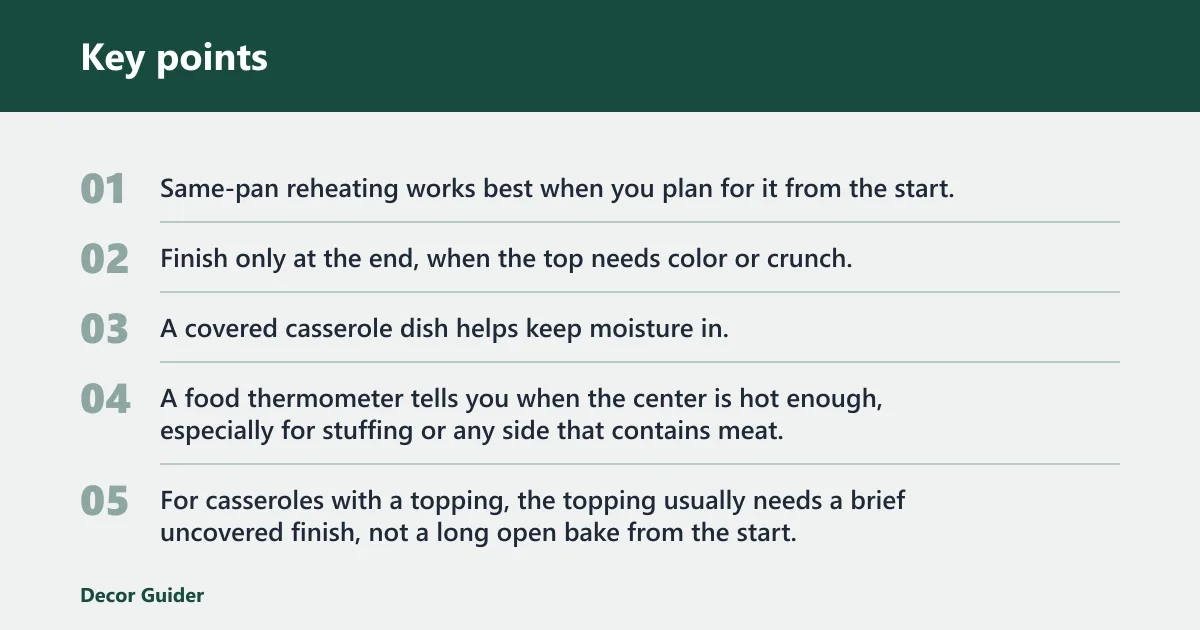


Same-pan reheating works best when you plan for it from the start. Assemble in the dish you will serve from, chill it flat, and choose a cover that traps moisture during the first part of reheating. Finish only at the end, when the top needs color or crunch.
A covered casserole dish helps keep moisture in. A food thermometer tells you when the center is hot enough, especially for stuffing or any side that contains meat. For casseroles with a topping, the topping usually needs a brief uncovered finish, not a long open bake from the start.
What you’ll need
- Freezer-safe baking dish, or another oven-safe dish marked by the manufacturer for fridge-to-oven or freezer-to-oven use
- Covered casserole dish or a tight lid
- Heavy foil, if your dish does not have a fitting lid
- Food thermometer
- Wooden spoon or silicone spatula
- Milk, cream, or another recipe-appropriate liquid for loosening dense sides
- Fat-rich add-ins such as cream cheese or sour cream for mashed potatoes
How do you prep sides ahead in the same pan?
Assemble the side in the pan you plan to reheat and serve from, then chill it quickly and evenly. Dense dishes like mashed potatoes and stuffing hold better when you press the surface flat before covering, while topped casseroles need the topping added at the right stage so it stays crisp.
- Choose the serving pan. Use a dish marked by the manufacturer for fridge-to-oven or freezer-to-oven use, and check the owner’s manual before you depend on it. If you plan to move it from freezer to oven, the maker must allow that exact temperature change for that model.
- Build the dish for reheating. Pack the food into a shallow, even layer so the center heats at the same pace as the edges. For mashed potatoes, add milk, cream cheese, or sour cream during assembly so the mixture stays smoother after reheating.
- Cover and chill fast. Cover the surface tightly with a lid or foil, then refrigerate as soon as the dish stops steaming. This limits drying and helps keep the top from forming a crust before reheating.
- Label the dish clearly. Mark the name and the date on the cover. That matters most when several holiday sides are stacked in the refrigerator and you need the oldest one first.
How do you store and chill them safely?
Store assembled sides in tightly covered dishes and keep them cold until reheating day. A freezer-safe baking dish is useful for make-ahead casseroles, but the dish still needs a tight cover and a slow thaw in the refrigerator when possible. That reduces cracking risk and helps the food reheat more evenly.
Freezer-safe baking dish rules
Use freezer-safe bakeware for assembled casseroles you want to hold longer than a short fridge window. Cover it tightly before freezing, then thaw in the refrigerator before reheating when possible. Do not move a cold dish straight from the freezer into a hot oven unless the manufacturer says that exact temperature change is allowed for your model.
Fridge storage, wrapping, and thawing
For fridge storage, keep the dish covered until the moment it goes into the oven. Mashed potatoes can be refrigerated for up to 3 days, and some make-ahead mashed potato recipes are made 2 days ahead; Seasons and Suppers says that version can be frozen for up to one month. Christina Tosi’s corn bake can be refrigerated for up to a week, but for food safety and quality, plan to use it within the shorter window your recipe gives.
How do you reheat them without drying out?
Reheat most sides covered first, then uncover only at the end if you need browning. The cover traps steam, which protects creamy fillings and the outer edge of shallow pans. If you uncover too soon, the edges dry before the center is hot.
- Set the oven first. Use 300°F for mashed potatoes, 325°F for corn bake, or 350°F for sweet potato casserole. Those temperatures match the source guidance for the specific dish and keep the top from overbrowning before the middle is warm.
- Add moisture before heating. Spoon in a thin layer of milk over mashed potatoes before reheating, or stir in a little recipe-appropriate liquid if the surface looks stiff. This helps creamy sides loosen without turning greasy.
- Cover for the first phase. Bake in a covered casserole dish or tightly foil-covered pan until the center warms through. For dense sides in a shallow pan, this is the step that prevents edge drying.
- Finish uncovered at the end. Remove the cover only when the food is hot and you need color, crisping, or a browned topping. Use the broiler for a brief finish, not a long second bake, so marshmallows or crumbs brown without scorching.
- Check the center temperature. Insert a food thermometer into the thickest part and confirm the center reaches 165°F before serving, especially for stuffing or any dish with meat.
Picture a 9-by-13-inch casserole of stuffing that has reheated covered at 325°F. If the center is still cool while the top is dry, the problem is usually too much uncovered time, not too little total time. Put the lid or foil back on for a few minutes, then recheck the center.
Holiday side reheating matrix
This same-pan matrix shows the make-ahead window, storage method, reheating cover, oven temperature, time range, finish step, and the most likely failure case for each common holiday side. Use it as a planning tool when you are juggling one oven and staggered serving times.
| Side dish | Make-ahead window | Storage method | Covered or uncovered | Oven temperature | Estimated reheat time | Finish step | Failure case to watch |
|---|---|---|---|---|---|---|---|
| Mashed potatoes | Up to 3 days in the fridge; some recipes 2 days ahead; up to 1 month frozen for the Seasons and Suppers version | Covered baking dish; thaw in the refrigerator when frozen | Covered | 300°F | 25 to 40 minutes, depending on depth | Stir after reheating; add a little milk if needed | Dry edges or a stiff center |
| Sweet potato casserole | Up to 2 days ahead | Covered casserole dish in the fridge | Covered first, then uncovered briefly | 350°F | 25 to 35 minutes | Broil for 1 to 2 minutes to brown marshmallows | Soggy topping or overbrowned marshmallows |
| Corn bake | Up to 1 week refrigerated | Tightly covered dish in the fridge | Covered | 325°F | 15 minutes | Stir lightly if the center needs even heat | Dry corners from overbaking |
| Stuffing | Partially baked ahead | Covered casserole dish, refrigerated; thaw first if frozen | Covered first, uncovered at the end | 325°F to 350°F | 20 to 35 minutes | Uncover to crisp the top before serving | Soggy top or a center that stays cool |
| Green bean casserole | 1 to 2 days ahead | Covered dish in the fridge | Covered first | 350°F | 20 to 30 minutes | Add fried onions near the end | Soggy topping |
| Mac and cheese | 1 to 2 days ahead | Covered dish in the fridge | Covered first | 325°F to 350°F | 20 to 30 minutes | Stir once, then top with crumbs if needed | Dry edges or separated sauce |
| Scalloped potatoes | 1 to 2 days ahead | Covered dish in the fridge | Covered | 325°F | 30 to 45 minutes | Rest 5 minutes, then serve | Curdled sauce or a watery bottom |
| Roasted root vegetables | 1 to 2 days ahead | Covered dish in the fridge | Uncovered for the last few minutes only | 350°F | 15 to 25 minutes | Toss once with oil or butter | Soft texture or overbrowning |
Common mistakes
The most common miss is opening the pan too soon. That dries the edges before the center is hot. Another is adding a browned topping at the start, which leaves it soggy or burnt by the time the base is ready. A third is skipping the thermometer and guessing.
Suppose sweet potato casserole goes into a 350°F oven with marshmallows already on top. By the time the middle is warm, the topping may be too dark. Hold the topping back until the last 1 to 2 minutes, or broil briefly at the very end.
- Overdrying shallow pans. Keep the cover on through most of the bake, and add a spoonful of liquid where the recipe needs it.
- Splitting creamy sauces. Reheat more gently and stir only after the dish is hot enough to loosen.
- Soggy toppings. Add crumbs, onions, or marshmallows at the end.
- Overbrowning the edges. Move the rack to the center and shield the rim with foil if needed.
Frequently asked questions
How do you make holiday side dishes ahead of time and reheat them without drying them out?
Assemble the dish in the same pan you plan to serve from, cover it tightly, and reheat it covered first at the recipe’s temperature. Use 300°F to 350°F for most holiday sides, then uncover only for a short finish if the top needs color. A thermometer should read about 165°F in the center before serving.
Which side dishes can be baked ahead and reheated in the same casserole dish?
Mashed potatoes, sweet potato casserole, corn bake, stuffing, green bean casserole, mac and cheese, scalloped potatoes, and roasted root vegetables can all work in one serving dish when the pan is oven-safe. The best candidates are dense or sauced dishes that benefit from a covered first bake and a brief finish at the end.
What temperature should I use to reheat a make-ahead holiday side dish?
Use the dish-specific temperature rather than one setting for everything. Mashed potatoes reheat well at 300°F, corn bake at 325°F for 15 minutes, and sweet potato casserole bakes at 350°F before serving. If the dish has a topping, keep it covered until the end so it does not overbrown early.
How far in advance can mashed potatoes or sweet potato casserole be made?
Some make-ahead mashed potatoes can be refrigerated for up to 3 days, and Seasons and Suppers says a version can be made 2 days ahead and frozen for up to one month. Sweet potato casserole can be assembled up to 2 days ahead, which makes it a strong choice for a crowded holiday oven.
How do you keep a casserole creamy when reheating it?
Keep it covered for most of the heating time, and add a little moisture before it goes in the oven. For mashed potatoes, NYT says to add a thin layer of milk before reheating, and some recipes benefit from cream cheese or sour cream in the mix. Stir only after the center is hot.
Can you reheat stuffing or corn bake in the same pan you cooked it in?
Yes, if the pan is oven-safe and the food was stored correctly in the refrigerator or freezer-safe baking dish. Christina Tosi’s corn bake reheats in a 325-degree oven for 15 minutes, while stuffing often needs a second bake to crisp the top before serving. Check the center with a thermometer.
What dishes should be reheated covered versus uncovered?
Creamy or dense sides should start covered: mashed potatoes, corn bake, scalloped potatoes, and stuffing all benefit from trapped steam. Uncover only at the end for browning or crisping, such as when you want the top of stuffing to brown or marshmallows on sweet potato casserole to color.
How do you know when a reheated holiday side dish is hot enough to serve?
Use a food thermometer in the thickest part of the dish. The center should reach 165°F before you serve it, especially for stuffing or any side with meat. If the edges are hot but the center is not, cover it again and give it a few more minutes in the oven.
Products related to this article
Sponsored / affiliate links. As an Amazon Associate I earn from qualifying purchases. I may earn additional commission from eligible campaigns.