How to Prevent Holiday Casseroles From Overcooking at the Edges
Stop casserole edges from overcooking by tenting with foil as soon as browning starts, moving the dish to the middle rack, and dropping the oven temperature 25°F if the edges brown 10 to 15 minutes before the center sets. If that gap is ignored, the sides may dry out or scorch while the center stays loose. Use the fastest fix in order: lower the heat, move the dish inward, then add insulation under the pan or foil over the top.
Fastest fixes in order:
- Lower the oven temperature 25°F if the edges are racing ahead.
- Move the dish to the middle rack to reduce direct top heat.
- Set the casserole on a baking sheet or use a second pan under it.
- Tent loosely with foil once browning starts, then uncover only near the end.
- Check doneness early so the center finishes before the rim dries out.
What you’ll need


- Foil for a loose tent or partial rim shield
- One baking sheet for under-pan insulation
- A second identical pan if you need double-pan insulation
- An instant-read thermometer for center doneness
- Oven mitts and a timer
- A shallow casserole dish, if the recipe allows a different shape
- A rack that can move to the middle or lower position
Casserole edge matrix
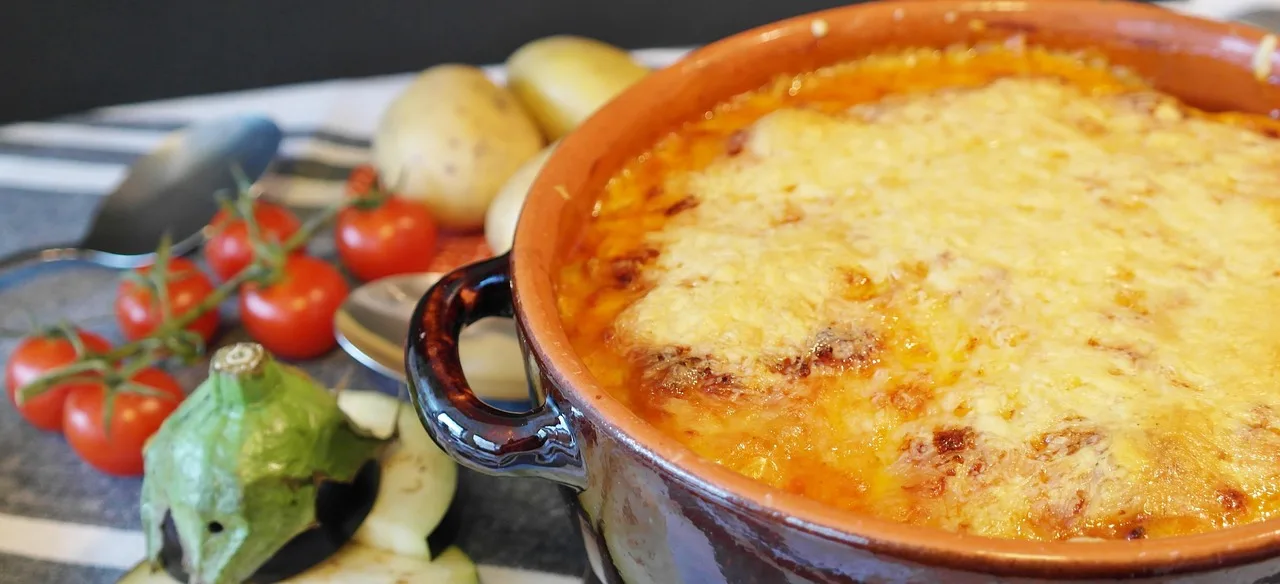
This matrix shows the most likely cause, the fastest fix, and when to act. Timing matters because edge browning often starts before the center has finished setting, especially in shallow dishes, metal pans, and convection ovens. For the most even bake, moderate temperatures reduce runaway edge color and give the center time to catch up.
| Scenario | Likely cause | Best fix | Bake-stage timing |
|---|---|---|---|
| Creamy potato casserole in glass, 9×13 | Glass holds heat at the rim and the wide surface area exposes more edge to direct oven heat | Set on the middle rack and shield the edges with a loose foil tent | Cover as soon as the edges start to color, usually midway through baking |
| Cheesy green bean bake under convection | Fan-driven airflow pushes heat across the top and rim faster | Lower the oven setting by 25°F and keep foil over the top until the last browning window | Cover early, uncover only near the end |
| Breadcrumb-topped side in a shallow ceramic dish | Shallow depth and large surface area brown the border before the center firms | Move to a lower rack and place the dish on a baking sheet | Start insulated; uncover briefly for the final browning stage |
| Sweet potato casserole in metal | Metal transfers heat quickly and can overbrowns the rim fast | Reduce direct heat with a double-pan setup | Use insulation from the start, then check early |
| Stuffing in an oval dish | Oval pans often have thin edges and uneven depth | Tent with foil and rotate once if the oven has hot spots | Rotate halfway through baking |
| Mac and cheese in a 9×13 metal pan | High edge exposure and strong bottom conduction dry the corners | Drop the oven temperature 25°F and move to the middle rack | Adjust at the first sign of edge color |
| Rice casserole in ceramic | Ceramic warms more slowly but can hold heat long enough to overcook the perimeter | Use a loose foil tent and rest after baking | Keep covered until the center is nearly done |
| Vegetable gratin near the top element | Top heat and exposed surface drive fast browning | Drop the rack one level and shield the top with foil | Move down before the top turns dark |
| Scalloped potatoes in a glass oval | Glass plus a wide oval shape creates fast rim browning | Set on a baking sheet and cover loosely | Insulate from the first bake interval |
| Cheese-topped casserole in a crowded oven | Uneven airflow and heat from nearby roast pans hit the sides hard | Leave space around the dish and rotate after half the bake | Check earlier than the recipe suggests |
| Crumb-topped casserole in a shallow 8×8 | Short depth and concentrated topping browning at the rim | Shield the edges, then finish under uncovered heat briefly | Protect early, brown late |
| Dutch oven casserole with lid removed too soon | The exposed surface dries and browns before the center finishes | Keep the tight-fitting lid on longer, then uncover near the end | Leave covered through the bulk of the bake |
How do you keep a casserole from overcooking around the edges?
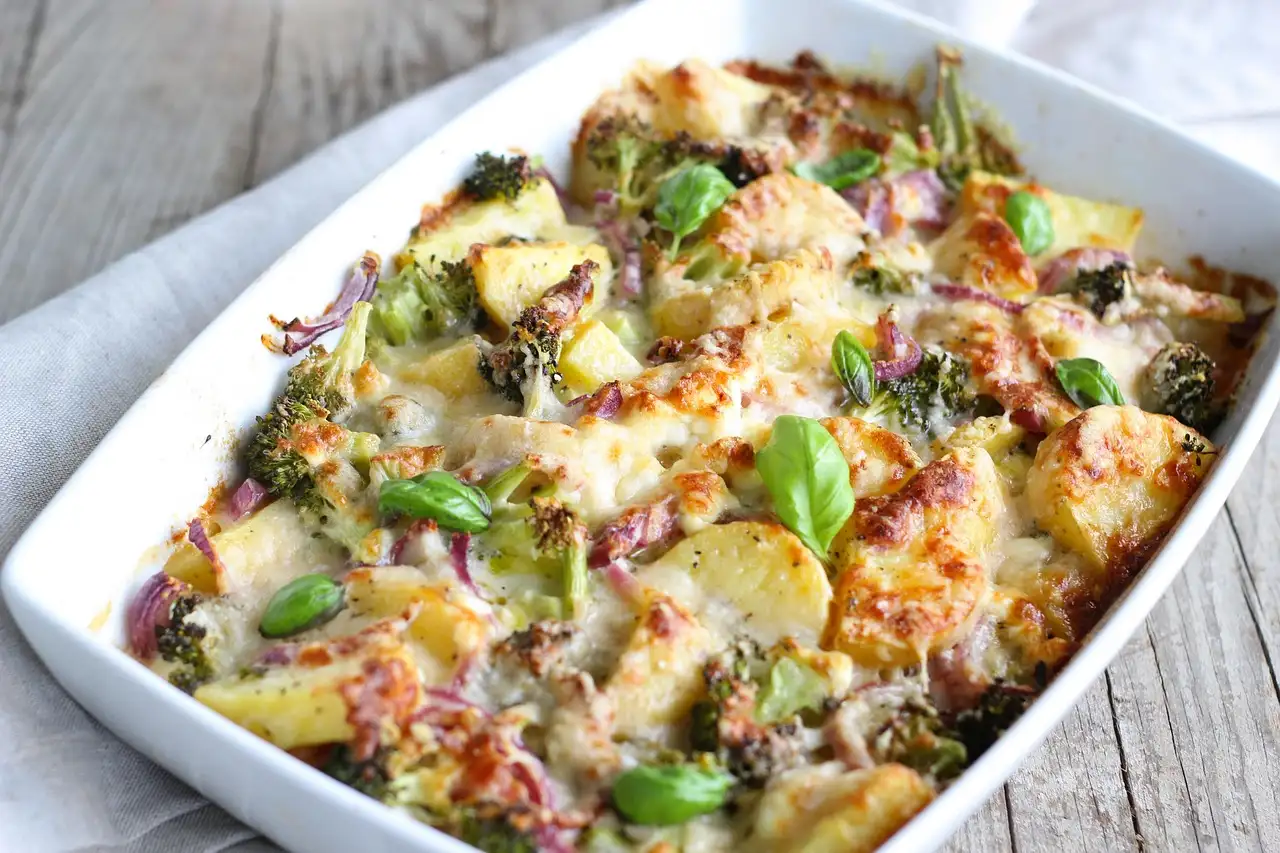
Start by cutting edge heat before it gets ahead of the center. Use the middle rack, keep the oven in the recipe’s usual 325°F to 375°F range, and add foil or insulation once the rim starts to color. If the edges are already 10 to 15 minutes ahead of the center, lower the temperature 25°F right away.
- Drop the heat first. Set the oven within the recipe’s normal 325°F to 375°F range, then reduce by 25°F if the edges brown early. Higher heat pushes the rim past the center faster.
- Move the dish inward. Use the middle rack by default. If the top browns before the center sets, move one level lower so the dish sits farther from the upper element.
- Add insulation fast. Put the casserole on a baking sheet or nest it in a second pan. That extra layer slows direct heat transfer at the bottom and sides.
Say your 9×13 macaroni and cheese is dark at the corners but still loose in the middle. Drop the oven from 375°F to 350°F, set the pan on a baking sheet, and cover the top loosely with foil until the center firms.
When should you lower the oven temperature?
Lower the temperature as soon as the edges move ahead of the center, not after the whole top has darkened. A 25°F drop is the common correction when the rim is browning too quickly, because it slows edge color without stalling the center. That matters most in shallow metal or glass pans.
Why does moderate heat bake more evenly?
Moderate oven heat gives the center time to set before the rim dries out. Higher heat drives surface browning first, especially along exposed edges and in thin layers. Keeping casseroles in the middle of the recipe range helps the whole dish progress together instead of letting the perimeter outrun the middle.
Why do casseroles cook faster on the edges than in the center?
Edges heat first because they face more hot air and more oven-wall radiation than the middle does. A shallow dish spreads the food into a thinner layer, so the rim has a larger surface-area-to-depth ratio, and metal pans move heat faster than glass or ceramic.
Dish material matters
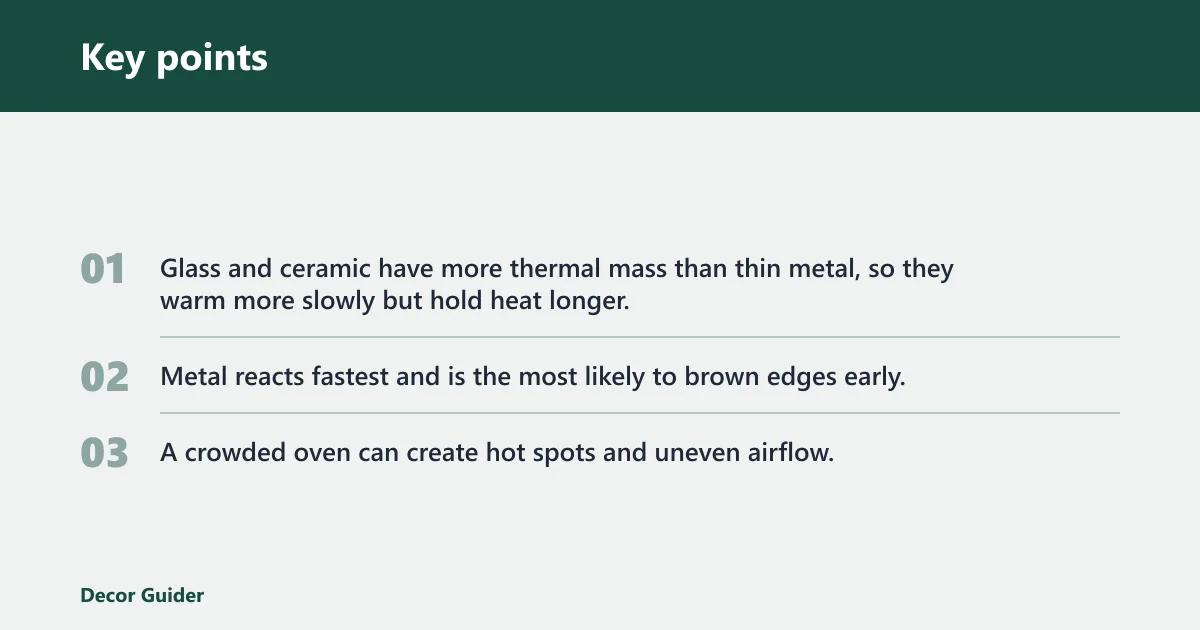
Glass and ceramic have more thermal mass than thin metal, so they warm more slowly but hold heat longer. Metal reacts fastest and is the most likely to brown edges early. Thick-walled cookware, including a Dutch oven, behaves differently again because its mass evens out heat and protects the sides better.
Oven setup matters too
A crowded oven can create hot spots and uneven airflow. Nearby roast pans and a fan in convection mode can push hot air across the rim and top, which is why the same recipe may brown faster in one oven than another.
What changes in convection, gas, electric, or toaster-style ovens?
Convection usually browns faster because moving air speeds heat transfer across the surface, so lowering the set temperature by 25°F is the standard correction. Gas and electric ovens can both have hot spots, but toaster-style and air-fry ovens often concentrate top heat more aggressively, so the rack position and foil shield matter even more.
What should you change for each casserole type?
Do not treat every holiday casserole the same. Creamy bakes need heat control, cheesy casseroles need topping control, and breadcrumb-topped sides need edge shielding earlier than most recipes suggest. Match the fix to the filling and the dish shape.
- Protect creamy casseroles. For potatoes, rice, or sauce-heavy bakes in glass or ceramic, use a loose foil tent and keep the dish on the middle rack. These casseroles often need slower edge heating so the center can set before the rim dries.
- Back off convection. For cheesy casseroles under convection, reduce the set temperature by 25°F and watch the top early. Fan-driven airflow speeds browning, so uncover only near the end if you want a browned top.
- Shield shallow sides. For breadcrumb-topped sides in an 8×8 or shallow oval dish, keep the edges covered with a foil collar or loose tent. Shallow dishes brown faster because the food layer is thinner and the rim is more exposed.
Suppose a scalloped potato bake in a glass oval dish is browning on the sides while the center still jiggles. Keep it covered, move it to the middle rack, and let it finish under gentle heat rather than increasing the temperature.
When should you use a water bath?
A water bath is most useful for casseroles that need very gentle, even heating and are prone to curdling, cracking, or drying at the rim. It cushions the dish from direct heat, but it is usually a niche fix for custard-like or egg-heavy bakes rather than typical cheesy or potato casseroles.
What is the rack rule for lower versus middle placement?
Use the middle rack for most casseroles because it balances top and bottom heat. Move one level lower when the top browns too quickly, when the oven’s upper element runs hot, or when the dish is shallow and the rim needs protection. Lower placement reduces direct top exposure.
How do you keep the topping from getting too brown?
Use foil in stages: full cover early for soft or creamy casseroles, a loose tent once the top begins to set, and foil only over the rim if the center still needs time. Remove the cover near the end only when the topping needs final browning and the center is nearly done.
- Cover early if needed. Use a full foil cover for the first part of the bake when the filling is still loose. This slows surface browning and holds moisture inside the dish.
- Switch to a tent. If the topping starts to color before the center sets, lift the foil so it does not touch the topping. A loose tent lets steam escape while blocking direct heat.
- Uncover late for color. Remove the foil during the last bake stage only when you need a browned top. If the edges still look ahead of the center, keep a strip of foil over the exposed rim instead of uncovering the whole dish.
How should you time foil-tenting by topping type?
Start with full cover for creamy or eggy casseroles, keep a loose tent in place when cheese or crumbs begin to color, and uncover only near the end when the center is already close to done. For toppings that brown fast, the safest sequence is cover early, tent at the first color change, and uncover briefly for the finish.
What if the edges are already too dark?
If the edges are already overbrowned and the center still needs time, protect the rim first, then slow the bake. Do not raise the heat to catch up the middle; that usually makes the perimeter worse. Save the surface, then finish the center gently.
- Shield the rim now. Fold foil into a collar and wrap it around the outside edge of the dish. If the top also darkens too fast, extend the foil into a loose tent.
- Lower the temperature. Reduce the oven setting by 25°F and move the dish one rack lower if the top element is the problem. That keeps the center cooking without punishing the sides.
- Add time in short checks. Continue baking in 5 to 10 minute intervals, then recheck the center. Stop when the middle reaches the recipe’s doneness cue and the bubbles at the edge are active but not violent.
A common first-timer mistake is pulling the foil off too soon because the top looks pale. If the center is still loose, leave the cover in place and finish in short intervals until the middle is set and the rim stops racing ahead.
What internal doneness cues should you use?
Use the recipe’s texture cue first, then confirm with temperature when the casserole includes eggs, dairy, or meat. The center should look set rather than loose, and the filling should no longer slosh when the pan is nudged. A thermometer gives the safest read when the dish contains those ingredients.
What temperature range is safe for egg, dairy, and meat casseroles?
For casseroles with eggs, dairy, or meat, use the thermometer range the recipe or food-safety guidance calls for and check the center, not the edge. Egg-rich and dairy-heavy casseroles usually need a fully set middle, while meat casseroles should reach the safe internal doneness standard for the meat in the dish.
Common mistakes
Most edge-browning problems come from too much direct heat, too much exposed surface, or too little insulation under the dish. Fixing only one of those often helps, but holiday ovens with roast meats, side dishes, and rotating trays usually need two changes at once.
- Using a shallow dish when the recipe can fit in a deeper one.
- Putting the pan too close to the upper heating element.
- Leaving a metal pan uncovered the whole time.
- Skipping the baking sheet under a thin or hot-spot-prone dish.
- Removing a browned topping too late, after the rim has already dried out.
Prevention: Match the dish to the recipe depth, start on the middle rack, and check the casserole 10 to 15 minutes before the recipe’s end time if your oven runs hot or the oven is crowded.
Frequently asked questions
Should I cover a casserole with foil to prevent burning?
Yes, when the top or edges start browning before the center sets. A loose tent works best because it slows browning without trapping as much steam as a tight seal. Remove it near the end only if the recipe calls for more color.
What temperature is best for baking holiday casseroles evenly?
Holiday casseroles are commonly baked in the 325°F to 375°F range. If your oven browns edges early, lower the setting by 25°F. For convection ovens, a common rule of thumb is to lower the set temperature by 25°F from the recipe’s conventional number.
Does a glass baking dish cook casseroles differently than metal?
Yes. Glass warms more slowly than metal but holds heat at the rim longer, so it can still overbake the edges once hot. Metal transfers heat faster and is more likely to brown the perimeter early, especially in shallow dishes.
What size and shape casserole dish bakes most evenly?
A deeper dish with less surface area often bakes more evenly than a shallow 8×8, 9×13, or oval pan. If the recipe allows, choose a shape that keeps the food thicker in the middle. That reduces the edge-to-center heat gap.
Products related to this article
Sponsored / affiliate links. As an Amazon Associate I earn from qualifying purchases. I may earn additional commission from eligible campaigns.