How to Choose Holiday Cookware for a Small Oven
Choose holiday cookware for a small oven by measuring the oven cavity first: a common rule of thumb is to leave about 1 inch on every side of the pan for airflow, rack movement, and safer handling, then pick a material that fits the dish. Skip that step and you can buy bakeware that is oven-safe on paper but too wide, too tall, or unevenly heated for your oven. This guide shows what to measure, which pan shapes fit best, and how materials affect browning, weight, and holiday cooking results.
How do you check whether cookware fits a small oven?
Measure the oven cavity, then compare the pan’s full outside dimensions, including handles and lid height, against the rack space and door swing. The direct rule is simple: if the pan cannot move in and out with at least 1 inch of clearance, it is the wrong size for that oven.
Holiday pieces fail in small ovens in predictable ways. Oversized handles can catch on rack rails, tall domes can touch the top element, and wide pans can block air movement around a roast or casserole. That is why fit comes before finish.
Small oven fit checklist
Use this checklist before you compare materials or finishes. A pan can be oven-safe on paper and still fail in a compact cavity because the sides, lid, or handles interfere with the rack, door, or top element.
| What to measure | What to compare | Simple pass/fail rule |
|---|---|---|
| Internal oven width | Width between the oven walls at the rack level | A pan generally fits if its width plus side clearance leaves about 1 inch on each side. |
| Internal oven depth | Depth from the back wall to the closed door | Pass if pan length fits without touching the door or rear wall. |
| Rack spacing | Distance between the rack you will use and the top element or upper rack | Pass if the pan and lid leave clear space above them. |
| Door swing clearance | Space the door needs when opening and closing | Pass if handles do not strike the door and the pan can slide in smoothly. |
| Pan length | Overall outside length, including rims | Pass if the pan fits the usable rack length with room to grip the edges. |
| Pan width | Overall outside width, including flared sides | Pass if the pan leaves airflow space and does not crowd burners on a compact stove. |
| Side-handle overhang | How far handles extend past the pan body | Pass if the handles do not block neighboring burners or catch on rack rails. |
| Lid height | Total height with the lid on | Pass if the lid clears the top element or oven roof with room to spare. |
The fastest oven-safe check is the marking on the pan’s base. Manufacturer markings may also include a maximum oven temperature, but that is only the final check. The weakest part of cookware often sets the oven limit, so a metal body does not override a plastic knob, silicone handle, or a coating with a lower ceiling.
-
Measure the cavity. Check internal width, depth, and rack spacing at the level where the pan will sit. Leave at least 1 inch of clearance around the pan for air circulation and safer handling.
-
Measure the cookware. Use the outside dimensions, not the cooking surface alone. Include rims, side handles, domed lids, and any knob that raises the total height.
-
Compare the worst-case point. If a handle, lid, or knob is taller than the body, use that number. A pan that fits by width can still fail if the lid hits the top element or the door will not close cleanly.
-
Check the base marking. Confirm the oven-safe symbol and any maximum temperature printed on the pan. If the pan has mixed materials, use the limit of the weakest component, not the strongest one.
-
Reserve broiler use carefully. Nonstick cookware should not go under a broiler. If you need high top heat for a holiday finish, choose bare metal or cast iron instead.
Say your oven is so tight that a 13-inch pan leaves little side clearance. Even if the label says oven-safe, the pan can block airflow and make it awkward to turn or lift. In that case, an 8-inch or 10-inch pan is the better fit, before you choose a finish.
Start with the cavity, not the catalog
Use the oven’s usable rack width and depth, not the exterior appliance size. Compact ovens often have less usable room than their outer shell suggests, especially when a rack is installed on the middle track.
A common first-timer mistake is buying a baking dish by recipe size alone. A 9 x 13 dish may be standard in a full-size oven, but a small cavity may need a shorter, narrower alternative such as a loaf pan, quarter-sheet pan, or mini roasting pan.
Check handles, domes, and lids
Handles matter as much as the body. Plastic or silicone handles can cap a pan below the metal body’s heat tolerance, and oven-safe phenolic handles still need the printed limit checked before use. Tall lids can also push a dish out of safe range if they sit too close to the upper element.
Picture a covered casserole that fits by width but sits too high with the lid on. The body may slide in, but the lid could sit uncomfortably close to the top element, which leaves too little room for safe browning or even heating.
Which material should you buy?
Choose the material after you know the oven clearance. For holiday cooking, the safest option is the one that fits, tolerates the needed temperature, and matches the dish you plan to bake, roast, or finish in the oven.
The oven-safe symbol and manufacturer temperature limit are the last checks. The material helps you decide how much headroom you really have for roasting, baking, or reheating before the weakest component becomes the limit.
Cast iron and enameled cast iron
Bare cast iron and enameled cast iron are among the most oven-tolerant cookware materials. They work well for stovetop-to-oven cooking, roasts, and one-pot holiday dinners because they hold heat steadily and tolerate high oven use.
For a small oven, the drawback is size and weight. A Dutch oven can be very useful, but its handles and lid add height, so you still need to check fit. A covered pot that is too tall can be worse than a shallower pan that has a lower heat ceiling.
Stainless steel and aluminum
Bare stainless steel and fully clad stainless steel are among the most oven-tolerant choices for holiday cooking. Stainless steel cookware often works well for stovetop-to-oven recipes, and a core of aluminum improves heat performance.
Aluminum cookware conducts heat well, but thin versions can warp. That makes it useful for light roasting and baking, though the pan shape matters. If the pan has a rack or inserts, check those components too, because the whole set must fit the oven.
Hard-anodized and nonstick cookware
Hard-anodized aluminum is reinforced aluminum that is commonly used in nonstick holiday cookware. It is a practical choice for everyday casseroles and baking when you want even heating and easier cleanup, but you still need to check the coating and handle limit.
Nonstick cookware generally has a lower heat ceiling than bare metal. If your holiday recipe needs top heat, do not choose nonstick for that part of the job. The safest approach is to rely on the pan’s printed oven limit and avoid broiler use entirely for these pieces.
Tempered glass bakeware
Tempered glass bakeware is oven safe only when labeled, and it can crack from sudden temperature swings. That makes it a reasonable choice for casseroles and baked sides when the dish is clearly marked for oven use and handled gently.
The drawback is thermal shock risk. Do not move a hot glass dish onto a wet surface or into a cold draft, and do not assume that every glass pan is equally safe just because it looks sturdy.
What size works best for holiday cooking?
For a small oven, compact sizes beat oversized pans. The most practical choices are 8-inch or 10-inch pans, a mini roasting pan for a smaller main, and shallow bakeware such as quarter-sheet pans and loaf pans for sides, casseroles, and desserts.
Small-kitchen cookware guidance points buyers toward compact 8-inch or 10-inch pans. Oversized pans can block other burners on compact stoves, so the right size helps both the oven and the stovetop stay usable during holiday prep.
8-inch and 10-inch pans for compact baking
An 8-inch or 10-inch pan is often the best starting point for a small oven because it fits more easily and leaves room for air to move around the food. That can help with browning and make it easier to slide the pan in and out without hitting the sides.
Buying guidance also points to a 10- or 12-inch nonstick skillet as a core essential, but a compact oven may still favor the smaller end of that range. For a tight cavity, the pan that fits better often performs better than the larger one.
Mini roasting pans for mains
A mini roasting pan is a good holiday option when you need one-pan mains for fewer servings. It leaves more room than a full-size roasting pan and is easier to turn on a small rack without crowding the oven walls.
If you roast poultry, vegetables, or a smaller cut of meat, the pan should fit with enough clearance to keep the hot air moving. A wider pan can be awkward in a small oven even if the recipe itself is simple.
Quarter-sheet pans and loaf pans for sides and desserts
Quarter-sheet pans work well for vegetables, rolls, cookies, and quick holiday sides. Loaf pans suit breads, stuffings, and compact desserts when a casserole dish would be too wide or too tall.
These shapes help because they are lower and easier to fit than bulky covered dishes. They also make it easier to keep several items in rotation if the oven only has one usable rack position.
Dutch ovens and casserole dishes in small ovens
A Dutch oven is oven-capable and useful for one-pot dinners, but size and lid height matter in a small oven. A casserole dish can be just as practical if it is shorter, narrower, and easier to handle with oven mitts.
Choose these pieces when the recipe benefits from covered cooking and moisture retention. Just make sure the lid does not hit the top element, and check that the handles do not crowd the door or neighboring burners.
What are some examples by need?
The examples below are best treated as fit-first options, not shopping shortcuts. Each one can work well in the right oven, but each also has a tradeoff, so the first question should still be whether the pan clears the cavity and rack space comfortably.
Best for one-pan holiday mains: Crock-Pot Artisan 3-Quart enameled cast iron Dutch oven

- Cast iron holds and distributes heat evenly.
- Works for slow cooking, baking, and roasting.
- Enameled finish is easy to clean.
This 3-quart enameled cast iron Dutch oven is a strong choice for braises, roasted vegetables, and small holiday mains. Cast iron holds and distributes heat evenly, and the enameled finish is easier to clean than bare cast iron.
The drawback is height and weight. In a small oven, you still need to check lid clearance carefully, and the round shape can be less efficient than a rectangular pan when you are trying to maximize rack space.
Best for casseroles and sides: HENXFEN LEAD 2.5 Qt Stoneware Casserole Dish
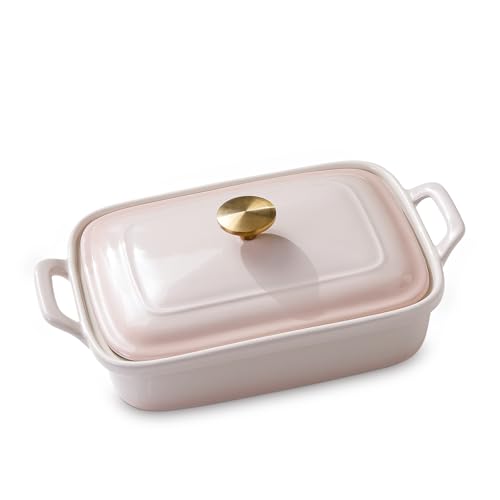
- Covered design helps retain heat and moisture.
- Side handles help with carrying.
- Stoneware construction promotes even heating.
This covered stoneware casserole dish is a compact option for lasagna, side dishes, and oven-to-table serving. The side handles help with carrying, and the covered design helps retain heat and moisture during holiday cooking.
The main limitation is thermal caution and size. Stoneware should still be checked against rack spacing and lid height, and it is a less flexible choice if you need quick stovetop-to-oven movement or a very high heat ceiling.
Best for baking desserts: Pyrex Deep 9×13 Glass Baking Dish with Lid

- Deep dish helps prevent spillovers.
- Oven, microwave, and freezer safe.
- BPA-free lid included for storage.
This deep glass baking dish works well for layered desserts, baked sides, and make-ahead holiday casseroles. The deeper profile helps reduce spillovers, and the included lid adds storage convenience after baking.
Glass needs more careful handling than metal. It is oven safe when labeled, but sudden temperature swings can crack it, so do not move it from a hot oven to a cold or wet surface.
Best for roasting in tight spaces: Cuisinart 14-Inch Stainless Lasagna Pan with Rack

- Includes a roasting rack.
- Dishwasher safe for easier cleanup.
- Cool-grip handles help with handling.
This stainless steel lasagna pan includes a roasting rack, which makes it useful for holiday roasting and draining excess fat. Stainless steel is among the most oven-tolerant materials, and the cool-grip handles are a practical detail for handling.
The tradeoff is length. A 14-inch pan can be too large for a compact oven or a small stove, so confirm both rack depth and door clearance before buying. In a small cavity, a shorter roasting pan may fit better even if this one looks useful on paper.
What mistakes should you avoid?
The biggest mistake is treating oven-safe labeling as the only test. A pan can be marked for the oven and still fail in a small cavity because the handles are too wide, the lid is too tall, or the rack space is too tight for proper airflow.
- Do not buy by diameter alone. A round pan with long handles may fit worse than a slightly wider pan with shorter side walls.
- Do not ignore the weakest component. Plastic, silicone, and some knob materials can set a lower limit than the metal body.
- Do not use nonstick under a broiler. Nonstick cookware should not go under a broiler, even if the base says oven-safe.
- Do not assume glass is heat-proof. Tempered glass and oven-safe ceramic can crack from sudden temperature swings.
- Do not choose a tall covered dish without checking lid height. A lid that touches the top element can ruin both the recipe and the cookware.
- Do not overload a compact stove with oversized pans. Larger pans can block other burners and make holiday prep harder.
Suppose you want a covered casserole for stuffing and a 10-inch skillet for a side dish. If the skillet has a silicone handle and the casserole lid sits too high, the better buy may be a shorter metal pan plus a separate lid-free bakeware piece, because both fit more predictably in the same small oven.
Frequently asked questions
How do I choose cookware that fits a small oven for holiday meals?
Measure the oven’s internal width, depth, and rack spacing first, then compare the pan’s outside length, width, handle overhang, and lid height. A pan should leave at least 1 inch of clearance on each side so air can move and the dish can slide in and out safely.
What size casserole dish works best in a small oven?
A shorter, narrower dish usually works best, especially one closer to an 8-inch or 10-inch format than a deep full-size pan. For holiday sides, choose a dish that fits the rack without crowding the walls or brushing the top element when covered.
Which cookware materials are oven safe for holiday baking?
Bare stainless steel and cast iron are among the most oven-tolerant choices. Hard-anodized aluminum and labeled nonstick options also work, but their real limit depends on the handle and coating. Tempered glass and oven-safe ceramic need careful handling to avoid thermal shock.
Can a nonstick pan go in the oven for holiday dishes?
Yes, if the pan is labeled for oven use and the temperature stays within the manufacturer’s limit. Do not put nonstick cookware under a broiler, and remember that the handle or coating may limit the pan below the metal body’s rating.
What should I check before putting a dish in a hot oven?
Check the oven-safe symbol on the base, the manufacturer’s maximum oven temperature, and the weakest component of the cookware. Then confirm that the dish fits the rack with safe clearance, including handles and lid height, before you preheat or slide it in.
Should I buy a Dutch oven, casserole dish, or baking pan for a small oven?
Choose a Dutch oven for one-pot mains, a casserole dish for covered sides, and a baking pan for flatter foods or desserts. In a small oven, the best choice is the one with the lowest height and the least handle overhang while still fitting the recipe.
Products related to this article
Sponsored / affiliate links. As an Amazon Associate I earn from qualifying purchases. I may earn additional commission from eligible campaigns.