Silicone Chocolate Mold Review: Best Picks for Valentine’s
For Valentine’s chocolates, the best overall pick here is the Fimary 1-inch deep silicone mold. Its deeper cavity suits truffles, filled hearts, and thicker gift chocolates, where release quality and shape stability matter more than decorative shape alone.
Verdict


- Thick 1-inch depth capacity
- Heat and cold resistant
- Non-stick easy release
Compared with shallow novelty molds, a deeper food-grade silicone mold is less likely to squash fillings or crack thin shells during unmolding. It is still silicone, so expect a softer finish than hard polycarbonate, but for home gift boxes it offers the best mix of depth, flexibility, and batch speed.
📊 One silicone chocolate mold option has 202 cavities. Source: 7 Best Silicone Chocolate Molds for 2026 (Make Perfect Treats).
Specs at a glance
| Spec | Fimary chocolate mold |
|---|---|
| Material claim | 100% BPA-free silicone |
| Depth | 1 inch |
| Release behavior | Non-stick easy release |
| Temperature claim | Heat and cold resistant |
| Best use | Large chocolates, thick candies, filled centers |
| Label confidence | Best read as a product claim, not a certification standard |
Silicone chocolate molds are usually made from PDMS, also called polysiloxane. That material uses a silicon-oxygen backbone, which keeps it rubber-like and flexible instead of rigid like metal or polycarbonate. Silicone is widely used in cooking, baking, and food storage products.
For candy work, the useful specs are depth, release, and label quality. A mold may be called food-safe, but that is not the same as an LFGB-certified mold, and a high-heat claim does not mean every silicone behaves equally under repeated oven use, freezer cycling, or greasy fillings.
Who it is for
This mold is for home bakers making Valentine’s gift chocolates that need clean unmolding and enough depth for a filled center. It is also a better fit for small-batch production than a novelty shape with shallow cavities.
If you want hearts, truffles, or thicker chocolate bites that can go straight into a box without much trimming, this is the kind of mold to start with. It is less ideal if you want a very sharp molded finish or a large number of tiny candies in one round.
What works

Deep cavities help Valentine’s fillings
A 1-inch cavity gives more room for ganache, nut butter, caramel, or layered fillings. That depth matters more than a heart outline alone, because thin cavities can collapse or crack when you demold a filled shell. For Valentine’s chocolates, thicker walls usually mean cleaner handling.
Flexible silicone makes release easier
Non-stick release is not only about slipperiness. Flexibility, detail retention, and tear-free removal matter just as much. When the mold bends slightly, the chocolate can come away without forcing it, which helps prevent broken tips on hearts, shells, and small decorative edges.
Batch speed is better than single-cavity novelty molds
Multi-cavity molds are faster than single-cavity molds because you can pour, chill, and unmold more pieces per round. That matters for Valentine’s boxes, where the goal is often a neat assortment rather than one large showpiece. More cavities mean more pieces per cycle.
Food-grade and LFGB labels are not the same thing
Food-grade silicone means the material meets FDA requirements for contact with food. LFGB-certified silicone is a European food-contact standard often marketed as a higher-safety benchmark. Neither label guarantees perfect performance, but both are better than unverified silicone from an unknown source.
High heat and high-fat foods can increase chemical movement from silicone, so the label matters even more when you are making buttery fillings or using the mold repeatedly. That is why low-quality material is the main safety concern, not silicone itself.
One practical use case
Say your goal is 24 Valentine’s truffles for a classroom box. A deeper mold can hold a ganache center, chill faster, and unmold with fewer cracks than a very shallow mold. The end result is usually cleaner, even if the finish is softer than a hard mold would give.
What does not
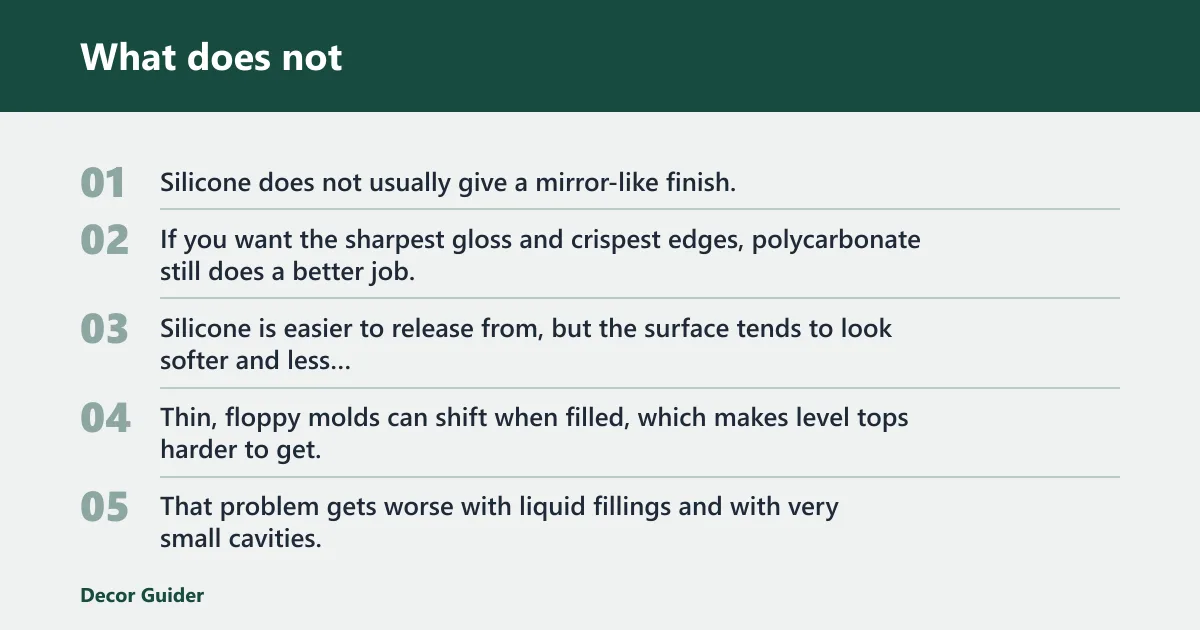
Silicone does not usually give a mirror-like finish. If you want the sharpest gloss and crispest edges, polycarbonate still does a better job. Silicone is easier to release from, but the surface tends to look softer and less reflective.
Wobble is another drawback. Thin, floppy molds can shift when filled, which makes level tops harder to get. That problem gets worse with liquid fillings and with very small cavities, where even a little bend can affect edge definition.
A common first-timer mistake is choosing a cute heart mold with very shallow cavities for filled chocolates. The shape looks right, but the thin shell can crack during unmolding or feel too fragile in a gift box. Depth matters more than decoration.
Alternatives

- Food-grade BPA-free material
- Dishwasher-safe design
- Heart shapes for gifts
The Generic 6-cavity heart mold is the simplest Valentine’s option here. Based on the product data, it is BPA-free silicone, dishwasher-safe, and shaped for gifts. Its drawback is capacity: six cavities are fine for a small batch, but slow if you need a full box fast.

- 20 cavities per batch
- Versatile multi-use shapes
- Wide temperature range tolerance
The X-Haibei 20-cavity stick mold is less Valentine-specific, but it suits fast batch work when you want bars, sticks, or snack-size chocolates. The main drawback is that its shape is not tuned to hearts or filled truffles, so it is better for quantity than for a gift-box presentation.
Should you buy it
Buy the Fimary mold if you want thicker Valentine’s chocolates, cleaner unmolding, and enough cavity depth for fillings. It is the best fit for truffles, filled hearts, and medium-size gifts where breakage would be frustrating.
Skip it if your main goal is tiny candies in large volume, or if you want a very glossy finish. For those jobs, a higher-cavity mini mold or a rigid mold may fit better. For most home bakers, though, depth and release are the deciding factors.
What silicone chocolate mold is best for homemade chocolates?
The best silicone chocolate mold for homemade chocolates is one with food-grade silicone, a smooth interior, firm side walls, and cavity depth that matches your filling. For Valentine’s treats, that usually means a mold that can make a thick truffle or filled heart without flexing too much during unmolding.
Shape matters less than performance. A heart mold is useful for gifting, but a shallow heart that cracks centers is a worse choice than a plain deeper cavity. For beginners, release quality and cavity depth are more important than decorative detail.
Are silicone chocolate molds safe for food?
Silicone chocolate molds are considered food-safe when they are made from food-grade silicone and properly labeled for food contact. FDA food-contact labeling is the basic U.S. signal to look for. LFGB-certified silicone adds another food-contact standard used in Europe, but it still does not replace careful label checking.
Low-quality silicone is the bigger problem. Some cheap molds may use unverified material or fillers, and high heat can increase chemical movement from silicone, especially with fatty fillings. For candy making, that means you should check the food-contact claim and the temperature rating, not just the shape.
How do you keep chocolate from sticking to a silicone mold?
To keep chocolate from sticking, use a clean, dry mold, temper the chocolate if you want the best release and finish, and let the pieces fully set before unmolding. Silicone is flexible, so the best release happens when the chocolate has firmed enough to hold its shape.
Do not overfill thin cavities. Thick, soft centers can smear or cling if the shell is too fragile. A smooth interior and firm sides also help, because detail retention improves when the mold keeps its shape while the chocolate sets.
What temperature can silicone chocolate molds handle?
Many silicone molds are often advertised with a temperature range around -40°F to +446°F, or about -40°C to +230°C. Silicone rubber itself can withstand temperatures from −55 to 300 °C, but you should still follow the specific product label because not every mold is rated the same way.
That range is why silicone can be used in the freezer, oven, or microwave in many cases. The catch is that appliance compatibility depends on the manufacturer’s claim, and dishwasher-safe does not automatically mean repeated high-heat dishwasher cycles will preserve every mold equally.
What size chocolate mold is best for truffles or mini candies?
For truffles, a deeper cavity is usually better than a tiny flat one. A cavity around 1 inch deep works well for thicker centers and filled chocolates. For mini candies, smaller multi-cavity molds are faster, especially if you want a full batch for gift boxes.
The right size depends on the filling. A mini square mold with 50 cavities is useful for small candies and fast output, while a mold with 202 cavities is better for very small pieces. If you want truffles, you generally need more depth than a mini candy mold offers.
Can you use silicone chocolate molds in the oven, freezer, and dishwasher?
Yes, many silicone chocolate molds are marketed for oven, freezer, microwave, and dishwasher use, but you should check each label. A temperature claim is only useful if it is clearly printed by the maker, and a dishwasher-safe claim should be treated as a convenience feature, not a durability guarantee.
Dishwasher cleaning saves time, especially for multi-cavity molds with sticky fillings. Still, printed finishes, coatings, and very thin molds may wear faster with repeated hot washing. When in doubt, hand washing extends reuse life and helps preserve release quality.
Do silicone molds give chocolates a smooth finish?
Silicone molds can give chocolates a clean finish, but usually not a hard, mirror-like one. The result is often softer than what you get from polycarbonate. Smooth interior walls help, yet the flexible material itself tends to leave a less glossy surface.
That does not make silicone a poor choice. For homemade Valentine’s chocolates, a slightly softer finish is often acceptable if release is easy and the shape stays intact. If you need sharp shine for premium box chocolates, hard molds still have the edge.
What should I look for in a food-grade silicone mold?
Look for a clear food-grade silicone label, a stated temperature range, a smooth interior, and cavity depth that fits your filling. LFGB certification is a plus if you want a higher food-contact standard, but the key is still verifiable material and a design that matches your chocolate style.
- Check the food-contact claim first.
- Compare cavity depth, not just shape.
- Match cavity count to your batch size.
- Confirm oven, freezer, microwave, and dishwasher claims on the label.
- Choose firmer walls if you want cleaner unmolding.
Picture a 50-piece Valentine’s batch versus a 6-cavity heart mold. The 50-cavity option wins on speed, but the 6-cavity mold may be better if each piece is a filled heart that needs careful unmolding. The right mold depends on if you are making volume or presentation first.
What is the best Valentine’s chocolate mold type?
The best Valentine’s mold type is the one that fits your filling and batch size, not the prettiest shape on the page. Heart, star, flower, shell, smiley, and helix molds all have a place, but a deeper heart mold usually works best for gifting because it balances presentation with easier release.
For beginners, start with a food-grade silicone mold that has a smooth interior and moderate cavity depth. That gives you cleaner unmolding, less breakage, and a better shot at chocolates that look good in a box instead of only in the mold.
What does cavity count change in real use?
Cavity count changes how fast you can produce a finished batch. Single-cavity molds are for showpieces or very large chocolates. Multi-cavity molds are better for Valentine’s boxes, and 50-cavity or 202-cavity mini molds make sense only when the pieces are small enough that speed matters more than size.
There is a tradeoff. As cavity count rises, each cavity is often smaller, which can make filled centers harder to manage. If you want truffles, keep enough depth. If you want tiny gift-box fillers, a high-cavity mini mold is more efficient.
Valentine’s chocolate mold decision table
| Mold type | Cavity size and depth | Shape | Release quality | Cleanup | Best use case |
|---|---|---|---|---|---|
| Deep heart mold | Medium, about 1 inch deep | Heart | Good if the sides are firm | Easy if dishwasher-safe; hand wash extends life | Filled hearts, truffles, gift boxes |
| Shallow decorative mold | Shallow, thinner shell | Star, flower, shell, smiley | Easy release, but fragile centers | Quick rinse, but details can trap residue | Solid chocolates, surface detail, fast small gifts |
| Mini multi-cavity mold | Small cavities, often high count | Mini squares or assorted small shapes | Good for small solids; less ideal for fillings | Fast cleanup per piece, slower total scrubbing | Mini candies, mix-and-match boxes, bulk batches |
| Large novelty mold | Larger cavity, variable depth | Helix, oversized heart, themed shapes | Can flex during unmolding | Depends on detail and size | One-off gifts, display pieces |
| 202-cavity mini mold | Very small cavities | Usually mini shapes or tiny forms | Best for quick solids, not thick fillings | Very efficient per batch | High-volume mini candies |
Which mold shape and depth work best?
Heart molds are the most natural fit for Valentine’s gifting, but depth decides whether the mold is practical. Shallow molds suit solid chocolates with clean surface detail. Deeper cavities are better for truffles and filled centers because they leave more room for structure and reduce cracking risk.
That is why the best mold is not always the prettiest one. A heart, shell, or flower can all work well if the cavity is deep enough and the silicone is firm enough to hold shape during filling and chilling.
How do you choose the right mold for your batch size?
Choose batch size by matching cavity count to your goal. Single-cavity molds are for display pieces. Multi-cavity molds are better for mixed Valentine’s assortments. A 50-cavity mold is useful when you want a larger batch of small candies. A 202-cavity mini mold is best when speed matters and each piece is tiny.
If you are making boxed gifts, a mid-size multi-cavity mold usually gives the best balance. It is fast enough for a home kitchen and large enough to keep detail and filling under control.
Suppose you need 18 filled hearts for two gift boxes. A 6-cavity mold means three rounds, which is manageable. If you need 200 mini chocolates for party favors, a high-cavity mini mold saves time even though each piece is smaller and simpler.
Frequently asked questions
What silicone chocolate mold is best for homemade chocolates?
The best silicone chocolate mold for homemade chocolates is food-grade, smooth inside, and deep enough for the filling you plan to use. For most home bakers, a medium-depth mold with firm walls gives better unmolding and fewer cracks than a very shallow novelty design.
Are silicone chocolate molds safe for food?
They are safe when they are made from food-grade silicone and clearly labeled for food contact. FDA food-contact labeling is the basic check in the U.S., while LFGB certification is a separate European standard. Unverified molds and high-heat use with fatty fillings deserve more caution.
How do you keep chocolate from sticking to a silicone mold?
Use a clean, dry mold, fill it evenly, and let the chocolate set fully before unmolding. Flex the mold gently from the back rather than pulling at one edge. A smooth interior and firm sides help the chocolate release without tearing or leaving residue behind.
What temperature can silicone chocolate molds handle?
Many are rated around -40°F to +446°F, or -40°C to +230°C, but the exact limit depends on the maker. Silicone rubber itself can withstand temperatures from −55 to 300 °C, so the product label is the final authority for oven, freezer, microwave, and dishwasher use.
What size chocolate mold is best for truffles or mini candies?
For truffles, a deeper cavity is usually better because it gives fillings enough room and helps the shell hold together. For mini candies, a smaller multi-cavity mold is more efficient. The right size depends on whether you want a boxed gift piece or a high-count batch.
Do silicone molds give chocolates a smooth finish?
They usually give a clean but softer finish than hard polycarbonate molds. Silicone is excellent for release, but the surface is generally less glossy. If you want a polished look for gifts, choose a mold with a very smooth interior and temper the chocolate carefully.
Products related to this article
Sponsored / affiliate links. As an Amazon Associate I earn from qualifying purchases. I may earn additional commission from eligible campaigns.
![ME.FAN Silicone Square Coasters with Holder [6 Pack] - Black](https://m.media-amazon.com/images/I/51AV8g4ktWS._SL500_.jpg)