Valentine’s Day Recipes Problems: Fixes That Work
Use the symptom to pick the fix: dry cake usually means too much flour or overbaking, runny ganache usually means not enough heat, and seized chocolate needs a little warm fat. If you ignore those signs, a last-minute Valentine’s dessert can turn dense, broken, or unsafe, and dinner timing can slip too. This guide helps you diagnose failed desserts, dinners, and baked gifts, then choose the fastest rescue step.
Why did my Valentine’s recipe fail?


A Valentine’s recipe usually fails because the symptom points to a different root cause than the clock does. Dry, spread-out, curdled, underdone, or bland results often come from oven temperature error, pan changes, ingredient measurement, substitutions, or cut thickness, so the fastest fix starts with the symptom, then the method.
Sort the failure by symptom
Start with what you can see and smell. A pale cookie that will not set, a cake that domes then sinks, a custard that sloshes, or a roast that looks done outside but stays tight inside each point to a different problem. Recipe times are estimates, not guarantees, so look at the edges, not just the timer.
Separate baking problems from savory problems
Baking failures usually trace to measurement, oven heat, pan type, or ingredient age. Savory failures more often trace to cut thickness, searing time, braising time, or whether the recipe assumed a certain roast size. The fix for a cookie spread is not the fix for a tough steak.
Choose save or restart
Save it when the structure is still mostly intact and the issue is incomplete cooking, slight dryness, a loose sauce, or a ganache that needs warmth. Restart when the batter is split beyond repair, a custard curdles badly, a cake collapses from the center, or the dish has the wrong texture all the way through. A fast check is whether more heat, more time, or a small correction can still change the result.
Valentine’s recipe failure triage
Use this table when you need a fast read on what went wrong and whether the dish is worth saving. It separates common dessert failures from dinner failures, because cookies, custards, chocolate sauces, and protein mains fail for different reasons.
| Symptom | Likely cause | Fastest fix | Save or restart |
|---|---|---|---|
| Heart cookies spread too much | Butter too warm, flour measured loosely, or oven running cool | Chill the shaped dough, verify oven temperature with an oven thermometer, and bake until edges are set and lightly browned | Save if they are still soft in the center; restart if the shapes have merged |
| Underbaked cookies | Oven temperature was low, bake time was too short, or dough pieces were too large | Return to the oven and bake until the edges are set and the centers look just opaque, not wet | Save if they still hold shape; restart if they collapsed into raw batter |
| Overbrowned bottoms | Dark pan, rack too low, or oven running hot on the bottom element | Move to a higher rack next time, use a lighter pan, and reduce temperature slightly if the recipe tolerates it | Save if only the underside is overbrowned; restart if the burnt flavor runs through the batch |
| Cake is dry or crumbly | Too much flour, overbaking, or pan material changed the bake rate | Brush layers with syrup, add filling or frosting, and cut bake time next round by checking for springy centers and a tester with a few moist crumbs | Save if the crumb is even; restart if the cake is hard all the way through |
| Sunken cake | Underbaked center, door opened too early, or too much leavening | Trim the top if needed, fill or frost, and bake the next cake until the center springs back and a tester shows only moist crumbs | Save if the center is only slightly low; restart if the middle is wet or gummy |
| Gummy cake | Too much liquid, underbaking, or batter mixed too heavily | Extend bake time in short checks and cool fully before deciding; next time, measure flour accurately and mix just until combined | Save if the crumb is simply damp in the center; restart if the whole cake is paste-like |
| Chocolate dessert is grainy or seized | Chocolate overheated, or cold liquid hit melted chocolate too fast | Stir in a small amount of warm fat or cream, then warm gently over low heat | Save if it smooths out; restart if it stays clumped and dull |
| Split ganache | Ratio was off, liquid was added too fast, or the emulsion overheated | Whisk in warm liquid a spoonful at a time or blend briefly until glossy again | Save if the fat can re-emulsify; restart if it stays oily and broken |
| Custard is runny or curdled | Not enough heat for setting, or heat was too high and the eggs tightened unevenly | For runny custard, return it to low heat and cook to a gentle set; for curdled custard, strain if the texture is only slightly rough | Save if the texture is close and strainable; restart if it split into curds and whey |
| Scrambled custard | Egg proteins overcoagulated from heat that was too high or too long | Strain immediately for a slightly grainy batch; if the curds are large, stop and restart the custard | Save if the grain is fine; restart if it looks like cooked egg pieces |
| Underdone chicken | Piece was thick, oven was cool, or pan was crowded | Return to heat and cook to a thermometer target, keeping the thickest part in view | Save if it is simply undercooked; restart only if it was held in the unsafe zone too long |
| Tough steak | Cut was too lean or was cooked beyond the desired doneness | Slice thinly across the grain and serve with sauce; next time use the right cut and pull at the proper temperature | Save if it is only slightly overdone; restart if it is leathery throughout |
| Pan-size mismatch | Batter depth changed, so the recipe baked faster or slower than written | Adjust batter depth, lower or raise the temperature slightly only if needed, and test earlier or later based on the pan used | Save if the center can still finish without burning the edges; restart if the geometry makes the bake impossible |
Cookies, cakes, and chocolate desserts
For baked sweets, the most common failures come from flour amount, oven heat, and pan behavior. A dark nonstick pan may brown faster than light stainless steel, and glass can behave differently again, so timing may shift by a few minutes either way. If the recipe used spooned flour and you scooped it, the dough may carry more flour than intended.
Say your heart-shaped sugar cookies look puffy at 10 minutes in one pan but spread flat in another. That difference can come from pan color, dough temperature, or a cool oven, not from the cutter shape itself. Check the edges, not just the timer. For more detail, see cookie troubleshooting and ingredient substitutions.
Custards and sauces
Custards and chocolate sauces need heat control more than bold stirring. A runny filling often needs more time over gentle heat, while a curdled one may have been pushed too hot and too fast. If the recipe says “cook until done,” you need a target texture: set edges, slight wobble in the center, and a spoon that leaves a clear trail.
That points to undercooking, not a flavor failure. If the base is still fluid after the stated bake or chill time, return it to the method that the recipe intended, then recheck for a soft set. For related guidance, see custard basics and chocolate ganache fixes.
Dinner mains and protein timing
Protein thickness changes cooking time. A 1-inch chop does not behave the same as a 1 1/2-inch chop, and a small roast may not follow the same timetable as a larger one. Braising and roasting outcomes depend on cut size, so a recipe written for one thickness can leave a thinner cut overdone and a thicker cut raw in the center.
For dinner mains, use doneness cues instead of only minutes. Look at color, texture, and thermometer targets for safety: poultry to 165°F, ground meats to 160°F, whole cuts of beef, pork, lamb, and veal to 145°F with a 3-minute rest, fish to 145°F, and leftovers reheated to 165°F. For more on heat control, see oven calibration.
Why are my cookies spreading or not setting?
Cookies spread too much when the dough is warm, the flour amount is low, or the oven runs cooler than the recipe assumes. They may also stay soft if the pan is pale and the bake never reaches the edge set that the recipe needs. Treat the clock as a guide, then check the edges and bottoms.
Flour measurement and ingredient age
Flour can vary by scoop versus spoon method, and a looser scoop can add enough extra flour to change the texture and spread. Older baking powder also loses strength over time, which can leave cakes and some cookie doughs flat or dense. Measure the way the recipe specifies, not the way that feels fastest.
Check whether the recipe expects spooned flour, sifted flour, or packed ingredients. If you swapped methods, the dough may need chilling, extra mixing, or a small correction on the next batch. Fresh leavening matters too, especially in cookies that should rise before they spread.
Oven heat and pan differences
Reliable oven sources such as the U.S. Department of Energy and extension programs note that home ovens can drift from the set temperature, and even a moderate error can change spread and browning. An oven thermometer is the quickest way to verify the actual temperature, especially when a batch bakes differently from one rack to another.
Glass, dark nonstick, and light stainless bakeware conduct heat differently. Dark pans usually brown faster. Glass can continue moving heat after it comes out of the oven. Light stainless often bakes more gently. The result is not a failed recipe so much as a timing change that the recipe did not spell out.
Fast fixes for spread or dryness
If cookies spread, chill the dough, bake one test cookie, and compare the result in a different pan if needed. If they are dry, reduce bake time slightly next round and pull them when the edges set but the centers still look a little soft. Do not wait for them to look fully hard in the oven.
Why did my cake, custard, or chocolate dessert go wrong?
These desserts fail for different reasons. Cakes usually point to flour, oven heat, or pan choice. Custards point to heat control. Chocolate desserts often fail because the liquid was too cold, the mixture was overheated, or a substitution changed how the fats and sugars behaved.
Dry, gummy, collapsed, or runny results
A dry cake often means too much flour or too much bake time. A gummy center usually means the outside set before the middle finished. A collapsed cake can mean it was underbaked, opened too early, or mixed in a way that weakened the structure. A runny custard usually needs more gentle heat, not more whisking.
What substitutions can change
Recipe substitutions can change hidden steps, not just flavor. A swap may alter moisture, structure, or binding, and some swaps require technique adjustments. Replacing sour cream, natural cocoa, or a dairy product can shift acidity, fat level, and thickness, so the batter may need different mixing or a different bake time.
When the substitute is liquid, cut back another liquid if the batter already looks loose. When the substitute is dry, expect a thicker batter and slower spread. If the recipe depended on eggs for structure, the dessert may need a gentler bake and a longer set time. For a fuller list of swap effects, see ingredient substitutions.
When a dessert is still salvageable
Save a dry cake with syrup, filling, or frosting. Save a slightly loose custard by cooking it a little longer over low heat. Save chocolate that seized by adding warm fat in small amounts. Restart only when the texture is broken across the whole dish, not just at one edge or one slice.
What if the dinner main is underdone or tough?
Underdone dinner mains need more cooking, but tough ones need a different response. Thickness, cut type, and method all matter. A roast that is too thick for its schedule may need more time, while a leaner or tougher cut may need braising instead of a dry roast.
Thickness changes cook time
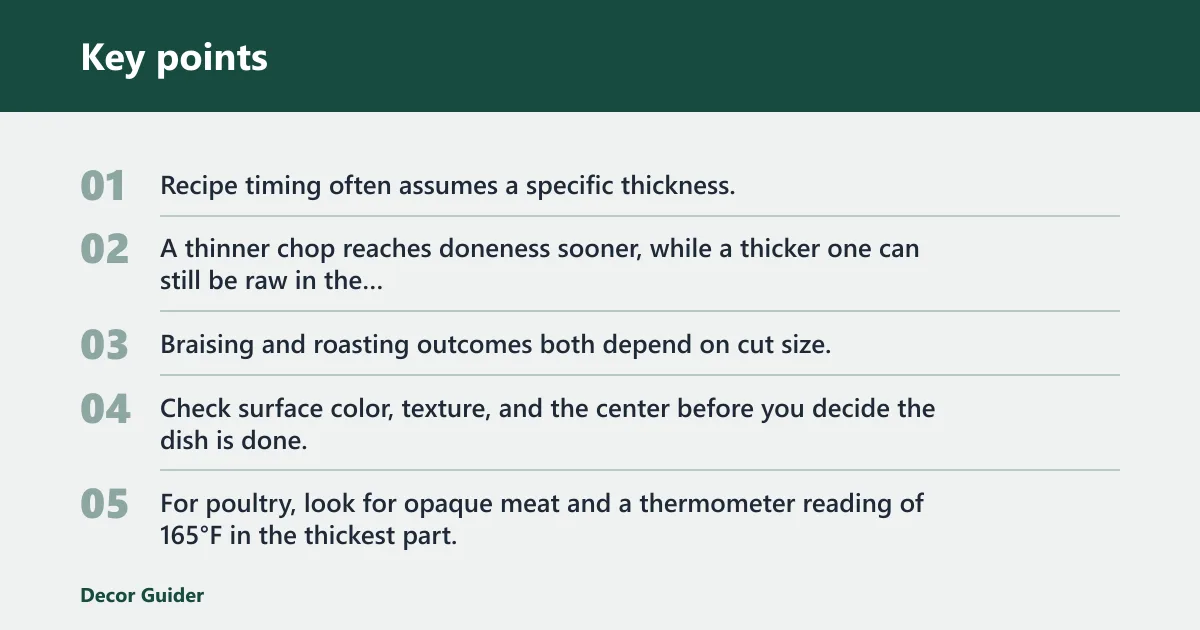
Recipe timing often assumes a specific thickness. A thinner chop reaches doneness sooner, while a thicker one can still be raw in the center when the outside looks ready. Braising and roasting outcomes both depend on cut size, so the same method can work very differently from one piece to the next.
Use doneness cues, not only minutes
Check surface color, texture, and the center before you decide the dish is done. For poultry, look for opaque meat and a thermometer reading of 165°F in the thickest part. For beef, pork, lamb, and veal, the safe minimum for whole cuts is 145°F with rest time; fish should reach 145°F. For custards, the cue is a set edge with a gentle wobble, not a slosh.
If the center is underdone, keep cooking and check again in short intervals. If the meat is already firm and dry, more oven time will not fix the texture. At that point, a sauce or a gentler serving method may help the meal, but it will not reverse overcooking.
When to keep cooking or switch methods
Keep cooking when the cut is simply behind schedule. Switch methods when the recipe assumed a different cut or thickness. A small roast may finish by dry heat, while a tougher cut often improves with a moist method that breaks down connective tissue over time.
Pan-size and bakeware substitution troubleshooting
When you move batter between 8-inch and 9-inch rounds, the batter depth changes enough to affect rise, browning, and bake time. A 9-inch round spreads batter thinner, so it usually bakes faster and may need a slightly lower temperature or earlier check. An 8-inch round is deeper, so it may need more time and a watchful center check.
Loaf pans, sheet pans, glass, dark metal, and light metal all change the bake path. Shallow sheet pans set quickly and brown fast; loaf pans need deeper center set time; glass retains heat and can overbrown the edges after removal; dark metal speeds browning; light metal bakes more gently. If batter depth changes, adjust the fill level to the pan’s intended capacity and begin checking early for shallow pans or later for deep pans. Use the recipe’s visual cues, not just the clock, and expect small temperature and time shifts whenever the pan geometry changes. For more troubleshooting, see oven calibration.
App and website access fixes
If the recipe itself will not load, the problem may be the site or app rather than your cooking. Clear the browser session, try a different device or network, and check the site’s own status or help page if one is available. A blank screen can come from a loading problem, an account issue, or a temporary server outage.
Login problems
Start with the account layer. If login fails, sign out and back in, then check whether the app or site is asking for a password reset or a fresh verification step. If the page still rejects the sign-in, the issue may be the browser session rather than the recipe page itself.
Saved recipe access and search failures
When saved recipes are missing, confirm that you are in the same account used to save them. If search fails, try a broader search term or the recipe title alone. Missing ingredients or directions can also point to a loading problem rather than a deleted recipe.
Blank-screen loading issues
If a page loads blank, try a hard refresh, clear cache and cookies, then test another browser or device. If the problem persists, check whether the site has posted a current outage notice or help-center update before changing DNS or other network settings. That sequence avoids blaming your device for a server-side issue.
Frequently asked questions
Why did my Valentine’s Day recipe not work?
Most failures come from a mismatch between the recipe’s assumptions and the real kitchen setup. Oven temperature, pan material, flour measurement, ingredient age, and cut thickness all change the result. Start by matching the symptom to the likely cause, then decide whether a small rescue or a full restart makes sense.
What do I do if a recipe says it will work but it doesn’t?
Treat the recipe as a starting point, not a guarantee. Oven temperature can drift from the set number, and bakeware can change browning speed. If the dish is close, adjust by checking doneness cues and giving it more or less time in short steps.
How do I fix a dessert that came out too dry or too runny?
Dry desserts usually need moisture added back, while runny ones need more set time or more gentle heat. Brush dry cake with syrup, add filling, or frost it. For runny custard or chocolate sauce, return it to low heat and check for the right texture before serving.
What if a recipe is written for a different pan size?
Use the pan size as a timing clue, not a fixed promise. A shallower pan may bake faster, and a deeper one may need more time. If the pan also differs in material, expect the browning rate to change too, especially with glass, dark nonstick, or light stainless steel.
How do I troubleshoot ingredient substitutions in baking?
Check whether the swap changes moisture, structure, or binding. A substitution may need a different mixing method, a different bake time, or a small correction in dry ingredients. If the batter looks looser or thicker than expected, stop and compare it with the texture the recipe describes.
Products related to this article
Sponsored / affiliate links. As an Amazon Associate I earn from qualifying purchases. I may earn additional commission from eligible campaigns.