Roasting Pan Cost / Price / How Much
A decent roasting pan usually costs about $25 to $80; thin aluminum is near the low end, heavy-gauge stainless or hard-anodized pans often cost about $60 to $150, and premium enameled cast iron can cost more than $200. Buy too cheap and you risk warping, hot spots, and handles that fail under a loaded turkey. This guide splits roasting pan price by material, size, and features so you can match cost to how often you cook.
Roasting pan price table
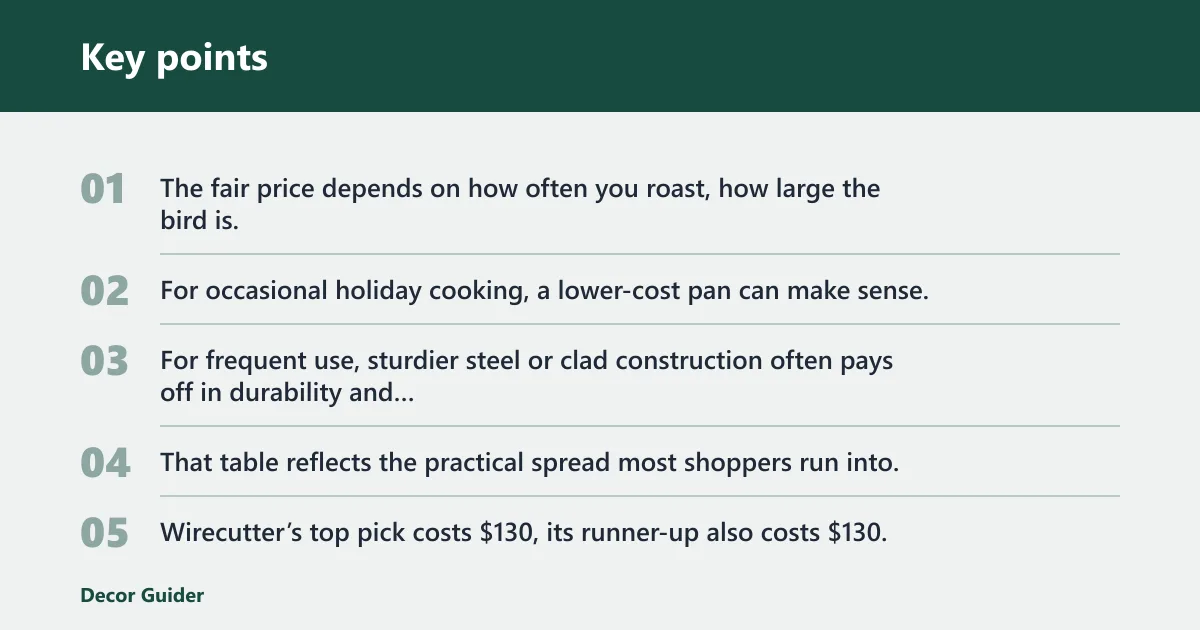


The fair price depends on how often you roast, how large the bird is, and whether you need stovetop use, a fitted rack, or a pan that will hold up for years. For occasional holiday cooking, a lower-cost pan can make sense. For frequent use, sturdier steel or clad construction often pays off in durability and steadier heat control.
| Pan type | Typical price band | Best use frequency | Size capacity | Rack quality | Worth it if |
|---|---|---|---|---|---|
| Budget aluminum or thin steel | $20 to $40 | Once or twice a year | Usually 14-inch to 16-inch; small to medium birds | Basic rack, sometimes included; often lightweight and coated | You want a low entry price and can accept shorter life and less even browning |
| Stainless steel roasting pan | $40 to $120 | Seasonal to regular use | Commonly 16-inch to 18-inch; medium to large birds | Often stainless steel, more stable, usually better fit | You want durability, better stovetop compatibility, and a pan that can do more than turkey |
| Nonstick roasting pan | $30 to $90 | Occasional to moderate use | Often 14-inch to 16-inch | Usually coated rack or lighter insert | You want easier cleanup and roast fewer very high-heat recipes |
| Cast iron roasting pan | $70 to $200+ | Frequent use or heat-heavy cooking | Commonly larger and heavier; some are lidded | Rack may be absent or separate | You value heat retention and do not mind weight |
| Premium multi-ply or fully clad | $130 to $315 | Frequent use | Usually larger capacity with stronger handles | Better rack fit and sturdier construction | You want a pan that can handle repeated use and may come with a lifetime warranty |
That table reflects the practical spread most shoppers run into. Wirecutter’s top pick costs $130, its runner-up also costs $130, the upgrade pick costs $250, and its small premium roaster costs $315. Taste of Home lists an All-Clad roasting pan at $160, while its Calphalon roaster fits a 26-pound turkey.
How much does a roasting pan cost?
A roasting pan usually lands in the $25 to $150 range, with the average buyer often paying somewhere in the middle for stainless steel or nonstick. The price climbs fast when you add a strong rack, heavier metal, larger capacity, or clad construction. Sale prices matter most when they cut a reputable midrange pan down near the low end of its class.
Typical price bands by material
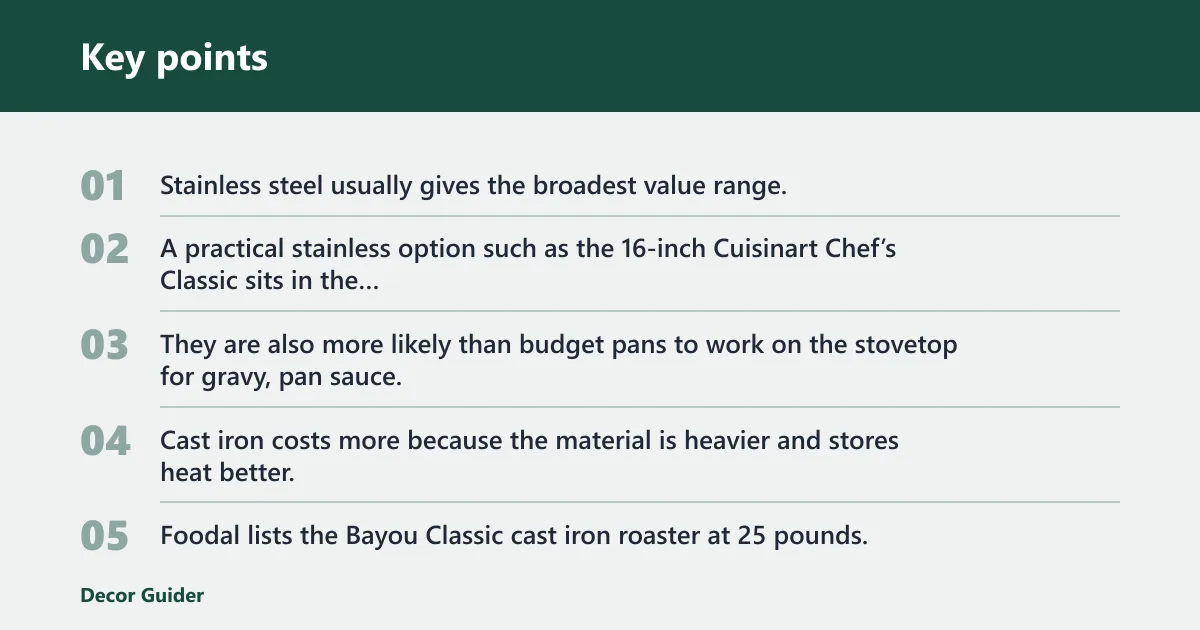
Stainless steel usually gives the broadest value range. A practical stainless option such as the 16-inch Cuisinart Chef’s Classic sits in the common midrange territory, and many stainless pans are sold with a rack included. They are also more likely than budget pans to work on the stovetop for gravy, pan sauce, or deglazing.
Cast iron costs more because the material is heavier and stores heat better. Foodal lists the Bayou Classic cast iron roaster at 25 pounds, which tells you what you are paying for: mass, steady heat, and a pan that feels built for long service. Some versions are lidded, which adds flexibility but also adds cost and weight.
Nonstick pans usually sit below premium stainless or cast iron, though the coating changes the equation. The same source says the All-Clad HA1 nonstick roaster is oven safe to 500°F, which is strong for a coated pan, but it still does not match bare metal for long-term toughness. The tradeoff is easier cleanup and less scrubbing after drippings.
Average price for budget, midrange, and premium pans
A fair budget price is usually around $20 to $40. Midrange pans often sit around $40 to $120, especially if they are stainless steel with a proper rack. Premium pans can start around $130 and move up to $315 or more when they use thicker metal, clad layers, or a larger, more stable build.
For occasional holiday cooks, the budget band can be enough. For regular roasting, the midrange band usually offers the best balance of cost, durability, and fit. Premium pans make the most sense when you roast often, want stronger handles, and need a pan that can handle years of repeated heat cycles.
What a fair sale price looks like
A sale is worth attention when it pushes a stainless steel pan into the budget-to-midrange overlap, or a premium pan down closer to ordinary stainless pricing. If a better-built 16-inch or 18-inch pan is discounted enough to match the cost of a thin entry model plus a separate rack, that is usually a better buy.
Do not judge a sale by the sticker alone. A low price on a flimsy pan can still cost more later if it warps, the rack bends, or you replace it after a few uses. The real bargain is the pan that fits your bird, oven, and cooking frequency without forcing a second purchase.
What makes one pan cost more?
Material, thickness, rack quality, and extra features drive price more than brand name alone. A heavier pan resists warping, sits flatter on the oven rack, and often browns more evenly. A better rack, strong handles, or a lid can add cost, but those extras matter only if you will use them often.
Material and gauge
Thicker metal usually costs more because it takes more material and tends to resist bending. Thin pans are cheaper but are more likely to buckle under a large turkey or under the heat of a hot oven. For buyers who roast only once or twice a year, thin steel may be acceptable; for frequent use, heavier gauge is easier to justify.
Gauge matters because it affects how the pan behaves under load. A floppy pan can be annoying to lift and may heat unevenly. A sturdier pan usually keeps its shape, which is one reason midrange and premium stainless pans cost more than the entry level.
Clad construction and heat behavior
Multi-ply or fully clad construction raises the price because it layers metals for better heat spreading and strength. That construction is common in premium pans and helps explain why some models cost $250 or $315. It is not required for good turkey, but it can help when you want a pan that also works for searing, braising, and repeated use.
Higher cost here is about consistency, not magic. A more expensive pan can still roast the same bird well as a simpler one, but it is less likely to warp and more likely to hold steady on the stovetop. That is the feature set that justifies the jump for frequent users.
Included rack, lid, and handle design
A rack adds real value because it raises the food for airflow and keeps the meat out of its own drippings. Stainless-steel racks usually cost more than coated wire racks, but they tend to be sturdier and easier to match with a heavy pan. Fit matters: if the rack slides around or sits too low, the bird can steam instead of roast.
Lids also push price up, especially on cast iron roasters. Handles matter too, because a deep pan with a loaded turkey needs a strong grip point. A bargain pan with weak handles can be a false savings if it makes lifting unsafe or awkward.
Which material is worth the price?
Stainless steel is the best all-around buy for most shoppers because it balances durability, oven use, and stovetop compatibility. Cast iron is worth the extra cost when heat retention matters more than weight. Nonstick is easiest to clean, but it is the least durable choice when you roast often or push high heat.
Stainless steel roasting pan
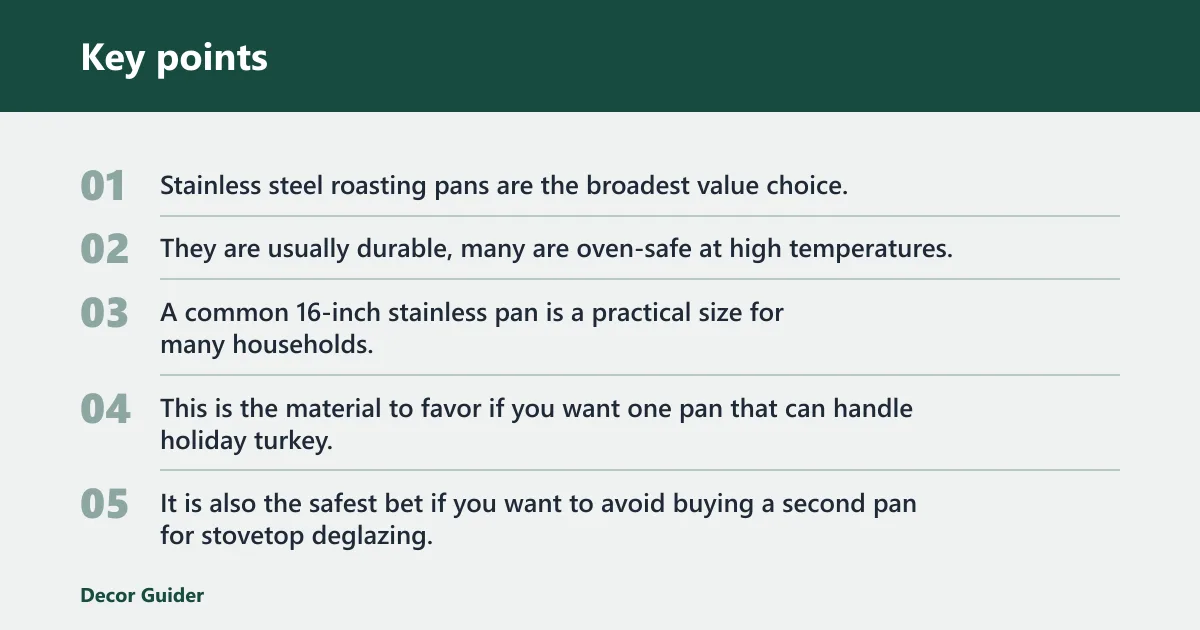
Stainless steel roasting pans are the broadest value choice. They are usually durable, many are oven-safe at high temperatures, and they often work on the stovetop for gravy or pan sauce. A common 16-inch stainless pan is a practical size for many households, and many models include a fitted rack.
This is the material to favor if you want one pan that can handle holiday turkey, roast chicken, and weeknight vegetables. It is also the safest bet if you want to avoid buying a second pan for stovetop deglazing. In most kitchens, stainless steel gives the strongest mix of cost and flexibility.
Cast iron roasting pan
Cast iron roasting pans cost more because they are heavier and retain heat well. That weight can help hold temperature steady, but it also makes the pan harder to move, wash, and store. Some cast iron roasters come with lids, which helps for braising and covered roasting, though the lid adds to the total price.
It makes sense to pay more for cast iron if you cook low-and-slow dishes often, want excellent heat retention, or plan to use the pan for braises as well as roasts. It is less attractive if you need a lighter pan for easy handling or if your storage space is limited.
Nonstick roasting pan
Nonstick roasting pans are appealing because cleanup is simpler and drippings release more easily. The price is usually moderate, but the tradeoff is durability. The coating can wear with repeated use, and nonstick is a weaker match for very high heat than bare metal.
Nonstick works best for buyers who roast less often and prefer low-effort cleanup over maximum longevity. It can be a smart choice for a holiday-only kitchen, but it is usually not the best value if you roast at high heat or want a pan that will last for years of frequent use.
Say your oven is small and you only roast a 12-pound turkey once a year. A 14-inch or compact 16-inch pan with a simple rack may be the best value, because a larger premium pan would cost more and take more storage space without improving the result.
What size roasting pan should you buy?
The best size depends on the bird, the oven, and where you store the pan. A 14-inch pan suits small birds. A 16-inch pan is the practical middle ground for many families. An 18-inch pan gives more clearance for larger turkeys and bigger batches of vegetables, but it takes up more room in the oven and cabinet.
14-inch, 16-inch, and 18-inch pan sizes
A 14-inch roasting pan is the better choice for smaller birds and tighter ovens. It may fit more easily in compact kitchens and is easier to store. A 16-inch pan is the best all-around size for a lot of buyers because it covers most medium roasts without becoming awkward to handle. An 18-inch pan is better when you need extra surface area and more room around the bird.
Taste of Home recommends a medium 16-inch pan for birds up to 16 pounds, and a large 18-inch pan for turkeys up to 20 pounds. Homes & Gardens says one roaster holds up to 20 pounds of turkey. Those figures are useful because they translate size into real food, not just pan dimensions.
Turkey capacity by bird weight
For a 12-pound bird, a small to medium pan is usually enough if the oven is not cramped. For a 16-pound turkey, a 16-inch pan is the practical floor. For a 20-pound turkey, the larger 18-inch size gives more breathing room. For a 25-pound turkey, look for a larger-capacity pan such as the All-Clad examples cited by Taste of Home, which holds up to a 25-pound turkey, or the Calphalon roaster that fits a 26-pound turkey.
Those capacities matter because the wrong size can force the bird too close to the pan walls. That can affect browning and make basting harder. If the pan is too small, you may also lose room for vegetables or drippings, which is part of the value calculation.
Oven space and storage limits
Measure your oven rack before buying. A pan that technically fits by label may still crowd the oven walls, make rotation difficult, or block airflow. Storage matters too: a large pan with a lid or bulky rack may be a poor value if it lives in a cramped cabinet eleven months of the year.
A common first-timer mistake is buying a pan for a 20-pound turkey and then discovering the oven cannot take the pan plus a rack without the door brushing the handle. In that case, the extra size adds cost and hassle without improving the roast.
Is a budget roasting pan worth it?
A budget roasting pan is worth buying when you roast infrequently, cook smaller birds, and need a lower entry price. The value drops when the pan warps, the rack bends, or the handles feel weak under load. If you roast often, spending more usually lowers the cost per use and reduces replacement risk.
Best use for occasional cooks
Budget pans make sense for holiday-only cooking, small households, and buyers who need a temporary solution. Wirecutter’s budget pick is a lower-cost covered oval roaster, which shows the lower end of the market still has a place. If your cooking is occasional, a basic pan can deliver acceptable results without a large upfront cost.
This is the segment where price matters most. If you know the pan will see one or two big meals a year, a modest build can be a rational buy. You do not need premium metal to roast a chicken or a smaller turkey well.
Where low-cost pans fall short
Low-cost pans often have thinner walls, weaker handles, and racks that bend or fit loosely. They may also have limited stovetop performance, which matters if you want to make gravy in the same pan. The hidden cost is replacement: a pan that warps after a few uses is not really cheap.
Budget pans also tend to have fewer extras. If the rack is poor, you may end up buying a separate one, which changes the true price. That is why the entry number on the shelf is only part of the story.
When spending more saves money later
Spending more is smarter when you roast more than a few times a year, want a pan that can move from oven to stovetop, or need a larger capacity for holiday meals. A sturdy stainless pan can outlast several low-cost replacements, which lowers the effective cost per roast over time.
Premium can also make sense if you plan to use the pan for more than turkey. Better handles, better rack fit, and stronger metal make one pan serve multiple jobs. That is where the extra money can be justified without assuming better price always means better food.
Frequently asked questions
How much is a roasting pan?
A roasting pan can be a low-cost kitchen buy or a long-term tool. For occasional use, a budget model may be enough. For frequent roasting, expect to spend more for stronger metal, a better rack, and easier stovetop use. The practical range for many shoppers is $40 to $120.
What is the average price of a roasting pan?
The average price usually lands in the midrange, around stainless steel models with included racks. That is the sweet spot for buyers who want durability without paying premium prices. If a pan is far below that range, check the build quality closely; if it is far above it, look for clad construction or larger capacity.
What makes one roasting pan cost more than another?
Thicker metal, clad construction, stronger handles, better rack quality, and larger capacity all raise the price. Cast iron also costs more because it is heavy and retains heat well. A lid, premium finish, or a warranty promise can add to the total too, especially in the premium tier.
Is a budget roasting pan worth buying?
Yes, if you roast only once or twice a year and do not need stovetop performance. A budget pan is less attractive if it warps easily or forces you to buy a separate rack. For frequent cooks, a sturdier stainless pan usually gives better value over time.
How much should I spend on a roasting pan for turkey?
For a 12-pound to 16-pound turkey, a practical target is often a midrange 16-inch stainless pan. For a 20-pound turkey, step up to an 18-inch pan. If you cook very large birds, premium models such as the $160 All-Clad roaster or higher-capacity pans make more sense.
What is the price difference between stainless steel and cast iron roasting pans?
Stainless steel usually costs less and weighs far less. Cast iron tends to cost more because it is heavier and stores heat better, and lidded versions can push the price up further. Stainless is the better general-purpose buy; cast iron is the choice when heat retention matters more than portability.
Do I need an expensive roasting pan to get good results?
No. Good results depend more on size fit, rack support, and oven space than on price alone. An expensive pan can offer better durability and heat control, but a properly sized midrange pan can roast turkey well. Spend more only when the extra construction matches your cooking habits.
What size roasting pan gives the best value?
A 16-inch pan gives the best value for many buyers because it handles medium birds, fits more ovens, and stores more easily than an 18-inch pan. Taste of Home recommends a medium 16-inch pan for birds up to 16 pounds, which is a practical target for many households.
How much does a pan cost?
If you mean a roasting pan, the answer is usually $25 to $150, with premium models beyond that. If you mean a general cooking pan, prices vary much more by type. For roasting specifically, the cost should track material, rack quality, and how much turkey you actually cook.
How much does a roast cost?
The roast itself is separate from the pan, so the answer depends on the cut and market price. A roasting pan is a one-time or infrequent buy, while meat cost changes each time you cook. If you are comparing value, judge the pan by its cost per use, not by the price of the roast.
Products related to this article
Sponsored / affiliate links. As an Amazon Associate I earn from qualifying purchases. I may earn additional commission from eligible campaigns.