CAROTE 8-Inch Frying Pan vs SNOWCLAD 12-Inch Sauté Pan: Which One Actually Belongs in Your Kitchen?
You look at your stovetop and see two pans. One has low, sloped sides. The other stands tall with straight edges and a glass lid. They both fry eggs. They both brown meat. So why do you need both?
| Our Pick | Runner Up |

|

|
| CAROTE CAROTE Nonstick Frying Pan, 8 Inch Classic… | SNOWCLAD SNOWCLAD Frying Pans Nonstick with Lid,Hybrid Non… |
| See on Amazon | See on Amazon |
As an Amazon Associate I earn from qualifying purchases.
The difference between sauté pan and frying pan comes down to geometry, not brand loyalty. I tested the CAROTE 8-inch Classic Granite Skillet against the SNOWCLAD 12-inch Hybrid Nonstick Sauté Pan to see which one earns its cabinet space. The short version: you are not choosing between good and bad. You are choosing between tossing and stirring, between a quick omelet and a braised dinner.
This matters if you cook for one, feed a family, or just bought your first apartment and need one pan that does everything. Let me walk you through the real differences, because the marketing photos do not tell you the whole story.
The Short Answer: Side Profile and Lid
Look at the pans from the side. That is the whole difference.
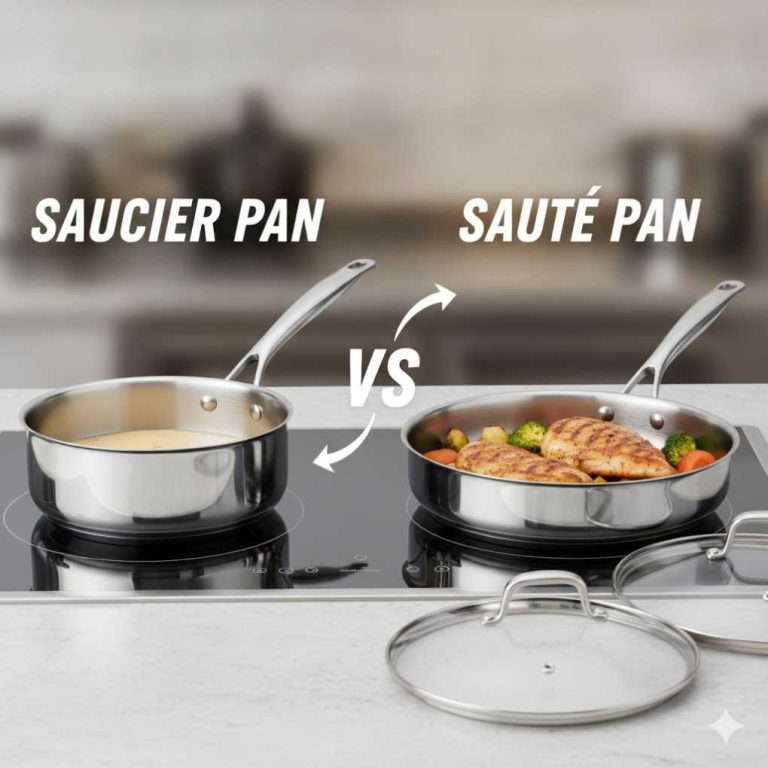
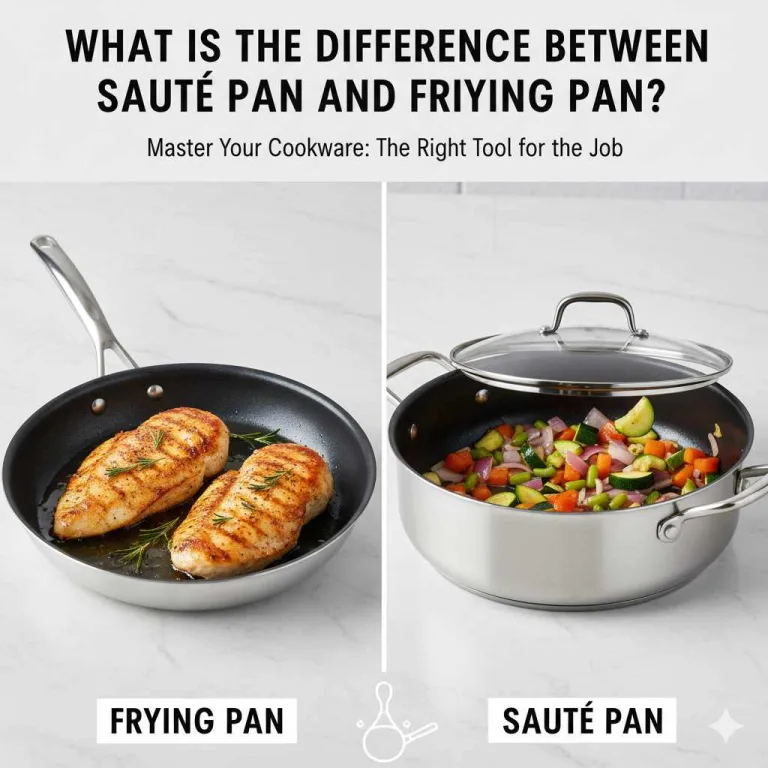
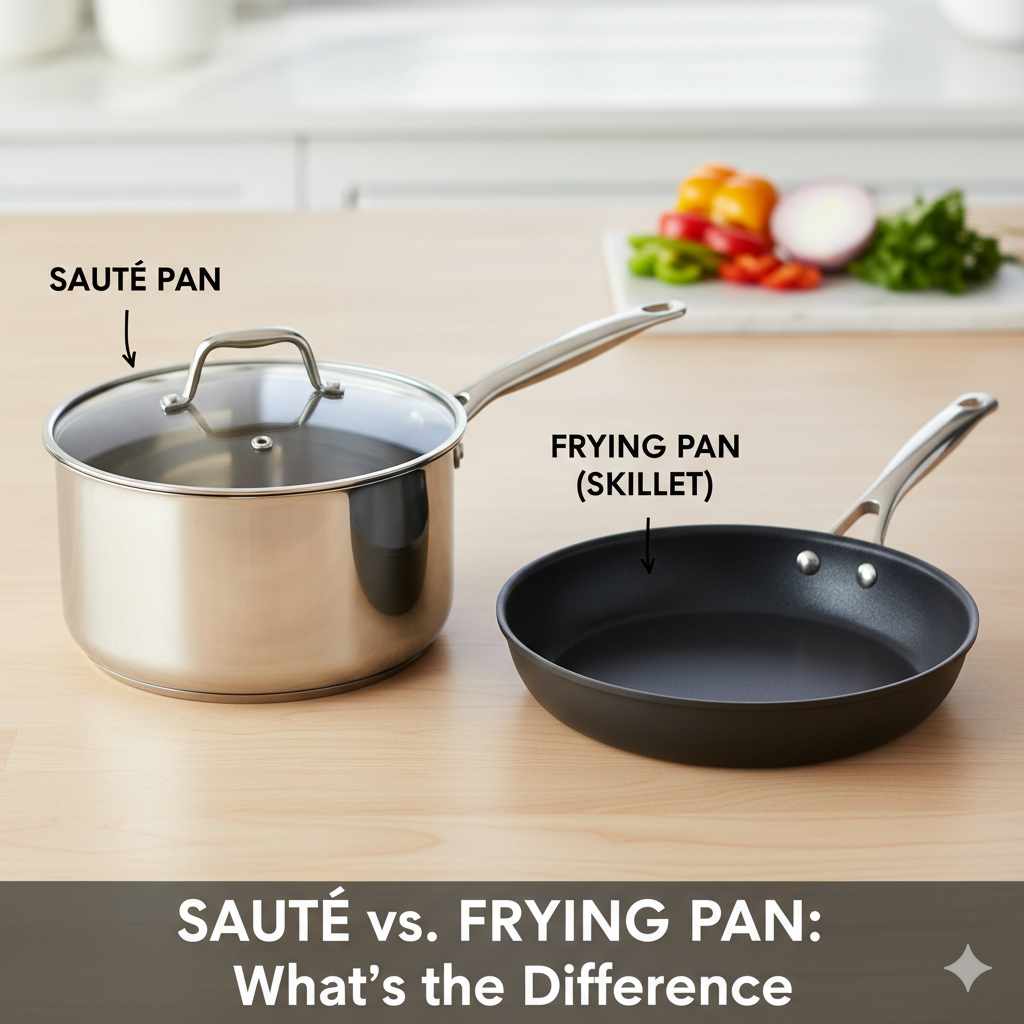
The CAROTE is a classic frying pan. Its sides slope outward from a flat bottom. The SNOWCLAD has straight, vertical sides that rise about three inches high and it comes with a lid. That straight wall changes everything about how you cook.
A frying pan is built for speed and flipping. A sauté pan is built for volume and liquid. The lid on the SNOWCLAD turns it into a mini braiser. You can sear a chicken thigh, toss in some broth, cover it, and walk away. Try that with the CAROTE and you will be wiping stovetop splatter for an hour.
But the CAROTE has its own strengths. It is lighter, cheaper, and easier to toss. So the real question is: what kind of cook are you?
Anatomy of a Sauté Pan: Straight Sides and a Lid
The SNOWCLAD is a 5-quart sauté pan with a 12-inch diameter. That is a big piece of cookware. The straight sides give you a larger cooking surface at the bottom than a frying pan of the same diameter, because nothing is cut off by the slope.
SNOWCLAD calls this their Snowflake Technology. The surface is laser-etched with a pattern that is part stainless steel and part nonstick. The idea is you get the release of a nonstick pan with the browning power of stainless steel. The company claims the clad surface covers 50% more area than typical hex-textured pans.
The hybrid surface works. Eggs slide off with a tiny bit of butter. But you can also get a proper sear on a pork chop without it sticking. That is a rare combo. The pan is dishwasher safe and oven safe, which the CAROTE does not claim. The stainless steel base makes it induction compatible, so it will work on any cooktop you plug it into.
The lid is the quiet hero here. It traps steam, which means you can cook rice, braise greens, or simmer a tomato sauce without splattering your backsplash. The 5-quart capacity handles a whole chicken or a pound of pasta with room to spare.
It is heavy, though. The multi-layer composite steel construction gives it heft. If you have weak wrists or limited upper body strength, this pan will be a workout every time you lift it to the sink.
Anatomy of a Frying Pan: Sloped Sides and Open Air
The CAROTE is an 8-inch frying pan with a granite-inspired nonstick coating. It is small, light, and nimble. The sloped sides mean food slides up and over the edge when you flick your wrist. That is the physics of flipping an omelet or tossing sautéed mushrooms.
The granite coating is PFOS and PFOA free. It is not real granite, despite the name. It is a mineral-infused nonstick layer that feels smooth and slightly matte. The pan heats up fast because the base is aluminum with a magnetic stainless steel plate for induction. That extended bottom design means it sits flat on any burner.
Cleaning is a wipe with a paper towel. You do not need soap most of the time. The nonstick surface is genuinely slick, so you can cook eggs with almost no oil. That is a real benefit if you are watching fat intake.
But an 8-inch pan is small. You can fit two eggs or one chicken breast. That is it. The sloped sides also mean the usable cooking surface is smaller than the top diameter. And without a lid, you cannot trap heat or moisture. You are stuck with open-air cooking, which is fine for a quick sear but useless for a stew.
The handle is comfortable and stays cool on the stovetop, which I appreciated. The whole pan weighs almost nothing compared to the SNOWCLAD. You can flip it with one hand all day.
The Science of Cooking: Why Shape Matters for Heat and Evaporation
The shape is not just about looks. It changes how heat moves and how moisture escapes.
Straight sides hold heat near the food. Sloped sides let heat dissipate into the air. That sounds minor, but it changes your sear. The SNOWCLAD’s tall walls trap radiant heat, so the entire surface of a steak gets consistent browning. The CAROTE’s open design loses that heat at the edges, which means the center of your food cooks faster than the edges.
Evaporation works the opposite way. The CAROTE’s wide open top lets steam escape quickly. That is great for crispy edges on a fried egg. The SNOWCLAD traps steam, which is good for braising but bad for crispiness. If you want a crunchy crust, you need the open pan. If you want tender, moist meat, you need the covered one.
Searing and Browning
For a proper crust on a steak, the SNOWCLAD wins. The hybrid surface gets hot enough to trigger the Maillard reaction without the food sticking. The straight sides keep the heat concentrated. I got a deep brown crust on a ribeye in about three minutes per side.
The CAROTE can sear too, but the nonstick coating works against you. Nonstick surfaces do not reach the same high temperatures as stainless steel without degrading. You will get a lighter brown, more like a tan. That is fine for a weeknight burger but not for a serious steak.
Tossing vs. Flipping
This is where the CAROTE shines. The sloped sides and light weight make it perfect for flipping. You flick the pan forward and the food slides up the curve and flips back down. It takes two minutes to learn.
The SNOWCLAD is too heavy and too tall for that motion. You cannot toss food in a 5-quart pan with straight sides. You will use a spatula to stir and turn. That is a different cooking style. Tossing is for quick, high-heat cooking. Stirring is for slower, saucier dishes.
If you love making stir-fry or fluffy omelets, you will miss the toss. If you make curries or braised short ribs, you will not care.
Liquid Capacity and Sauces
The SNOWCLAD holds far more liquid. Straight sides mean you can fill it with two inches of broth without sloshing over. The 5-quart capacity handles a full batch of chili or a pasta sauce for four people.
The CAROTE cannot do this. The sloped sides mean liquid has nowhere to go but over the rim. You are limited to shallow frying or a quick pan sauce made with a quarter cup of wine. The SNOWCLAD also lets you deglaze properly. You can pour in stock, scrape up the fond, and reduce it into a sauce without the pan overflowing.
Can You Use Them Interchangeably? (And When You Shouldn’t)
Yes, you can fry an egg in the SNOWCLAD. The hybrid surface is nonstick enough. And you can braise in the CAROTE if you cover it with foil, but it will be clumsy and messy.
The real issue is volume. The CAROTE is an 8-inch pan. The SNOWCLAD is a 12-inch pan. That is a huge size difference before you even consider shape. The CAROTE is for one or two servings. The SNOWCLAD is for a family.
Do not use the CAROTE for anything with more than a cup of liquid. Do not use the SNOWCLAD for a delicate French omelet. You will struggle with both.
Here is a quick reference for specific dishes:
| Dish | Better Choice | Why |
|---|---|---|
| Fried egg | CAROTE | Sloped sides make it easy to slide the egg onto a plate |
| Omelet | CAROTE | Light weight allows the flip technique |
| Steak sear | SNOWCLAD | Straight sides retain heat for a crust |
| Stir-fry | CAROTE | Tossing motion keeps veggies crisp |
| Chicken braise | SNOWCLAD | Lid traps steam and 5-quart capacity fits a whole bird |
| Tomato sauce | SNOWCLAD | Tall sides prevent splatter and hold volume |
| Pasta for two | SNOWCLAD | 12-inch surface and deep walls boil without spilling |
| Pancakes | CAROTE | Easy to flip and the nonstick release is flawless |
Which Pan Should You Buy First? A Decision Guide
If you are building a kitchen from scratch, buy the SNOWCLAD first. It does more. The lid, the depth, the 5-quart capacity, and the hybrid surface mean you can cook almost anything. It is not perfect. It is heavy and takes up serious cabinet space. But it replaces a frying pan, a saucepan, and a small dutch oven in one tool.
Buy the CAROTE if you cook for one, live in a tiny apartment, or need a second pan for eggs and pancakes. It is also a great gift for a college student. The 8-inch size fits in a dorm kitchen and the nonstick surface means nobody has to scrub burnt food.
Your experience level matters too. A beginner will find the SNOWCLAD more forgiving. The lid prevents splatter, the even heat prevents burning, and the hybrid surface prevents sticking. The CAROTE takes a light touch. You have to watch the heat and flip with confidence. If you are still learning, the SNOWCLAD is the safer bet.
Budget is a factor. The CAROTE is a budget-friendly option. The SNOWCLAD costs more because it is larger and uses a more complex manufacturing process. Check the current price on Amazon to see the gap. It is worth paying more for the SNOWCLAD if you cook dinner most nights.
Also consider your cooktop. Both work on induction, gas, and electric. The SNOWCLAD is oven and dishwasher safe. The CAROTE does not claim either. If you want to finish a frittata under the broiler or skip hand-washing, the SNOWCLAD is the only choice.
My Verdict: Buy the SNOWCLAD, Borrow the CAROTE
I am going to be direct. The SNOWCLAD is the better pan for most people. It is more versatile, holds more food, and the hybrid surface genuinely delivers on its promise of nonstick release plus stainless steel searing. The lid alone changes your cooking. You can braise, steam, and simmer without buying another pot.
The CAROTE is not a bad pan. It is a great egg pan. It is light, cheap, and easy to clean. But it is a specialty tool. You use it for breakfast and quick lunches. The SNOWCLAD is the workhorse.
If you have the budget and the cabinet space, get the SNOWCLAD. Then save up for a small frying pan like the CAROTE for the days when you just want a two-egg omelet without hauling out the heavy artillery. That combo covers every recipe you will ever try.
For a deeper look at how these shapes compare to other cookware, check out this sauté pan guide and this skillet comparison for more context.
Frequently Asked Questions
Is a sauté pan better than a frying pan?
For most home cooks, yes. A sauté pan with straight sides and a lid can sear, braise, simmer, and shallow fry. A frying pan only excels at quick, open-air cooking. The sauté pan is more versatile. The frying pan is better for flipping and for making crispy-edged eggs. It depends on what you cook more often.
Can you fry in a sauté pan?
Yes. The SNOWCLAD has a hybrid nonstick surface, so you can fry eggs and pancakes without sticking. The straight sides make flipping a bit awkward, but a spatula works fine. You can also shallow fry chicken cutlets in about an inch of oil. The tall sides prevent splatter, which is a nice bonus.
What size pan do I need?
For a single person or a couple, an 8-inch frying pan like the CAROTE is enough for eggs and small portions. For a family of three or more, you need the 12-inch size of the SNOWCLAD. The 5-quart capacity handles a full pound of pasta or a whole chicken. If you only buy one pan, go bigger. You can always cook a small amount in a large pan, but you cannot cook a large amount in a small one.
Products related to this article
Sponsored / affiliate links. As an Amazon Associate I earn from qualifying purchases. I may earn additional commission from eligible campaigns.