Roasting Pan Lid Fit Problems: Troubleshooting
If a roasting pan lid rocks, clean the rim first, then check for warp. If it still wobbles after a full dry fit, the lid is usually the wrong size or bent, not merely dirty. A bad fit lets steam escape, slows roasting, and can spill hot grease or juice. This guide shows how to tell whether the lid, pan body, or insert is at fault and which fix is safest.
What you’ll need

- Caliper or tape measure
- Dry towel
- Flat countertop or table
- Straightedge, if available
- Marker or painter’s tape for noting measurements
- Oven mitts or heat-safe gloves
- Heavy-duty aluminum foil for a temporary tent
How to diagnose a lid fit problem
-
Clean and cool everything.
Wash grease and dried drips from the roasting pan lid, rim, and insert, then dry them fully. Residue on the sealing surface can mimic a fit problem, and a warm pan can expand enough to change the fit. -
Check the lid on a flat surface.
Set the lid upside down on a counter and press lightly at opposite corners. Rocking usually points to warp or denting; a flat lid that still fails on the pan points more toward the pan body or insert. -
Measure the opening precisely.
Use a caliper or tape measure to record inside length, inside width, and rim-to-rim opening at the widest contact points. Also note rim profile and handle clearance, because a lid can match the opening yet still miss the rolled edges or knobs. -
Test the fit in order.
Place the lid on the bare roasting pan body first, then on the insert if your set uses one. If the lid fits the body but not the insert, the insert is the mismatch source; if it fails on both, suspect the lid or a brand/model incompatibility. -
Compare contact marks.
Look for shiny rub spots, one-corner gaps, or a lip that touches on one side and lifts on the other. Uneven contact shows where deformation sits and whether the sealing surface is a lid gasket or lip issue rather than a full-size mismatch.
Roasting pan lid fit matrix
| Symptom | Likely cause | Best next step |
|---|---|---|
| Rocking on a flat counter | Lid warp, denting, or bent rim | Check for visible bowing; compare opposite corners and measure the lid against the pan opening |
| Gap at one corner | Lid warp, pan-body distortion, or rolled-edge mismatch | Test the lid on the bare pan body, then the insert, to isolate the warped part |
| Lid sticks after heating | Heat expansion, rim burr, or a tight handle/knob interference point | Let the pan cool a few minutes, then lift at the least distorted edge and check clearances before the next use |
| Lid leaks steam | Poor sealing surface, warped lip, or body/insert mismatch | Use a foil tent for this cook and verify inside dimensions before replacing anything |
Why doesn’t my roasting pan lid fit?
A lid usually misses for one of four reasons: the lid is warped, the pan body has bent or rolled edges, the roaster insert no longer matches the outer pan, or the set mixes brands or vintage parts with different rim profiles. Measure the inside opening before blaming the lid.
Lid warp and denting
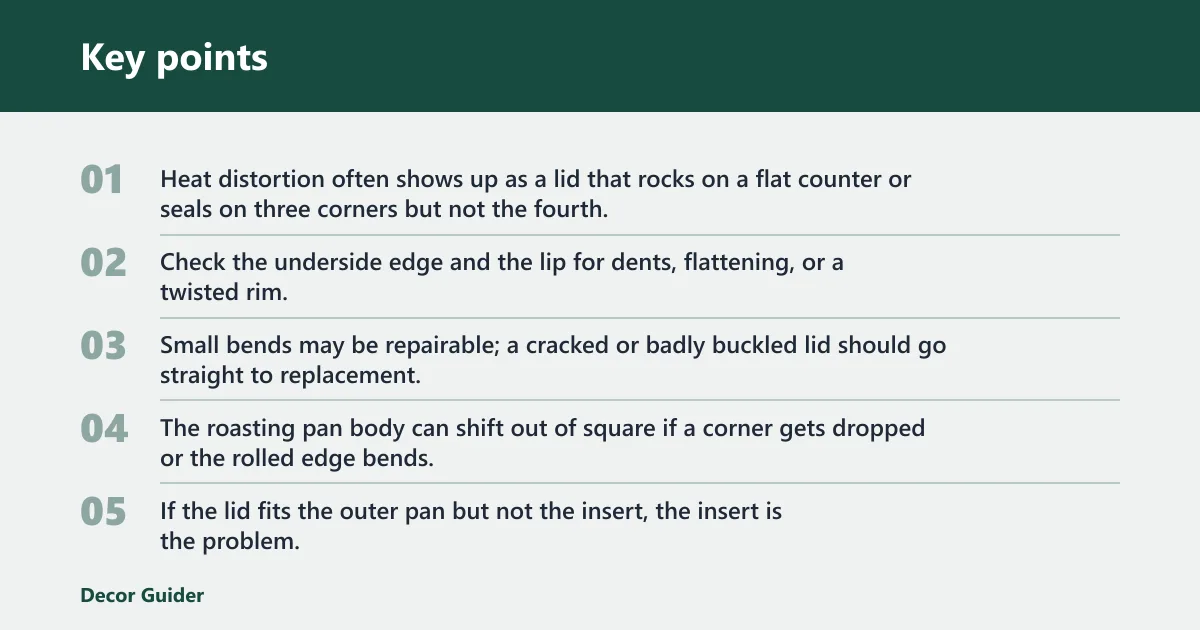
Heat distortion often shows up as a lid that rocks on a flat counter or seals on three corners but not the fourth. Check the underside edge and the lip for dents, flattening, or a twisted rim. Small bends may be repairable; a cracked or badly buckled lid should go straight to replacement.
Pan-body distortion and rim shape
The roasting pan body can shift out of square if a corner gets dropped or the rolled edge bends. That changes the top opening more than the outside size. Measure inside length and inside width at the rim, not the base, because the lid must fit the opening, not the outer shell.
Roaster insert mismatch
Lift-out inserts are a common mismatch source because the insert footprint can be slightly smaller, deeper, or differently rolled than the outer pan. If the lid fits the outer pan but not the insert, the insert is the problem. Use the insert alone with foil tenting or replace the matched set as a pair.
Mixed-brand and vintage compatibility
Aftermarket lids and inherited roaster sets often fail because one maker’s rim profile is flatter, steeper, or wider than another’s. A lid may measure “close enough” on paper and still fail at the rim-to-rim contact area. Brand/model compatibility matters most when the set is meant to self-baste or braise.
How do I tell if my roaster lid is warped?
A warped lid usually shows a visible bow, a rocking test failure, or uneven contact around the lip. If the lid sits flat on the counter but gaps appear only on the pan, the pan body or insert may be the distorted part instead. Check the lid before you force a fix.
Visual checks
- Set the lid down. Place it on a known flat surface and look for light under any edge.
- Rotate and retest. Turn the lid 180 degrees and repeat. If the same corner lifts, the lid is likely warped.
- Inspect the rim. Check for dents, flattened spots, and a bent lip near handles or knob mounts.
If a lid is meant to cover a 16-by-13-inch roaster but one front corner lifts by about 1/8 inch while the opposite side sits flush, that usually points to a bent rim rather than a size mismatch. That pattern usually points to a bent rim, not a size mismatch, because the error stays in one location after rotation.
Can I use foil instead of a roasting pan lid?
Yes, aluminum foil tenting is a practical short-term workaround when the lid fit is uncertain or the set is mixed-brand. Use enough foil to cover the food with a loose tent, and leave a small vent so steam can escape. Foil works best for dry roasting, not for a true seal.
Temporary workaround
- Shape a loose tent. Pull foil high enough to avoid touching the food, then crimp the edges around the rim.
- Leave one vent. Pinch one small corner open if you need controlled steam release during roasting.
- Watch the drips. For braising or self-basting, use extra foil layers or a deeper pan to reduce spill risk.
Suppose a turkey breast fits under foil but the lid from another brand leaves a 3/8-inch gap at the rear handle cutout. Foil is acceptable for that cook if the goal is even browning and moisture control, but it is a weaker choice for braising liquid or a long self-basting roast.
Can I fix a bent lid or use a workaround?
Minor bends can sometimes be corrected, but only if the metal is not cracked and the deformation is localized. If the lid has a deep crease, a twisted frame, or a damaged sealing edge, replacement is the safer choice. A poor fit is more acceptable for open roasting than for braising or steaming.
If that didn’t work, try this next
-
Recheck after cooling.
Let the lid cool to room temperature, then test again on the bare pan body. Heat can temporarily tighten or loosen the fit, so a hot check can mislead. -
Correct minor bends.
If the bend is slight, apply gentle hand pressure along the rim and retest after each small adjustment. Stop if the metal creases or the lip starts to split. -
Replace unsafe parts.
Choose an oven-safe replacement lid with a confirmed size match, the same rim profile, and a knob or handle material rated for oven heat. If the maker lists a model number, match it exactly.
Handle clearance matters here. A lid can fit the opening and still hit a tall center knob, a side handle, or a raised insert flange when the metal expands in the oven. Check both the lid material type and the handle material before buying a replacement.
Common mistakes
- Measuring the outside of the pan instead of the inside opening
- Ignoring rim profile and assuming any 16-by-13-inch lid will fit any 16-by-13-inch roaster
- Testing only the lid and not the body or insert
- Forcing a lid onto a mismatched rim, which can bend the edge further
- Using a loose lid for braising or steaming and assuming steam loss is harmless
- Shocking hot metal with cold water, which can worsen warp
A common rule of thumb is to measure the inside length, inside width, rim-to-rim opening, rim profile, and handle clearance before buying a replacement lid or mixing parts from another set. Dry all parts fully before storage so corrosion does not roughen the sealing surface.
Frequently asked questions
What size lid fits a standard roasting pan?
There is no single standard roasting-pan-lid size that fits every pan. Match the inside length, inside width, and rim profile, not just the nominal pan size. Many replacement listings also specify model compatibility, which is the safest match when the roaster has rolled edges or an insert.
Is it safe to use a lid that doesn’t seal tightly?
It can be acceptable for dry roasting, where some steam escape is normal. It is generally a poor choice for braising, steaming, or self-basting because liquid loss and hot splatter become more likely. If the lid moves or rattles, use foil tenting or replace the part.
When should I replace a roasting pan lid?
Replace it if the lid is cracked, deeply twisted, or still fails after cleaning and a full dry fit against the correct pan body. Replace it sooner if the knob, handle, or sealing edge is damaged and the part is no longer listed as oven-safe at your cooking temperature.
Products related to this article
Sponsored / affiliate links. As an Amazon Associate I earn from qualifying purchases. I may earn additional commission from eligible campaigns.