Roaster Insert Size Chart
Choose a roaster insert that leaves about 1 inch of total breathing room across the pan’s usable base, with at least 1/2 inch clearance on all sides for lift-out and airflow. A mismatch can keep the rack from sitting flat, trap drippings, or make the lid close poorly. This guide gives a fit-first roaster insert size chart, clearance checks, and the exact measurements to match rack or insert style to your pan or electric roaster.
How roaster insert sizing works

Measure a roaster from rim to rim, then check inside width and usable depth before you buy an insert or rack. Handles, rolled rims, tapered walls, and wall thickness can change the real fit, so outside inches alone can mislead. The pan also needs space for airflow, lid movement, and safe lifting. For a broader buying comparison, see roasting pan basics and how they differ from a roaster oven.
Measure rim to rim first
The most common roaster pan lengths are 14, 16, and 18 inches, measured rim to rim. That outside length does not equal the usable interior length, especially on oval pans with sloped sides or rolled rims. In practical use, a 14-inch pan suits smaller roasts, a 16-inch pan is the most versatile, and an 18-inch pan is for larger birds and batch cooking.
Check inside width and usable depth
Inside width tells you how much room a rack footprint really has. Usable depth matters too: many roasting pans fall in the 3 to 4 inch wall range, and a deeper wall can help with splatter while a shallower one can vent heat faster. USDA-style roasting guidance also depends on enough open space around the meat so hot air can circulate rather than steam the roast.
Account for handles and oven walls
Handles and thick side walls shrink the space that actually fits in the oven. A typical oven interior is roughly 24 to 25 inches wide, but the usable opening is smaller once you account for side racks, door clearance, and the pan’s handles. Measure the oven interior and the rack position before buying, especially if the pan must slide in with a cover on top.
Roaster insert fit chart
This chart maps pan length, inside width, usable depth, rack footprint, rack height, and lid clearance to the insert or rack style that usually fits best. Use it as a sizing check, not a guess. For oval roaster pans, match the rack footprint to the usable base area rather than the outer rim alone. If you are deciding between a stove-top-style pan and a covered appliance, compare roasting rack use with the pan size you already own.
| Pan length | Inside top width | Inside base width | Usable depth | Rack footprint range | Rack height range | Minimum lid clearance | Choose universal vs replacement |
|---|---|---|---|---|---|---|---|
| 14 inches | About 10 to 11.5 inches | About 8.5 to 10 inches | About 3 to 4 inches | About 9 to 11.5 inches long by 6.5 to 8.5 inches wide | About 0.75 to 1.25 inches | At least 1/2 inch above the roast; 1 inch if the lid is domed and low | Choose universal only if the rack sits flat with 1/2 inch side clearance; otherwise use a pan-specific replacement rack |
| 16 inches | About 11 to 13 inches | About 9.5 to 11.5 inches | About 3 to 4 inches | About 10.5 to 13 inches long by 7.5 to 10 inches wide | About 0.75 to 1.5 inches | At least 1/2 to 1 inch above the roast | Choose universal for standard oval pans with straight walls; use replacement when the original rack is missing, curved, or keyed to the exact pan |
| 18 inches | About 13 to 15 inches | About 11 to 13.5 inches | About 3 to 4.5 inches | About 12.5 to 15 inches long by 9.5 to 12 inches wide | About 1 to 1.75 inches | At least 1 inch above the roast | Choose replacement if the pan has a branded shape, narrow base, or fixed lid profile; universal works only when the base is broad and the rack is stable |
| Electric roaster | Varies by model | Varies by model | Varies by model | Model-specific insert footprint | Model-specific rack height | Follow the cover height for that unit | Use only the insert made for that model or a verified compatible replacement; universal racks are usually a poor fit for covered electric roasters |
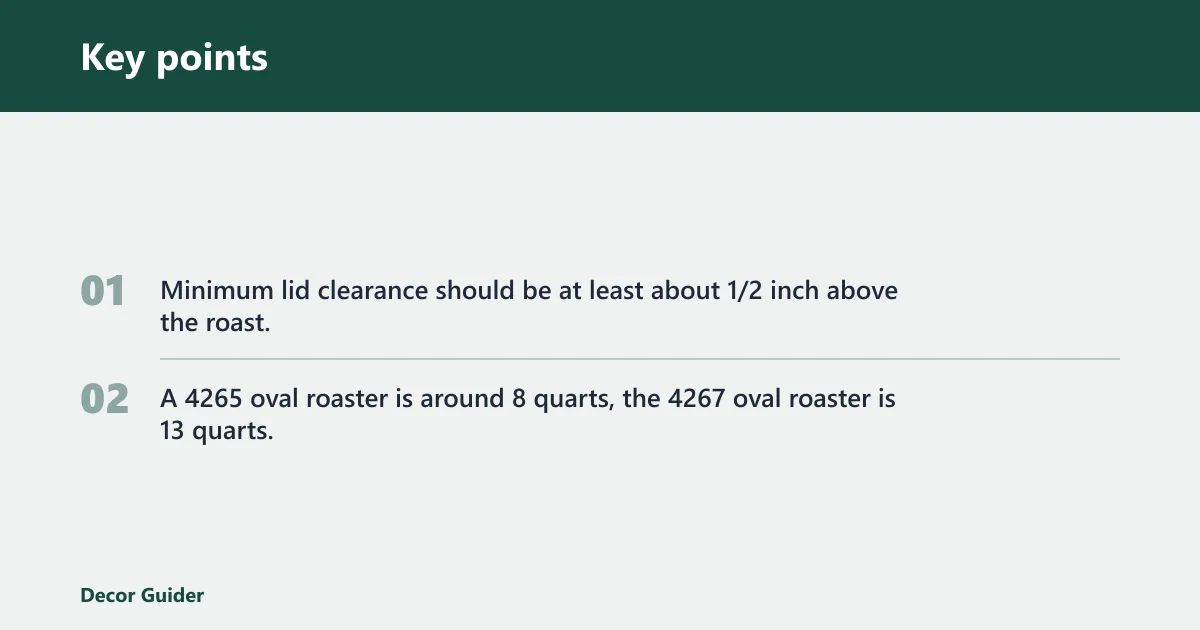
Minimum lid clearance should be at least about 1/2 inch above the roast, with more room for larger birds or domed covers that dip lower in the center. Do not rely on quart capacity alone for fit. A 4265 oval roaster is around 8 quarts, the 4267 oval roaster is 13 quarts, and the 4269 oval roaster is 17 quarts, but the same quart class can still differ in usable base width and lid height.
What size roaster do you need?
Choose the smallest roaster that still leaves room for the meat and the rack. A 14-inch pan works for small roasts and up to a 12-pound turkey. A 16-inch roasting pan is ideal for birds up to 16 pounds, and an 18-inch pan fits turkeys up to 20 pounds or more depending on shape and rack profile.
14-inch pans for smaller cooks
A 14-inch roaster is a practical pick for smaller roasts, roast chicken, and side dishes that do not need a lot of surface area. If you buy an insert for this size, keep the footprint compact so drippings do not pool too close to the meat. That helps the roast brown instead of steam. A compact footprint also reduces the chance that tapered walls or a rolled rim will keep the rack from sitting flat.
16-inch pans for most households
A 16-inch roaster is the most versatile size. It gives enough room for a medium turkey, a chicken with vegetables around it, or a roast that needs a little extra space for air movement. If you only want one pan and one rack, this is the safest starting point. It also tends to be the easiest size to match with standard replacement racks because the base footprint is broad enough to support the meat without crowding the walls.
18-inch pans for larger loads
An 18-inch pan is best for large gatherings and bigger turkeys. It also helps when you want to cook several vegetables at once without crowding. Bigger is not always better, though; if the insert is too large for the roast, juices spread out thin and the food can dry at the edges. The larger the pan, the more important it is to check the rack footprint against the usable base rather than the outer rim.
Say your pan is 18 inches long but your roast is modest. A rack that spans the whole base can still be wrong if it sits too high and touches the lid. In that case, a lower replacement rack with a smaller footprint is the better call.
How much clearance should a roast have?
Give the roast enough space for air to move under and around it. A rack keeps the bottom of the roast out of its juices, and a rack also promotes air circulation. The goal is not only fit, it is even browning and safe lid closure.
Why rack height matters
A rack that is too short can let the meat sit in drippings, which softens the bottom and slows browning. A rack that is too tall can block lid closure or press the roast too close to the cover. Either problem changes how heat moves through the pan, and both are more common in pans with tapered walls or a narrower inside base than expected.
Minimum lid clearance to check
Check for at least 1/2 inch of clearance between the top of the roast and the lid or cover, and more for larger birds. If a domed cover is part of the roaster, measure the low point of the lid rather than the outer height. A cover that closes poorly can vent heat unevenly. Fixed handles on some roasters can also reduce the effective clearance even when the lid height looks adequate on paper.
When depth is too shallow or too deep
Shallow pans can splatter, especially with basting or fatty poultry. Deep pans can trap steam if the sides block air movement around the rack. That is why the common 3 to 4 inch wall range matters: it gives enough room for drippings without turning the pan into a steam chamber. Warped racks create a different failure case: the roast tips, the juices run to one side, and the bird browns unevenly.
Picture a 16-inch pan with a rack that lifts the roast too high. The lid will sit on the meat, not the rim. A lower rack solves the problem better than trimming the roast or forcing the cover down.
Which roaster insert fits my pan?
Match the insert to the pan shape, the base width, and the space under the lid. A universal insert works when the pan is close to standard and the fit leaves side clearance. A replacement rack is better when the original rack is worn, missing, or made for that exact pan shape. For appliance shoppers, this is also where electric roaster versus roasting pan comparisons matter, because electric models often have tighter, model-specific fit limits.
Replacement rack versus universal insert
Choose a replacement rack when you need the same support profile as the original pan or when the lid clearance is tight. Choose a universal insert when the pan is standard in size and the rack can sit flat without sliding. If the pan is oval, the insert should also be oval or shaped to match the base. Exact rule: choose universal only when the rack footprint is at least 1/2 inch smaller than the inside base on all sides and the lid still clears; choose replacement when that rule fails.
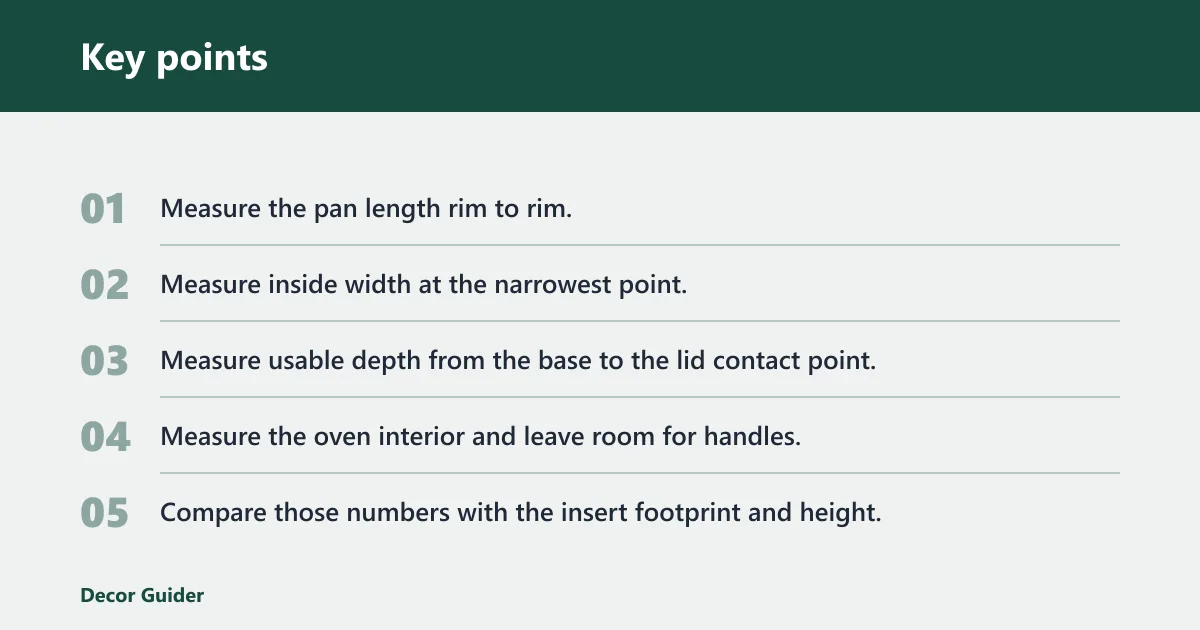
- Measure the pan length rim to rim.
- Measure inside width at the narrowest point.
- Measure usable depth from the base to the lid contact point.
- Measure the oven interior and leave room for handles.
- Compare those numbers with the insert footprint and height.
Oval roasting pan rack inserts
Oval roaster inserts are common because many roasting pans taper inward. The real fit problem is not the label on the box; it is whether the rack lands flat inside the usable base. If the rack is too narrow, it can tip with a heavy turkey. If it is too wide, it may not sit down fully. Rolled rims and domed lids can also shrink the usable opening more than the listing suggests.
Electric roaster inserts and compatibility
Electric roaster inserts are model-specific more often than oven roaster racks. The insert, base, and cover need to match the unit’s interior shape and height. Some electric roaster inserts come in multi-piece sets, but compatibility still depends on the maker’s model size, not just the inch label. Before buying, check the interior length, the rack seat, and the underside of the lid because electric roasters often have a narrower clearance window than open pans.
Roaster materials and fit tradeoffs
Material changes weight, stiffness, and how much room the pan needs around the handles. Stainless steel and anodized aluminum are common because they are relatively light and hold shape well. Copper and enameled cast iron are heavier, which can affect lift-out space and oven clearance.
Stainless steel and anodized aluminum
Stainless steel resists warping and usually works well for replacement racks and inserts that need stable support. Anodized aluminum is lighter, so it is easier to move in and out of the oven, but it can dent more easily. Both can fit standard roaster sizes without adding much bulk to the pan, which helps preserve the clearance you measured.
Copper and enameled cast iron
Copper roasters conduct heat well, but they are often more substantial in weight and may have thicker walls or handles that change fit. Enameled cast iron is heavy and holds heat well, yet that weight matters when you are checking handle clearance and oven shelf support. Do not size by looks alone. The same outside length can hide a much tighter inside base.
Weight, stiffness, and handle clearance
Heavier pans may need more room around the handles so you can lift them without scraping oven walls. Stiffer pans can also reduce flex, which helps a rack stay flat under a turkey or roast. If the pan is bulky, measure the handles as part of the overall width, not as an afterthought. A pan that fits the shelf but not the door opening still fails in real use.
Frequently asked questions
How big is a roaster?
The most common roasting pans are 14, 16, and 18 inches, measured rim to rim. That length is only part of the answer, though. You also need inside width, usable depth, and enough oven space for handles, since those can change whether the pan fits and whether a rack sits flat. A 14-inch pan is usually the smallest practical everyday size; 16 inches is the most versatile.
How much does a roaster hold?
Capacity varies by shape and model, so quart capacity is not always obvious from inch measurements. The same inch size can hold different volumes, which is why inside base size and lid height matter more than the quart number alone.
What size roast for 4?
For four people, a 14-inch roaster is often enough for a small roast or a modest chicken, with room for vegetables if the rack footprint is compact. If you want more sides in the pan or a larger bird, a 16-inch roaster gives more working room without going oversized. For a crowded pan, check that the rack still leaves airflow under the roast.
How do I measure a roaster insert?
Measure the insert’s longest point, its widest point, and its height from the base to the top of the rack. Then compare those numbers to the pan’s inside width and usable depth, not just the outer length. The final check is lid clearance, because a tall rack can fail even if the base fits. If the rack touches the lid or rocks on the base, it is the wrong fit.
What size roaster works for a turkey?
A 14-inch roasting pan works for up to a 12-pound turkey, a 16-inch pan is ideal for birds up to 16 pounds, and an 18-inch pan is best for turkeys up to 20 pounds. If you add a rack, keep enough space above the bird so the lid closes without pressure. The safest rule is to confirm both the bird size and the lid clearance before buying the insert.
How much clearance should a roast have in the pan?
Leave enough room for air to move under the meat and around the sides. A practical target is at least 1/2 inch above the roast to the lid, with more room for larger birds. The roast should sit on a rack, not directly in the drippings, if you want better browning. If the pan has a domed lid or fixed handles, measure the low point of the cover and the narrowest opening, not just the outside dimensions.
Products related to this article
Sponsored / affiliate links. As an Amazon Associate I earn from qualifying purchases. I may earn additional commission from eligible campaigns.