How to Remove a Sink Drain Stopper (Even When It’s Stuck)
You push the rod down and the water just sits there. Or you press the toe-touch and it won’t pop back up. The sink drains slow, the water pools, and you know there’s a hair clog somewhere below the stopper. The fix starts with getting that stopper out of the drain, and that’s where most people get stuck.
This guide covers every common sink stopper type, the tools you actually need, and the messy situations: stripped screws, corroded metal, hard water scale, and stoppers that refuse to budge. You’ll also learn how to reinstall the stopper so it seals properly and doesn’t leak. No guesswork, no calling a plumber for a 20-minute job.

ARCTIC EAGLE
ARCTIC EAGLE Drain Snake Hair Clog Remover…
- Package Includes: Each ARCTIC EAGLE set includes 3 pieces of 20" drain clog remover cleaning tools. The width of the hair cleaner…
- Soft & Flexible Barbed Wand:ARCTIC EAGLE plastic drain clog remover is designed with Multi-tooth and the polypropylene is soft eno…
- Wide Application: ARCTIC EAGLE drain clog remover tools are suitable for kitchen sink, toilets, washbasin, bathtubs,sewers etc. Th…
As an Amazon Associate I earn from qualifying purchases.
If the drain is clogged once you get the stopper out, a tool like the drain stopper guide can help, but for the clog itself, the ARCTIC EAGLE Drain Snake Hair Drain Clog Remover (3 pack) is a cheap, reusable option. Each 20-inch barbed wand bends into the P-trap and hooks hair and debris without harsh chemicals. Just make sure your drain opening is larger than 0.5 inches before you buy.
Identify Your Sink Stopper Type (Visual Guide)
Before you pull anything, look at the sink. The stopper type determines the removal steps, and guessing wrong can damage the mechanism. Here’s how to tell them apart at a glance.
Pop-Up (Lift Rod) vs. Push-Pull vs. Toe-Touch vs. Flip-It
Pop-Up (Lift Rod): The most common in bathroom sinks. You see a small rod behind the faucet, and a knob on top of the stopper. Pull the knob up, the stopper drops; push it down, the stopper rises. This one connects to a pivot rod and clevis strap under the sink.
Push-Pull: No rod behind the faucet. The stopper itself is the control. Push down to close, pull up to open. It works with a spring or a friction fit. Usually you can just twist and pull it straight out.
Toe-Touch: A flat, round stopper you press with your foot or toe. It uses a spring-loaded mechanism. To remove it, you usually twist it counterclockwise and it pops up.
Flip-It: A small lever or tab on the stopper that flips up to open and down to close. Often found in bathroom sinks or vessel sinks. The entire stopper body lifts out, sometimes with a quarter-turn twist.
Still unsure? Look under the sink. If you see a horizontal rod going into the drain pipe, it’s a pop-up. If not, it’s one of the other types. That’s your single best clue.
Tools You Actually Need (And What to Skip)
Most stopper removals need almost nothing. Here’s the honest list:
- Flathead screwdriver – for the set screw on the stopper knob and for prying off caps.
- Needle-nose pliers – for pulling the hair clip off the pivot rod and grabbing small parts.
- Adjustable wrench or pliers – for loosening the mounting nut on the drain flange if you have to remove the whole assembly.
- Penetrating oil (like WD-40) – for corroded threads.
- White vinegar and an old towel – for mineral deposits.
- A bucket or shallow pan – to catch water that spills out when you disconnect the pivot rod.
Skip the basin wrench unless you’re removing the entire drain flange from the sink. For a simple stopper removal, it’s overkill. Also skip any chemical drain cleaner — it won’t help you remove the stopper, and it can damage the rubber seals and metal parts you’re trying to save.
How to Remove a Pop-Up Sink Stopper (Lift Rod)
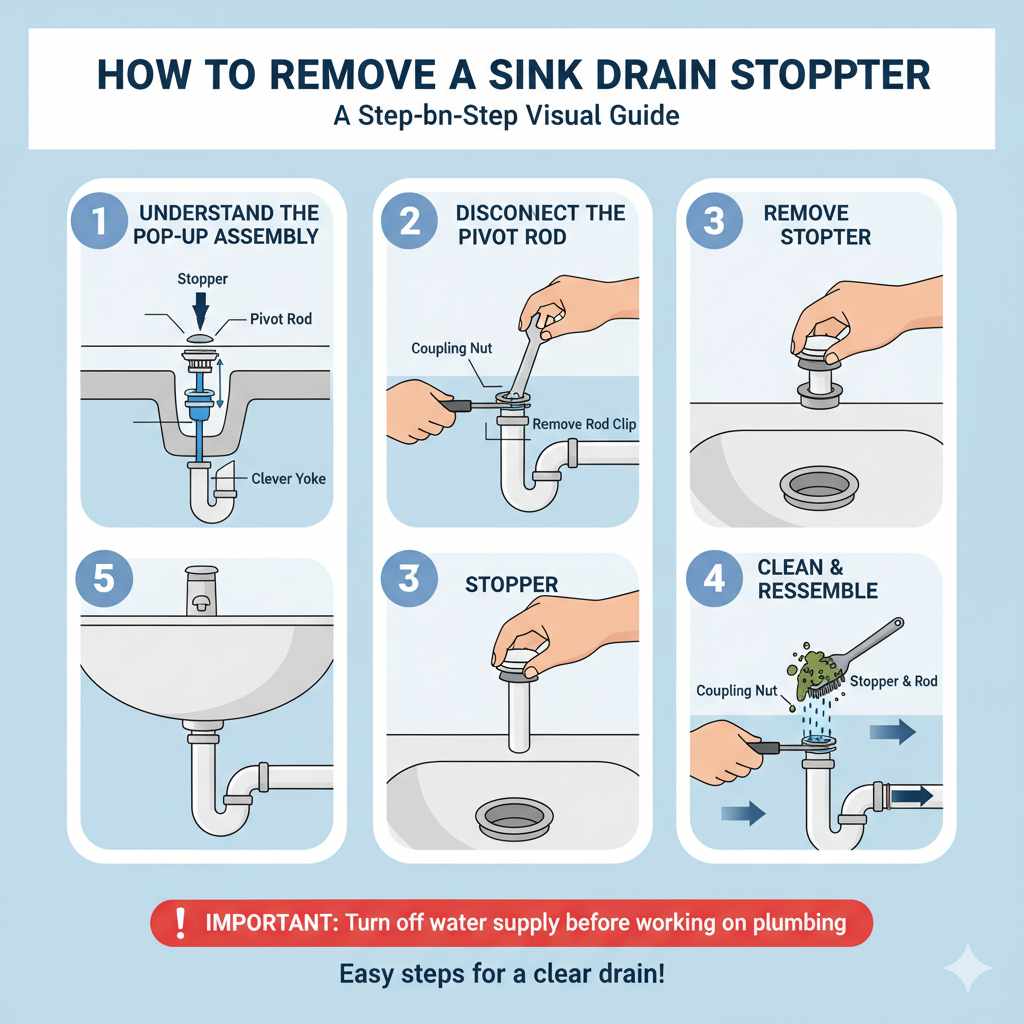
This is the classic bathroom sink setup. It has three main parts: the lift rod behind the faucet, the clevis strap (the vertical metal strip with holes), and the pivot rod (the horizontal rod that goes into the drain pipe).
Detaching the Pivot Rod and Clevis Strap
First, push the stopper down so it’s closed. This gives you slack in the linkage. Reach under the sink and find the pivot rod where it enters the back of the drain pipe. There’s a small retaining clip or a wing nut holding it in place.
- Loosen the wing nut or pull the clip off the pivot rod. The clip is usually a small, U-shaped piece of spring steel. If it’s a wing nut, turn it counterclockwise.
- Pull the pivot rod straight out of the drain pipe. Water will drip, so have your bucket underneath.
- Look up at the clevis strap. There’s a set screw on the side that holds the lift rod. Loosen it with a flathead screwdriver.
- Slide the clevis strap off the lift rod. Now the linkage is free.
- Go back to the sink top. Grab the stopper knob and pull straight up. It should come out of the drain opening easily.
If the stopper doesn’t lift out, it’s probably caught on the stopper stem’s horizontal slot where the pivot rod connects. Wiggle it gently while pulling. The stem is the metal rod attached to the bottom of the stopper; it has a slot or hole that the pivot rod tip sits in.
One common mistake: people try to unscrew the stopper by twisting the knob. Don’t. Pop-up stoppers are not threaded into the drain. They’re held by the pivot rod, and twisting only risks breaking the stem.
How to Remove Push-Pull and Toe-Touch Stoppers
These are simpler because there’s no linkage under the sink. The mechanism is inside the drain body itself.
Push-Pull: Grasp the stopper knob firmly and twist it counterclockwise about a quarter turn. You’ll feel it release from a bayonet-style lock. Then pull straight up. If it doesn’t twist, try pulling straight up with steady force — some are just a friction fit. If it still won’t budge, the rubber seal around the stopper may have swollen or gotten sticky with soap scum. Run hot water over it for a minute, then try again.
Toe-Touch: These usually have a spring-loaded mechanism. Press down on the stopper and twist counterclockwise at the same time. The spring tension will push it up once it’s unthreaded. If it’s stuck, the spring may be broken or the threads are corroded. Spray penetrating oil around the base, wait 10 minutes, then try again.
For both types, once the stopper is out, you’ll see the drain body. That’s where the hair and gunk collect. Use a flashlight to check for debris before reassembling.
How to Remove a Flip-It Stopper
The Flip-It design is a single piece: a flat cap with a small lever that flips up to open. The whole assembly sits in the drain opening.
To remove it, flip the lever to the open position. Then grip the cap with your fingers and twist counterclockwise. It should unscrew from the drain body in a few turns. If it doesn’t turn, look for a small set screw on the side of the cap. Loosen it, then lift the cap straight up.
Some Flip-It models use a quarter-turn bayonet mount instead of threads. In that case, twist 90 degrees and pull. You’ll know which type you have once you start twisting — threaded ones turn multiple times, bayonet ones stop after a quarter turn.
Flip-It stoppers are prone to getting stuck when the hinge mechanism fills with toothpaste and soap scum. Soak the entire cap in hot vinegar for 15 minutes if it’s gritty or hard to turn.
How to Remove a Stuck or Corroded Stopper (Without Breaking It)
This is where most guides stop, but it’s the situation you’re probably in. Here’s how to handle seized hardware.
Using Vinegar and Heat to Break Down Mineral Deposits
Hard water scale and mineral buildup can weld a stopper to the drain body. The fix is chemical and thermal, not brute force.
- Pour white vinegar around the base of the stopper until it fills the gap between the stopper and the drain flange.
- Let it sit for 30 minutes. The acetic acid dissolves calcium carbonate and hard water scale.
- Heat the area with a hairdryer on high for 2-3 minutes. The expansion from heat helps break the bond. Don’t use a torch — you’ll melt the rubber seals or damage the chrome finish.
- Try twisting the stopper again. If it moves even a little, work the vinegar into the gap and repeat.
For severe cases, make a paste of baking soda and vinegar, apply it around the stopper, and let it sit for an hour. The bubbling action helps lift grime and scale.
The “Twist and Pull” Method for Stripped Screws
If the set screw on your pop-up stopper is stripped or corroded, you can’t loosen it. But you can still get the stopper out.
- Grip the stopper knob with a pair of pliers, but wrap the jaws with electrical tape so you don’t scratch the chrome.
- Twist the entire stopper counterclockwise while pulling upward. The goal is to shear the stripped screw or break the corroded bond.
- If it won’t turn, spray penetrating oil into the set screw hole and around the stem. Wait 15 minutes.
- Use a rubber band or a piece of rubber shelf liner between the pliers and the knob for extra grip.
This method works because the stopper stem is usually held by just that one small screw. Once the screw fails, the stem slides out. You’ll likely need to replace the set screw or the whole stopper assembly afterward, but that’s a $5 part at a hardware store.
If the stopper is stuck because of a broken spring (common in toe-touch models), you’ll need to unscrew the entire drain flange from the sink. Use needle-nose pliers to grip the crossbars inside the drain opening and turn counterclockwise. If that doesn’t work, the flange is likely corroded to the sink — that’s a job for a plumber, because you risk cracking the sink.
How to Clean the Drain and Reinstall the Stopper Properly
With the stopper out, you can finally deal with the clog. Use a flashlight to see what’s down there. If it’s hair, use a drain snake or the ARCTIC EAGLE tool mentioned earlier — the barbed wand grabs hair and pulls it out. Run hot water after to confirm the drain flows freely.
Before reinstalling, clean the stopper itself. Soak it in a 50/50 vinegar and water solution for 20 minutes, then scrub with an old toothbrush. Pay attention to the rubber gasket — if it’s cracked or hardened, replace it. A worn gasket is the #1 cause of stoppers that leak or don’t seal.
Reassembly is the reverse of removal, but here’s what most people get wrong:
- Pop-up: Align the stopper’s stem slot with the pivot rod hole. Insert the pivot rod all the way through the drain pipe and into the stem slot. Tighten the wing nut or reattach the clip. Then adjust the clevis strap so the stopper opens and closes fully. The set screw should be snug but not stripped.
- Push-pull and toe-touch: Screw the stopper back in clockwise until hand-tight. Don’t overtighten — you’ll crush the rubber seal. Test the open/close action.
- Flip-it: Screw the cap back in clockwise, then flip the lever to test. If it’s a bayonet mount, align the tabs and twist 90 degrees.
After reassembly, run water for 30 seconds and check for leaks under the sink. If the pivot rod connection drips, tighten the wing nut or replace the rubber washer inside the drain pipe connection.
When to Call a Plumber (Signs of a Bigger Problem)
You can fix most stopper issues yourself, but some signs point to a deeper problem.
You see water stains on the cabinet floor under the sink. That means the drain pipe is leaking, not just the stopper. The leak is likely at the pivot rod connection or a corroded pipe joint.
The stopper won’t stay closed even after reinstallation. The linkage is worn or the spring is broken. Sometimes you can adjust the clevis strap, but if the parts are corroded, they need replacing.
The drain is still slow after you’ve cleared visible hair. The clog is deeper in the P-trap or the branch line. You can try a longer drain snake, but if that doesn’t work, a plumber will need to disassemble the trap.
You’ve tried the twist-and-pull method and the stopper still won’t budge. If you’ve applied penetrating oil, heat, and vinegar with no luck, you risk breaking the drain flange. A plumber has better tools and can replace the flange without damaging the sink.
One more thing: if your sink is a high-end brand like Delta or Moen, the stopper mechanism might be proprietary. Look up the model number before forcing anything. The removal steps are usually in the manual, and some brands use a special tool that a plumber will have.
FAQs About Removing Sink Stoppers
Can I remove a sink stopper without any tools?
Yes, for most types. Push-pull and flip-it stoppers often just twist and pull out by hand. Pop-up stoppers need the pivot rod disconnected under the sink, which requires at least a screwdriver or a pair of pliers for the clip. If you have a stuck stopper, try the hot water and twisting method before reaching for tools.
Why is my pop-up stopper stuck in the down position?
The linkage is jammed or disconnected. Check under the sink: the pivot rod may have popped out of the clevis strap, or the clip holding it has slipped. If the linkage looks fine, the stopper stem is probably corroded. Spray penetrating oil down the drain opening and work the stopper up and down by hand.
How do I know if my stopper is Delta or Moen?
Look for a brand name stamped on the stopper itself or on the underside of the drain flange. Delta often has a “D” logo on the stopper knob. Moen typically stamps “Moen” on the lift rod or the clevis strap. If you can’t find a mark, take a photo of the stopper and the linkage to a hardware store — they can usually identify it and get the right replacement parts.
What if the set screw on the lift rod is stripped?
You can try a slightly larger screwdriver to grip the remaining slot, or use a rubber band between the screwdriver and the screw head for extra friction. If that fails, the twist-and-pull method will break the bond. You’ll need a new set screw (most are 6-32 or 8-32 machine screws, about 1/4 inch long).
Should I use plumber’s putty when reinstalling the stopper?
Only if you’re replacing the drain flange itself. The stopper’s rubber gasket provides the seal, and plumber’s putty on the stopper itself just creates a mess. If you’re reinstalling a flange, a thin bead of plumber’s putty around the underside of the flange lip is correct. Wipe away any excess after tightening.
What to Remember Next Time
- Identify the stopper type before touching anything. The visual cues are obvious once you know what to look for.
- Most stoppers come out with a simple twist and pull. Only pop-up models require work under the sink.
- Stripped screws and corroded parts respond to penetrating oil and patience, not force.
- Vinegar and heat break down mineral deposits better than any chemical cleaner.
- Clean the stopper and check the rubber gasket before reinstalling. A worn gasket leaks.
- If the drain is still slow after clearing visible hair, the clog is deeper — use a drain snake before calling a plumber.
- When in doubt about a proprietary brand mechanism, check the manual or call a pro. It’s cheaper than a cracked sink.
Products related to this article
Sponsored / affiliate links. As an Amazon Associate I earn from qualifying purchases. I may earn additional commission from eligible campaigns.