Bookshelf Doors Problems: Not Working Troubleshooting
Bookshelf doors that stick, sag, scrape, reverse, or won’t close usually point to misalignment, worn hardware, or a failing closer; check alignment first, then hinges, tracks, latches, and any spring or lift mechanism. Ignore it and you can chip wood, strip fasteners, jam the door harder, or let a loaded shelf door fail suddenly. This guide walks you through symptom-by-symptom checks so you can isolate the fault before buying parts.
Bookshelf door troubleshooting matrix


Use this table to match the symptom to the most likely cause and the right first check. It is organized around hinged bookshelf doors, sliding bookcase doors, and pivot or concealed styles, since those problems can show up differently.
| Symptom | Hinged doors | Sliding doors | Pivot or concealed doors | Likely cause | First checks | DIY fix | Stop now if… |
|---|---|---|---|---|---|---|---|
| Door closes unevenly | Top or bottom gap differs side to side | Panel meets stop unevenly | One edge lands before the other | Frame out of square, hinge sag, latch misfit | Check alignment first, then hinges, tracks, latches | Re-seat screws, adjust hinge, shim strike plate | Jamb is twisted or door binds after adjustment |
| Door sticks or rubs | Rubs at top edge or latch side | Drags on track or guide | Touches pocket edge or pivot point | Finish swell, debris, overtightened hinge, misaligned guide | Look for shiny rub marks and swelling | Clean dirty components and remove debris, lightly sand contact point, adjust hardware | Wood is split or hardware keeps loosening |
| Door will not stay closed | Latch misses strike | Stop or catch does not hold | Closer loses hold near the end | Latch or strike plate out of alignment | Check latch engagement and closing force | Shift strike plate, tighten fasteners | Door rebounds hard or frame flexes |
| Grinding or scraping noise | Hinge wear or looseness | Rollers, track, or guide debris | Pivot hardware dragging | Wear, dirt, bent track, loose fasteners | Inspect for debris, bent metal, loose screws | Clean dirty components and remove debris, tighten, realign, lubricate where allowed | Roller has jumped the track or cracks appear |
| Door reverses or pops back open | Too much closing force, misread stop | Interference at the end stop | Closer or catch set too tight | Force setting, sensor issue, latch misfit | Check obstruction, sensor path, closing force | Reduce force setting if the model allows it | Door slams or spring tension seems wrong |
| Uneven head or side margin | Door sags on hinge side | Guide rides low on one side | Pivot axis shifted | Loose fasteners, worn hinge, twisted jamb | Measure gap at top and side corners | Shim, tighten, adjust hinge alignment | Gap changes after every adjustment |
| Draft or light leaks | Seal not touching evenly | Stop strip misfit | Peripheral gap around panel | Weatherstrip missing, cracked, torn, or painted | Look for daylight and air movement | Replace damaged seal, restore even contact | Seal damage is tied to a warped frame |
| Door will not open or close | Obstruction or hinge bind | Track obstruction or roller failure | Closer, sensor, or control fault | Debris, power issue, safety sensor issue | Check power, batteries, pairing, sensors | Clean dirty components and remove debris, replace batteries, reset pairing | Panel shows an error or motion feels unsafe |
| Door is off-track | Rare, but possible at guide points | Common after impact or wear | Can happen at pivot hardware | Track damage, roller jump, bent guide | Inspect track line and roller seats | Stop using the door and call a professional for spring-related repairs | Any panel is hanging, tilted, or loaded unevenly |
| Problem returns after adjustment | Fasteners, hinge, or jamb movement | Track or stop shifts again | Pivot or closer loosens again | Underlying squareness or wear issue | Recheck square, twist, and fastener bite | Use longer screws or shim as needed | Repeated loosening or fresh cracking appears |
Why are my bookshelf doors not closing evenly?
Uneven closing usually means the frame is out of square, the hinge side has sagged, or the latch and strike plate no longer meet cleanly. On bookshelf doors, even a small shift can leave a visible head gap at the top or a tight rub at one corner, especially after seasonal wood movement.
Check the frame before the hardware
Start with the jamb and door margins. Therma-Tru notes that a sagging door can have an uneven head margin, and that detail applies here too: if the top gap is wider on one side, the frame may be twisted or the hinge side may have dropped. Look for uneven reveals, not just loose screws.
If the gap changes after you tighten a hinge, the problem may be structural rather than a bad screw. A warped jamb, a shifted shelf opening, or repeated adjustment without a square frame will keep pushing the door out of line.
Then check hinge, latch, and seal contact
Hinge alignment controls where the door lands, while the latch and strike plate control whether it stays there. If the door meets the stop on one edge but not the other, inspect the latch fit and the weatherstrip. The same source says a door may not meet the weatherstrip evenly when it closes, and damaged weatherstrip should be replaced.
Picture an about 24-inch hinged bookshelf door that closes flush at the latch side but leaves about a 3 mm gap at the top hinge corner. That points more toward hinge sag or jamb twist than a latch problem. If the latch still clicks but the gap remains, do not keep forcing the door shut.
What should I check first when bookshelf doors won’t open or close?
Check the simplest causes first: obstructions in the door path, debris in tracks or hinge points, loose fasteners, and power or battery issues on powered systems. That order saves time and keeps you from replacing parts that are still functional. It also helps separate a physical bind from a control fault.
Start with the path
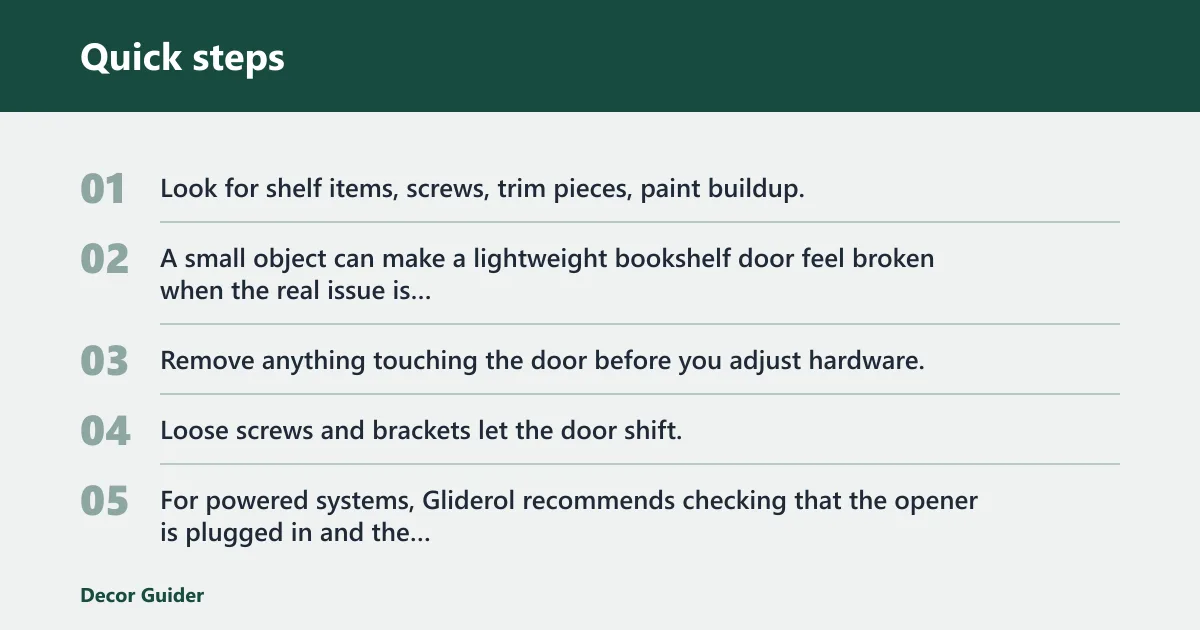
Look for shelf items, screws, trim pieces, paint buildup, or a bent stop that blocks travel. A small object can make a lightweight bookshelf door feel broken when the real issue is just contact at the edge or bottom rail. Remove anything touching the door before you adjust hardware.
Then check fasteners and power
Loose screws and brackets let the door shift, which creates new rubbing points and makes alignment work fail again. For powered systems, Gliderol recommends checking that the opener is plugged in and the outlet has power, and also verifying that circuit breakers haven’t tripped. Most remotes use a CR2016 3V lithium cell, so a dead battery can be the whole problem.
Say your sliding bookcase door stopped halfway and the remote light still comes on. That does not prove the opener is working. Check the outlet, breaker, and battery first, then look for a track obstruction before touching the drive settings.
Check sensors and control response last
If the door reverses or refuses to close, inspect the sensor path. Gliderol advises checking for objects blocking safety sensors, and notes the control panel may display “IR” when photo sensors have an issue. Dirty lenses, misalignment, or interference can stop motion even when the door itself is fine.
Why do bookshelf doors stick or rub?
Sticking or rubbing usually comes from finish swell, seasonal movement, dirty tracks, misaligned guides, or hinge friction. On narrow bookshelf doors, the margins are smaller, so a change that would be minor on a full-size door can create a hard bind or a scrape in just one corner.
Finish swell and seasonal movement
Wood edges swell when humidity rises, especially at painted or sealed surfaces that have built up thickness over time. That can turn a door that closed freely in winter into one that rubs in summer. Look for fresh rub marks, darkened finish, or a tight edge where the door meets the frame.
Track buildup and roller drag
For sliding bookcase doors, dirt and chips in the track are common causes. A roller that has worn flat, jumped the track, or lost alignment often leaves grinding or scraping noise behind it. Clean the track, check that it is level, and confirm the roller sits fully in its guide before you test motion again.
Hinge friction and over-tightened hardware
Hinges can bind when a screw pulls them too hard into the jamb or when a previous adjustment over-corrected the leaf position. The same source suggests a 9/64” Allen wrench for one hinge adjustment method, but if the hinge has already been overtightened, replacement may be the better fix. Over-tightening can also make the door slam instead of closing with control.
Hinges, latches, and seals
These parts create the final fit. If the door is structurally sound but still misbehaves, the fault is often here. Hinge alignment sets the door plane, the latch and strike plate set the hold, and the weatherstrip controls the final seal against light and drafts.
Hinge alignment, looseness, and replacement signs
Loose hinge screws, worn knuckles, or a hinge leaf that has shifted in the wood will let the door sag. Therma-Tru instructs using LONG hinge screws in the top hinge through the jamb to the stud, which helps anchor the load instead of letting the screws chew out the jamb. If the hinge has been repeatedly over-tightened or stripped, replacement is often cleaner than another adjustment.
Latch and strike plate fit
A door that closes but will not stay shut often has a latch or strike plate that is sitting too shallow, too high, or too low. Tightening the fit can solve a weak catch, but forcing the latch into a bad position can also make the door close unevenly. Adjust the strike plate before you blame the closer.
Weatherstrip contact and leaks
Weatherstrip problems show up as light leaks, draft gaps, and uneven compression at the top or bottom. Damaged weatherstrip that is missing, cracked, torn, or painted over will not compress evenly. If the door closes with one edge touching first and the other edge floating, replace the seal rather than forcing the door harder against it.
Tracks, rollers, and sensors
These parts matter most on sliding or powered bookshelf doors, but they can also affect concealed or pivot styles. The diagnostic pattern is different from hinge problems: track issues create drag and noise, roller issues create jump or sag, and sensor or control faults create refusals, reversals, or error displays.
Cleaning and level alignment for tracks
Track cleaning is not optional when a door drags. Dust, chips, hardened lubricant, or a bent section can force the roller out of line. After cleaning, confirm the track sits level and the guide path is straight. A crooked track will keep producing the same symptom even if the roller is new.
Roller wear, jump-off, and scraping noise
Grinding, scraping, or a repeated bump usually means the roller is worn, the axle is loose, or the door has jumped the track. Stop using the door if it is carrying significant weight and the panel is no longer fully supported. Off-track doors are one of the clearest cases for professional repair; Gliderol warns that doors off-track generally require professional repair.
Sensor lenses and control-panel checks
If the door reverses or refuses to close, inspect the photo sensors first. Clean the lenses, make sure nothing blocks the beam, and check for misalignment or interference. If the control panel displays an error such as “IR,” treat it as a sensor fault until proven otherwise. For auto-reverse systems, Gliderol says to test with a 40mm wooden block, which helps confirm whether the reverse function is responding correctly.
When is a bookshelf door problem a DIY fix versus a pro job?
Minor alignment, loose fasteners, dirty tracks, weak battery power, and a misfit strike plate are usually DIY territory. Off-track panels, broken springs, repeated failures after adjustment, and any sign of unbalanced load or hanging hardware belong with a professional. If the door could fall, bind hard, or slam, stop there.
DIY-appropriate problems
Use DIY steps when the fault is visible and limited: a loose hinge screw, a dirty track, a dead remote battery, a shifted strike plate, or a weatherstrip that no longer seals evenly. These repairs usually improve immediately once the cause is corrected. If the door returns to the same bad position after one adjustment, the underlying cause is probably bigger than the symptom.
Stop-now problems
Do not keep operating a door that is off-track, visibly unbalanced, or carrying a damaged spring or lift mechanism. Springs store energy, and tension imbalance or a broken spring is not a casual repair. A loud slam, a panel that drops unexpectedly, or repeated sensor failure with no clear cause is enough reason to stop and call a professional for spring-related repairs.
A common first-timer mistake is tightening every screw in sight after the door starts rubbing. That can mask the real issue for a day, then push the panel farther out of square. Fix the cause in order: path, fasteners, alignment, then hardware condition.
Frequently asked questions
How do I fix bookshelf doors that stick or rub?
Start with the rubbing point, not the hinge name. Clean debris, check for swollen edges or finish buildup, and confirm that screws are tight without being over-tightened. Sliding doors need track and roller checks, while hinged doors need hinge alignment and frame squareness.
Why do cabinet or bookshelf doors sag out of square?
Sag usually comes from loose hinge screws, worn hinges, or a jamb that is no longer square. Over time, repeated opening can pull the top hinge loose or shift the frame. If the gap keeps changing after tightening, the structure may need shimming or realignment.
What should I do if a door is off-track or unbalanced?
Stop using it. Off-track doors can bind, drop, or damage the rollers and guide hardware. If the panel is unbalanced or a spring-related part is involved, that is a safety issue, not a simple tune-up. Professional repair is the safer call.
Why do doors make grinding, scraping, or unusual noises?
Those noises usually mean friction, wear, or a part that is no longer seated correctly. On sliding doors, look at the track and rollers first. On hinged doors, check hinge looseness and rub marks. Noise is a clue that something is moving where it should not.
Products related to this article
Sponsored / affiliate links. As an Amazon Associate I earn from qualifying purchases. I may earn additional commission from eligible campaigns.