Best Ceiling Fans for Renters (2026): we compared
The best ceiling fans for renters are often lightweight, flush-mount or low-profile models with remote controls and reversible motors, and the blade span should be matched to room size: roughly 29–36 inches for small rooms, around 42 inches for many bedrooms, and about 44–52 inches for larger spaces. Pick the wrong fan and you can violate a lease, strike a low ceiling, or live with wobble and motor noise. This guide covers lease-safe picks, size rules, install limits, and what to check before you buy.
This guide is part of our Home lighting and ceiling fan guide series.
Quick comparison
| Product | Badge | Best for | Price | ||
|---|---|---|---|---|---|
 |
ISTRUESDA 28" Inch Ceiling Fan AC 110V Gazebo Fans Plug inISTRUESDA | Budget pick | 28 in · 110V plug-in · detachable blades | $19.99
Price as of 9 Oct 2026
|
View |
 |
HAOLEDI 9" 36W LED Ceiling Fan Light Retrofit Kit, CeilingHAOLEDI | Upgrade pick | 9 in · 36W LED · 5CCT adjustable | $16.98
Price as of 9 Oct 2026
|
View |
 |
HAOLEDI 4” 20W LED Ceiling Fan Light Retrofit Kit, CeilingHAOLEDI | Also great | 4 in · 20W LED · 3000K warm white | $14.98
Price as of 9 Oct 2026
|
View |
 |
53T Smart Wi-Fi Ceiling Fan Remote Control Kit, 3 Fan Speed53T | Pair with it | Wi-Fi remote · 3 speeds · light dimmer | $24.97
Price as of 9 Oct 2026
|
View |
 |
21" Portable Ceiling Fan with Light & Remote,20400mAhAusic | Our pick | 21 in · 20400mAh battery · remote included | $54.99
Price as of 9 Oct 2026
|
View |
Start with the room, then check clearance and control type. A fan that fits the ceiling height is safer than a larger fan with better airflow on paper.
📊 Some premium ceiling fans cost more than $600 or $700. Source: Best Ceiling Fans (2026).
How we chose
We focused on lease-friendly installation, ceiling clearance, motor noise, and control convenience. We also weighted blade span and airflow so the fan size fits the room instead of overwhelming it.
We gave extra credit to DC motors, remotes, LED light kits, and Energy Star certification where those features help renters. Total ownership mattered too, including electrician cost and the risk of leaving a fan behind when you move.
Because rental ceilings vary so much, we also looked for low-profile options, reversible motors, and damp-rated models for spaces that may need moisture tolerance.
Top pick: the renter-friendly DC fan: best for most apartments
This is the safest all-around choice for renters who need a simple, portable solution for small spaces without a hard ceiling install. The 28-inch size suits compact rooms, and the plug-in setup avoids the ceiling-box question entirely.
It stands out for flexibility. The detachable blades make storage easier if you move, and the AC 110V plug-in format can work in a dorm, garage, porch, tent, or small bedroom where a permanent fan would be a bad fit.
The drawback is obvious: this is not a standard fixed ceiling fan, so it is not the answer for a main living room or a room that needs a code-compliant ceiling mount. It also will not replace the airflow, efficiency, or quiet control of a good DC ceiling fan.
What ceiling fan size fits your rental room?

The safest size depends on both floor area and headroom. For many apartments, 42 to 53 inches is the practical range, while a 56-inch fan is better for one large room or open-plan living space. Small rooms need smaller spans so the fan does not crowd the ceiling.
Small rooms and studios
For a studio or compact bedroom, keep the blade span modest. A smaller fan reduces the chance of hitting cabinets, loft beds, or low ceiling lines, and it usually looks less bulky in a tight room.
If the room is very narrow or the ceiling is low, a flush-mount or low-profile model is safer than chasing a larger fan with more airflow than the space can use.
Standard bedrooms and living rooms
For most bedrooms and standard rental living rooms, 42 to 53 inches is the practical target range. That size is broad enough to move air effectively without creating the clearance problems that oversized fans can cause in apartments.
Use the room layout as a second filter. A bed under the fan, a tall dresser, or a ceiling light in the center all reduce the room’s usable clearance.
Large open-plan rentals
For one large room or open-plan living space, a 56-inch fan is the clearer fit. Top Ten Reviews suggests fan sizes between 42 and 53 inches for larger rooms, and a 56-inch fan for one large room or open-plan living space.
That said, renters should still check ceiling height first. Bigger blades make sense only when the room can safely clear them.
Renter decision matrix
| Scenario | Ceiling height | Room size | Noise tolerance | Install complexity | Safest fan type |
|---|---|---|---|---|---|
| Studio | Standard or low | Small to medium | Low | Simple, reversible preferred | Low-profile DC fan with remote and LED light kit |
| Standard apartment | Standard | Medium | Medium | Moderate if a box already exists | 42 to 53 inch ceiling fan with remote, light kit, Energy Star when available |
| Furnished rental | Any | Small to medium | Low to medium | Easy reversibility matters most | Simple remote-controlled fan or plug-in solution that is easy to remove |
| Low-ceiling unit | Low | Small to medium | Low | Clearance is the main limit | Flush-mount or low-profile fan with compact blade span |
Use the matrix as a filter, not a wish list. If the room and ceiling height do not match the fan type, skip it.
DC motor vs. AC motor: which is better for renters?
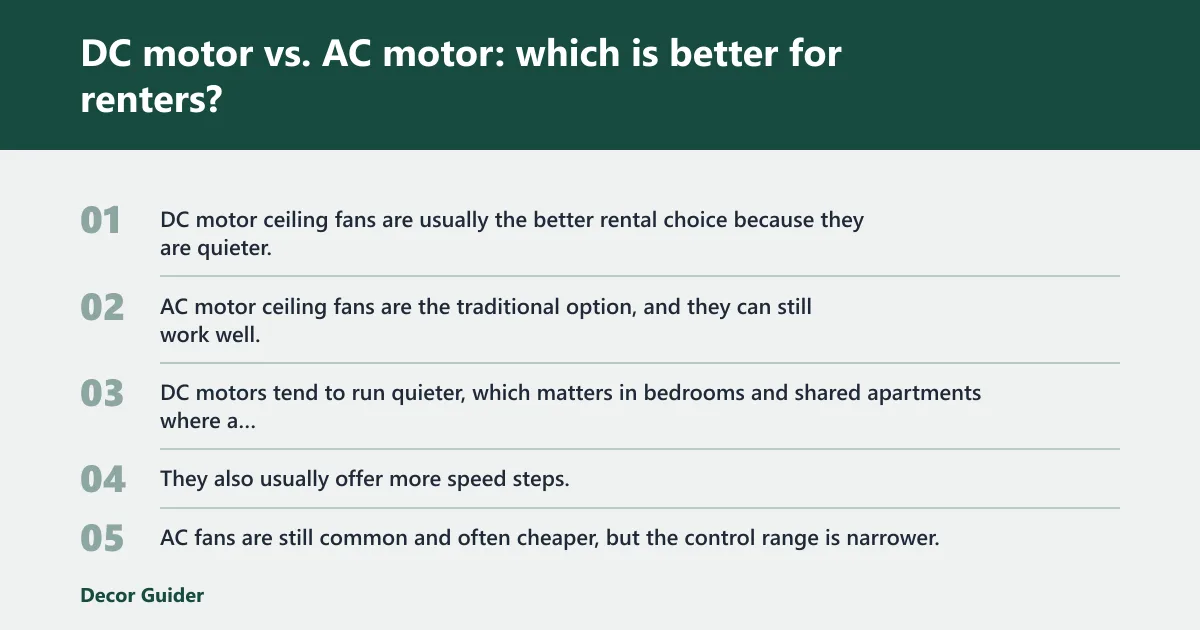
DC motor ceiling fans are usually the better rental choice because they are quieter, more efficient, and often give you finer speed control. AC motor ceiling fans are the traditional option, and they can still work well, but they usually use more energy and offer less precise control.
Noise and speed control
DC motors tend to run quieter, which matters in bedrooms and shared apartments where a steady hum can become annoying. They also usually offer more speed steps, so you can tune airflow more carefully instead of jumping between a few coarse settings.
AC fans are still common and often cheaper, but the control range is narrower. That can matter if you want just enough air movement for sleep without a stronger draft.
Energy use and utility bills
Energy Star certification is worth checking because it signals a more efficient fan. That does not cool the room itself, but it can help cut electricity use when the fan runs often.
A ceiling fan cools people, not the room temperature. The comfort gain comes from air movement, so efficiency matters most when you use the fan for long stretches.
When AC still makes sense
AC fans still make sense when upfront price matters more than control range, or when you are replacing a basic fan in a rental that already has AC wiring in place. If the room is not used for sleep, the noise tradeoff may be easier to accept.
For renters, the safest rule is simple: choose DC when quiet matters, and choose AC when budget is tighter and the room is less sensitive.
Do renters need a remote or light kit?
Yes, often they do. A remote control is a renter convenience feature, not a luxury, because it avoids pull-chain-only limitations and is easier to use in bedrooms, tall ceilings, and rooms where the switch is inconvenient.
Bedroom convenience
For bedrooms, a remote is often the better choice because it lets you change speed or shut the fan off without getting up. That is especially useful when the bed placement blocks easy access to the wall switch.
One-fixture rooms
An LED light kit matters when the fan is also the main light source. In a multipurpose room, that one fixture has to do more work, so a built-in light kit saves space and can lower energy use compared with separate lamps.
When pull chains are enough
Pull chains are fine in a spare room, a low-use guest room, or a rental where the fan is mostly there for circulation. They are less useful if the fan is mounted out of reach or if the room layout makes access awkward.
Low ceilings, damp spaces, and other special cases
Low ceilings call for flush-mount or low-profile fans because headroom is the first safety issue. Damp-rated fans are the safer choice for covered porches or moisture-prone spaces, but only if the lease allows that location and the install is permitted.
Flush-mount and low-profile picks
Low-profile fans reduce the distance between the blades and the floor, which helps in basements, attic rooms, and older apartments with limited headroom. If the fan needs at least seven feet of clearance between fan and floor, as Hunter Palermo does, you need to verify the finished height before buying.
Top Ten Reviews says that Hunter Palermo is best in rooms with ceilings around nine feet or higher. That is the kind of detail renters should check before purchase.
Damp-rated fans for covered areas
Damp-rated ceiling fans are useful for covered outdoor spaces or rooms with humidity, but they are not a default buy for every apartment. If your lease limits exterior fixtures or modifies where you can mount hardware, skip this category.
Clearance and wobble checks
Older rental boxes can wobble, and a shaky fan becomes a noise problem fast. Check whether the existing junction box is rated for a ceiling fan, since a light-fixture box is not always enough.
A common first-timer mistake is buying a fan for airflow alone and ignoring the height and mounting box. The result is often a fan that looks fine in the box and wrong on the ceiling.
What features matter most in a rental-friendly ceiling fan?
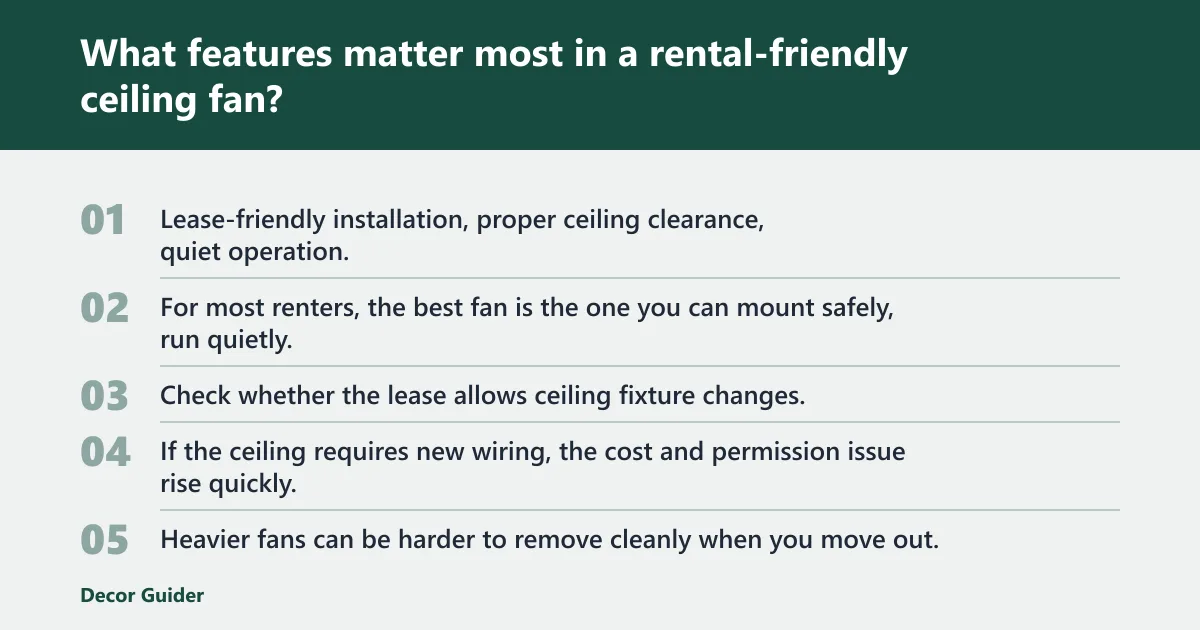
Lease-friendly installation, proper ceiling clearance, quiet operation, and easy reversibility matter more than decorative extras. For most renters, the best fan is the one you can mount safely, run quietly, and remove later without a costly repair bill.
Lease rules and existing wiring
Check whether the lease allows ceiling fixture changes, and confirm that there is an existing ceiling junction box rated for a fan. If the ceiling requires new wiring, the cost and permission issue rise quickly.
Weight and de-installation
Heavier fans can be harder to remove cleanly when you move out, and they can be a poor fit in older apartments with questionable support. If you may leave soon, choose a model that is easier to uninstall or easy to leave behind if the lease requires it.
Airflow rating and room coverage
Airflow rating, measured in CFM, tells you how much air a fan moves. Hunter Palermo has a high airflow rating of 3,817 CFM, while Fanimation Odyn moves 11,190 CFM on its highest speed and uses 32 watts on that same speed.
Those numbers are useful because they separate real air movement from style. A low-CFM fan may look fine and still underperform in a larger room.
Energy Star and utility impact
Energy Star certification matters for renters who run the fan often and want lower electricity use over time. It will not transform the room temperature, but it can help control the utility bill impact of frequent use.
Quick picks
| Need | Best pick | Why it fits renters | Price note |
|---|---|---|---|
| Portable no-drill cooling | ISTRUESDA 28″ plug-in fan | Works where a ceiling mount is not practical | $19.99 |
| Bright one-fixture lighting | HAOLEDI 9″ 36W LED retrofit kit | High output light for multipurpose rooms | $16.98 |
| Simple low-cost light replacement | HAOLEDI 4″ 20W LED retrofit kit | Compact, efficient, and easier to fit in tight spaces | $14.98 |
| Smart control add-on | 53T smart Wi-Fi remote kit | Lets you add app and voice control to many existing fans | $24.97 |
| Covered outdoor or camp use | Ausic 21″ portable battery fan | Battery power avoids cord limits in temporary setups | $54.99 |
ISTRUESDA 28 inch ceiling fan: best for portable spaces
This is for renters who need airflow without a ceiling install. It suits dorms, porches, RVs, garages, and temporary sleeping spaces where lease limits or missing wiring make a fixed ceiling fan unrealistic.
Its strongest point is simplicity. The plug-in format and detachable blades make it easy to set up, move, and store, which is useful for people who expect to relocate again soon.
The drawback is that it is not a true mounted ceiling fan, so it does not solve low-ceiling clearance the way a flush-mount model would. It is also less appropriate for a main living room that needs a permanent, centered fixture.
HAOLEDI 9 inch 36W LED ceiling fan light retrofit kit: best for bright rental rooms
This kit is for renters who need better light from an existing ceiling fan or ceiling fixture. The adjustable color temperature, from 3000K to 6000K, makes it easier to tune a room for warm evening use or brighter daytime tasks.
It stands out for output. The listed 4300 lumens is a lot of light for a multipurpose room, and the ETL certification is a useful safety signal when you are replacing a ceiling light component.
The drawback is that this is a retrofit kit, not a full fan. It helps if the fan already exists or if the fixture needs a lighting upgrade, but it does not address airflow, blade span, or motor noise by itself.
HAOLEDI 4 inch 20W LED ceiling fan light retrofit kit: best for compact light replacement
This is the simpler light-focused option for smaller rooms or tighter fixture spaces. It is a good fit when you want a clean replacement light with less bulk and less energy draw than an older bulb setup.
The 2400-lumen output and flicker-free design make it practical for bedrooms, hallways, or small living areas where the main need is dependable overhead light. The included wiring connectors also make the install process less fussy than many bare-bones replacements.
The tradeoff is scale. It is not the brightest choice in this list, and it does not replace the need for a full fan if cooling is the goal.
53T smart Wi-Fi ceiling fan remote control kit: best for easy control
This is the best fit for renters who already have a compatible ceiling fan and want remote control without replacing the entire fixture. It is useful in bedrooms, tall-ceiling rooms, and spaces where a wall switch is awkward to reach.
Its main advantage is convenience. The kit adds remote, app, and voice control, plus speed and dimmer control, which can make a basic fan much easier to live with day to day.
The drawback is compatibility. Even though it claims broad support, renters still need to confirm the existing fan can accept this type of kit before buying.
Ausic 21 inch portable ceiling fan with light and remote: best for temporary outdoor use
This is the rental-friendly pick for patios, covered hangout spaces, or temporary setups where battery power is the main advantage. The 20,400mAh battery removes cord limits, and the remote makes it easier to use from a chair or bed.
It also stores neatly thanks to its detachable design, which matters when a fan needs to be packed away between leases or used only part of the year.
The drawback is that battery operation is a different category from a wired ceiling fan. It is useful for temporary comfort, but it will not replace a properly mounted fan for daily apartment use.
Which one should you buy
If you want the lowest noise in a bedroom, start with a DC motor ceiling fan with a remote and, if the room needs it, an LED light kit. Quiet control matters more than brand style in sleep spaces.
If your ceiling is tight, choose a flush-mount or low-profile fan before you look at blade count or decor. Clearance mistakes are harder to fix than airflow mistakes.
If you want the easiest install, choose a product that works with the existing ceiling setup, or use a portable option when the lease makes hard mounting risky. A basic fan with an existing rated box is usually simpler than a new wiring job.
If you want the lowest total cost, compare the fan price, electrician cost, and the chance you may have to leave the fan behind. Most ceiling fans cost around $100–$250 depending on airflow and size, but some premium ceiling fans cost more than $600 or $700, and wiring work can raise the real total fast.
Picture a one-bedroom apartment with a 9-foot ceiling and a noisy box fan in summer. A 42 to 53 inch DC fan with a remote and LED light usually makes more sense than a cheaper AC model that rattles at night.
Say your lease forbids ceiling changes in a furnished sublet. A plug-in or portable option is safer than gambling on a fan that may need de-installation or landlord repair later.
Are ceiling fans a good investment?
Yes, if you choose the right type for the room and keep the install cost in mind. A good ceiling fan can improve comfort, reduce reliance on other cooling, and serve for years, but the value drops quickly if it is too large, too noisy, or too hard to remove.
Are ceiling fans better than floor fans?
Often yes for a rental bedroom or living room, because ceiling fans save floor space and move air across the room without creating clutter. Floor fans are easier to move and avoid ceiling work, but they can take up space and may be noisier at close range.
Are expensive ceiling fans worth it?
Sometimes. Higher-priced fans may offer better motors, quieter operation, stronger airflow, and more refined control. That said, a renter should only pay for features that match the room, because a $700 fan is poor value if the ceiling is too low or the lease is temporary.
Can a renter install a ceiling fan without damaging the ceiling?
Sometimes, but only if the ceiling already has a fan-rated junction box and the lease allows the change. If new wiring, box replacement, or patching is needed, the risk and cost rise. For many renters, a removable or plug-in option is safer.
What ceiling fan size is best for an apartment or rental room?
For many bedrooms and standard rooms, 42 to 53 inches is the practical range. For one large room or open-plan space, 56 inches can work better. Smaller spans make more sense in studios, low ceilings, or rooms where headroom is tight.
Do renters need a fan with lights or remote control?
Often yes, especially in bedrooms and one-fixture rooms. A remote makes the fan easier to use without reaching a chain or switch, and an LED light kit can replace a separate lamp in compact spaces. Those features are convenience tools, not decorative extras.
How much does a ceiling fan cost for a bedroom?
Most ceiling fans cost around $100–$250 depending on airflow and size. The real bedroom cost may be higher if you need electrician work, a fan-rated box, or a model with remote control and integrated lighting. Cheap upfront pricing can hide installation cost.
What type of ceiling fan is best for a low ceiling rental?
A flush-mount or low-profile fan is the safest type for a low ceiling rental. It reduces headroom problems and lowers the chance of a clearance mistake. Always check the finished hanging height before buying, especially in older units with uneven ceilings.
What features matter most in a rental-friendly ceiling fan?
Start with ceiling clearance, a fan-rated junction box, quiet motor type, and the right blade span. After that, remote control and LED lighting matter because they make the fan easier to live with in a rental. Energy Star and CFM help judge efficiency and airflow.
Products related to this article
Sponsored / affiliate links. As an Amazon Associate I earn from qualifying purchases. I may earn additional commission from eligible campaigns.