Ceiling Fan Mounting Height Chart: What Fits Each Ceiling
For most homes, hang a ceiling fan so the blades sit about 8 to 9 feet above the floor, with 7 feet as the absolute minimum clearance; a flush mount is commonly used for 8-foot ceilings, a short downrod for 9-foot ceilings, and longer downrods are typically used as ceilings rise. That target band aligns with manufacturer installation guidance and common electrical reference recommendations for ceiling fans and fan support boxes. Mount it too low or too high, and you can get poor airflow, wobble, noise, and a fan that feels unsafe. This ceiling fan mounting height chart shows the right mounting type, downrod range, and blade-height check for each finished ceiling height.
Ceiling fan height basics
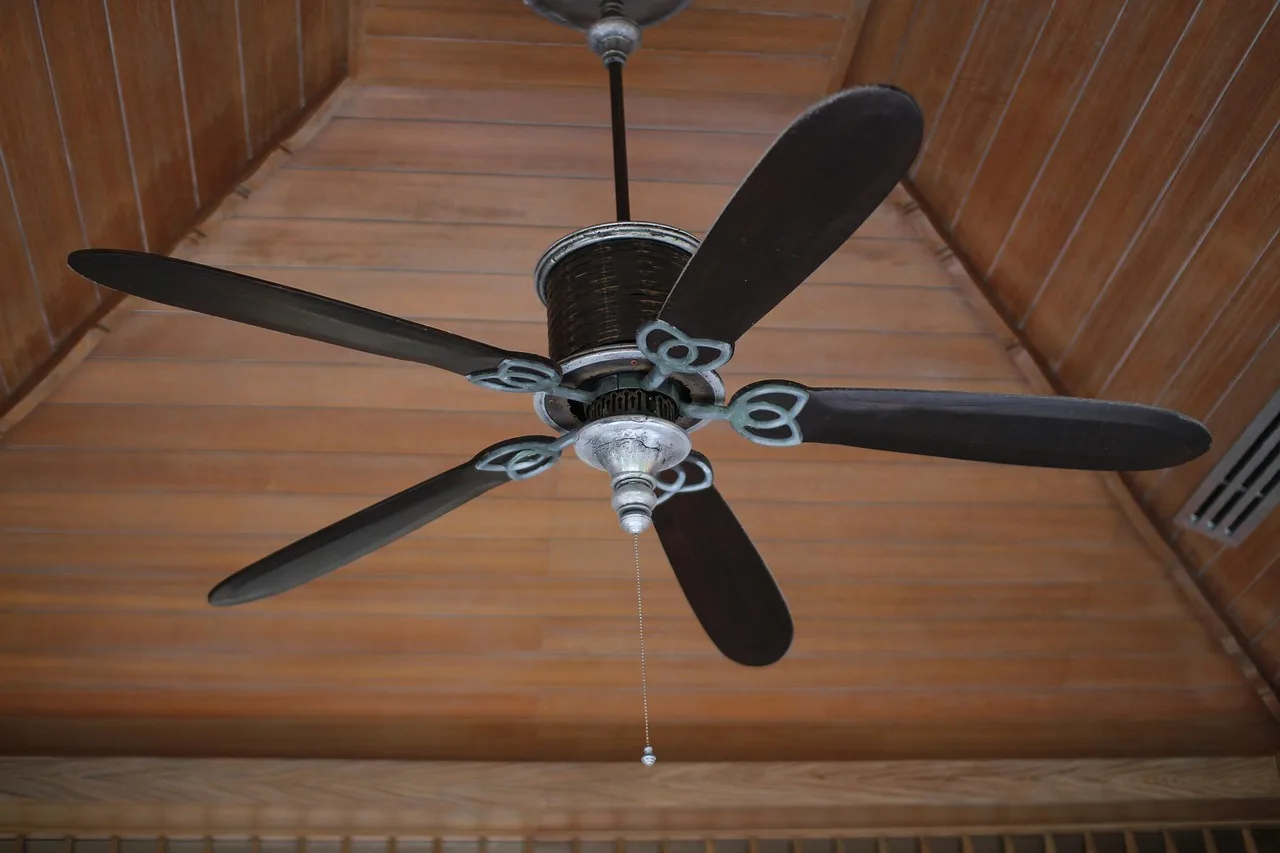


Ceiling height drives the whole decision. It changes the mounting type, the downrod length, and the final blade height above the floor. New homes commonly are 9 feet high, but the practical rule is not that every code path “requires” an 8-foot ceiling; rather, the finished fan installation must preserve the needed blade clearance and safety spacing for the room. Raising flat ceilings beyond standard height can work between 10 and 13 feet, and the final fan drop should be chosen from the model’s own ceiling-to-blade measurement, not from rod length alone.
Finished blade height: 7-foot minimum and 8- to 9-foot target
The target blade height is 8 to 9 feet from the floor. That range gives the blades enough room to move air without hanging so low that they feel intrusive. Treat 7 feet as the absolute minimum clearance, not the goal, consistent with common ceiling-fan installation guidance and the safety-clearance floor used in major manufacturer manuals. If a fan cannot stay above that line once you account for the housing depth, choose a different mount or a different fan.
Why ceiling height changes airflow, comfort, and clearance
Higher mounting drops usually move more air through the occupied zone, but only if the blades stay in the correct band above the floor. Too little drop can leave the fan too close to the ceiling, which cuts circulation. Too much drop can put blades in the path of tall people, open doors, or light fixtures. The right balance is determined by the fan’s total hanging depth, which includes the canopy, motor housing, and blade plane, not just the downrod.
Picture a 10-foot room with a fan mounted on a very short rod. The blades may still clear the floor, but they can sit too close to the ceiling to move air well. The fan may also look awkward because the body sits high while the blades stay above the comfort zone.
What to measure before you buy
Measure three things before shopping: ceiling height, room square footage, and the fan body depth shown in the manufacturer listing. The body depth matters because the downrod is not the full story; the housing, canopy, and blade mount all affect the finished blade height. On sloped ceilings, also measure the slope angle, because compatible sloped-ceiling canopies and adapters have model-specific angle limits that vary by manufacturer.
- Measure floor to ceiling at the fan location.
- Measure the room’s length and width to get square footage.
- Check the fan’s overall hanging depth in the listing or manual.
- Check whether the ceiling is flat or sloped.
- Confirm the electrical box is fan-rated before installation.
What the mounting chart gives you
This chart turns ceiling height into a starting plan. It points you to the likely mount, the approximate downrod range, and the finished blade height to verify before you buy. Use it as a buying aid, then confirm the exact dimensions against the fan’s spec sheet and manual, especially the model’s stated ceiling-to-blade measurement and any required slope hardware.
How to read the ceiling-height rows
Read across each row from left to right. First, match your finished ceiling height. Then note the recommended mounting type. Last, check the blade-height column against the 8 to 9 foot target and the 7-foot minimum. If the model’s listed dimensions push the blades outside that band, pick a different rod length or a different fan.
How to use the pass/fail checks
The chart includes four checks: wall clearance, slope threshold, box support, and a quick checklist. The wall check follows the 18-inch rule. The slope check tells you when a compatible sloped-ceiling canopy or adapter is needed, if the model allows it. The box check reminds you that the fan must attach to a fan-rated electrical box.
What the chart does not replace
The chart does not replace the manufacturer listing or manual. It cannot confirm the exact hanging depth of a specific model, and it cannot override model-specific clearance rules. If the manual calls for a different downrod, a different adapter, or a different box rating, follow the manual. For sizing, use ENERGY STAR’s room-size guidance as a starting point, then verify the blade height and wall clearances in the room itself.
| Finished ceiling height | Recommended mount | Approximate downrod range | Expected finished blade height | Pass/fail checks |
|---|---|---|---|---|
| 8 feet and lower | Flush mount or hugger mount | 0 inches; use the shortest low-profile setup the model allows | Usually near the lower edge of the safe band; verify it still clears 7 feet | Pass only if the fan stays above 7 feet, blades clear walls by 18 inches, the ceiling is level or correctly adapted, and the box is fan-rated |
| 9 feet | Short downrod | 12 inches | Use the model’s stated ceiling-to-blade measurement to confirm the blades land in the 8- to 9-foot operating zone | Pass if wall clearance is 18 inches, the box is fan-rated, the slope check passes for the chosen mount, and the listing matches the rod length |
| 10 feet | Short to medium downrod | 12 to 18 inches | Usually inside the 8 to 9 foot target band, depending on fan body depth | Pass if the finished blade height lands in the target band and the fan clears walls and obstacles |
| 11 feet | Longer downrod | 18 to 24 inches | Usually around the target band if the fan body is not unusually deep | Pass if the rod plus housing still keeps blades between 8 and 9 feet and at least 18 inches from walls |
| 12 feet | Longer downrod | 24 to 36 inches | Varies by model; verify on the spec sheet before buying | Pass if the finished blade height is checked from the listed hanging depth, not the rod alone |
| 13 feet | Extended downrod | 36 to 48 inches | Depends on the fan body and canopy depth | Pass if the fan-rated box, rod length, slope threshold, and wall clearance all check out |
| 14 feet | Extended downrod | 48 to 60 inches | Model-dependent; confirm before ordering | Pass only after confirming the finished blade height from the manufacturer dimensions |
| 15 feet | Extended downrod | 60 inches or longer, as the model allows | Model-dependent; verify the full hanging depth | Pass if the listed rod length and housing depth produce the target floor clearance |
| 16 feet | Extended downrod, often custom length | Custom or extra-long downrod may be needed | Model-dependent; confirm with a dimension check | Pass only after checking box support, rod rating, and the finished blade height |
How to read the chart for irregular rooms
For a room with sloped sections, openings, or a non-rectangular plan, use the primary occupied zone, not the full footprint. Start from the area where people sit, stand, or walk most often. That is the space the fan needs to serve, and it is the area where wall and door clearance matter most.
Quick pass/fail mini-checklist by row
Before you buy, use this short checklist for every row in the chart: the blades must clear the floor by at least 7 feet, the tips must stay 18 inches from walls, the ceiling box must be fan-rated, and any sloped installation must stay within the model’s listed angle limit using the proper canopy or adapter. If any one of those fails, the row does not pass.
How do you choose the right downrod length?
Choose the downrod by working backward from the target blade height, not by guessing from ceiling height alone. Start with the ceiling height, subtract the fan’s hanging depth from the listing, then subtract the rod length until the blades land in the 8 to 9 foot band. Exact needs vary by fan body depth and manufacturer specs, so the downrod must always be adjusted to the model’s stated ceiling-to-blade measurement.
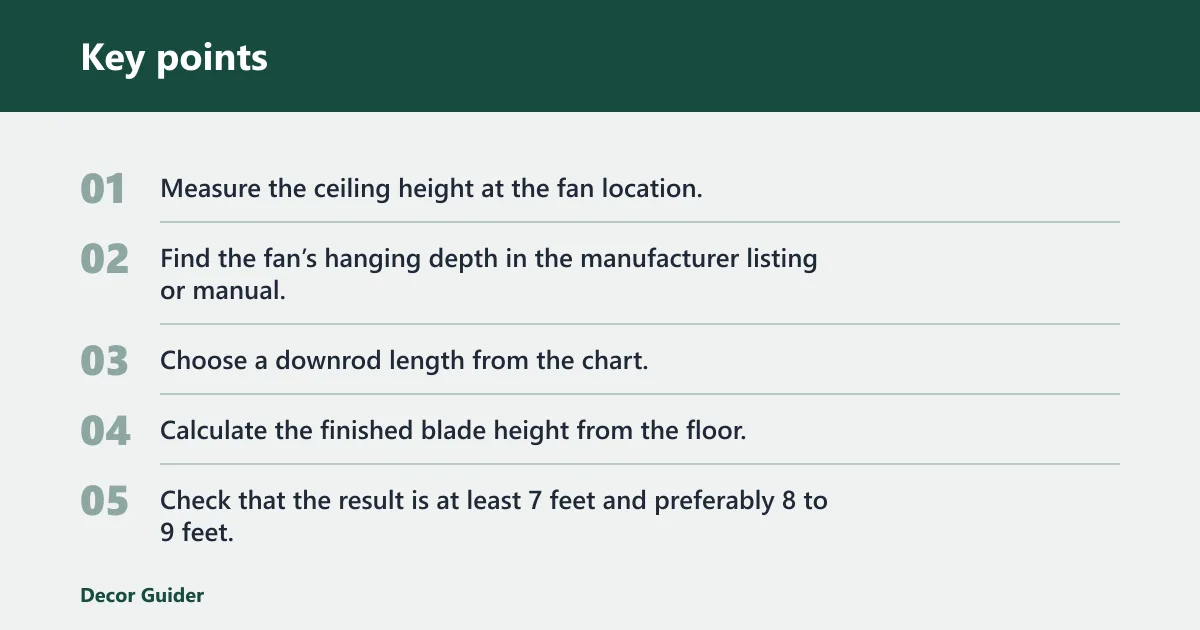
Step-by-step calculation from ceiling height to finished blade height
- Measure the ceiling height at the fan location.
- Find the fan’s hanging depth in the manufacturer listing or manual.
- Choose a downrod length from the chart.
- Calculate the finished blade height from the floor.
- Check that the result is at least 7 feet and preferably 8 to 9 feet.
The key point is separation. Downrod length is only one part of the drop. The hanging depth includes the motor housing and blade assembly, so a 12-inch rod does not always mean the blades hang exactly 12 inches lower than a flush mount. Use the full hanging depth to verify the final number.
Worked example: 10-foot ceiling with fan body depth included
Suppose a 10-foot ceiling has a fan whose listed hanging depth is 14 inches from the ceiling to the blade plane when paired with a 12-inch downrod. That puts the blades about 8 feet 10 inches above the floor. The result sits inside the 8 to 9 foot target band, so the setup is a fit if the wall and box checks also pass.
A common first-timer mistake is to focus only on blade size and ignore the ceiling height when choosing a mounting height. A 12-inch rod can look right on paper, yet still miss the target if the fan housing is deep or the canopy adds extra drop. The fix is simple: use the listed overall hanging depth, not the rod alone.
When a custom downrod may be needed
Custom lengths become more likely as ceilings move above 12 feet, especially in vaulted or cathedral spaces. If the room needs a rod longer than the standard sizes the manufacturer offers, check the listing for compatible extensions or ask for a model that supports the needed length. Do not mix parts unless the manual allows it.
Worked example: 9-foot ceiling
For a 9-foot ceiling, a short downrod is usually the starting point, but the finished height should still be verified from the manufacturer’s ceiling-to-blade measurement. The common goal is to keep the blades in the 8- to 9-foot operating zone, with 7 feet as the floor minimum. If the model’s housing depth pushes the blades too high or too low, adjust the rod length or choose a different fan.
Worked example: vaulted ceiling
For a vaulted ceiling, first confirm the slope angle and whether the fan supports a compatible sloped-ceiling canopy or adapter. Then choose the rod length from the vertical drop needed to keep the blades in the target band. The usable slope threshold varies by model, so the installation only passes if the ceiling angle stays within the manufacturer limit and the fan remains level after the adapter is installed.
Can you mount a ceiling fan on a sloped ceiling?
Yes, but only with the right hardware. A ceiling fan on a sloped surface requires a compatible sloped-ceiling canopy or adapter so the fan hangs level. Without that adapter, the body can tilt, the blades can track unevenly, and the fan can vibrate or fail to move air well.
When an angled ceiling adapter is required
Any visible slope at the mounting point is a warning to check the adapter requirement. Flat ceilings do not need it. Sloped, vaulted, and cathedral ceilings usually do. The adapter keeps the fan body level even when the mounting point is not, but only within the slope range stated by the manufacturer.
How slope changes the vertical drop and blade clearance
On a slope, rod length and vertical drop are not the same thing. The rod follows the line of the slope, while the vertical drop is the straight distance from the ceiling to the blades. That difference matters because the lowest blade point is what must stay above the floor and away from walls.
What to verify before installation on vaulted or cathedral ceilings
Verify three things before you buy anything: the adapter is compatible, the rod length keeps the blades in the target band, and the box is fan-rated for the installation setup. For vaulted or cathedral ceilings, also check whether the slope changes across the room. If it does, mount in the area where the fan can stay level and clear.
How far should a ceiling fan be from the wall?
Keep blade tips at least 18 inches from all walls. That is the minimum clearance in the supplied guidance and is consistent with manufacturer installation instructions for safe blade sweep clearance. Also check center-to-wall distance, because the fan may meet the 18-inch rule but still feel too close to a door swing, shelving, or a tall cabinet.
The 18-inch wall clearance rule
The 18-inch rule is a blade-tip check, not a center-of-fan check. Measure from the outer edge of the blade sweep to the nearest wall or fixed obstruction. If the blade tips come closer than 18 inches, the fan can lose efficiency and create a cramped feel in the room.
How center-to-wall distance changes in small rooms
Small rooms need extra care because the fan may have enough ceiling height but not enough lateral space. A compact room can pass the blade-height check and still fail the wall check. In that case, choose a smaller blade span or move the fan toward the room center if the electrical box location allows it.
Blade span, room square footage, and obstruction checks
ENERGY STAR room guidance uses 0–75 sq ft for 29 to 36 inches, 76–150 sq ft for 36 to 44 inches, and 151–225 sq ft for 44 to 50 inches. Use that as a starting point, then confirm the primary zone in irregular rooms. A fan sized for the room still needs open space around doors, beams, and furniture.
Say your room is 12 feet by 10 feet, with a 120 square foot floor area and a doorway near one corner. A 44 to 50 inch fan may fit the square footage, but the blade tips still need the 18-inch wall clearance. If the doorway cuts into that space, move up to a smaller span or shift the fan location.
Frequently asked questions
How high should a ceiling fan be above the floor?
Set the blades 8 to 9 feet above the floor when you can. Treat 7 feet as the absolute minimum clearance. If the fan lands below that line after you account for the housing depth and the rod, change the mount or choose a different fan.
How to mount a ceiling fan on a 9-foot ceiling
For a 9-foot ceiling, the supplied guidance points to a 12-inch downrod. That is a starting point, not an exact universal outcome, because the final blade height depends on the model’s stated ceiling-to-blade measurement. Before ordering, confirm the fan’s hanging depth in the listing, and make sure the finished height stays inside the 8- to 9-foot operating zone.
How to mount a ceiling fan on a 10-foot ceiling
For a 10-foot ceiling, use a 12 to 18-inch downrod. That range usually puts the blades in the 8 to 9 foot target band, but the final height still depends on the fan body depth. Check the manual and make sure the blades stay at least 18 inches from the wall.
What is the minimum ceiling height for a ceiling fan?
The practical minimum is not a building-code ceiling height by itself; it is the finished blade clearance after installation. Many installations can work with an 8-foot ceiling if the fan is low-profile enough, but the blades still need to clear the floor by at least 7 feet. If the finished setup cannot meet that clearance, it is not the right fit for that room.
How do I choose the right downrod length for my ceiling height?
Start with ceiling height, then use the fan’s listed hanging depth to work backward to the finished blade height. A 12-inch downrod fits the 9-foot example in the supplied guidance, while 10-foot ceilings usually need 12 to 18 inches. For taller ceilings, confirm the exact model dimensions before buying, and use the model’s stated ceiling-to-blade measurement rather than the rod length alone.
What fan box do you need for a ceiling fan?
You need a fan-rated electrical box, not a standard light fixture box. The box must be listed to support the fan’s weight and motion, and installation references such as the NEC and manufacturer manuals treat that support as mandatory for a safe mount. If the box is not fan-rated, replace it with one that is.
Products related to this article
Sponsored / affiliate links. As an Amazon Associate I earn from qualifying purchases. I may earn additional commission from eligible campaigns.