What Size Ceiling Fan Do I Need for My Bedroom?
Start with room square footage: 36- to 42-inch fans usually suit small bedrooms, 44-inch fans fit mid-sized rooms, and 48- to 52-inch fans fit larger bedrooms. Then adjust for ceiling height and bed placement so the blades clear the room safely and do not blow directly onto the sleeper. A fan that is too small leaves the room stuffy; one that is too large can feel drafty and noisy at sleeping height. This page shows how to size a bedroom fan by square footage, ceiling height, and where the sleeper actually feels the air.
Matching fan size to your bedroom dimensions



Start with room square footage, then use ceiling height to choose the mount. Measure length and width in feet, then multiply them. Split irregular bedrooms into rectangles if needed. For a bedroom, the better question is not only how much floor area the fan covers, but how the blades clear the bed, dresser, and walking path.
Blade span is the main size signal. For small bedrooms, a 36- to 42-inch fan usually fits. Typical bedrooms often land around 44 inches, while larger bedrooms often move to about 48 inches or 52 inches. If two fans have the same blade span, compare CFM next, since airflow can separate fans that look similar on paper.
Bedroom sizing matrix
| Bedroom size | Square footage | 8-foot ceiling | 9-foot ceiling | Vaulted ceiling |
|---|---|---|---|---|
| 8 x 8 | 64 | 29-36 inch fan, flush-mount or low-profile; keep blades well away from the bed edge | 29-36 inch fan, standard mount if you still keep 7-8 feet of blade-floor clearance | Small fan on a downrod only if the blade height can still meet clearance targets |
| 8 x 10 | 80 | 24-42 inch blade span, flush-mount preferred for headroom | 36-42 inch fan, standard mount or short downrod | 36-42 inch fan with a longer downrod and slope-compatible hardware if needed |
| 10 x 10 | 100 | 36-42 inch low-profile fan | 42-44 inch fan with standard mount or 12 inch downrod | 44 inch fan with downrod sized to hold 7-8 feet of blade-floor clearance |
| 10 x 12 | 120 | 42-44 inch flush-mount fan | 44-48 inch fan, often a strong fit near the small-to-standard boundary | 48 inch fan with slope-compatible mounting if the ceiling pitches |
| 12 x 12 | 144 | 44-48 inch fan if the low ceiling still leaves safe headroom | 44-48 inch fan, standard mount or 12 inch downrod | 48 inch fan, usually better balanced visually than an oversized 52 inch model |
| 12 x 14 | 168 | 44-48 inch fan, low-profile only if the room layout is tight | 48 inch fan, downrod usually helps with blade-floor clearance | 48-52 inch fan if the sleeping area is broad and furniture leaves open circulation |
| Master bedroom range | 176-300 | 44-48 inch fan if ceiling height is limited | 48-52 inch fan is common when the room is open and the bed is centered | 52 inch fan or larger only when the room is wide enough and clearance stays correct |
Use the room as a layout, not a perfect box. A wide dresser, a canopy bed, or a ceiling slope changes the airflow zone more than the raw square footage does. In elongated bedrooms, the fan should cover the sleeping area first, then the rest of the room.
- Measure the bedroom length and width in feet.
- Multiply those numbers to get square footage.
- Check whether the room is under 100 square feet, around 100 to 150 square feet, or above that range.
- Note the ceiling height before choosing a mount.
- Check bed placement, closet doors, and dresser clearance.
- Compare blade span, then compare CFM if two fans are close in size.
What blade span fits your room?
For most bedrooms, 36- to 42-inch fans suit small rooms, 44-inch fans fit borderline rooms, and 48- to 52-inch fans fit larger bedrooms. The best choice depends on both floor area and how much open space surrounds the bed. A 44-inch fan often beats a 52-inch fan in a compact room because it moves air without crowding the visual field or pushing a strong draft straight onto the pillow.
Bedrooms under 100 square feet can use a 36- to 42-inch fan, and rooms around 100 to 144 square feet often fit a 44-inch fan. Bigger is not always better in a sleeping zone.
When a 44-inch fan beats a 52-inch fan
Choose 44 inches when the bedroom is close to the next size band, the bed sits near the centerline, or the room has little open wall space. Choose 52 inches when the room is genuinely large and the fan can stay visually balanced. If the fan hangs over the bed too strongly, the air can feel cold at night even if the room temperature is fine.
Suppose a 12 x 12 bedroom has a queen bed, two nightstands, and a dresser across from the bed. A 44-inch fan usually fits the sleeping zone better than a 52-inch model, because the larger fan may push air too directly onto the pillow area and may look oversized from the doorway.
How ceiling height changes the choice

Ceiling height changes the mount choice as much as the blade span. For an 8-foot ceiling, a flush-mount or low-profile fan is usually the better fit because it keeps the blades closer to the ceiling and helps preserve head clearance. For 9-foot ceilings and taller, a downrod often becomes the safer choice so the blades sit at the right height in the room.
Keep blades at least 7 to 8 feet above the floor. That clearance matters in bedrooms, where people walk barefoot, get dressed, and move around the bed in the dark.
Standard mount, flush mount, or downrod
A flush-mount fan, sometimes called a hugger fan, works best for low ceilings. A standard mount is a middle option when the ceiling has a little more room but still does not need a long drop. A downrod is the better choice for taller ceilings because it helps place the fan in the airflow zone instead of too close to the ceiling.
For a 9-foot ceiling, a downrod is a practical starting point for many bedrooms. For vaulted ceilings, choose a slope-compatible fan or adapter if the ceiling angle requires it. Dual-mount fans are useful because they can often work as flush-mount or downrod models, depending on the room.
Picture a guest room with an 8-foot ceiling and a twin bed pushed near one wall. A low-profile 36-inch or 42-inch fan usually fits better than a hanging model, because the room needs headroom more than extra blade diameter.
Do you need a flush-mount fan?
Yes, if the bedroom ceiling is 8 feet or if the room feels tight once the bed, closet, and door swing are in place. A flush-mount fan keeps the profile compact and helps maintain safe headroom. Choose a downrod instead when the ceiling is 9 feet or higher and you need the fan lower in the room to meet clearance targets.
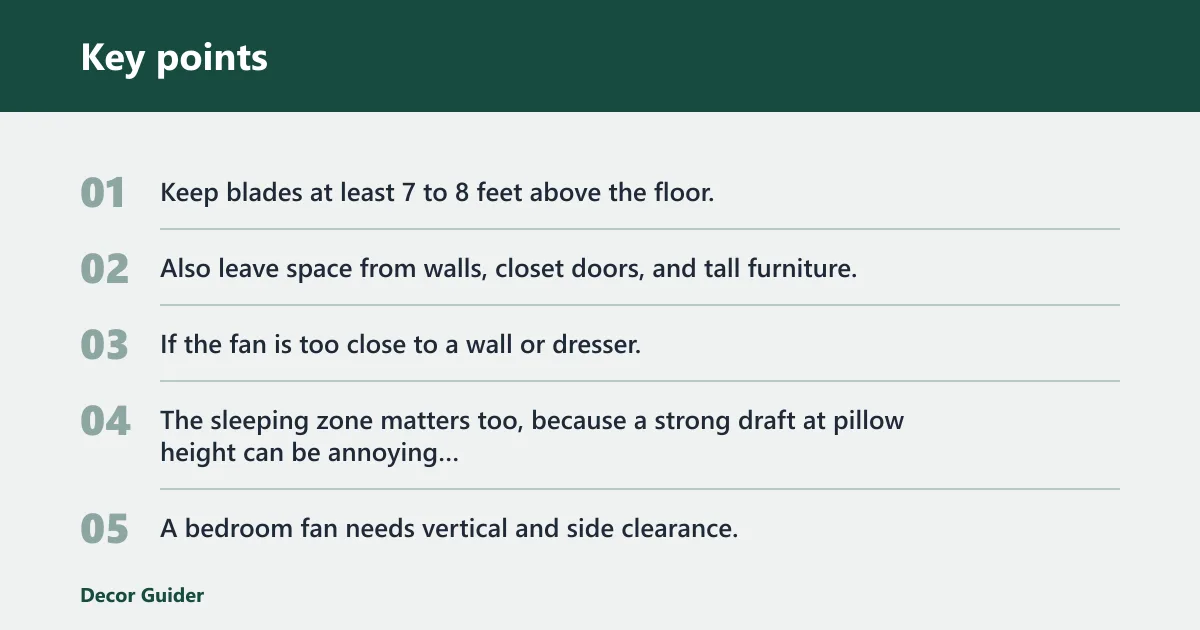
Keep blades at least 7 to 8 feet above the floor. Also leave space from walls, closet doors, and tall furniture. If the fan is too close to a wall or dresser, air can bounce oddly and the room can feel choppy instead of comfortable. The sleeping zone matters too, because a strong draft at pillow height can be annoying even when the room is technically sized correctly.
Bedroom clearance rules
A bedroom fan needs vertical and side clearance. The blades should be high enough for safe walking space, and the fan should sit far enough from walls and obstacles to avoid noise, wobble, or uneven airflow. In smaller rooms, that can make a 44-inch fan a smarter pick than a 52-inch one.
Do not let the size chart override the layout. A fan over the foot of the bed may feel harsher than the same fan mounted closer to the room center. If the bed is under the fan, check whether the sleeper will feel direct airflow at night.
Frequently asked questions
What size ceiling fan do I need for my bedroom?
Use square footage first, then ceiling height. Adjust down for low ceilings and tight sleeping zones.
What size ceiling fan should I get for my bedroom?
If your bedroom is small or has an 8-foot ceiling, start with a flush-mount 36- to 42-inch fan. If the room is mid-sized or borderline, 44 inches is often the best middle ground. For a larger master bedroom, 48 inches is a common starting point, with 52 inches reserved for rooms that truly need it.
What size ceiling fan for my bedroom?
Measure length and width, then use the result to place the room into a size band. That method is better than guessing from the bed size alone. A 10 x 10 bedroom usually fits a 42- to 44-inch fan, while a 12 x 12 bedroom often works well with 44- to 48-inch blades.
How do I measure my bedroom for a ceiling fan?
Measure the room’s length and width, multiply them for square footage, and note any alcoves or narrowed sections. If the room is irregular, split it into rectangles and add the areas together. Then measure ceiling height, since 8-foot ceilings usually call for flush-mount fans while 9-foot ceilings often need a downrod.
Do I need a flush-mount fan for an 8-foot bedroom ceiling?
Usually, yes. An 8-foot ceiling often leaves too little room for a hanging fan without compromising head clearance. A flush-mount or low-profile model keeps the blades close to the ceiling and helps you stay within the recommended 7 to 8 feet of blade-floor clearance.
Should I choose a downrod or hugger fan for a bedroom?
Choose a hugger fan for low ceilings and a downrod for taller ceilings. The right choice depends on where the blades land in the room, not only on style. If the ceiling is 9 feet or higher, a downrod is a practical starting point for many bedrooms.
Products related to this article
Sponsored / affiliate links. As an Amazon Associate I earn from qualifying purchases. I may earn additional commission from eligible campaigns.