Dimmable Lights vs Smart Lights: Which Is Better for Bedrooms?
For bedrooms, Dimmable Lights are usually better if you want simple wall control, sleep-friendly low light, and fewer failure points; choose Smart Lights only if you will use app, voice, or schedules every night. Poor lighting can leave a bedroom too bright for winding down, awkward for shared use, or tied to an app that nobody wants to open at 11 p.m. This guide compares dimmable and smart options by sleep comfort, wall wiring, automation, and reliability.
| Factor | Dimmable Lights | Smart Lights | Winner |
|---|---|---|---|
| Wall control at bedtime | Brightness changes from the wall with a standard dimmer | On/off from the wall; dimming needs a smart dimmer or smart bulb setup | Dimmable Lights |
| Automation and remote control | No app control unless you add a smart dimmer | App, voice, and schedules come with the system or through smart controls | Smart Lights |
| Installation risk | Usually lower if the existing wiring and bulbs already dim cleanly | Higher because many smart switches and dimmers need a neutral wire and more box depth | Dimmable Lights |
| Sleep friendliness | Strong if you keep the light warm and low | Strong only if automation keeps warm, low light consistent | Dimmable Lights |
| Total cost of ownership | Often lower to start and simpler to maintain | Higher hardware cost, with more points of failure and more setup decisions | Dimmable Lights |
What each option controls
Dimmable Lights change brightness. Smart Lights add remote control, scheduling, or voice control, but the exact behavior depends on whether you choose a smart dimmer switch, a smart light switch, or a smart bulb. For bedrooms, that difference matters more than the label on the box.
Dimmable lights
A traditional dimmer changes light output only. It is the simplest way to get low, bedside-friendly light for reading or winding down, and it usually keeps the wall switch doing the one thing people expect at night: turning the room down without opening an app.
Smart lights
Smart switches give you on/off control, while smart dimmers add brightness control on top of wall use. Smart light switches can also handle schedules and automation, but they do not dim a standard bulb unless the source or the load is set up for dimming. Smart bulbs can change brightness and scenes, but they add ecosystem dependence and can conflict with dimmer switches.
Bedroom decision matrix
The right pick changes with the night-time routine. Reading at night, one sleeper in a shared room, and an older home with limited wiring all push the decision in different directions. That is where the choice becomes practical instead of theoretical.
| Bedroom scenario | Brightness control | Automation | Installation risk | Sleep friendliness | Total cost of ownership | Pick |
|---|---|---|---|---|---|---|
| Reading at night | Excellent with Dimmable Lights | Good with Smart Lights | Lower with Dimmable Lights | Better with Dimmable Lights | Lower with Dimmable Lights | Dimmable Lights |
| Shared bedroom with one sleeper | Excellent with either option if properly set | Better with Smart Lights for timed shutoff and wake-up use | Lower with Dimmable Lights | Better with Smart Lights if schedules keep late-night light low | Lower with Dimmable Lights | Smart Lights |
| Bedroom with older wiring | Good with Dimmable Lights if the bulb and dimmer match | Weak if a neutral wire is missing | Lower with Dimmable Lights | Better with Dimmable Lights | Lower with Dimmable Lights | Dimmable Lights |
For reading, the wall dimmer wins because the user needs instant, low, predictable light. For a shared room, Smart Lights can be worth the added complexity if schedules reduce wake-ups and keep late bright light out of the room. Older wiring usually pushes the choice back to Dimmable Lights because many smart switches and dimmers need a neutral wire.
Which option is better for sleep?
Dimmable Lights are usually better for sleep because they make it easier to keep the room warm and low without relying on an app. Smart Lights can do the same job, but only if you actually set them up for bedtime and keep the automation consistent.
Warm light and color temperature
Bedroom lighting in the 2700K to 3000K range is usually the safer choice for winding down. Cooler 5000K to 6500K light feels more alerting and is a poor match for pre-sleep use, though it can help for a wake-up routine if you want the room to feel brighter in the morning.
Low-brightness behavior and wake-up use
The real bedroom question is not whether a light can get bright. It is whether it can get low enough without flicker, dropouts, or harsh jumps at the bottom of the range. Smart Lights help most when you want an automatic wake-up scene, but a well-matched dimmer is often better for simply getting the room quiet and dim before bed.
Suppose a bedside lamp uses a dimmable LED bulb and a wall dimmer, and you lower it to a very low level at 10:30 p.m. If the bulb and dimmer match well, the room stays usable for reading without a sudden jump in brightness. If the pairing is poor, the same low setting may flicker or shut off before it becomes truly comfortable.
How do wiring and load limits change the choice?
Wiring matters because many smart switches and dimmers require neutral wires for proper installation. LED load behavior matters because a switch that looks compatible on paper can still buzz, flicker, or fail to dim cleanly if the bulb driver and control method do not agree.
Neutral wire needs
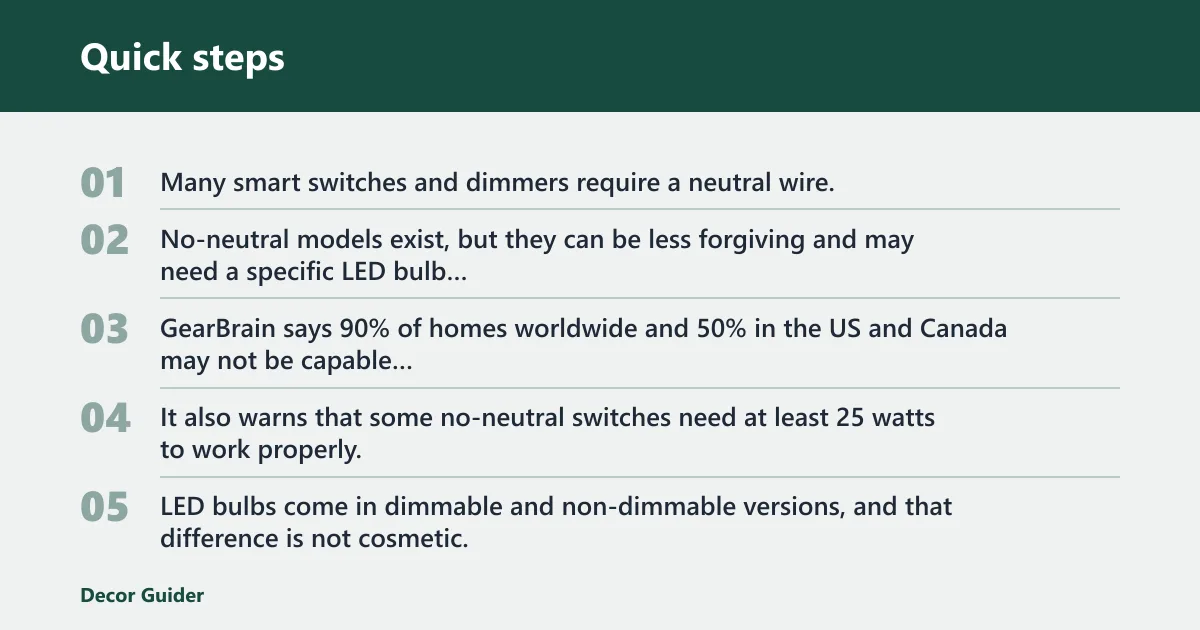
Many smart switches and dimmers require a neutral wire, and older homes often do not have one in the switch box. No-neutral models exist, but they can be less forgiving and may need a specific LED bulb type or a minimum load to work properly.
GearBrain says 90% of homes worldwide and 50% in the US and Canada may not be capable without rewiring. It also warns that some no-neutral switches need at least 25 watts to work properly, and some may let the lights glow when off if the bulb type is wrong.
LED bulb compatibility
LED bulbs come in dimmable and non-dimmable versions, and that difference is not cosmetic. A non-dimmable bulb on a dimmer can flicker, buzz, or cut out early. Even dimmable bulbs depend on the driver inside the bulb and the control method in the wall.
Wirecutter notes that smart switches can be bulky, so box depth should be checked before you buy. It also warns against pairing smart bulbs with a smart dimmer. That combination often creates control confusion, and in many setups it can cause odd dimming behavior or no usable dimming at all.
Phase-cut dimming and low-end issues
Traditional dimmers often use phase-cut dimming, which may be leading-edge, forward phase, or reverse phase, also called ELV. If the bulb driver expects a different style, the low end can look rough: flicker, buzz, dead zones, or a jump from off to too bright.
That can matter in bedrooms because the problem often shows up when you need a gentle low setting. A dimmer that cannot hold a stable low level is a poor fit for bedside reading, partner sleep, or a late-night bathroom trip.
Can you use smart bulbs with a dimmer?
Usually no, not in the way people hope. Smart bulbs and dimmer switches often conflict because the dimmer changes power to the bulb, while the bulb also expects steady power for its own electronics and app control. That can lead to flicker, lost connectivity, or a bulb that never behaves consistently.
If you want smart bulbs, leave the wall switch on and use the app, voice assistant, or scenes to control brightness and color. If you want wall dimming, choose a dimmable bulb and a compatible dimmer instead of mixing systems.
When a smart bulb makes sense instead
A smart bulb makes sense when you want color scenes, a wake-up alarm effect, or room-by-room control without changing the wiring. It is better for a lamp than for a hard-to-reach ceiling fixture, especially if you are comfortable leaving the wall switch alone so the bulb always has power.
Smart dimmers, smart switches, and traditional dimmers
These are not the same product type. A smart dimmer switch changes brightness and adds app and voice control. A smart light switch controls on/off and automation. A traditional dimmer changes brightness only, and that simplicity is often exactly what bedrooms need.
Smart dimmer switch features
A smart dimmer gives you wall dimming, app control, and voice control in one device. Many models also add schedules or scenes, and some use Z-Wave, Zigbee, or Wi-Fi for connectivity. That makes them the most flexible wall control, but also the most demanding on wiring, box space, and bulb compatibility.
Smart light switch features
A smart light switch is best when you want automation and remote control more than dimming. It can turn the room on or off from the app, respond to voice assistants, and follow schedules. But it does not dim a standard bulb unless the rest of the setup is built for that.
Traditional dimmer behavior
A traditional dimmer is the cleanest fit for a bedroom that just needs low light at night. It is often the simpler choice for guests and less likely to create a support problem later. If the bulb is LED, it should be dimmable and rated for the dimmer type in the box.
Say your bedroom has a single ceiling fixture and a bedside lamp, both using warm 2700K bulbs. A traditional dimmer on the ceiling light and a normal switch at the lamp often gives a better bedtime result than a more complex smart setup that no one uses after the first week.
Bedroom setup recommendation
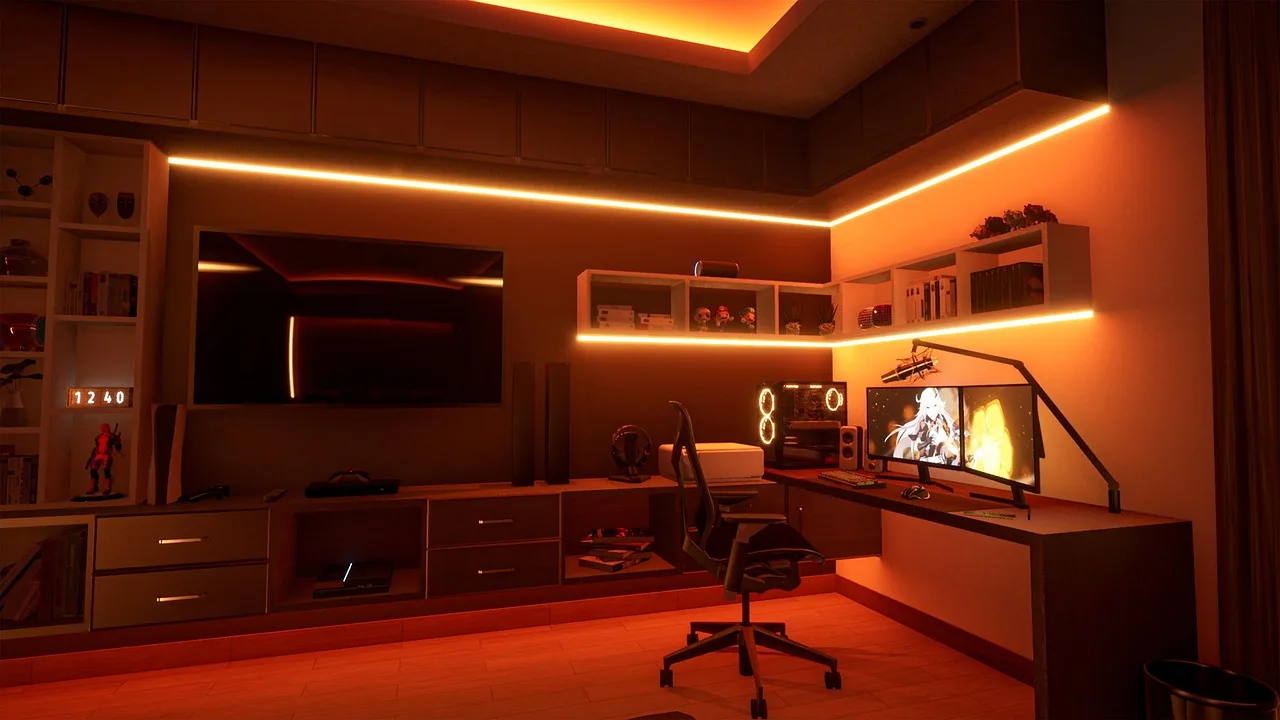
Choose Dimmable Lights if you want simple wall control, steady low brightness, and the lowest wiring risk. Choose Smart Lights if you will actually use app control, voice, or schedules every night, or if you want a wake-up scene that changes the room automatically. Choose a smart dimmer if you want both bedside dimming and automation, and the wiring box can support it.
Choose Dimmable Lights if…
Choose Dimmable Lights if your priority is reading, winding down, or a shared bedroom where the wall switch must stay obvious and dependable. Choose them if the home may lack a neutral wire, if you want fewer setup decisions, or if you do not want bedroom lighting tied to Wi-Fi.
Choose smart Lights if…
Choose Smart Lights if you want bedtime and wake-up routines, room scenes, or remote control from outside the bedroom. Choose them if you are willing to keep the wall switch logic simple and avoid pairing smart bulbs with a dimmer switch.
Choose smart dimmers if…
Choose smart dimmers if you want wall-based dimming plus app control and your electrical box can handle the device size and wiring needs. That is the most versatile option, but also the one most likely to require checking neutral-wire availability, LED compatibility, and multi-way support first.
- Check whether the bedroom switch box has a neutral wire.
- Confirm that the bulb is LED-rated and dimmable if you want wall dimming.
- Decide whether you need only brightness control or also automation.
- Measure box depth if you are considering a smart switch or smart dimmer.
- Match the control type to the routine: reading, shared sleep, or wake-up scheduling.

Frequently asked questions
Are dimmable lights better than smart lights for a bedroom?
Usually yes, if your main goal is comfortable low light and dependable wall control. Dimmable Lights are the simpler bedroom choice when you want reading light, sleep-friendly levels, and fewer compatibility problems. Smart lights are generally the better choice only when automation or remote control will be used often.
Do smart lights need a neutral wire in the switch box?
Many smart switches and dimmers do. That is especially relevant in older homes, where the switch box may not have a neutral wire at all. No-neutral models exist, but they can be more limited and may need a minimum load or special LED bulbs to avoid off-state glow.
Can you use smart bulbs with a dimmer switch?
Usually not a good idea. A dimmer changes power to the bulb, while a smart bulb expects steady power for its own controls. In many setups the result is flicker, dropped connectivity, or confusing behavior. Smart bulbs are better on a regular switch that stays on.
Which is better for sleep: adjustable brightness or app control?
Adjustable brightness matters more. Sleep-friendly bedroom lighting is usually about keeping the room in the 2700K to 3000K range and low enough not to feel harsh. App control helps only if it reliably sets that state for you every night and does not add another thing to manage.
What happens if a dimmer and LED bulb are mismatched?
You can get flicker, buzzing, a narrow dimming range, or a light that cuts out before it gets very low. Phase-cut mismatch can make the low end especially bad. The safest setup is a dimmable LED bulb matched to an LED-rated dimmer with compatible load behavior.
Do smart lights work during Wi-Fi outages?
It depends on the control method. A smart switch or smart dimmer still gives wall control, but app features, voice control, and schedules may stop if Wi-Fi, the hub, or the cloud service is unavailable. For bedrooms, that is one reason wall reliability often matters more than extra features.
Products related to this article
Sponsored / affiliate links. As an Amazon Associate I earn from qualifying purchases. I may earn additional commission from eligible campaigns.