
How to Measure a Ceiling Fan for the Right Size
Measure a ceiling fan by blade span, not by the motor housing, and match that diameter to the room, the room width, and the usable fan zone. As a practical starting point, many standard fans fall into these broad bands: 29–36 inches for very small rooms, 36–42 inches for compact rooms, 44–50 inches for medium rooms, and 52 inches or more for larger spaces. A fan that is too small can leave stagnant air. A fan that is too large can crowd lights, walls, doors, beds, and low ceilings. This guide shows how to measure the fan, measure the room, and check clearances before you buy.
What you’ll need


- Tape measure
- Stepladder
- Notepad or phone notes
- Optional laser measure
Start with blade span, the tip-to-tip diameter across the full sweep of the blades. That is the main size metric for ceiling fans. Then compare that number with room width, room area, ceiling height, and nearby obstacles, because fan size only works when the clearances do too.
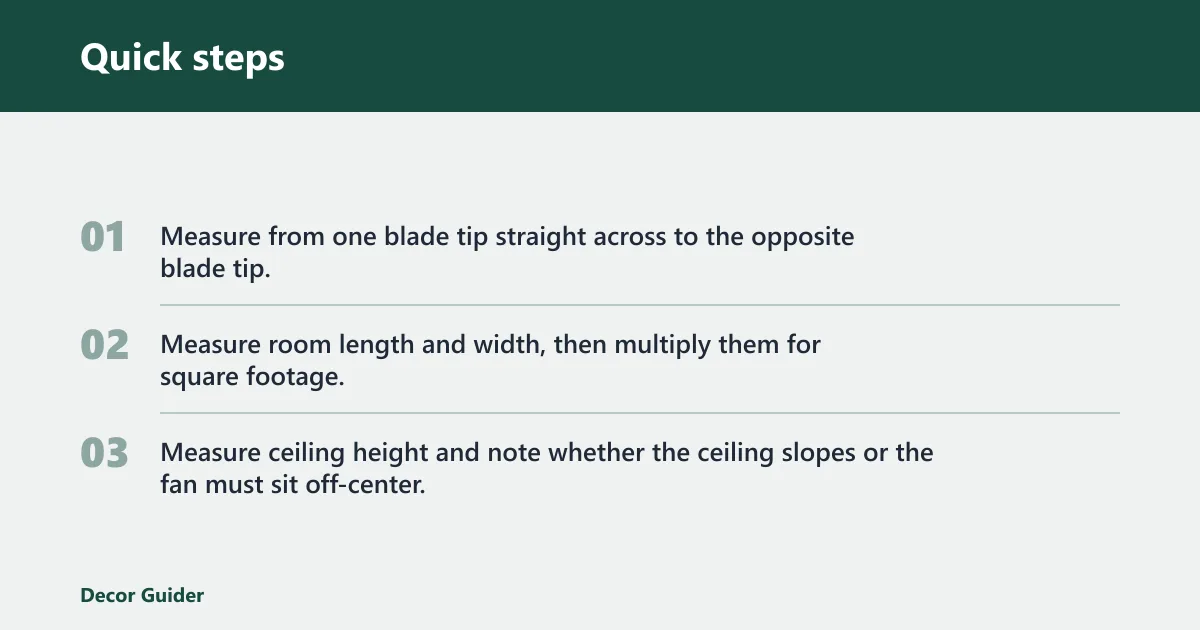
Measure the fan and the room
- Measure from one blade tip straight across to the opposite blade tip.
- Measure room length and width, then multiply them for square footage.
- Measure ceiling height and note whether the ceiling slopes or the fan must sit off-center.
If the blade shape makes tip-to-tip awkward to capture, measure from the center of the fan hub to one blade tip and multiply by 2. For fans with an even or odd blade count, the measuring method is the same: use the full sweep diameter, not the motor housing or light kit.
Say your existing fan measures 48 inches tip to tip and sits in a 14-foot by 12-foot ventilated room. That size lands in the middle range for many bedrooms and medium rooms, but the final call still depends on ceiling height, wall clearance, and what occupies the floor below the fan.
Suppose a room is 12 feet by 12 feet, but a bed and a closet door sit close to the mounting point. Room area alone can point one way, yet the furniture layout may push you toward a smaller fan or a different mounting spot.
What blade span means in practice
A blade span is the distance from one blade tip to the opposite blade tip. Do not measure the motor housing. If the fan has an odd number of blades, use the same tip-to-tip span; the blade count generally does not change the measuring method.
What size ceiling fan do I need?
Use the room as the starting point, then adjust for shape, furniture, and ceiling height. Small rooms up to about 75 square feet often work best with fans in the 29 to 36 inch range. Compact rooms around 75 to 144 square feet usually fit 36 to 42 inch fans. Mid-size rooms around 144 to 225 square feet often call for 44 to 50 inch fans. Larger rooms generally need 52 inches or more, and very large or open rooms may need two fans instead of one oversized unit.
Use the room-width decision table
| Room condition | Typical fan size | Notes |
|---|---|---|
| Narrow room or small bedroom up to 75 square feet | 29 to 36 inches | Good when the usable fan zone is tight or furniture sits close to the center |
| Compact room about 75 to 144 square feet | 36 to 42 inches | Works well when the room is not crowded by a bed, door swing, or tall storage |
| Mid-size room about 144 to 225 square feet | 44 to 50 inches | A common fit for many bedrooms, dens, and medium living spaces |
| Larger room over 225 square feet | 52 inches or more | Often better with more than one fan if the layout is wide, divided, or open |
Choose between two close sizes
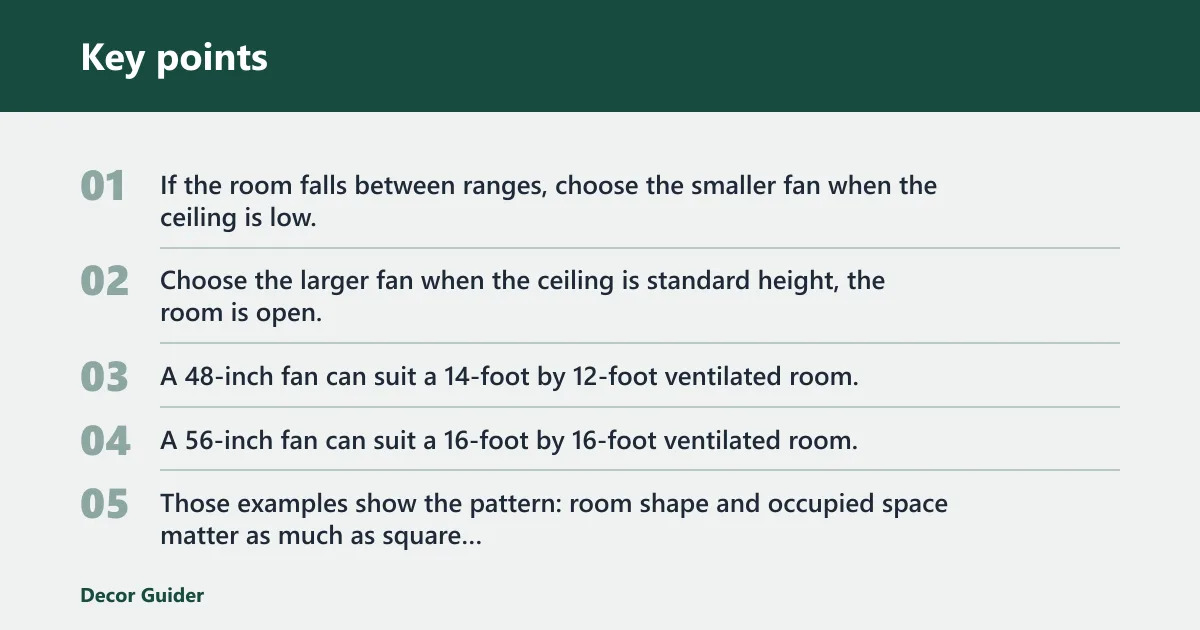
If the room falls between ranges, choose the smaller fan when the ceiling is low, the room is narrow, or furniture sits close to the center. Choose the larger fan when the ceiling is standard height, the room is open, and the blades have room to move without crowding walls or fixtures.
A 48-inch fan can suit a 14-foot by 12-foot ventilated room. A 56-inch fan can suit a 16-foot by 16-foot ventilated room. Those examples show the pattern: room shape and occupied space matter as much as square footage.
Adjust for room shape and furniture placement
Room square footage helps, but it does not tell the whole story. Long narrow rooms often need a fan sized to the narrow width, not the total area. L-shaped rooms may need two smaller fans or an offset fan location that covers the main occupied zone. If a bed, desk, or sofa sits under the planned fan path, treat that occupied area as off-limits when you choose span and location.
How much clearance should a ceiling fan have?
A ceiling fan needs space above, below, and around the blades. As a common installation baseline, many manufacturers recommend keeping blade tips at least 18 inches from walls and other fixed obstructions. The fan should also maintain safe floor clearance, especially in rooms with beds, tables, or people passing underneath.
Wall clearance
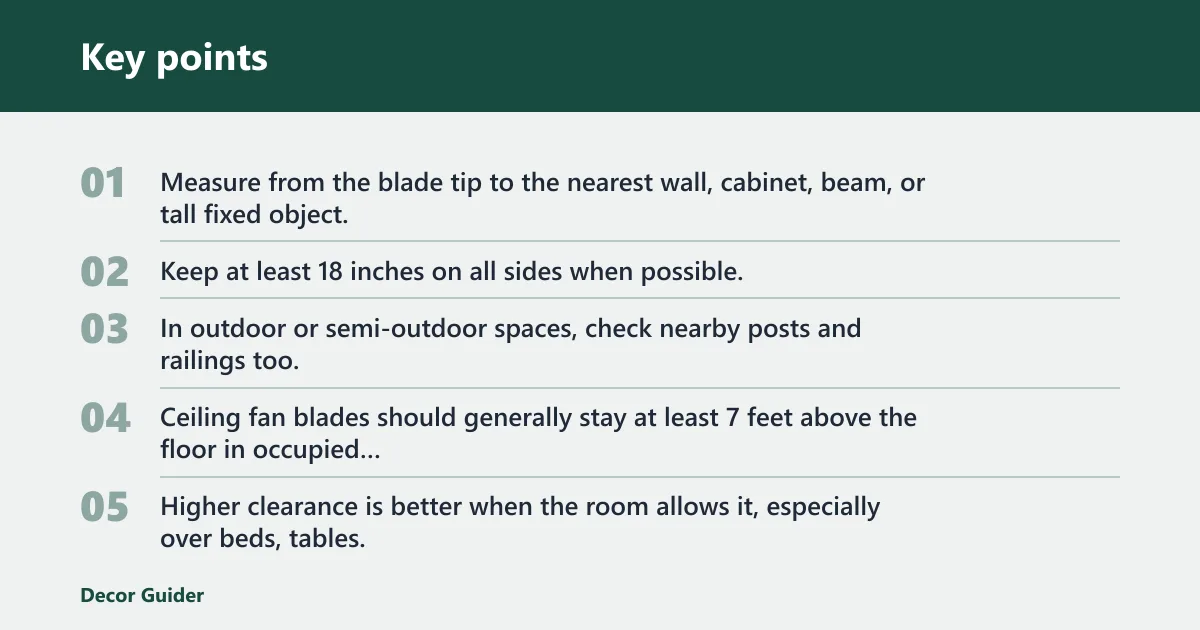
Measure from the blade tip to the nearest wall, cabinet, beam, or tall fixed object. Keep at least 18 inches on all sides when possible, and increase that gap if the room has doors, tall furniture, or an unusual layout. In outdoor or semi-outdoor spaces, check nearby posts and railings too, because breeze patterns do not stop blade contact.
Floor clearance
Ceiling fan blades should generally stay at least 7 feet above the floor in occupied spaces. Higher clearance is better when the room allows it, especially over beds, tables, or circulation paths. If your room is very low, choose a flush-mount or hugger fan rather than forcing a standard downrod installation into a tight height.
Bed, table, and doorway clearance
Check the swing of closet doors, bedroom doors, and cabinet doors before you commit to a location. A fan that clears the floor can still fail if a door hits the sweep path or if a bed headboard sits under a low blade arc. Recheck the full swing radius, not just the center point.
A common first-timer mistake is centering the fan on the room rather than on the usable floor area. In a narrow bedroom with a queen bed pushed to one side, an offset fan can avoid the bed while still serving the main walking path.
Does ceiling height change the fan size I should buy?
Yes. Ceiling height affects downrod length, blade-to-floor clearance, and whether a flush-mount or hugger fan makes more sense. Standard ceilings often accept a regular downrod, while low ceilings usually call for a shorter-profile fan so the blades stay within safe height limits.
Use ceiling height to choose the mount
A downrod lowers the fan from the ceiling and helps place the blades in the right air zone on taller ceilings. For low ceilings, a flush-mount or hugger fan keeps the profile shorter. For taller ceilings, use the manufacturer’s recommended downrod length and check that the finished blade height still clears the floor and stays within the fan’s installation instructions.
Know the tradeoff of a flush-mount fan
Flush-mount and hugger fans work well where headroom is tight. The tradeoff is that they may move air less efficiently than a fan that hangs lower in open space. If the room has enough height, a standard mount with the right downrod often gives better balance and clearance.
Check sloped ceilings and off-center joists
Sloped ceilings can change both the visual center and the safe mounting position. If a joist sits off-center, the fan may need to shift away from the room center to mount securely. Check the fan’s slope-kit compatibility and installation limit before you buy, because slope allowances vary by model. Measure the finished clearance after you account for slope, not before.
Ceiling fan sizing checklist
Use this checklist before you buy or reinstall. It keeps the decision tied to actual measurements instead of a guess based on room label alone.
3-step measuring workflow
- Measure the existing fan blade span tip to tip, or measure the room width and length if you are buying new.
- Measure ceiling height, then note whether the fan needs a flush mount, a hugger profile, or a downrod.
- Check every clearance point: walls, floor, beds, tables, doors, and any sloped-ceiling edge.
Ceiling fan decision table
| Room size input | Suggested fan span | What to verify next |
|---|---|---|
| Up to 75 square feet | 29 to 36 inches | Wall clearance and ceiling height |
| About 75 to 144 square feet | 36 to 42 inches | Door swing and furniture radius |
| About 144 to 225 square feet | 44 to 50 inches | Mounting height and blade-to-floor clearance |
| Over 225 square feet | 52 inches or more | Whether one fan covers the whole area |
Clearance red flags for low ceilings and sloped ceilings
- Blade tips sit within 18 inches of a wall.
- The fan hangs low enough to violate the 7 ft minimum from floor to blade.
- A bed, table, or doorway sits inside the sweep path.
- A sloped ceiling forces the fan lower on one side than planned.
- An off-center joist pushes the fan away from the room center without a revised layout check.
Common mistakes
Most sizing errors come from skipping one measurement. Square footage alone is not enough, and neither is blade span alone. You need the room width, the ceiling height, and the clearance around the fan before the size decision is reliable.
- Do not size from motor housing; measure blade span tip to tip.
- Do not ignore ceiling height; a fan that fits the room may still hang too low.
- Do not center the fan without checking beds, doors, and walkways.
- Do not choose one large fan for an irregular room when two smaller fans would cover the space better.
- Do not skip the slope check if the ceiling is not flat.
In an open-plan room, one large fan may leave the far side under-served if the seating area sits far from the mount. In that case, two fans or a shifted placement can make more sense than a single oversized unit.
Frequently asked questions
How do you measure a ceiling fan to see what size it?
Measure from one blade tip straight across to the opposite blade tip. That tip-to-tip number is the blade span. Do not include the motor housing or light kit. If the fan has a wall control or remote, that does not change the size measurement.
How do you measure how big a ceiling fan?
Use a tape measure across the blade circle, tip to tip. Write down the number in inches, then compare it with the room size range. If you are replacing a fan, also measure how far the blades sit from the nearest wall and from the floor.
What is the blade span on a ceiling fan?
Blade span is the diameter of the fan measured tip to tip across the blades. It is the main size metric used for ceiling fans. The number tells you how much room the fan needs and how much coverage it may provide, which is why it matters more than the motor size.
Products related to this article
Sponsored / affiliate links. As an Amazon Associate I earn from qualifying purchases. I may earn additional commission from eligible campaigns.