Ceiling Fan Size for Outdoor Patio Chart
Use a 52-inch outdoor ceiling fan for many covered patios under about 200 square feet; roughly 56 to 60 inches can suit spaces around 200 to 400 square feet, and larger covered spaces may need two fans. The wrong size leaves corners still, creates wobble, and wastes money on a fan that never moves enough air. This guide pairs patio square footage with exposure, ceiling height, and whether one fan or two is the better buy.
Match blade span to your patio’s square footage
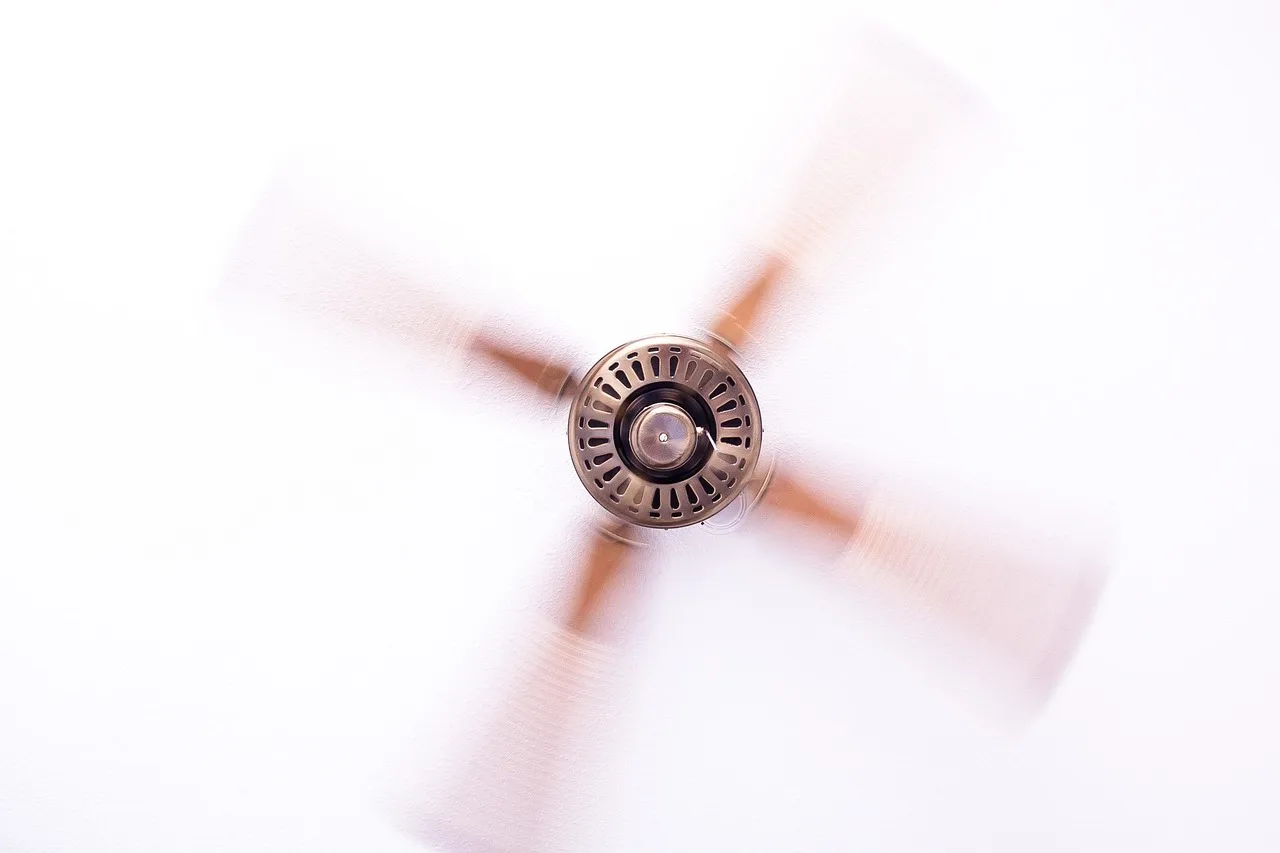

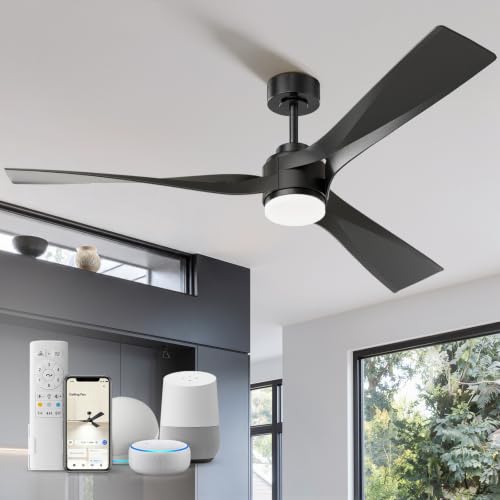

Start with square footage, then adjust for exposure and ceiling height. For most patios, blade span should match the area, with 52-inch fans common for smaller covered spaces and 56- to 60-inch fans better for larger decks and outdoor kitchens. If the space is long, open-sided, or breezy, two fans may work better than one oversized unit.
Start with square footage
Patio square footage is the first filter because airflow drops fast when a fan is too small for the area. A compact 80-square-foot porch does not need the same span as a 300-square-foot outdoor kitchen. Most patios use a 52-inch to 56-inch outdoor ceiling fan, and larger spaces often move up from there.
Use blade span to match airflow to the space, not the décor
Blade span is a sizing tool, not a style choice. A 52-inch fan can fit many covered patios, while 56-inch and 60-inch fans suit larger footprints. For very large covered outdoor kitchens and pavilions, 60- to 72-inch fans may fit better than one mid-size fan placed in the center.
When to size up because the patio is open-sided or breezy
Open sides change the airflow pattern. Wind can pull conditioned air away before it settles across the seating area, so a patio that feels “medium” on paper may need a larger span or two smaller fans. Say a roughly 220-square-foot patio is long and narrow, with one open side facing a yard: two 52-inch fans may cover the length more evenly than one oversized fan in the middle.
Patio fan size chart
This chart gives a practical starting point for outdoor patios, porches, decks, and pavilions. Use the square footage first, then check exposure, ceiling height, and whether the layout is long enough to favor two fans over one.
| Patio type | Square footage | Exposure | Recommended blade span | One fan or two? | Note |
|---|---|---|---|---|---|
| Compact covered porch | Under 100 sq ft | Covered or screened | 52 inch or smaller, depending on the listing | One fan | Keep clearance in mind if the ceiling is low; screened porches still need a damp- or wet-rated listing based on exposure. |
| Covered patio | 100 to 200 sq ft | Covered and protected from direct rain | 52 inch | One fan | This is the most common patio range for a single fan. Most covered patios in this band pair well with damp-rated models. |
| Covered deck | 200 to 400 sq ft | Covered, open-sided, or breezy | 56 to 60 inch | One fan for compact layouts; two fans for long rectangles | Long rooms and open edges often need two fans instead of one larger unit placed in the center. |
| Large outdoor kitchen or pavilion | 400+ sq ft | Covered or partially open | 60 to 72 inch | Often two fans | Large spaces may need two fans for even circulation, especially when seating and cooking zones are separated. |
For a screened patio, use the same square-footage logic, but treat screening as a barrier that blocks direct debris while still allowing humidity and outdoor air. That means the fan still needs the correct outdoor listing. Screening does not make an indoor fan safe for the space.
Damp-rated vs wet-rated fans
Outdoor fans need an outdoor listing. Covered patios and porches can use a damp-rated fan, while uncovered installations call for a wet-rated listing in the product label and local code language. A covered patio can also use a wet-rated fan if the model fits the space; the key is matching the listing to the exposure.
What a UL Damp-rated ceiling fan
A UL Damp-rated ceiling fan is made for covered patios and porches that handle humidity and condensation but do not take direct water exposure. These models are usually less expensive than wet-rated fans, which makes them a practical choice for a covered patio, screened porch, or protected deck.
What a UL Wet-rated ceiling fan
A UL Wet-rated ceiling fan is built for direct rain exposure. Product listings for these fans typically include a sealed motor and stainless-steel hardware. Use this listing for uncovered outdoor installations or any spot where rain can reach the fan.
Why a covered patio can still use either listing, depending on the model and exposure
A covered patio does not force one answer. If the fan stays fully protected from rain, a damp-rated model is usually enough. If the patio is exposed to splash, wind-driven rain, or a harsher outdoor setting, a wet-rated fan may make more sense. Check the manufacturer’s listing for your model and follow local code language.
How ceiling height changes the answer
Ceiling height affects both safety and airflow. Fan blades should be about 7 feet or higher above the floor or deck, and you should follow the manufacturer’s mounting instructions for your model. A low overhang can rule out a larger blade span, while a higher ceiling may need a downrod to place the fan at the right height.
The 7-foot minimum blade-clearance rule
Keep the lowest point of the blades at least 7 feet above the floor or deck. That minimum matters on patios with low beams, sloped roofs, or shallow overhangs. If the fan cannot meet that clearance, choose a different mounting location, a shorter fan, or a different ceiling height plan.
Why low ceilings can rule out larger blade spans
Larger fans often sit lower once the motor housing and blade drop are factored in. That can be a problem on a low porch ceiling where the fan must stay above the 7-foot clearance line. In that case, a smaller fan with the right blade drop may be a better fit than a larger model with poor clearance.
When a downrod changes the install plan
A downrod can help place the fan in the airflow zone on a taller patio ceiling, but it also changes the finished height. Check the manufacturer’s mounting instructions before you buy, because the right downrod length varies by model. A tall pavilion may need it; a low covered porch may not.
Do you need one fan or two?
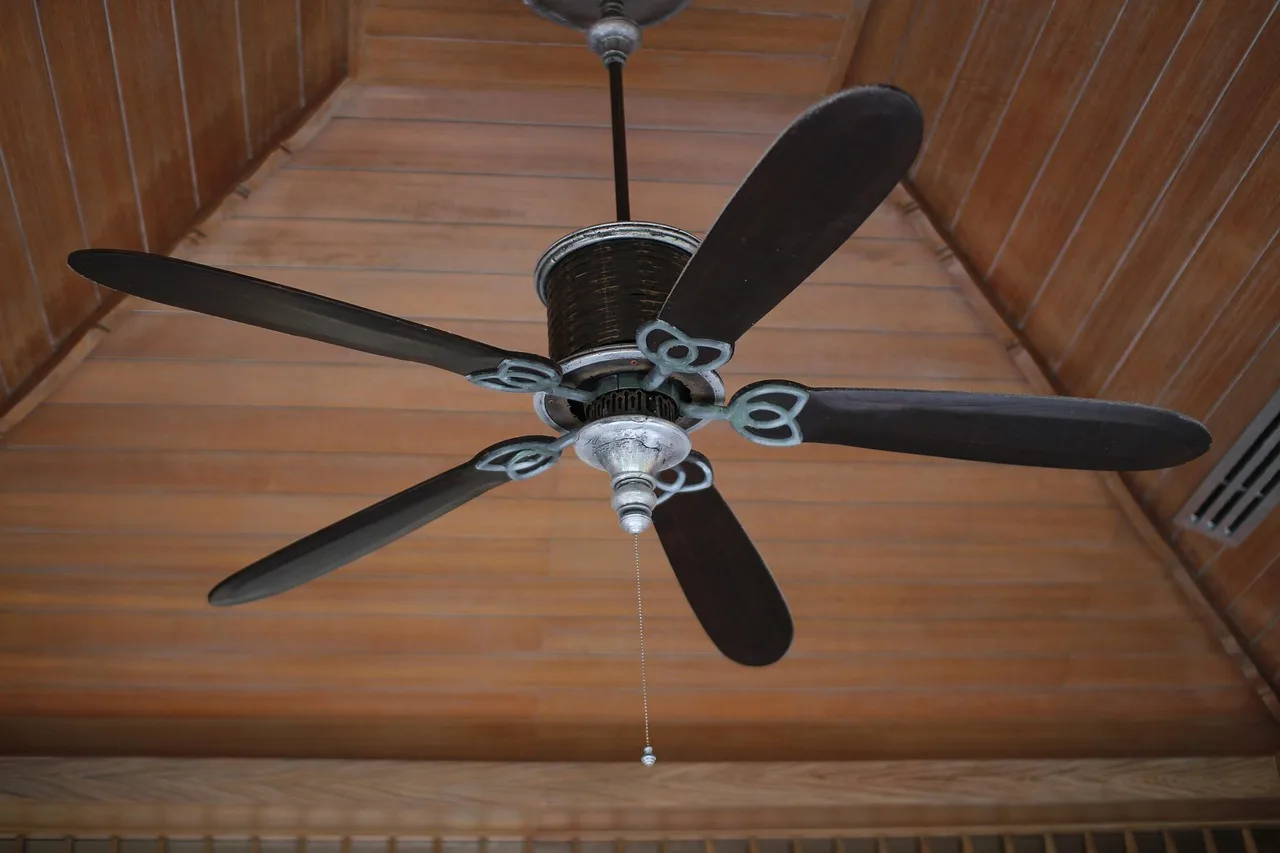
One fan works well for many covered patios, but long rectangles, split seating zones, and large pavilions often do better with two fans. The choice is about coverage, not symmetry. If one fan leaves dead spots at the ends of the patio, two smaller fans usually move air more evenly.
Long rectangular patios and split airflow zones
Long patios often have one seating area near the house and another near the outer edge. A single fan in the middle may cool the center but leave the ends stale. Two fans spaced along the length of the patio usually give better coverage than one oversized unit trying to do all the work.
Wide covered decks and pavilions
Wide spaces can also need two fans, especially when the ceiling area is broken up by beams or changes in roof depth. Large covered decks often need 60-inch or larger fans, and some large spaces may need two fans to move air across the full footprint. That matters most when the seating area sits far from the fan’s center point.
When one larger fan is still the better choice
A single larger fan can be the better buy when the patio is square, the ceiling height is adequate, and the seating area sits near the center. In a compact covered outdoor kitchen, for example, one 56-inch or 60-inch fan may cover the cook zone and table without the cost of a second unit. That avoids extra wiring and extra mounting hardware.
- Measure the usable patio area, not the whole slab or roof footprint.
- Check exposure: covered and protected, or uncovered and directly exposed to rain.
- Confirm the blade clearance will stay at least 7 feet above the floor or deck.
- Match the square footage to blade span using the chart above.
- Decide whether the layout needs one fan or two based on length, width, and open sides.
- Check the listing for damp or wet rating, then verify the mounting details in the manufacturer’s instructions.
Exposure, finish, and blade material
Exposure changes what fails first. Salt air can corrode hardware, strong sun can fade blades, and humidity can stress finishes over time. For that reason, outdoor fans often need more than the right size; they also need the right coating, hardware, and blade material for the setting.
Coastal-rated finishes and stainless hardware
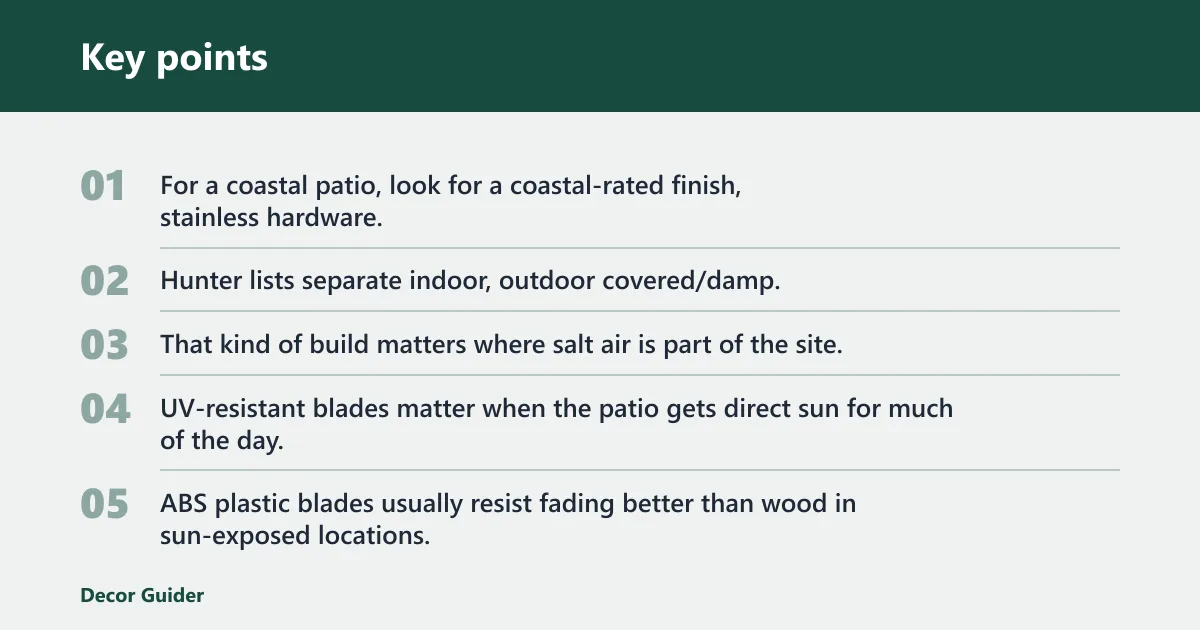
For a coastal patio, look for a coastal-rated finish, stainless hardware, or a special corrosion-resistant coating. Hunter lists separate indoor, outdoor covered/damp, and outdoor coastal WeatherMax categories, and Hunter WeatherMax fans are described as wet-rated and corrosion resistant. That kind of build matters where salt air is part of the site.
UV-resistant blades for sun-heavy locations
UV-resistant blades matter when the patio gets direct sun for much of the day. ABS plastic blades usually resist fading better than wood in sun-exposed locations, while wood can be more sensitive to finish changes over time. If the fan sits near an open edge, choose blades meant for outdoor sun.
Screened porches, humidity, and condensation
Screening cuts debris and direct rain, but it does not remove humidity. On a screened porch, a damp-rated fan is often the practical starting point, though a wet-rated model is also acceptable when the listing fits the space. The main job is to keep moisture and airflow needs aligned with the product label.
Nearby costs can change the final buy. Wet-rated models often cost more than damp-rated ones, and coastal hardware can add another premium. If the ceiling is tall, a downrod may be needed too, so compare the fan price with the mounting parts before you decide.
Suppose you are choosing between a damp-rated 52-inch fan and a wet-rated 52-inch fan for a covered porch. The damp-rated model usually costs less and fits protected spaces well. If that porch gets wind-driven rain, the wet-rated model may be the safer match for the exposure.
Frequently asked questions
What size ceiling fan do I need for an outdoor patio?
Most covered patios use a 52-inch to 56-inch outdoor ceiling fan. For 100 to 200 square feet, 52 inches is a common match. Larger patios often need two fans rather than one oversized unit.
What size ceiling fan for outdoor porch?
For a covered porch, start with 52 inches unless the porch is very small or unusually long. A porch under 100 square feet may need a smaller span, while a porch that stretches across a wide front elevation may need a larger fan or two fans to avoid dead spots.
How do I choose an outdoor ceiling fan for a covered patio?
Choose by square footage first, then check whether the space is covered, screened, or open to rain. A covered patio usually fits a damp-rated fan. Then confirm the ceiling height, blade clearance, and whether one fan can cover the layout without leaving stagnant corners.
Do I need a damp-rated or wet-rated ceiling fan outside?
Covered patios and porches can use a damp-rated fan, while uncovered installations call for a wet-rated listing in the product label and local code language. If the fan may see direct rain, splash, or heavy exposure, choose the wetter-rated option that matches the product listing.
What size fan works for a 200 sq ft patio?
A 200-square-foot patio usually sits right on the edge between 52 inches and 56 inches. If the patio is compact and well covered, 52 inches is often enough. If it is open-sided, breezy, or stretched into a rectangle, 56 inches may move air more evenly.
Can I use an indoor ceiling fan on a patio?
No, not in the usual outdoor sense. Indoor fans are not built for humidity, condensation, or direct weather exposure. Use a damp-rated or wet-rated model that matches the patio’s exposure, and confirm the listing before you buy or install the fan.
How many blades should an outdoor patio fan have?
Blade count matters less than blade span and motor performance. Many outdoor fans have 3 to 5 blades, but the better question is whether the fan is sized correctly for the patio. A well-sized 52-inch or 56-inch fan usually matters more than the blade count on the box.
What ceiling fan size is best for a large covered deck?
Large covered decks often need 56 to 60 inches, and some spaces need 60 inches or larger. If the deck is 400 square feet or more, two fans may work better than one. Long layouts and open sides make that choice even more useful.
Products related to this article
Sponsored / affiliate links. As an Amazon Associate I earn from qualifying purchases. I may earn additional commission from eligible campaigns.
 CONGARTENO Heat-Resistant Square Ceiling Light Shade Soft Diffuser Covers for Ceiling Lights Filters DIY Lampshade Fabric Lamp Shade Modern Diffuser
 94" L x 5.375" W Indoor/Outdoor Wood Shiplap Paneling – Decorative Wall & Ceiling Slat Panels | Barn Accent Boards, Primed & Painted, Easy DIY Installation (Set of 6)