Best Under Cabinet Lights for Dark Kitchens (2026): We Compared
For dark kitchens, pick plug-in LED bars for fast, bright coverage, hardwired strips for long cabinet runs, and battery puck lights only for short, low-use spots; target 300 to 500 lumens per linear foot. Mismatched lights leave prep areas dim, throw shadows, or create wiring issues that waste time and money. This guide compares fixture types by darkness level, counter length, brightness, and installation access.
Quick comparison
| Product | Badge | Best for | Price | ||
|---|---|---|---|---|---|
 |
Amazon Basics LED Motion Sensor Light BarAmazon Basics | Our pick | 12 inch · motion sensor · USB/battery | $19.13
Price as of 6 Nov 2026
|
View |
 |
Enbrighten 24 Inch Plug in Under Cabinet Light with 5 ColorEnbrighten | Also great | 24 inch · plug-in · selectable color temps | $39.98
Price as of 6 Nov 2026
|
View |
 |
36 Inch Under Cabinet LightingAKIHE | Upgrade pick | 36 inch · linkable · plug-in/hardwired | $73.98
Price as of 6 Nov 2026
|
View |
 |
16 Inch Under Cabinet LightsSUNLINKCO | Also great | 16 inch · rechargeable · motion sensor | $29.99
Price as of 6 Nov 2026
|
View |
 |
LAIFUNI Dimmable Under Cabinet LightingLAIFUNI | Pair with it | 36 inch · remote control · color changing | $46.89
Price as of 6 Nov 2026
|
View |
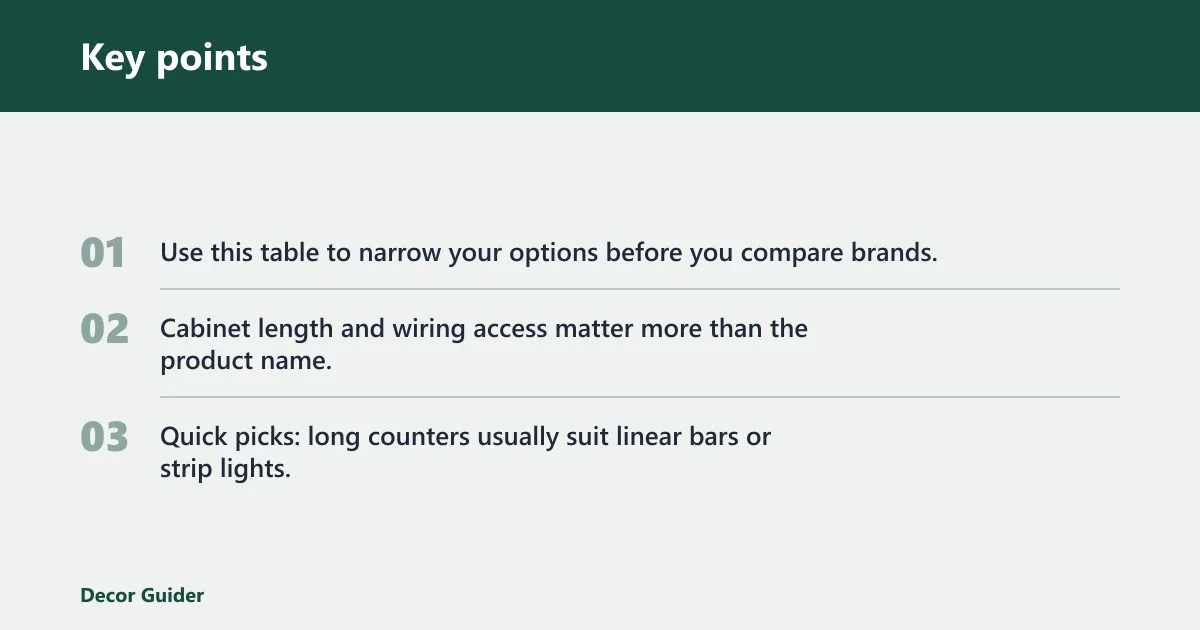
Use this table to narrow your options before you compare brands. Cabinet length and wiring access matter more than the product name.
Quick picks: long counters usually suit linear bars or strip lights; sink zones do well with focused light and motion sensing; rental kitchens usually need battery or plug-in options; no-outlet kitchens need rechargeable or battery units; heavy-cooking kitchens usually need brighter, dimmable bars with broader coverage.
How we chose
Selection starts with coverage pattern, not marketing language. A kitchen with a dark run of cabinets needs continuous light more than isolated bright spots.
We compared brightness, color temperature options, install method, and whether the fixture suits a long run, a tight task zone, or a renter-friendly setup. We also weighed common failure points: glare, hotspotting, weak end-to-end coverage, battery fatigue, and dimmer mismatch.
Where products offered real flexibility, such as motion sensing, remote control, or linkable bars, that counted too. Those features matter more in dark kitchens than decorative features do.
Under cabinet lights decision table
| Kitchen scenario | Best fixture type | Recommended brightness range | Ideal color temperature | Install difficulty | Common failure mode |
|---|---|---|---|---|---|
| Long counters | Linear LED lights or LED strip lights | 300 to 500 lumens per linear foot | 3000K to 4000K for task balance | Moderate to high, depending on wiring | Hotspots or dark gaps when coverage is broken up |
| Sink zones | Puck lights with motion sensor or a focused bar | 250 to 400 lumens per zone | 2700K to 3000K for softer night use | Low to moderate | Glare on stainless or glossy surfaces |
| Rental kitchens | Battery puck lights or plug-in bars | 200 to 400 lumens per short section | 3000K to 4000K | Low | Adhesive failure or awkward wire routing |
| No-outlet kitchens | Rechargeable puck lights or battery bars | 200 to 350 lumens per unit | 3000K to 5000K, depending on task use | Low | Battery fatigue and frequent recharging |
| Heavy-cooking kitchens | Linkable linear LED lights | 400 to 500+ lumens per linear foot | 3500K to 5000K for crisp task light | Moderate to high | Dimmer incompatibility or too much glare on glossy counters |
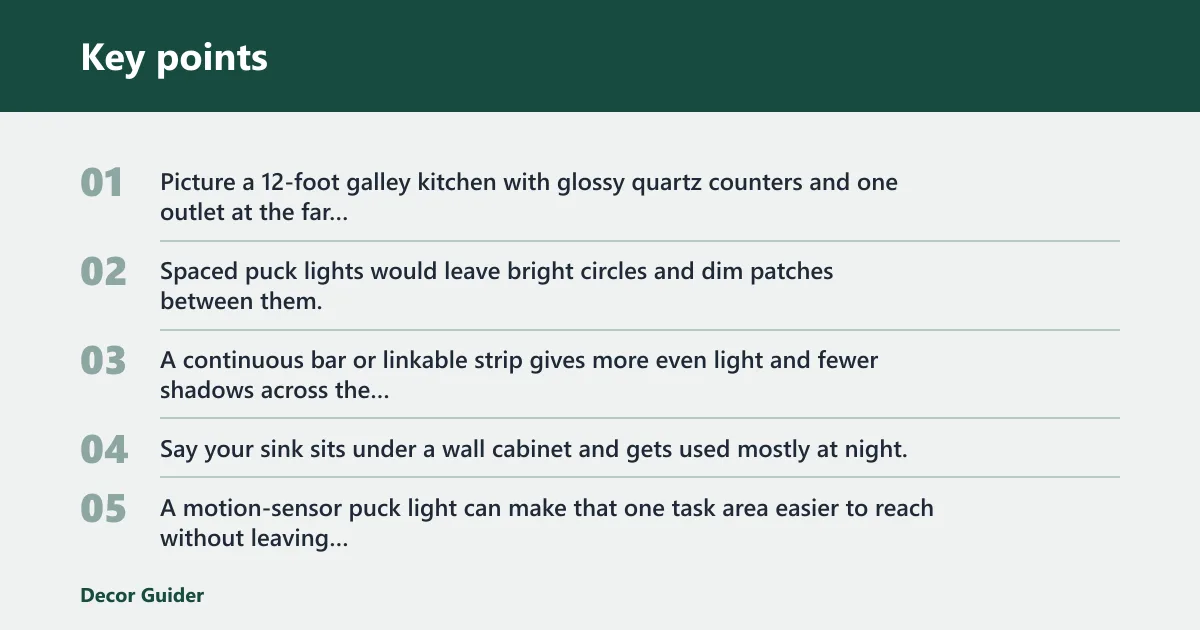
Picture a 12-foot galley kitchen with glossy quartz counters and one outlet at the far end. Spaced puck lights would leave bright circles and dim patches between them. A continuous bar or linkable strip gives more even light and fewer shadows across the whole prep run.
Say your sink sits under a wall cabinet and gets used mostly at night. A motion-sensor puck light can make that one task area easier to reach without leaving lights on all evening, but the same setup would be weak for a 10-foot prep counter.
Best under cabinet lights for dark kitchens
For most dark kitchens, a plug-in or hardwired linear LED bar with dimming works best. It gives the most even coverage, cuts shadow lines across prep space, and handles long cabinet runs better than spaced puck lights.
Quick picks
| Pick | Best for | Key spec | Price | Install style |
|---|---|---|---|---|
| Enbrighten 24 Inch Plug in Under Cabinet Light | Most kitchens needing bright, adjustable coverage | 1561 lumens, 5 color temperatures, linkable | $39.98 | Plug-in |
| AKIHE 36 Inch Under Cabinet Lighting | Long counters and anti-glare coverage | 1760LM, 3 color temperatures, plug-in or hardwired | $73.98 | Plug-in or hardwired |
| Amazon Basics LED Motion Sensor Light Bar | Small zones, closets, quick kitchen fixes | 250 lumens, motion sensor, USB/battery | $19.13 | USB or battery |
| SUNLINKCO 16 Inch Under Cabinet Lights | No-outlet spots and rechargeable use | 6500K, stepless dimming, motion sensor | $29.99 | Rechargeable magnetic |
| LAIFUNI Dimmable Under Cabinet Lighting | Remote-controlled comfort and lighting presets | 36 inch, color changing, remote control | $46.89 | Plug-in style bar |
Enbrighten 24 Inch Plug in Under Cabinet Light: best for bright, linkable coverage
This suits homeowners who want a bright, low-fuss bar with enough output for most dark kitchens. Based on the published specs, it gives 1561 lumens, five color temperatures, dimming, and linkable setup, which makes it a practical choice for a counter run that needs consistency.
The main advantage is flexibility. You can tune the color temperature, link multiple bars, and avoid the uneven look that happens when a kitchen relies on separate small lights.
One drawback: a 24-inch bar may not cover a long run by itself, so larger kitchens may need more than one unit. It also fits planned installation better than a temporary fix.
AKIHE 36 Inch Under Cabinet Lighting: best for long counters with anti-glare coverage
This targets larger kitchens that need one longer light source instead of several short ones. The published details list 1760LM, 3000K/3500K/4000K color options, linkable units, and plug-in or hardwired installation, which fits the needs of a dark kitchen with a broad work area.
It stands out for its size and indirect, anti-glare design. That matters on glossy counters, where direct glare can be more distracting than low light.
The drawback is install complexity. At 36 inches, it is less discreet than smaller fixtures, and the best results depend on correct placement and enough room for the full bar.
Amazon Basics LED Motion Sensor Light Bar: best for small zones and quick installs
This works best for a short prep stretch, pantry edge, or sink-side zone where automatic light matters more than full-room brightness. The listed specs include 250 lumens, motion sensor ON/OFF/AUTO modes, and USB or battery power, which makes it easy to place where wiring is limited.
The swivel head helps direct light onto the work surface rather than straight down the cabinet face. That is useful in cramped spots where aim matters.
The tradeoff is output and coverage. A 12-inch bar at 250 lumens is not the right answer for a long dark counter, and battery use can become annoying if the light is left on often.
SUNLINKCO 16 Inch Under Cabinet Lights: best for no-outlet kitchens
This is the better fit when you need light without new wiring and want a rechargeable option instead of disposable batteries. The published details include motion sensor control, always-on and auto modes, stepless dimming from 10% to 100%, and magnetic mounting.
The rechargeable design helps in kitchens where an outlet is missing or awkwardly placed. The motion-sensor mode is also convenient for night use, when you want light fast without flipping a wall switch.
The drawback is ownership upkeep. Rechargeable lights still need charging, and that can become a hassle if the kitchen sees frequent use. A cool 6500K setting may also feel too stark for some homes.
LAIFUNI Dimmable Under Cabinet Lighting: best for remote control convenience
This bar fits users who want remote control without reaching for a wall switch every time. The published product details describe a 36-inch light bar with brightness control, color changing, dynamic modes, and memory function, which can help in kitchens that need different lighting moods across the day.
The remote adds practical control for brightness adjustment and preset use. That is especially handy when the fixture is mounted in a place that is hard to reach.
The drawback is that remote-controlled lights are only useful if the remote stays available and batteries stay fresh. The light also depends on a style of setup that may be more feature-heavy than some kitchens need.
LED strip lights: best for long, even runs
LED strip lights are the right choice when you want continuous illumination across a cabinet run. They are flexible, adhesive-backed, and can be cut to fit specific cabinet lengths, which makes them useful for kitchens with uneven spans or corners. They also come in warm, neutral, or cool color temperatures and can last up to 30,000 hours.
When strip lights work best
Strip lights work well on long counters, especially when the main goal is even light from end to end. They reduce the broken-up look that comes from placing several small fixtures too far apart.
They are also useful where cabinet bottoms are narrow and you want a low-profile fixture that stays out of sight. That matters in kitchens where the light should disappear when off.
Where strip lights fall short
The weakness of strip lights is not usually brightness alone. The bigger risk is placement: a poorly mounted strip can create visible bright lines or dead spots, especially if the cabinet surface is uneven or the adhesive fails.
They also depend on the right power setup. A long strip without enough access to wiring or a solid power source can become more trouble than it is worth.
Puck lights: best for focused task zones
Puck lights suit small, defined work areas where you want a concentrated pool of light. They are compact, hockey-puck shaped, and can be battery-operated or hardwired. Some versions also use motion sensors for automatic activation, which helps in sink zones and short-use spaces.
Surface-mounted versus recessed puck lights
Puck lights can be surface-mounted or recessed into cabinet bottoms. Surface mounting is simpler and more common for renters or quick projects. Recessed installation looks cleaner, but it asks for more work and a suitable cabinet base.
The main drawback of puck lights is coverage pattern. On a long counter, spaced pucks can create hotspots and dark gaps between them.
Battery and motion-sensor options
Battery puck lights are useful where there is no outlet or where you do not want wiring. Motion sensors make them more convenient for night use and can reduce wasted energy in low-traffic spots.
That convenience comes with a tradeoff. Batteries wear down, and motion sensors can feel either too sensitive or not sensitive enough depending on placement.
Linear LED lights: best for low-profile coverage
Linear LED lights create a continuous line of light with reduced shadows, which makes them strong performers for dark kitchens. They are sleek, low-profile, and often linkable, so you can extend coverage across larger runs without breaking the light pattern.
Linkable bars for larger kitchens
Linkable units are the main reason to choose a linear bar over separate puck lights. They let you cover more counter space while keeping the look and output more uniform.
That matters in cooking-heavy kitchens, where every break in light becomes a shadow on food prep, cutting boards, or appliance controls.
Dimming and glare control
Dimmable variants help because dark kitchens often need full brightness for prep and softer output later at night. Dimming improves flexibility, but the light still needs to be even; a bright fixture with poor spread can be harder on the eyes than a slightly dimmer one with better uniformity.
Glare control matters too, especially on polished stone or glass backsplashes. Indirect or diffused bars are usually better there than bare-point puck lights.
How bright should under cabinet lights be?
For dark kitchens, plan for 300 to 500 lumens per linear foot as a practical target. That range gives enough task light for prep areas without forcing you to rely on a single overly bright spot. In long runs, uniformity matters as much as peak brightness.
Lumens for dark kitchens
Brightness is measured in lumens. A kitchen with deep cabinets, dark counters, or limited ceiling light usually needs the higher end of the range, especially at the sink and main prep zone.
Short zones can work with less, but long counters need enough light to stay even from end to end. A bright center with dim ends is still a poor result.
Why uniformity matters
Uniform light helps you see texture, knife edges, and spills more clearly than a cluster of bright spots does. That is why strip and bar lights usually outperform scattered pucks on long counters.
A common first-timer mistake is choosing a very bright small fixture for a wide run. It looks powerful on paper and still leaves the outer work area too dark.
How to choose color temperature and power source
Color temperature is measured in Kelvin. For cabinet lighting, warm light usually falls around 2700K-3000K, while cool light usually runs around 5000K-6500K. Warm light feels softer; cool light gives a crisper task view.
Warm vs cool light in kitchens
Warm light usually works better when the kitchen doubles as an evening gathering space or when you want a gentler look near a sink. Cool light can help in heavy-prep kitchens where visibility matters more than atmosphere.
The tradeoff is simple: warmer light is easier on the eyes at night, while cooler light usually makes food prep details stand out more clearly.
Adhesive, screw, plug-in, or hardwired
Adhesive mounting is the fastest route and fits renters or light-duty installs, but it depends on clean surfaces and decent adhesive quality. Screw mounting is steadier for permanent fixtures.
Plug-in lights are often the easiest permanent-style option when there is an outlet nearby. Hardwired setups are best when you want a clean look and reliable power, especially over long cabinet runs. Wall-dimmer compatibility should be checked before you buy, since not every LED bar works with every dimmer.
Motion sensor lighting and remote control
Motion sensor lighting is useful for automatic activation, night use, and some energy savings. It shows up often in battery-powered options, where turning the light on and off manually would be less convenient.
Remote control adds on/off control, brightness adjustment, and timer settings. That is especially useful in renter-friendly kits and in kitchens where the light bar is hard to reach after installation.
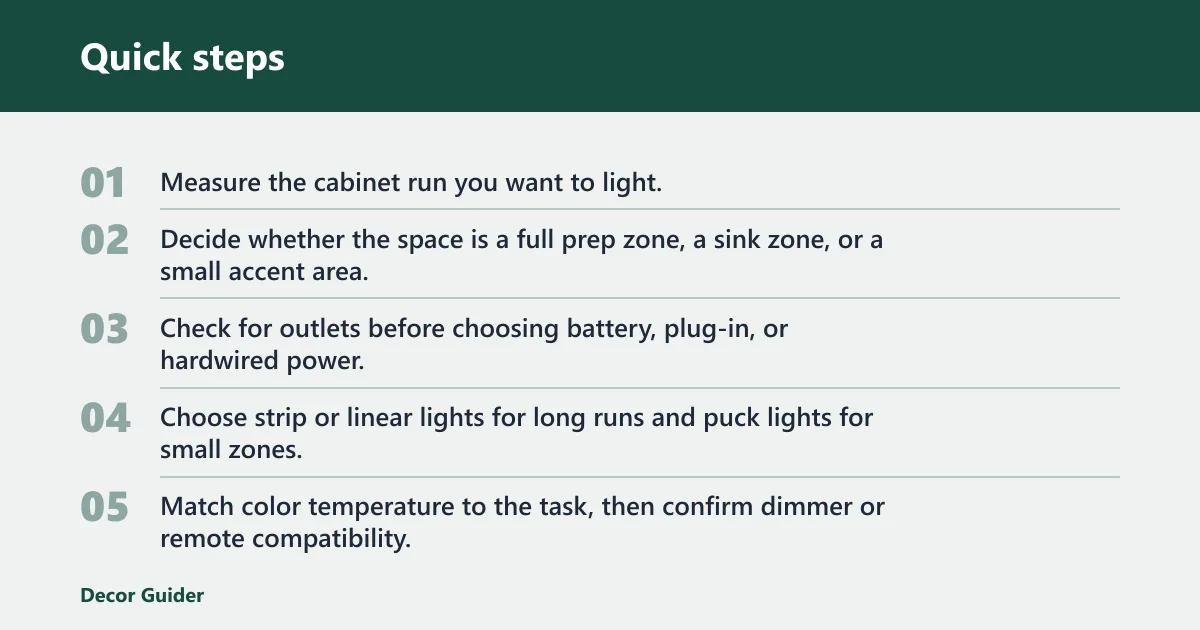
- Measure the cabinet run you want to light.
- Decide whether the space is a full prep zone, a sink zone, or a small accent area.
- Check for outlets before choosing battery, plug-in, or hardwired power.
- Choose strip or linear lights for long runs and puck lights for small zones.
- Match color temperature to the task, then confirm dimmer or remote compatibility.
Suppose a 9-foot counter sits under upper cabinets with one outlet hidden behind the toaster. A plug-in bar can handle the long run if the cord path is workable; if not, a battery or rechargeable option may be easier, but it will usually need more upkeep.
Which one should you buy?
If you want a strong fix for a dark kitchen, start with a dimmable linear bar that can cover the longest practical stretch of counter. If the run is very long, choose a linkable model instead of breaking it into scattered lights.
If you are on a tighter budget or need something for a rental, a battery puck light or USB-powered bar is the easiest install. Just keep the light to short zones, because coverage and battery life are the first things to suffer.
If your kitchen has a nearby outlet and you want the least fuss over time, plug-in is usually the best middle ground. If you are remodeling or want the cleanest finish, hardwired makes more sense, but only if the install effort is justified by the layout.
One more rule helps. If you cook often, prioritize uniformity and dimming before decorative extras. If you only need light for the sink or a narrow prep nook, a compact motion-sensor puck can be enough.
Frequently asked questions
What are the best under cabinet lights for a dark kitchen?
The best choice is usually a dimmable linear LED bar or a linkable strip light. Those styles give the most even coverage across a long counter and reduce the shadows that make dark kitchens harder to work in. Puck lights are better only when the job area is small.
How many lumens do I need for under cabinet lighting?
A practical target for dark kitchens is 300 to 500 lumens per linear foot. Short zones can work with less, but long counters need enough output to stay even across the full run. A brighter center alone will not solve poor coverage at the ends.
What color temperature is best for kitchen under cabinet lights?
Kitchen under cabinet lights are measured in Kelvin. Many kitchens do well in the middle range if the fixture is dimmable.
Are battery-operated under cabinet lights good for kitchens?
They are good for short zones, rentals, and places with no outlet. They are less suited to long prep counters or heavy daily use because batteries need replacing or recharging. Motion sensor models help with convenience, but they do not solve weak coverage.
Should I choose puck lights or strip lights under cabinets?
Choose strip lights for long runs and puck lights for small, focused zones. Strip lights give more even coverage and fewer shadows, while puck lights are easier to place in tight spots. On long counters, spaced pucks often create hotspots and dark gaps.
Do I need hardwired or plug-in under cabinet lights?
Use plug-in lights if you want an easier install and have an outlet nearby. Use hardwired lights if you want a cleaner look and a more permanent setup. For renters or no-outlet kitchens, battery or rechargeable options are usually the simplest path.
How do I light a dark kitchen without rewiring?
Pick plug-in bars if an outlet is available, or use rechargeable and battery-powered lights where it is not. Adhesive mounting and magnetic mounts keep installation simple. Remote control and motion sensors help if you want convenience without touching the wall switch every time.
Can under cabinet lights be dimmable?
Yes, and dimming is one of the most useful features for a kitchen. It lets you use full brightness for prep and lower output later in the evening. Just check that the light is compatible with your dimmer or uses its own control system.
Products related to this article
Sponsored / affiliate links. As an Amazon Associate I earn from qualifying purchases. I may earn additional commission from eligible campaigns.