Ceiling Fan Blade Span Size Chart
Choose ceiling fan blade span by room area first: about 29-36 inches for up to 75 sq ft, 42-48 inches for 76-144 sq ft, 50-54 inches for 145-225 sq ft, and 60 inches or more for larger rooms. If the size is off, the fan can feel weak, push air in the wrong spots, or sit too close to walls and furniture. This guide matches blade span to room size, ceiling height, and layout limits, then shows where the standard chart falls short.
What blade span means
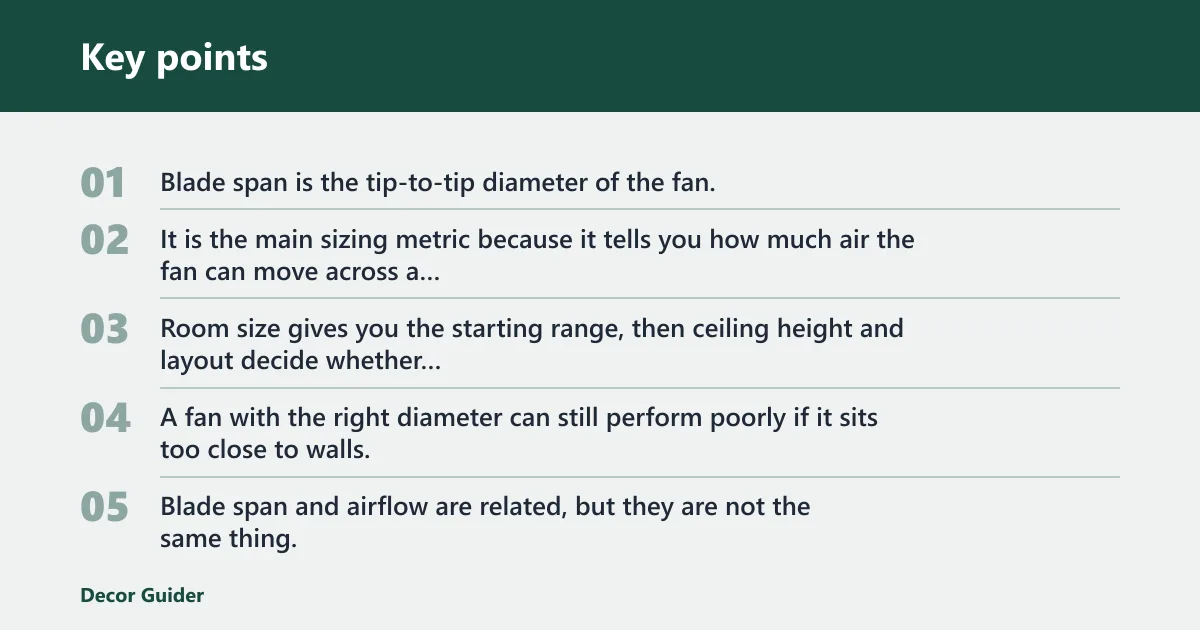

Blade span is the tip-to-tip diameter of the fan, measured across the full sweep of the blades. It is the main sizing metric because it tells you how much air the fan can move across a room area, but it does not tell you everything about airflow, noise, or mount height.
Why span comes first
Room size gives you the starting range, then ceiling height and layout decide whether that range still fits. A fan with the right diameter can still perform poorly if it sits too close to walls, hangs too low, or runs into a beam, cabinet, or sloped ceiling.
How span differs from airflow
Blade span and airflow are related, but they are not the same thing. CFM is the airflow figure to compare after you narrow the size, because two fans with the same diameter can move different amounts of air depending on blade pitch, motor design, and speed settings.
How do you measure your room?
Measure the room’s length and width, then multiply those numbers to get square footage. That total gives you the starting band for blade span. For borderline rooms, the total area matters more than a quick guess based on how the room looks.
Find the square footage
A 10-by-12 bedroom is about 120 sq ft. A 12-by-12 room is 144 sq ft. Those are different buying decisions even though both are common bedroom sizes, because the chart bands move in steps and the edge of one band can sit right on top of the next.
Spot the 144 sq ft boundary
This is where many charts stop short. At 144 sq ft, the calculator shows a 42-44 inch transition range, and that boundary sits between the 76-150 sq ft band and the next size step. If the room is square and open, 42 or 44 inches can both make sense; if furniture or trim tightens the space, the smaller end is safer.
Ceiling height and mount choice
Ceiling height changes finished blade height, which changes both safety and comfort. In an 8-foot room, a flush-mount or hugger fan often fits best because it reduces hanging depth. In 9-foot and taller rooms, a downrod mount may be needed to keep the blades at a usable height.
8-foot ceilings and flush-mount fans
Flush-mount fans keep the motor and blades closer to the ceiling. That helps with low ceilings, but it can reduce airflow feel in some rooms compared with a higher mount. The goal is still to keep the blades at least 7 feet above the floor.
9-foot and taller ceilings with downrods
Downrod mounts use a short or extended rod to lower the fan into the air space where it can circulate better. On taller ceilings, that helps keep the finished blade height in the preferred 8 to 9 feet range when the ceiling allows it. Too short, and the fan may sit higher than needed; too long, and the room can feel crowded.
Finished blade height targets
ENERGY STAR says blades should be at least 7 feet above the floor, and 8 to 9 feet is preferred when the ceiling allows it. That target matters as much as blade span, because a well-sized fan can still be a poor choice if the blades hang too low or sit awkwardly under a sloped ceiling.
How far should a fan be from the wall?
Blade tips should stay at least 18 inches from walls and obstructions. That includes beams, cabinets, shelving, and tall furniture edges. If the room shape forces the fan too close to one side, a smaller blade span is the safer pick.
Beams, cabinets, and other obstructions
Measure from the blade tip to the nearest obstruction in the sweep path, not just to the nearest wall. A ceiling fan can meet the room-area chart and still fail the clearance rule if a beam cuts into the blade circle or a cabinet sits under one side of the sweep.
When room shape forces a smaller span
Irregular rooms often need the fan centered over the usable zone, not the geometric center of the full floor plan. In that case, a fan one size down may be the better fit because wall clearance and furniture layout matter more than the raw square footage.
Blade span fit check
This table turns the room-size chart into a practical check. Use it as a starting point, then verify wall clearance, mount type, and finished blade height before you buy.
| Room scenario | Room dimensions | Recommended starting blade span | Mount type | Minimum wall-clearance check | Do not choose this if |
|---|---|---|---|---|---|
| Square bedroom | 10 x 10 ft | 36-44 in | Flush-mount for 8-foot ceilings; short downrod for taller ceilings | Keep blade tips 18 in from all walls | Bed corners, wardrobe doors, or trim cut into the sweep path |
| Narrow bedroom | 8 x 12 ft | 36-44 in | Flush-mount if the ceiling is low; short downrod if height allows | Check both long walls and the end wall near the bed | The fan would hang over a tall headboard or closet doors |
| 12×12 room boundary case | 12 x 12 ft | 42-44 in | Flush-mount or short downrod, based on ceiling height | Keep 18 in from walls, corners, and crown molding | The room has built-ins that shrink the open center area |
| Low-ceiling room | Up to 150 sq ft | 36-44 in | Flush-mount / hugger fan | Verify 18 in to every wall and overhead obstruction | The blades would sit below 7 ft from the floor |
| Vaulted ceiling room | 150-225 sq ft on a sloped or high ceiling | 44-50 in | Downrod mount | Check the slope line, not only the floor edges | A short rod leaves the fan too high to move air well |
| Long living room | 12 x 20 ft | 50-54 in | Downrod mount | Confirm 18 in clearance along the long axis and seating edges | The fan would sit off-center from the main seating zone |
| L-shaped room | Two connected zones, about 180-220 sq ft of usable area | 44-50 in | Downrod mount, centered on the primary zone | Check the sweep against both arms of the L | The secondary leg is too narrow for the blade circle |
| Open-plan area | 250-400 sq ft of shared living space | 54-60 in | Downrod mount | Keep the full sweep clear of lights, beams, and furniture | The fan would be too close to a circulation path or stair opening |
Use the table as a failure check
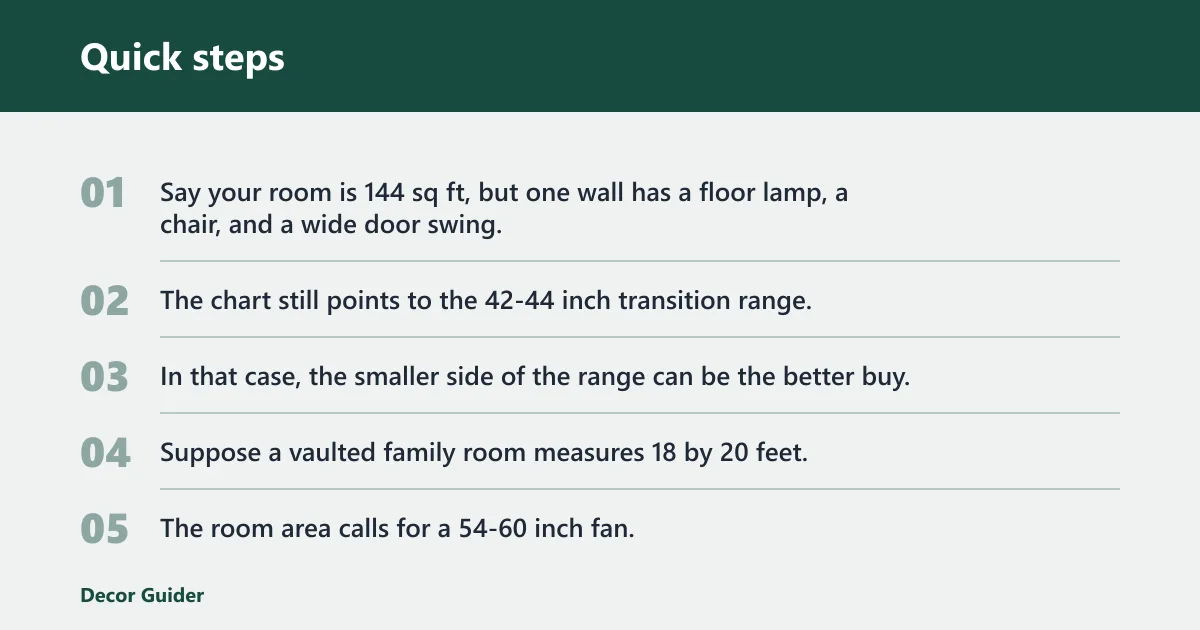
Say your room is 144 sq ft, but one wall has a floor lamp, a chair, and a wide door swing. The chart still points to the 42-44 inch transition range, yet the usable center may be tighter than the raw area suggests. In that case, the smaller side of the range can be the better buy.
Suppose a vaulted family room measures 18 by 20 feet, but the fan would sit under a slope with no room for a long downrod. The room area calls for a 54-60 inch fan, but the mount height would put the blades too high. That is a layout problem, not a diameter problem.
What size fan do you need?

Start with the room band, then adjust for shape and ceiling height. For a small bedroom, a 29-36 inch fan is the usual starting point under 75 sq ft. For a 12×12 room, 42-44 inches is the practical transition zone. For a large living room, 54-60 inches is the usual starting point once the room moves into the 401-700 sq ft band.
Small bedrooms
Use the 29-36 inch band for compact bedrooms, offices, or nursery-sized rooms. If the room is long and narrow, stay alert to the blade tips near the walls and furniture. A slightly smaller fan is often better than a diameter that crowds the corners.
12×12 rooms
A 12×12 room is exactly 144 square feet, and that makes it the classic border case. The room sits near the top of the 76-150 sq ft band, so 42-44 inches is a sensible starting point. If the room has oversized furniture or a low ceiling, 42 inches can be easier to fit than 44.
Large living rooms
Large living rooms usually need 54-60 inches once the area climbs into the upper bands. Open-plan zones often need the larger end of the range because the fan must cover a wider usable area, not just a neat square. If the room is broken by beams or a dining zone, check the clear path before choosing the largest diameter.
When to size up or down
Size up when the room is open, furniture is low, and wall clearance is easy to keep. Size down when the room is irregular, the ceiling is low, or the fan must sit near cabinets, beams, or a sloped edge. Bigger is not always better, especially in tight or segmented spaces.
Does a bigger ceiling fan always move more air?
No. A larger blade span can move more air across a broader area, but actual airflow depends on the exact model, motor, blade pitch, and speed settings. CFM is the better airflow comparison after you choose the right diameter, because diameter alone does not tell you how the fan will feel at the seat or bed.
Blade span versus CFM
Two fans with the same span can have very different airflow numbers. One may use a stronger motor or different blade geometry, and one may be quieter at low speed. That is why size charts should narrow the search, not finish it.
Sound and speed settings
Larger fans can sometimes feel calmer because they can move air at lower speed, but that depends on the motor and blade design. A smaller, high-speed fan can sound harsher in a quiet bedroom. For sleeping spaces, compare speed range and published CFM along with diameter.
Why model specs still matter
A 54-inch fan that fits the room can still be a poor pick if it has weak airflow or a noisy high speed. The size chart gets you close; the product specs decide whether the fan suits the room’s actual use.
How do I convert ceiling fan size from inches to mm?
To convert inches to millimeters, multiply the inch size by 25.4. That matters for buyers comparing models listed in India or other markets where mm is common. For reference, 36 inches is approximately 900 mm, and common Indian ceiling fan sizes include 1200 mm and 1400 mm.
Practical conversion examples
36 inches is about 900 mm. A 1200 mm fan is roughly 47 inches, which sits close to the 44-50 inch band. A 1400 mm fan is roughly 55 inches, which lands near the 54-60 inch range. That makes mm listings easier to place on the room chart.
Buying with mm labels
If a listing uses mm, match the converted size to the same room band you would use for inches. Do not buy by conversion alone. Check the ceiling height, mount type, and wall clearance before you decide.
Frequently asked questions
What is ceiling fan blade size?
Ceiling fan blade size means the tip-to-tip diameter of the spinning blades. It is usually listed in inches, and it is the main number used to match a fan to room area. Think of it as the fan’s sweep width, not its airflow rating.
How do I measure ceiling fan blade span?
Measure from the tip of one blade straight across the center hub to the tip of the blade on the opposite side. That full diameter is the blade span. If the blades are an odd number, use the furthest tip-to-tip distance across the circle the fan makes.
What ceiling fan size do I need for a 12×12 room?
A 12×12 room is 144 square feet, so 42-44 inches is the practical transition range. If the room is open and the ceiling is high enough, either size can work. If the room has furniture, trim, or a low ceiling, the smaller end is often easier to fit.
What size ceiling fan fits a small bedroom?
For a small bedroom under 75 sq ft, start with 29-36 inches. If the room is narrow or has a bed close to one wall, stay within that band and verify the 18-inch clearance. A smaller fan often fits the layout better than a larger one.
How far should a ceiling fan be from the wall?
Keep blade tips at least 18 inches from walls and obstructions. That applies to beams, cabinets, and other fixed items too. If the room shape cannot maintain that clearance, step down to a smaller blade span or change the fan location.
How high should ceiling fan blades be from the floor?
Blades should be at least 7 feet above the floor, and 8 to 9 feet is preferred when the ceiling allows it. That range helps with safety and airflow. In low rooms, a flush-mount fan often makes the height target easier to meet.
Products related to this article
Sponsored / affiliate links. As an Amazon Associate I earn from qualifying purchases. I may earn additional commission from eligible campaigns.