Skillet Size Chart: How to Measure the Right Pan
Skillet size is usually measured by the top-rim diameter rather than the base, and cast-iron number sizes commonly map to inches: #5 is about 8 inches, #8 is about 10 1/4 inches, and #10 is about 12 inches. Measure it wrong and you can end up with too little cooking surface, a lid that does not fit, or a pan that feels awkward on your burner. This skillet size chart shows how to measure accurately, read cast-iron numbers, and pick the right pan size for your food and burner space.
Measure the inner rim, not the outside, for accurate sizing


Measure straight across the top rim, from one inner edge to the opposite inner edge, unless a seller clearly states outside diameter. The cooking surface can be smaller than the rim, and that is where many buyers go wrong. If the sides flare, the top opening is the number that matters for fit, lids, and how much food you can cook at once.
Inside diameter and outside diameter are not the same thing. Inside diameter tells you the usable opening; outside diameter includes the wall thickness and can make a pan sound larger than it cooks. On vintage cast iron, the number stamp often tracks a nominal size, but the actual inches can vary by brand and era.
If the skillet has a heat ring, flared sides, or a rounded lip, measure at the widest top point you can use for cooking. A bent rim can make a pan look larger or smaller than it really is. That is why the top rim, not the base alone, is the safest shopping reference.
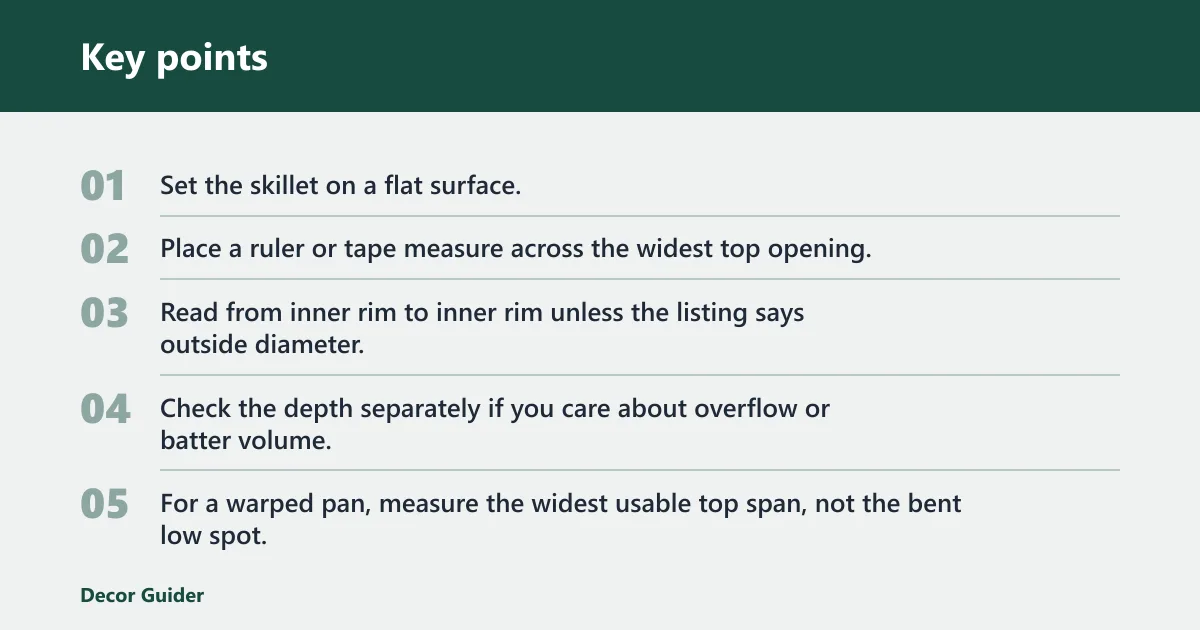
- Set the skillet on a flat surface.
- Place a ruler or tape measure across the widest top opening.
- Read from inner rim to inner rim unless the listing says outside diameter.
- Check the depth separately if you care about overflow or batter volume.
- For a warped pan, measure the widest usable top span, not the bent low spot.
Skillet size reference table
| Measurement method | What to measure | Expected inch range | Common cast-iron number equivalent | Likely serving capacity | Common mistake to avoid |
|---|---|---|---|---|---|
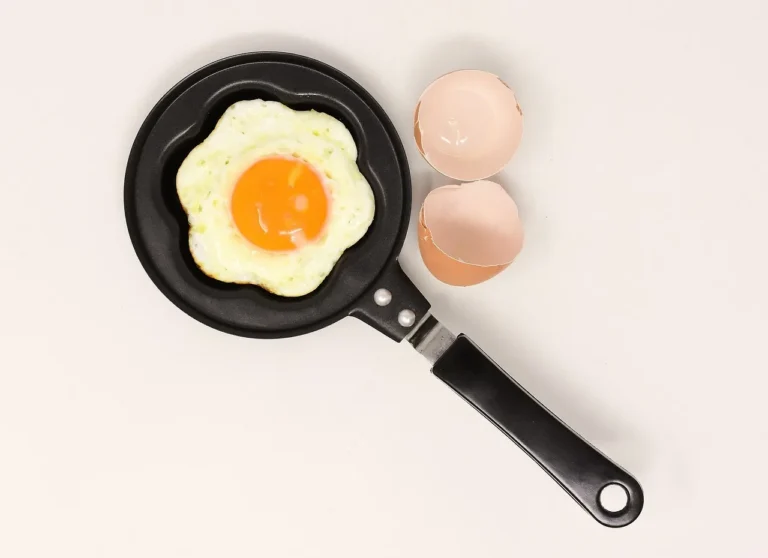
| Top-rim opening | Inner edge to inner edge across the rim | About 6 to 7 inches | #3 or #4 | One egg skillet or a side dish for one | Measuring the base instead of the opening |
| Top-rim opening | Inner edge to inner edge across the rim | About 8 inches | #5 | One to two servings | Assuming every #5 has the same depth |
| Top-rim opening | Inner edge to inner edge across the rim | About 10 to 10 1/4 inches | #8 | Two to four servings | Confusing inside diameter with outside diameter |
| Top-rim opening | Inner edge to inner edge across the rim | About 12 inches | #10 | Three to five servings | Expecting every 12-inch pan to cook the same amount |
| Top-rim opening | Inner edge to inner edge across the rim | About 13 to 14 inches | #12 or #14 | Family meals or larger batches | Using diameter alone to judge heavy batter or deep-fry volume |
Brand variation note: Lodge often tracks the size number in a straightforward modern way, but older pieces can still vary a little. Griswold and Wagner vintage pans are the ones where collectors pay the closest attention to stamped numbers, since the inch match can shift by era. Birmingham Stove & Range also has size variation that buyers should verify against the actual rim.
What does a skillet number mean?
A skillet number is a size reference, not a perfect promise of exact inches. Numbers such as #3, #5, #8, and #14 are common cast-iron shorthand, and the same number can land at slightly different diameters depending on the maker. That is why number size and measured size should be checked together.
How #3, #5, #8, and #14 fit the old numbering system
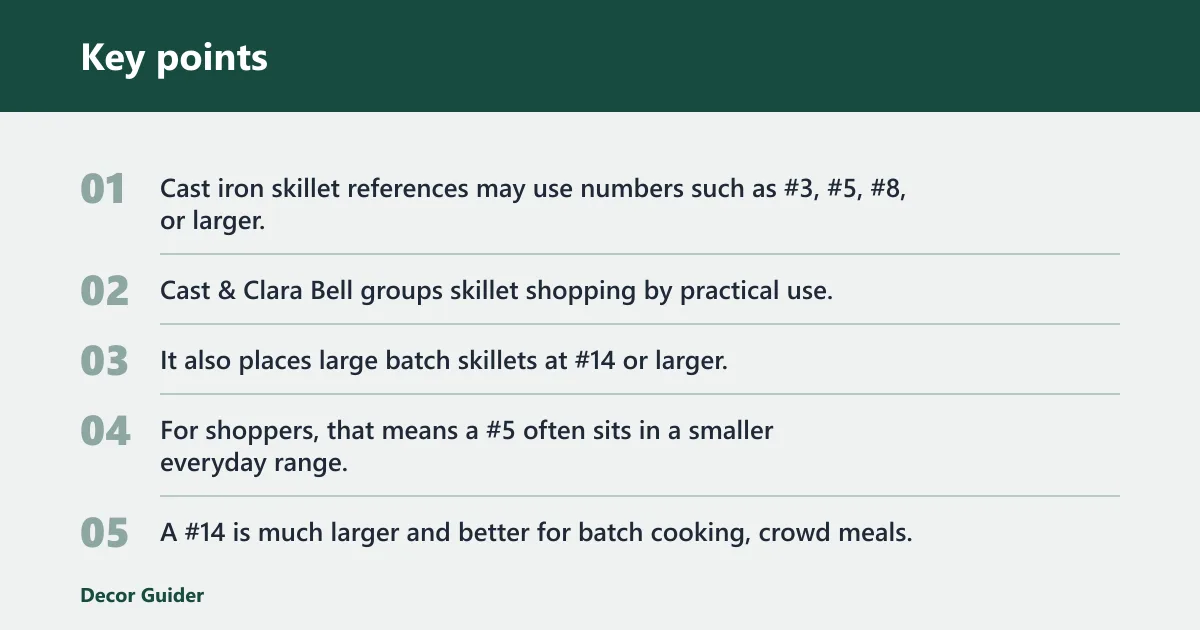
Cast iron skillet references may use numbers such as #3, #5, #8, or larger. Cast & Clara Bell groups skillet shopping by practical use, including egg skillets and saute skillets, and it treats entree skillets as a common everyday starting point. It also places large batch skillets at #14 or larger, with the #8 skillet range as a common everyday starting point.
For shoppers, that means a #5 often sits in a smaller everyday range, while a #8 is a practical pan for many kitchens. A #14 is much larger and better for batch cooking, crowd meals, or oven work that needs a lot of surface area.
Why the same number can mean slightly different inches
Vintage makers did not always use the same exact conversion. A #8 from one brand can be a little wider or a little narrower than another brand’s #8, and the lid fit can change with it. That is why collectors compare the stamp, the rim measurement, and the maker before buying.
A common first-timer mistake is treating all #8 pans as interchangeable. Suppose a seller lists a “#8” skillet for cornbread, but the actual top rim is closer to a small 10-inch pan than a true 10 1/4-inch piece. The skillet may still cook well, but the fit in a tight oven or under a lid can be different.
How collectors and sellers use number sizes
Collectors often use the stamp as a quick identifier, then confirm the rim diameter to judge the piece. Sellers may list both: the number for collector search terms and the inches for cooking use. That dual labeling helps buyers compare a modern 10-inch pan with a vintage #8 and avoid a mismatch.
How do you measure a warped skillet?
Use a ruler or tape measure on a flat surface and measure the widest usable top point, not the lowest bent point. A warped skillet can still be useful, but the warp changes the true opening and can affect lid fit, burner contact, and batter spread. Measure the rim twice if the shape is uneven.
Step-by-step for warped, flared, or heat-ringed pans
Place the pan on a counter. If it rocks, do not use the base as your measurement guide. Instead, align the ruler across the top opening and read the widest span that the cooking area actually gives you. For heat rings, ignore the ring itself and use the top rim for the size label.
Flared sides can make a skillet look wider from above than it measures at the cooking surface. That matters for eggs and cornbread, because the batter spreads to the opening, while the food rests on the flat cooking area. The rim measurement tells you which pan fits the recipe shape more reliably.
What size skillet fits your meal?
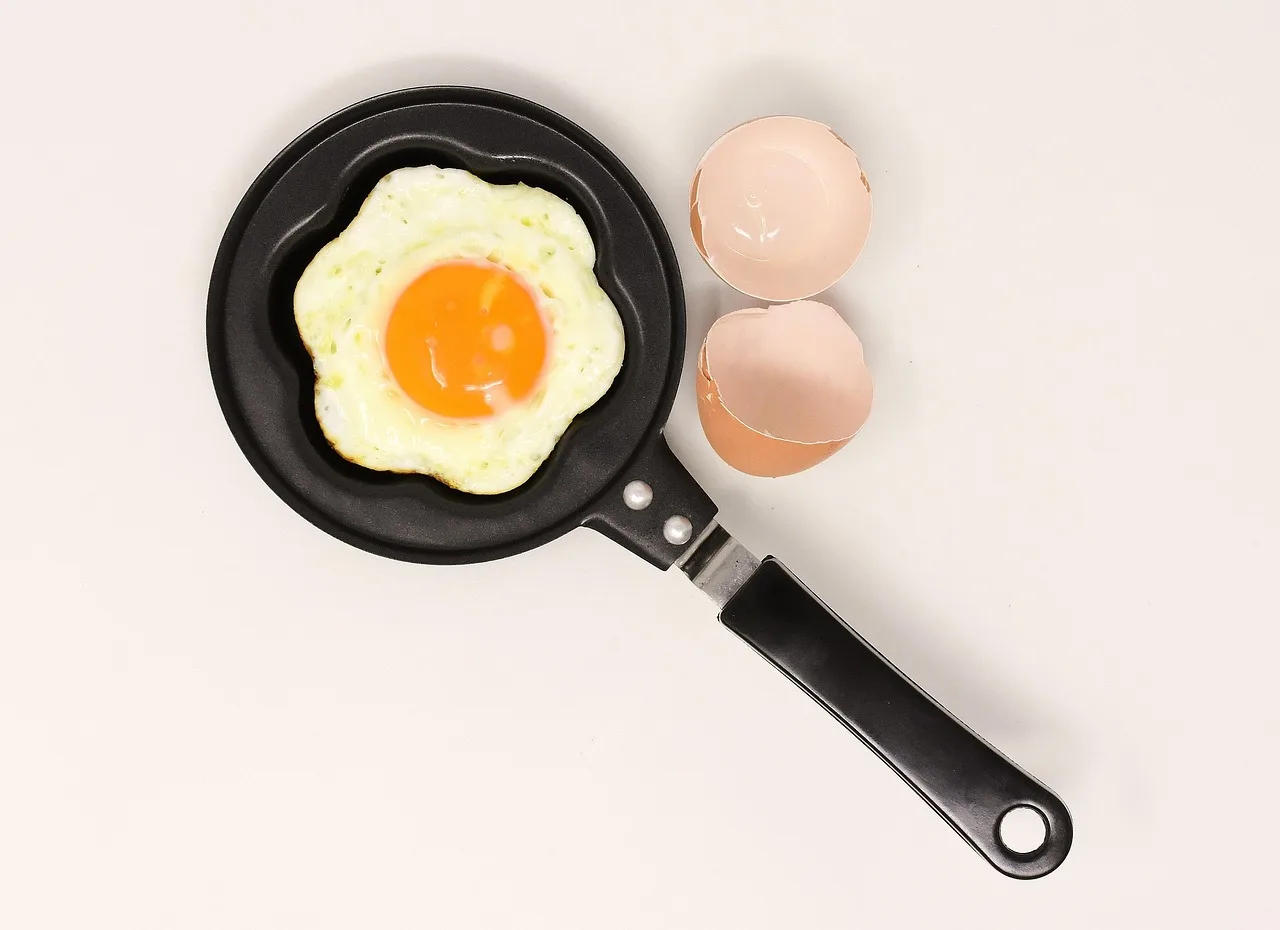
The right skillet size depends on what you cook, not only on how many inches it measures. A smaller pan suits eggs and side dishes. A 10-inch pan is a common reference point for medium meals, while a 12-inch pan makes more sense for family cooking or larger batches. Capacity and diameter are related, but they are not the same thing.
Best skillet size for one person
For one person, a smaller skillet around #3 to #5 is often enough for eggs, a grilled sandwich, or a single portion of vegetables. If you want more room for flipping or browning, a small #8 can still work, but it may be more pan than you need for one serving.
Why 10-inch pans are the common reference point
A 10-inch skillet is the everyday comparison size because it balances surface area and handling. Cast & Clara Bell identifies the #8 skillet range as a common everyday starting point, which fits the way many home cooks think about a medium pan. It is large enough for several eggs, chicken cutlets, or a modest cornbread batch.
How many cups does a 10-inch skillet hold? There is no exact cup number from diameter alone, because depth changes the answer. As a practical guide, a 10-inch skillet is best treated as a medium-capacity pan for two to four portions, not as a fixed-volume vessel.
When 12-inch pans make more sense
A 12-inch skillet is the larger family-use size many shoppers reach for when they cook steaks, big sautés, or a full pan of potatoes. It gives more surface area for browning and keeps food from piling up. If you cook for more than two people often, this size usually feels easier than a 10-inch pan.
How do you compare a vintage cast iron skillet number to inches? Start with the stamped number, then check the top rim. A #8 often reads near a 10-inch pan, while a #10 often sits around 12 inches, but the brand and era can shift the exact fit. The number helps you search; the ruler tells you what you own.
How skillet size compares with a 9×13 pan
What size skillet replaces a 9×13 pan? For a skillet, the answer depends on the food. A large skillet can replace part of that baking-pan role for stovetop-to-oven meals, but it will not match the rectangular shape or volume of a 9×13 pan. Toponautic notes that a 13 by 9 by 2-inch rectangular cake pan holds 14 cups.
For rough pan comparison, Toponautic says a 10-inch round cake pan holds 11 cups and a 12-inch round pan holds 18 cups. That shows why a 12-inch skillet feels much more useful for larger batches than a 10-inch one. Use the round-pan figures as a volume cue, not as a direct skillet guarantee.
Eggs, cornbread, steaks, and single-pan meals
Eggs usually need a smaller skillet with enough surface area to spread but not so much that the food dries out. Cornbread often suits a 10-inch or similar everyday pan. Steaks need room between pieces for browning, so a 12-inch skillet is often the better call. Single-pan meals need the widest room you can manage without crowding.
Say your skillet number is #8 and you want to cook four eggs with room for toast on the side. That pan is a sensible fit for an everyday breakfast. Suppose the same pan is used for two thick steaks and potatoes; it may crowd the food, slow browning, and push juices to the edges.
Vintage cast iron brand differences
Brand matters because old cast iron was not sized with one universal standard. Lodge, Griswold, Wagner, and Birmingham Stove & Range each have patterns that collectors learn to read against the stamp and the rim measurement. The right comparison is brand plus inches, not the number alone.
Lodge skillet size patterns
Vintage Lodge skillet sizes often read in a way that feels familiar to modern buyers, but the actual rim should still be checked. Lodge pieces are useful for shopping because many listings match them to straightforward inch labels. Even so, a buyer should not assume every Lodge #8 lands exactly where a newer pan does.
Griswold skillet size patterns
Griswold skillet sizing is especially important to collectors because some pieces are sought after by stamp and shape. A Griswold #8 may line up near the common 10-inch range, but the exact fit can differ from another maker’s #8. Check the pan, not the label alone.
Wagner skillet size patterns
Wagner skillet sizes also need a two-part check: the stamp and the rim. Some vintage Wagner pieces are close to the expected inch range, while others reflect older production differences. Buyers comparing Wagner to modern skillets should use the rim measurement first, then the number for reference.
Birmingham Stove & Range size patterns
Birmingham Stove & Range skillets are another case where stamped number and actual inches should be paired. A size stamp is useful for collector shorthand, but it does not replace the ruler. If you are buying for cooking, verify the top rim before you assume it matches a modern 10-inch or 12-inch pan.
Brand-variation note: Lodge, Griswold, Wagner, and Birmingham Stove & Range may all use the same size number, yet the real inch measurement can shift a little from one maker to another. That is normal in vintage cast iron. The safest comparison is: stamp, rim diameter, then use case.
Skillet size chart in practice
The chart below ties size to use without pretending diameter and volume are identical. Treat the serving range as a practical estimate. It helps you choose between a small egg pan, an everyday 10-inch skillet, and a larger 12-inch or #14 pan for bigger meals.
| Size reference | Approximate inches | Practical use | Meal fit |
|---|---|---|---|
| #3 to #4 | About 6 to 7 inches | Eggs, butter, one side dish | One person |
| #5 | About 8 inches | Small sautés, single servings, quick breakfast food | One to two people |
| #8 | About 10 to 10 1/4 inches | Everyday cooking, cornbread, chicken cutlets | Two to four people |
| #10 | About 12 inches | Bigger batches, steaks, family meals | Three to five people |
| #14 or larger | About 13 inches and up | Large batch cooking, crowd meals, oven work | Four or more people |
Use this chart as a shopping filter, then verify the pan with a ruler. If the seller lists the number only, ask for the top rim measurement. If the seller lists inches only, ask whether that number comes from the outside or inside opening. That one detail can change the fit of lids and recipes.
Frequently asked questions
How do you measure a skillet size?
Measure across the top rim from inner edge to inner edge. Do not use the base alone, because the cooking opening can be wider or narrower than the bottom. If the sides flare or the pan is warped, use the widest usable top span so the number matches how the skillet cooks.
Is skillet size measured across the top or the bottom?
Skillet size is measured across the top. The bottom can be smaller, especially on pans with a heat ring or tapered sides. Buyers who use the base measurement often end up with a pan that looks right on paper but cooks smaller than expected.
What does a #8 skillet size mean?
A #8 skillet usually refers to a common everyday cast-iron size near the 10-inch range. Cast & Clara Bell identifies the #8 skillet range as a common everyday starting point. The exact inch match can vary by brand, so the stamp should be checked against the rim.
What is the standard skillet size for everyday cooking?
A 10-inch skillet is the common everyday reference point for many home cooks. It gives enough room for eggs, sautéed vegetables, cutlets, and small batch meals without feeling oversized. In vintage cast iron terms, that often lines up near a #8 pan.
How many cups does a 10-inch skillet hold?
There is no single cup figure for a 10-inch skillet because depth changes the result. A 10-inch pan can be a practical everyday size for two to four servings, but you should not treat its diameter as a direct cup measurement. Volume and width are related, not equal.
How do I compare a vintage cast iron skillet number to inches?
Start with the stamped number, then measure the top rim. A #5 is often about 8 inches, a #8 is about 10 1/4 inches, and a #10 is about 12 inches, but brand differences can shift the exact reading. Use the number for search terms and the ruler for fit.
Products related to this article
Sponsored / affiliate links. As an Amazon Associate I earn from qualifying purchases. I may earn additional commission from eligible campaigns.