Ramadan Meal Prep Cost: Budgeting for Iftar and Suhoor
A practical Ramadan meal prep cost starts with your normal grocery budget, adds a separate guest-night line item, and keeps ordering out to the fewest meals you can truly manage. If you skip that split, food spending can climb fast and you end up paying for last-minute takeout or buying too much of ingredients you will barely use. This guide gives you a text-only calculator with copyable formulas, example currency ranges, worksheet tables, and a monthly budget structure for staples, Iftar, and Suhoor.
What Ramadan meal prep cost includes
Ramadan recipes and meal ideas for suhoor and iftar are the food side of the budget, but the cost worksheet needs three daily buckets: Iftar, Suhoor, and snacks. It also needs a fixed family baseline and a separate variable line for guest nights, because a normal night and a full table do not cost the same.
The calculator plans Iftar and Suhoor spending across the month. It asks for the number of family members eating daily, and it also includes an average daily guest count for Iftar. That split keeps the monthly total usable. If you want a sibling planning page to compare alongside this one, use Ramadan budgeting as the broader household context.
Fixed costs versus variable costs
Short answer: fixed costs are the meals your household eats every day; variable costs are the nights that change shape: guests, takeout, delivery fees, disposable serving items, and extra grocery trips.
If you mix those together, the average gets blurry and the budget is harder to follow. For most homes, fixed costs are the base plan. Variable costs should be tracked separately so one big Friday table does not make the whole month look more expensive than it really is.
Why guest nights change the total
Short answer: guest nights usually add more protein, more sides, more drinks, and often more dessert.
They also change serving size. Even a small increase in guest count can move the budget more than an extra bowl of soup or one more loaf of bread. That is why guest-heavy iftars need their own allowance. If you do not isolate them, the regular family budget absorbs costs that only happen on a few nights.
Ramadan meal prep cost worksheet
Short answer: use the worksheet below as a starter price grid, then swap in your local prices and store brands.
This worksheet gives you a per-person starting point for Iftar, Suhoor, and snacks, then lets you scale up for household size and guest nights. Use it as a framework, not a fixed price list, since food prices vary by country and by store.
| Tier | Iftar per person | Suhoor per person | Snacks per person | Typical meal style |
|---|---|---|---|---|
| Economy | $2 to $4 | $1.50 to $3 | $0.50 to $1.50 | Basic protein, rice or bread, water, dates |
| Standard | $4 to $8 | $2.50 to $5 | $1 to $3 | More sides, fruit, yogurt, and one dessert item |
| Premium | $8 to $15 | $5 to $9 | $3 to $6 | Higher-cost protein, multiple sides, more drinks and sweets |
Use the table to set a ceiling for each person. Then multiply by household size for family nights and add a separate guest allowance for nights when your table grows.
Per-person Iftar planning
Short answer: Iftar usually carries the biggest cost drivers, so plan it first.
Protein, sides, drinks, desserts, and serving size matter more here than at Suhoor. For an average family, 3 to 4 dishes for Iftar are enough, and that limit helps prevent extra spending on dishes nobody needs.
Copyable formula: Iftar family cost = household size × Iftar per person
Per-person Suhoor planning
Short answer: Suhoor can stay lower-cost if you lean on simple, filling foods.
Eggs, bread, yogurt, dates, and water are common base items. Leftovers work well here, especially when last night’s main dish can become a fast pre-dawn meal.
Copyable formula: Suhoor family cost = household size × Suhoor per person
Per-person snacks planning
Short answer: snacks should be treated as a separate category, not hidden inside dinner.
That makes it easier to cut back if you already have enough food at home. It also keeps sweets and drinks from quietly taking over the month’s total.
Copyable formula: Snacks family cost = household size × snacks per person
How many people are you feeding each day?
Short answer: start with the number of family members eating daily, then add the average guest count for Iftar.
That gives you two different numbers, which is the simplest way to keep normal nights separate from guest-heavy nights and avoid overbuying or underbuying.
Household size and portion planning
Short answer: household size drives the base budget.
A larger family does not need more variety every night, but it does need more portions. Plan the same core meal format across the week, then adjust protein and sides to match appetite and age ranges in the home.
Picture a household of five that cooks for home dinners most nights. If each person gets the same plate every night, the total stays steady. If portion sizes drift upward on busy days, the monthly total climbs even without more guests.
Average guest count for Iftar
Short answer: guest count should be averaged across the month, not guessed in one lump sum.
A few guest nights can change the total sharply because they usually increase protein, bread, drinks, and dessert together. Track them as a separate allowance rather than folding them into family meals.
Copyable formula: Guest allowance = average guests × guest-night add-on × guest nights
How to separate family nights from guest nights
Short answer: use two columns: one for family dinners and one for guest iftars.
Family nights use your normal per-person cost. Guest nights use the same base formula plus a guest add-on for the extra food and serving items.
What does a realistic daily Ramadan food budget look like?

Short answer: a realistic daily Ramadan food budget is the sum of daily household meals plus an average guest allowance.
The right number depends on household size, meal tier, and whether you cook at home, order out, or mix both. The point is to model one day, then multiply it across the month.
Per-day cost modeling
Short answer: build the day from pieces: Iftar, Suhoor, snacks, and any guest or takeout line.
This makes the budget easier to adjust because you can change only one part instead of reworking the entire month.
| Daily item | Economy | Standard | Premium |
|---|---|---|---|
| Iftar per person | $2 to $4 | $4 to $8 | $8 to $15 |
| Suhoor per person | $1.50 to $3 | $2.50 to $5 | $5 to $9 |
| Snacks per person | $0.50 to $1.50 | $1 to $3 | $3 to $6 |
| Guest add-on per guest | $3 to $5 | $5 to $9 | $9 to $15 |
Those are planning ranges. Replace them with your local currency after you price the ingredients in your market.
29-day versus 30-day totals
Short answer: Ramadan may run 29 or 30 days, so the monthly budget should support either length.
The difference is one extra day of family meals, plus any guest or ordering costs that happen on that day. Use both totals so you are not caught short at month’s end.
Copyable formula: Monthly total = (daily family cost × Ramadan days) + guest nights + takeout nights + special nights
Simple monthly formula for a spreadsheet
Short answer: sum the family row, guest row, and any ordering row, then calculate the total twice: once for 29 days and once for 30.
If you want a tighter version, add columns for Iftar, Suhoor, snacks, guests, and ordering fees. Then sum each row for 29 or 30 days.
Home cooking or ordering food?
Short answer: home cooking is usually cheaper than ordering food during Ramadan, but the size of the gap depends on your menu, fees, and frequency.
Ingredient cost is spread across multiple meals, so home cooking usually keeps more control in the household budget. Restaurant ordering can still fit the budget, but it should stay visible as a separate line because the full cost is higher once fees and add-ons are included.
Home Cooking cost factors
Short answer: home cooking usually wins on cost when you cook staple dishes, reuse leftovers, and buy in bulk.
Dates, rice, oil, and flour help lower the per-meal cost because they stretch across many dishes. Batch-cooked protein can do the same.
Restaurant Ordering cost factors
Short answer: restaurant meals are often materially more expensive than the same food cooked at home once delivery and extras are included.
The gap depends on your area and the order size. Ordering is convenient, but it should be counted as a major cost choice, not a small extra.
Say your family orders four meals in a week because work runs late. The budget impact is not just the menu price. Delivery fees and the lost value of groceries already at home can turn that week into the most expensive part of the month.
Mix as a middle option
Short answer: a mix works when some nights are home-cooked and a few are ordered for time pressure or guest volume.
This option can make sense if you reserve ordering for the busiest nights and keep all routine meals at home.
Staples and meal components that move the budget
Short answer: dates, rice, oil, flour, protein, sides, drinks, and desserts are the main budget drivers.
Some items do more of the budget work than others. Dates, rice, oil, and flour often act as the base layer. Protein, sides, drinks, and desserts usually drive the swing from low-cost to high-cost meals.
Dates, rice, oil, and flour
Short answer: these staples matter because they carry multiple meals.
Dates are common at Iftar, rice can stretch a main dish, oil is used in many cooked foods, and flour supports breads and baked items. Bulk-buying these basics before the month starts can reduce last-minute price spikes.
Copyable formula: Staple reserve = estimated monthly use × current store price
Protein, sides, drinks, and desserts
Short answer: protein is often the largest single cost in Iftar.
Sides add volume, drinks add repetition, and desserts add extra ingredients that are easy to underestimate. If your budget is tight, trim dessert frequency before you cut the core meal.
Lower-cost Suhoor foods that still hold you over
Short answer: Suhoor does not need to be complex to be useful.
Eggs, bread, yogurt, dates, and water are common lower-cost options, and leftover rice, chicken, or soup can work too. Batch-prep helps because the food is already portioned and ready early in the morning.
Short answer: the cheapest Ramadan routine is the one you can repeat without waste.
That means buying staples early, cooking in batches, freezing portions correctly, and using leftovers at Suhoor before they spoil. It also means keeping guest nights separate from routine nights.
Bulk-buy staples before the month starts
Short answer: buy long-lasting items in the sizes you can store well.
Bulk buying works best when you already know how often you use each staple, so you do not overbuy a low-turnover item.
Batch cook and freeze portions
Short answer: batch cooking lowers cost when it cuts both waste and repeated effort.
Cool food before freezing, portion it into flat freezer bags, and label the contents so you can use them in order. This makes leftovers easier to turn into Suhoor without another full cooking session.
Copyable formula: Freezer portions = cooked batches ÷ planned servings per batch
Use leftovers for Suhoor
Short answer: leftovers are one of the cleanest ways to control costs.
A curry, rice dish, soup, or roasted chicken can move from Iftar to Suhoor with little extra spending. That reduces waste and keeps the next meal simple.
Avoid waste, extra trips, and disposable add-ons
Short answer: hidden costs matter.
Extra grocery trips can lead to impulse buys. Disposable serving items add up fast. Delivery fees and small takeaway orders can outweigh the value of one carefully planned homemade meal.
- Set a weekly menu before shopping.
- Separate family nights from guest nights.
- Buy staples in one planned trip.
- Cook extra portions for Suhoor.
- Record ordering fees and disposable items separately.
Ramadan meal prep budget calculator

Short answer: this calculator turns your plan into a monthly total for 29 or 30 days.
It supports three budget tiers and three preparation methods: Home Cooking, Restaurant Ordering, and a mixed approach. Use one row for the base family and one row for guest nights.
How to copy the formula into a spreadsheet
Short answer: create columns for household size, per-person costs, average guest count, guest-night cost, takeout nights, and special nights.
Then apply the monthly total formula and copy it down for each tier you want to compare.
Copyable formula: Monthly total = ((Iftar per person + Suhoor per person + snacks per person) × household size × days) + (guest add-on × guest count × guest nights) + takeout nights + special nights
| Line item | Formula | Example note |
|---|---|---|
| Family Iftar | Household size × Iftar per person | Daily base meal |
| Family Suhoor | Household size × Suhoor per person | Pre-dawn meal |
| Family snacks | Household size × snacks per person | Optional but tracked |
| Guest nights | Average guests × guest add-on × guest nights | Track separately |
| Takeout nights | Number of ordering nights × order cost | Include fees |
| Special nights | Premium event cost × number of special nights | Use only when needed |
How to track guests, takeout, and special nights
Short answer: keep three separate trackers: guest iftars, ordered meals, and special nights with higher spending.
That keeps a crowded weekend from changing the whole month’s average. It also shows which nights are worth the extra cost and which ones are not.
How to total the full month
Short answer: add the family total, guest total, takeout total, and special-night total, then run the sum for 29 days and again for 30 days.
The gap gives you a useful buffer if the month runs long.
A common first-timer mistake is planning a Premium table every night because it feels generous. If the food budget is limited, that approach tends to crowd out staples and raises waste. A better rule is to keep regular nights at Standard or Economy, then reserve premium dishes for a few planned guest nights only.
Worksheet tables for a real Ramadan budget
Short answer: use these tables to build a usable month-by-month worksheet instead of a vague estimate.
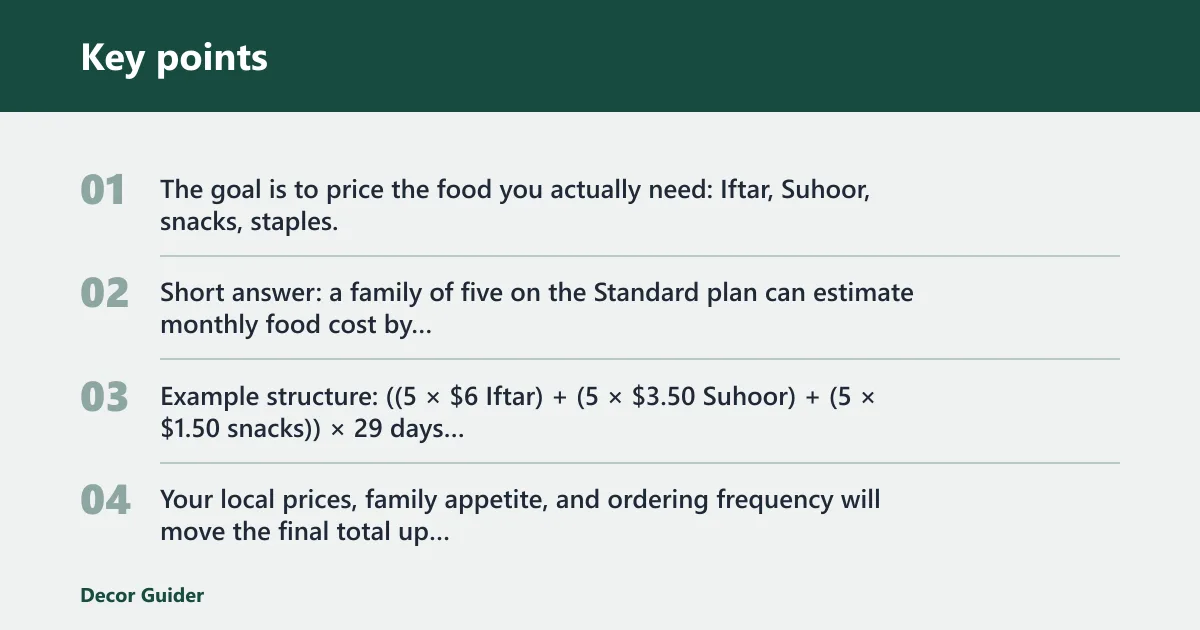
The goal is to price the food you actually need: Iftar, Suhoor, snacks, staples, guest-night add-ons, freezer portions, and hidden costs.
Iftar worksheet
| Item | Economy range | Standard range | Premium range | Notes |
|---|---|---|---|---|
| Main protein | $0.80 to $1.50 | $1.50 to $3.50 | $3.50 to $7 | Chicken, lentils, eggs, beef, fish, or mixed protein |
| Side dishes | $0.50 to $1 | $1 to $2.50 | $2.50 to $5 | Rice, bread, salad, soup, vegetables |
| Drinks | $0.20 to $0.60 | $0.50 to $1.20 | $1.20 to $2.50 | Water, juice, milk, laban, homemade drinks |
| Dessert / sweets | $0.30 to $0.80 | $0.80 to $2 | $2 to $5 | Keep optional if budget is tight |
Suhoor worksheet
| Item | Economy range | Standard range | Premium range | Notes |
|---|---|---|---|---|
| Eggs or protein base | $0.50 to $1 | $1 to $2.50 | $2.50 to $4.50 | Eggs, yogurt, cheese, legumes, leftovers |
| Bread / grain | $0.30 to $0.80 | $0.80 to $1.50 | $1.50 to $3 | Bread, oats, rice, flatbread, cereal |
| Fruit / hydration | $0.20 to $0.60 | $0.60 to $1.50 | $1.50 to $3 | Water is the lowest-cost anchor |
Snacks worksheet
| Item | Economy range | Standard range | Premium range | Notes |
|---|---|---|---|---|
| Fruit | $0.20 to $0.60 | $0.60 to $1.50 | $1.50 to $3 | Fresh fruit or seasonal fruit |
| Nuts / dried fruit | $0.30 to $0.80 | $0.80 to $2 | $2 to $4 | Measure carefully to avoid overspending |
| Tea / coffee / drinks | $0.10 to $0.40 | $0.40 to $1 | $1 to $2.50 | Often grows quietly through the month |
Staples worksheet
| Staple | Budget benchmark | How it helps | What to watch |
|---|---|---|---|
| Dates | 1 to 2 servings per person per day | Standard Iftar opener and snack backup | Premium varieties can raise the total quickly |
| Rice | 1 batch can stretch several meals | Low-cost volume for mains and leftovers | Watch side dishes that increase cost per plate |
| Oil | Buy only what you can use in the month | Supports many cooked dishes | Bulk size is only helpful if it will be used |
| Flour | Enough for bread, flatbread, or baking | Supports cheap homemade basics | Humidity and storage matter |
Ramadan meal prep cost worksheet
| Add-on | Economy range | Standard range | Premium range | Example use |
|---|---|---|---|---|
| Extra protein | $1 to $2 per guest | $2 to $4 per guest | $4 to $8 per guest | More meat, fish, or substantial vegetarian protein |
| Extra bread / rice / sides | $0.50 to $1.50 per guest | $1.50 to $3 per guest | $3 to $5 per guest | Enough volume to serve a bigger table |
| Extra drinks / dessert | $0.50 to $1 per guest | $1 to $2.50 per guest | $2.50 to $5 per guest | Usually the most underestimated part |
Ramadan meal prep cost worksheet
| Freezer task | Target amount | Planning use | Cost effect |
|---|---|---|---|
| Batch size | 2 to 4 meals per batch | Fits a short week without waste | Reduces last-minute ordering |
| Labeling | Date + meal name + portion count | Lets you rotate food in order | Prevents spoilage and duplicates |
| Backup Suhoor portions | 1 to 2 servings per adult / teen | Turns leftovers into a planned meal | More value from a single Iftar cook |
Hidden costs worksheet
| Hidden cost | How it shows up | Why it matters | How to track it |
|---|---|---|---|
| Extra grocery trips | Impulse purchases, duplicate ingredients | Raises spend without adding meals | Log each unplanned store visit |
| Delivery fees | Order total looks lower than the real bill | Can erase the savings from one home-cooked meal | Track fees on the same line as the meal |
| Disposable serving items | Plates, cups, utensils, foil, bags | Easy to overlook in a large gathering | Add a fixed guest-night allowance |
| Food waste | Spoiled produce or leftover trays | Turns planned cost into loss | Record what was thrown away |
One worked family example
Short answer: a family of five on the Standard plan can estimate monthly food cost by combining daily family meals, snacks, and a few guest nights.
Example structure:
((5 × $6 Iftar) + (5 × $3.50 Suhoor) + (5 × $1.50 snacks)) × 29 days
= ($30 + $17.50 + $7.50) × 29
= $55 × 29 = $1,595
Then add guest nights separately:
4 guest nights × 3 guests × $5 guest add-on = $60
Estimated 29-day total = $1,655
For 30 days, add one more day of the same family total:
$1,655 + $55 = $1,710
This is only a planning example. Your local prices, family appetite, and ordering frequency will move the final total up or down.
Frequently asked questions
How much does Ramadan meal prep cost for a family?
Short answer: it depends on household size, meal tier, and how often you host guests.
Start with a daily family total for Iftar, Suhoor, and snacks, then add a separate guest-night line. That gives you a realistic monthly budget instead of a vague guess.
What is a realistic daily Ramadan food budget?
Short answer: a realistic daily Ramadan food budget is the amount your family can repeat without heavy takeout or waste.
Build it from per-person Iftar, Suhoor, and snack costs, then add a guest allowance only on the nights you expect extra people.
How can I reduce Ramadan meal prep costs without skimping on food?
Short answer: focus on staples, leftovers, and batch cooking.
Keep Iftar to 3 to 4 dishes, use Suhoor leftovers when possible, and reserve ordering for the few nights when time or guests make home cooking impractical. That trims cost without making meals feel bare.
Is home cooking cheaper than ordering food during Ramadan?
Short answer: home cooking is usually cheaper, but the gap depends on the order size, delivery fees, and menu choices.
Keep ordering visible as a separate line because the full cost is higher once extras are included.
What should I budget for dates, rice, oil, and staples in Ramadan?
Short answer: budget these as foundation ingredients, not one-off purchases.
Dates, rice, oil, and flour often lower the average meal cost because they support many dishes. Bulk-buy only the amounts your household will actually use within the month.
How do guests change my Ramadan meal prep costs?
Short answer: guests increase cost by raising protein, sides, drinks, desserts, and serving size.
Track guest nights separately from regular family nights so one large iftar does not distort the rest of the month. An average guest count makes the monthly budget much easier to control.
How do I estimate Ramadan meal prep cost for 29 or 30 days?
Short answer: use your daily family cost as the base, then multiply it by 29 and again by 30.
Add guest nights, takeout nights, and special nights on top. The two totals show you the budget range and make month length easier to plan for.
Sources
Food inflation and price context are commonly tracked by the Food and Agriculture Organization of the United Nations, the World Bank, and national consumer price index releases. Household food budgeting benchmarks are also published by agencies such as USDA Food Plans and similar national budget tools. This worksheet uses those kinds of references as context for a planning range, not as a fixed price list.
Useful source categories to check for your own country: food inflation index releases, staple crop and retail price reports, and household food budget guides from government statistics or consumer agencies.
Products related to this article
Sponsored / affiliate links. As an Amazon Associate I earn from qualifying purchases. I may earn additional commission from eligible campaigns.