How to Store Cooked Ramadan Food Safely
Cool cooked food within about 2 hours, divide it into shallow portions, refrigerate it promptly at 40°F (4°C) or below, freeze extras the same day, and reheat leftovers until they reach about 165°F (74°C) throughout. Do not leave food out to cool for hours. Slow cooling or room-temperature holding lets bacteria multiply fast, which can ruin iftar dishes and make suhoor unsafe. This guide covers cooling, labeling, chilling, freezing, reheating, and discarding cooked rice, curries, fish, soups, fried snacks, and dairy desserts.
Ramadan food storage basics


The safest pattern is simple: cool fast, portion small, label, chill, reheat once, or freeze. Large shared platters, deep pots, and buffet-style serving create the biggest risk because food stays warm too long and gets handled more than once.
A useful rule is this: if a dish can be divided, divide it before it goes into the fridge. Smaller portions cool faster, and that shortens the time food spends in the danger zone.
Use this quick decision workflow for leftovers:
- Eat tonight: Keep only the portion you will serve right away, then refrigerate the rest within 2 hours.
- Refrigerate: Move food into shallow, covered containers and keep the fridge at 40°F (4°C) or below.
- Freeze: Freeze meal-size extras the same day if you will not use them within the fridge window.
- Discard: Throw food away if it stayed out beyond the time limit, smells off, looks slimy, or shows curdling, bubbling, or other spoilage signs.
For shared iftar platters, sauces, and buffet-style service, keep one serving spoon for each dish, place fresh utensils beside each container, avoid topping up a dish with food that has already sat out, and return leftovers to cold storage quickly after serving. Keep rice, salad, chutney, yogurt, meat, and sauces separated whenever possible so crumbs, juices, and serving spoons do not cross between dishes.
What you’ll need
- Shallow airtight containers with tight lids
- Freezer bags with a write-on label area
- Clean spoons, tongs, and serving utensils
- Permanent marker and labels or masking tape
- A refrigerator set to 4°C or below
- Food thermometer for reheating checks
- Shallow trays or small containers for cooling soups and sauces
How to cool and store leftovers
-
Split food into shallow portions. Move rice, curry, soup, meat, and sauce into small containers instead of leaving them in one deep pot. Smaller portions cool faster, and large hot containers should not be stacked because that traps heat.
-
Separate mixed dishes. Keep rice, protein, and sauce in separate containers when you can. This helps each part cool at its own pace and keeps crisp foods from turning soggy.
Use sealed, clean containers for each item so utensils do not move sauce, crumbs, or juices from one food to another.
-
Label and chill right away. Mark each container with the dish name and date before it goes into the fridge or freezer. Put leftovers in the refrigerator within 2 hours, and within 1 hour if the room is hotter than 90°F (32°C).
-
Freeze extra portions. If you will not eat the food soon, freeze it the same day. Press out excess air from freezer bags, flatten the contents for easier storage, and date the package before freezing.
-
Reheat only once. Warm leftovers until they reach 165°F (74°C) throughout. Reheat only the portion you plan to eat, especially for rice and mixed dishes.
Ramadan leftover storage table
| Dish | Portion guidance | Best storage method | Max counter time | Cooling speed | Fridge life | Freezer life | Safest thawing method | Discard triggers |
|---|---|---|---|---|---|---|---|---|
| Rice dishes | Meal-size portions only; do not leave in a deep mound | Airtight container; refrigerate promptly | No more than 2 hours, or 1 hour in heat above 90°F (32°C) | Shallow layer, not a deep mound | No more than 2 days | Up to 1 month | Thaw in the fridge, then reheat once to 165°F (74°C) | Left out over 2 hours, or over 1 hour in heat above 90°F (32°C); warm smell or slimy texture |
| Curries and stews | Small portions in separate boxes if possible | Shallow airtight container; separate from rice if possible | No more than 2 hours, or 1 hour in heat above 90°F (32°C) | Divide into smaller containers | About 3 to 4 days | About 2 to 3 months | Thaw in the fridge overnight, then reheat until steaming hot | Left out too long, bubbling stopped long ago, or the lid bloats after storage |
| Cooked meat | Slice or portion before chilling | Airtight container or freezer bag; remove excess air | No more than 2 hours, or 1 hour in heat above 90°F (32°C) | Slice or portion before chilling | About 3 to 4 days | About 2 to 3 months | Thaw in the fridge, then reheat once | Left out over the time limit, or a sour odor after storage |
| Fish | Small portions; keep pieces thin for faster chilling | Airtight packaging with excess air removed | No more than 2 hours | Divide into small portions | About 3 to 4 days at 40°F (4°C) or below | 3 to 4 months | Thaw in the fridge and cook or reheat promptly | Left out more than 2 hours; use faster if the fridge stays warmer than 40°F (4°C) |
| Soups | Small containers with enough headspace for rapid cooling | Shallow container with a tight lid | No more than 2 hours, or 1 hour in heat above 90°F (32°C) | Spread into smaller containers | About 3 to 4 days | About 2 to 3 months | Thaw in the fridge, then bring to a full reheat | Foamy surface, sour smell, or held at room temperature too long |
| Fried snacks | Single layer when possible; keep sauces separate | Container lined for the fridge; separate from sauces | No more than 2 hours, or 1 hour in heat above 90°F (32°C) | Keep in a single layer when possible | About 2 to 3 days | About 1 to 2 months | Thaw in the fridge, then reheat until crisp and hot | Soft filling, wet coating, or left out during a long serving period |
| Dairy-based desserts | Portion into small cups or boxes | Covered airtight container | No more than 2 hours, or 1 hour in heat above 90°F (32°C) | Portion into small cups or boxes | About 3 to 4 days | About 1 to 2 months | Thaw in the fridge and keep chilled until serving | Curdling, separation, or sitting out during taraweeh or a long gathering |
How long can cooked Ramadan food stay in the fridge?
Most cooked leftovers should be eaten within about 3 to 4 days, but rice is stricter: refrigerate it for no more than two days before reheating. Fish should stay at 40°F (4°C) or below and is best used within about 3 to 4 days.
Set the fridge to 40°F (4°C) or below. For fish, 36°F to 38°F is a useful target because colder storage slows spoilage better without freezing the food.
Say your iftar has biryani, grilled chicken, and a yogurt dessert left after guests leave. Put each part into separate covered containers the same evening, then plan to use the rice first and the dairy dessert within the same short window.
When should you freeze or discard leftovers?
Freeze leftovers the same day if you will not finish them within the fridge window. Discard any perishable food that sat out more than 2 hours, or more than 1 hour when the room is above 90°F (32°C). Do not try to rescue food that smelled fine but sat warm too long.
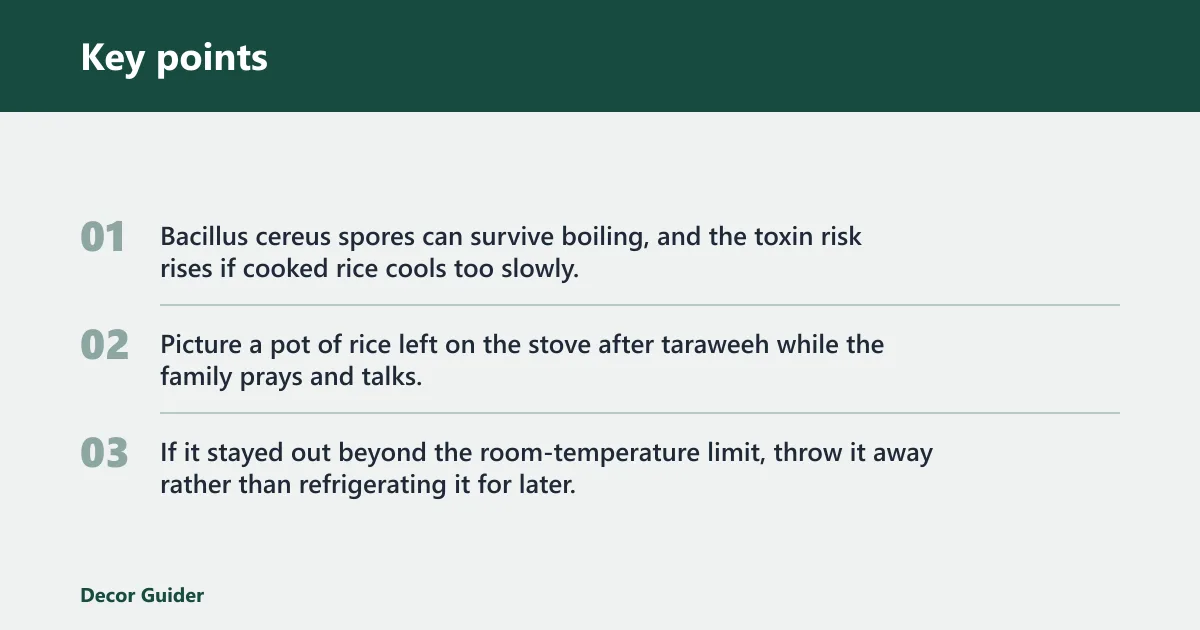
For rice, the risk is not only spoilage. Bacillus cereus spores can survive boiling, and the toxin risk rises if cooked rice cools too slowly. That is why prompt chilling matters more than waiting for a pot to cool on the counter.
Picture a pot of rice left on the stove after taraweeh while the family prays and talks. If it stayed out beyond the room-temperature limit, throw it away rather than refrigerating it for later.
How do I stop bacteria from growing in cooked food before I refrigerate it?
Move food out of the danger zone quickly. Portion it into shallow containers, spread dense foods across multiple boxes, and get them into the fridge within the time limit. Keep the refrigerator at 40°F (4°C) or below, and avoid stacking hot tubs because stacked containers hold heat longer.
Do not leave rice out to cool for hours. Divide it into shallow portions and refrigerate it promptly within 2 hours; if the room is hotter than 90°F (32°C), get it cold within 1 hour. Use a clean spoon for each dish and keep the lid loose only while food is actively cooling, then close it once the food is packed away.
What containers are safest for storing cooked food during Ramadan?
Airtight containers are the safest all-purpose choice for fridge storage. They seal out air, help retain freshness and aroma, and let you separate foods cleanly. For freezer storage, use freezer bags or freezer-safe boxes with excess air removed so the food freezes faster and stores more neatly.
Use shallow containers for soups, stews, and rice so heat can escape quickly. Use sealed containers for sauces and dairy desserts, and avoid very deep tubs unless the food is already cold.
How many times can you reheat leftover Ramadan food?
Reheat leftovers once only. Cooked rice should not be reheated more than once, and it should be warmed until steaming hot all the way through. For mixed dishes, reheat only the portion you will eat and return the rest to cold storage only if it has stayed safely chilled the whole time.
A common mistake is reheating the same rice tray for suhoor and then again at midday. That repeats heating and cooling cycles and raises the risk of unsafe storage.
How can I avoid cross-contamination when storing mixed dishes and sauces?
Use separate containers and separate utensils for different foods. Clean surfaces and tools before reuse, especially if raw ingredients, dairy, or sticky sauces were on them. Cross-contamination can happen when a shared spoon moves juices or crumbs from one food to another.
Keep salad, chutney, yogurt, rice, and meat apart if possible. Sealed airtight containers are useful here because they keep foods from touching and help prevent contamination during fridge storage.
Common mistakes
Leaving a big pot on the counter is the fastest way to create trouble. Move food into shallow portions instead of waiting for the center of the pot to cool on its own.
Another mistake is assuming every dish has the same shelf life. Rice needs a shorter fridge window than many other leftovers, and fish needs cold storage at 40°F (4°C) or below.
Do not keep serving from the same communal tray after everyone has eaten. Once spoons, hands, and side dishes have mixed into the meal, the risk of cross-contamination rises.
Do not treat fried snacks as harmless just because they are crisp. Fillings, starches, and sauces inside them still spoil.
Frequently asked questions
How soon should cooked food be cooled before refrigerating it?
Get perishable leftovers into the refrigerator within 2 hours, or within 1 hour if the room is above 90°F (32°C). Use shallow containers so the food cools faster and spends less time in the danger zone.
Can I freeze cooked rice, fish, or other iftar leftovers?
Yes. Cooked rice can be frozen safely for up to one month, and cooked fish can be frozen for 3 to 4 months. For mixed leftovers, freeze in meal-size portions, remove excess air, flatten freezer bags, and label them before freezing.
What should I do if Ramadan food has been left out too long?
Throw it away. If perishable food stayed out more than 2 hours, or more than 1 hour in heat above 90°F (32°C), it is no longer a safe candidate for the fridge or freezer. Do not taste it to decide.
Does fasting change the food-safety rules for leftovers?
No. Fasting rules and food safety are separate. The same storage limits still apply whether food is for iftar, suhoor, or a later meal.
Can I cool rice on the counter if I plan to eat it later?
No. Do not leave rice out to cool for hours. Divide it into shallow portions and refrigerate it promptly within 2 hours, or within 1 hour in heat above 90°F (32°C).
Is it safe to keep buffet-style iftar food out for guests?
Only for the short serving window that fits the 2-hour rule, or 1 hour in heat above 90°F (32°C). After that, food should be refrigerated, frozen, or discarded, and shared utensils should be replaced or cleaned before reuse.
What if a dish was served with many different spoons or hands?
Use a stricter approach and discard it if it stayed out too long or was heavily handled. Shared serving increases cross-contamination, especially for sauces, rice, yogurt, and buffet dishes.
Products related to this article
Sponsored / affiliate links. As an Amazon Associate I earn from qualifying purchases. I may earn additional commission from eligible campaigns.