
How to Calculate Shipping Costs for Cabinet Hardware
Divide the carrier’s total billed shipping by the number of cabinet hardware units in the shipment, then add carton, fuel, residential, oversize, or remote-area surcharges before you set the per-unit rate. If you leave those costs out, small orders get undercharged and bulk orders can land so high they leave checkout. This guide shows how to build carton math, pack-size thresholds, and SKU-level shipping rules for single packs, mixed kits, sample packs, and bulk orders.
How shipping cost is calculated
Shipping cost starts with actual package weight or dimensional weight, whichever is higher after packing, then adds the zone, service level, packaging supplies, insurance, and any surcharge reserve. For cabinet hardware, turn that total into a per-piece rate so knobs, pulls, hinges, screws, and mixed kits stay priced the same way.
Rate inputs carriers use
Carrier calculators ask for destination, weight, and dimensions. USPS, FedEx, and UPS all use those inputs, and the quote changes with service speed, account settings, and package type. Shipping zones are distance bands between origin and destination ZIP codes, and USPS domestic zoning includes Local as well as numbered zones.
What changes the final bill
The final bill changes when the carton is larger than needed, when the order ships faster, or when add-on fees apply. Surcharges can include fuel, oversize package, weekend delivery, residential delivery, signature required, and address correction. International shipments can also add customs charges, which may be paid by either the seller or the buyer.
Cabinet hardware shipping formula
Use a carton-level formula first, then spread the result across the units in the box. That matters because cabinet hardware is dense, small, and often sold in assortments. A box of hinges and screws can be cheap to move per pound but expensive per piece if the carton is oversized.
Carton-level cost inputs
Start with this working formula:
Total shipping cost = base carrier rate + packaging supplies + insurance + surcharge reserve + split-shipment fees.
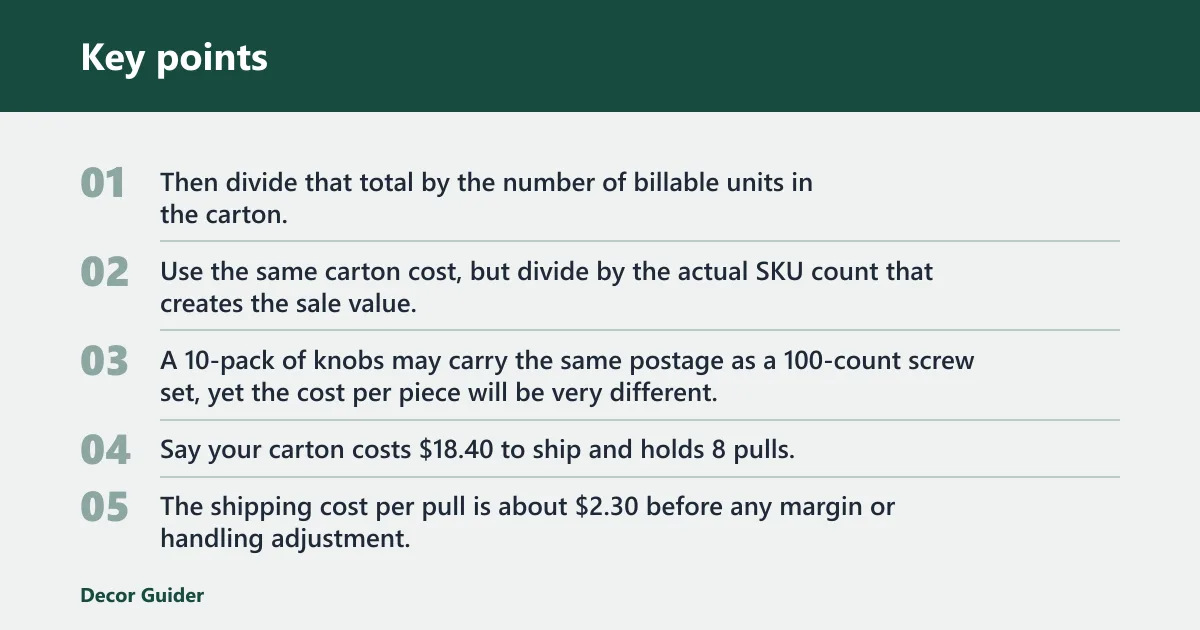
Then divide that total by the number of billable units in the carton. If the order ships in more than one package, calculate each carton separately and add them together before dividing by the total units in the order, or allocate the carton cost by the SKU or kit that creates the shipment.
Per-piece cost for knobs, pulls, hinges, and screws
Use the same carton cost, but divide by the actual SKU count that creates the sale value. A 10-pack of knobs may carry the same postage as a 100-count screw set, yet the cost per piece will be very different. That is why per-item shipping should be tied to pack size, not just order subtotal.
Say your carton costs $18.40 to ship and holds 8 pulls. The shipping cost per pull is about $2.30 before any margin or handling adjustment. If the same box holds about 80 screws, the shipping cost per screw is about $0.23, which is why screw packs often need a separate minimum-charge rule.
Mixed kits and split shipments
Mixed kits need a unit rule that follows the dominant SKU or the highest-density component. If a kit contains 4 hinges, 2 pulls, and a bag of screws, treat the box as one ship unit unless the carton must split across two boxes. Split orders should carry both cartons into the total, because each label can trigger its own base rate and surcharge set.
A common first-timer mistake is pricing a kit as if it will always fit one small box. Once the order crosses the size limit, the rate can jump because the package falls into a larger zone rate class or picks up dimensional weight.
Shipping zones and delivery speed
Zone and speed are separate levers. A close destination in a slow service may still beat a distant destination in a faster one, but the faster service almost always costs more. For cabinet hardware, the right rule is to quote service-specific rates, not a single flat postage number.
USPS zones 1 through 9
Zones are geographic areas carriers use to calculate delivery times and prices. The United States is generally broken down into several distance bands, and USPS uses zone designations that include Local and numbered zones. As zone distance increases, rates usually rise too, even when package weight stays the same.
Ground, 2-day, overnight, and same-day pricing
Standard and ground services usually work best for small hardware orders that are not time-sensitive. Two-day, overnight, and same-day options cost more because the carrier is moving the package faster. Use a separate rate for each service, then decide whether your store absorbs part of the premium or passes it through.
When faster service changes unit cost
Speed changes unit cost most on small orders. A single knob set or sample pack can carry a large share of the base rate, so a faster service may double the shipping cost per piece even when the package weight does not change. That is why express options should be optional unless the SKU is urgent by design.
How do you calculate dimensional weight?
Dimensional weight is calculated by multiplying length, width, and height, then dividing by a carrier-specific divisor. Billable weight is the higher of actual weight or dimensional weight after packing, so a light but bulky carton can cost more than a heavier compact one. The carton should be measured after sealing it.
Length, width, and height after packing
Measure the longest outside points on the sealed box. Empty space matters because it increases the dimensions even when the hardware itself is small. For cabinet hardware, oversized void fill or a box that is too deep can push the shipment into a higher billed weight than the actual scale reading.
Carrier divisors and billable weight
The divisor changes by carrier, service, rate type, package, and contract. USPS, FedEx, UPS, and DHL all publish service-specific rules that can differ by shipment type and pricing arrangement.
Example: a sealed carton measuring 12 × 10 × 8 inches has a DIM weight of about 5.8 pounds when divided by 166, before carrier rounding rules are applied. If the actual packed weight is about 4.2 pounds, the billable weight is the higher of the two numbers.
When a smaller box lowers cost
A smaller box lowers cost when the dimensional weight drops enough to move the package into a lower billed tier. This is common with hinges, pulls, and screws shipped in padded or right-sized cartons. If the box still protects the hardware, reducing empty space can cut postage without changing the product count.
- Weigh the packed carton. Record the actual package weight after tape, labels, and void fill are added. Use the packed weight, not the loose product weight, because carriers bill the finished parcel.
- Measure the sealed box. Capture the longest outside length, width, and height. Do not use the inner box size, since billing is based on the outside dimensions after sealing.
- Calculate DIM weight. Multiply length × width × height and divide by the carrier divisor for that service. Compare that number with the actual weight, then use the higher one as billable weight.
- Price the service zone. Enter the destination ZIP code into the carrier tool and note the zone and service level. Zone distance and speed both move the rate.
- Add non-postage costs. Include packaging supplies, insurance, and a reserve for surcharges or damage. This keeps cabinet hardware prices from being too low on checkout and too high on light orders.
What fees should you add besides postage?
Postage is only one part of shipping cost. Packaging supplies, insurance, and surcharge reserves can materially change the landed shipping number, especially for small dense hardware orders that ship in low-cost cartons but still need protection and tracking support.
Packaging supplies and void fill
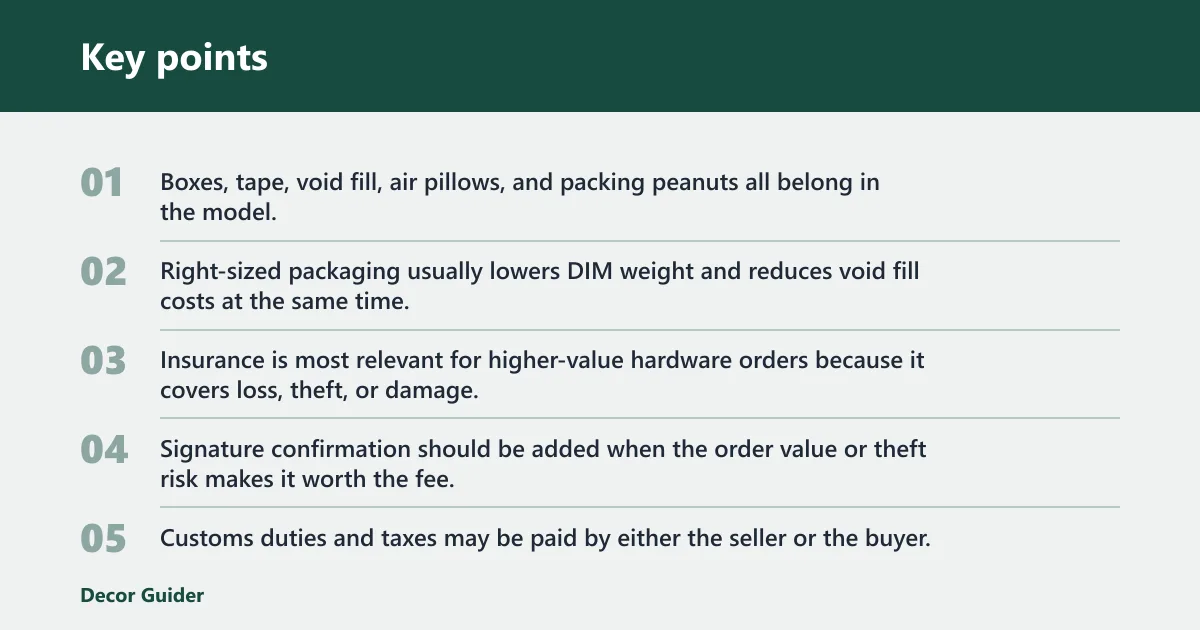
Boxes, tape, void fill, air pillows, and packing peanuts all belong in the model. USPS provides some free materials for some levels of shipping, but many cabinet hardware sellers still need to buy right-sized cartons to avoid wasted space. Right-sized packaging usually lowers DIM weight and reduces void fill costs at the same time.
Insurance and signature confirmation
Insurance is most relevant for higher-value hardware orders because it covers loss, theft, or damage. It is often priced as a percentage of item value, so a premium brass pull order should be treated differently from a low-value screw pack. Signature confirmation should be added when the order value or theft risk makes it worth the fee.
Fuel, residential, oversize, and address correction surcharges
Build a surcharge reserve into every quote for fuel, oversize package, residential delivery, signature required, and address correction. Some of those fees apply only on certain shipments, but a reserve keeps your checkout estimate close to the final invoice. That is especially useful for bulky mixed kits and split shipments.
Duties and taxes for international orders
Customs duties and taxes may be paid by either the seller or the buyer. If you ship cabinet hardware across borders, state clearly who pays those charges at checkout. Duties and taxes are part of landed cost, not the carrier shipping charge itself.
Cabinet hardware shipping worksheet
Use this worksheet to convert a carton quote into a per-hardware-unit shipping cost. Fill in the box data first, then calculate the total order shipping cost, then divide by the number of units in the shipment.
| Field | Example value | Formula or note |
|---|---|---|
| Package weight | 4.2 lb | Actual packed weight after sealing |
| DIM weight | 5.8 lb | Length × width × height ÷ carrier divisor |
| Carrier zone | Zone 4 | Based on destination ZIP code band |
| Base rate | $12.40 | Quoted service rate for the billable weight |
| Packaging cost | $1.35 | Box, tape, void fill, label materials |
| Insurance | $0.90 | Based on declared item value and carrier rule |
| Surcharge reserve | $1.25 | Fuel, residential, oversize, address correction buffer |
| Total order shipping cost | $15.90 | Base rate + packaging + insurance + reserve |
| Knobs, cost per piece | $1.99 | $15.90 ÷ 8 knobs |
| Pulls, cost per piece | $3.98 | $15.90 ÷ 4 pulls |
| Hinges, cost per piece | $1.59 | $15.90 ÷ 10 hinges |
| Screws, cost per piece | $0.16 | $15.90 ÷ 100 screws |
| Mixed kit, cost per set | $15.90 | One ship unit if the carton ships as one kit |
Use the worksheet to set floor pricing rules. If the calculated per-piece number falls below your minimum, set a shipping floor for that SKU type instead of using the raw math.
How to price orders by SKU type
Cabinet hardware does not ship as one uniform category. Replacement parts, sample packs, bulk orders, and mixed kits all create different shipping patterns, so each should have its own threshold and shipping rule.
Single items and replacement parts
Single knobs, pulls, or hinges often have the highest shipping cost per piece because the carton still needs a label, a box, and carrier handling. Use a minimum-charge threshold here so postage does not sink margin on one-item orders. If the actual rate is lower, the minimum still covers carton handling and labor.
Sample packs and small assortments
Sample packs are usually light, but they can still trigger a nontrivial base rate. For these orders, right-sized packaging matters more than the product weight. A padded mailer may work when the hardware cannot shift and the carrier accepts the package format for the service selected.
Bulk orders and mixed hardware kits
Bulk orders should be priced from carton count, not from item count alone. If a hardware bundle needs two boxes, the rate should reflect both labels, both boxes, and both sets of possible surcharges. Mixed kits should be assigned a kit rule so a light screw pack does not hide the cost of heavier parts in the same order.
Suppose a mixed kitchen bundle includes 12 pulls, 24 hinges, and 200 screws. If it fits one carton, the cost per unit drops sharply as the piece count rises. If the same bundle splits into two cartons because of space, the per-piece cost rises even though the hardware count stays the same.
Frequently asked questions
How are shipping costs calculated?
Shipping costs are calculated from package weight, dimensional weight, destination zone, and service speed, then adjusted for packaging, insurance, and surcharges. For cabinet hardware, the best practice is to calculate the carton total first and then divide by the number of pieces or kits inside the box.
How do I calculate shipping costs for cabinet hardware?
Measure the sealed carton, weigh it, compare actual weight to DIM weight, and use the higher number for the carrier quote. Then add packaging supplies, insurance, and a surcharge reserve. Divide the final total by the number of knobs, pulls, hinges, screws, or kits in the shipment when the order is a single, uniform carton.
What is dimensional weight and how does it affect shipping?
Dimensional weight is a billing weight based on the carton’s outside size rather than just its scale weight. Carriers calculate it by multiplying length, width, and height, then dividing by a carrier-specific divisor. If DIM weight is higher than actual weight, the carrier bills the DIM number.
How do carrier zones change shipping cost?
Carrier zones are distance bands between the origin and destination ZIP codes. As the zone number rises, rates usually rise too. USPS uses zone designations that include Local and numbered zones, so a nearby shipment generally costs less than a farther shipment at the same weight and service level.
Which shipping fees should I include besides postage?
Include packaging supplies, insurance, and a reserve for surcharges such as fuel, oversize package, residential delivery, signature required, and address correction. For international shipments, add duties and taxes if they are part of your landed-cost model. Those items often decide whether an order is profitable.
How do I calculate shipping cost per item?
Calculate the full carton cost first, including postage, packaging, insurance, and surcharge allowance. Then divide by the number of items in the box when the shipment is a single SKU or a uniform kit. If the order is mixed or split across cartons, allocate the cost by carton or by the SKU mix before setting the per-item rate.
Products related to this article
Sponsored / affiliate links. As an Amazon Associate I earn from qualifying purchases. I may earn additional commission from eligible campaigns.
 20PCS Home Decor Brick Hook, Metal Brick Wall Hanger for 2 - 1/4 to 2 - 2/5 Inch Bricks, No Drill Heavy Duty Alloy Steel Clip with 20 lbs Capacity for Indoor Outdoor Use20PCS Home Decor Brick Hook, Metal Brick Wall Hanger for 2 - 1/4 to 2 - 2/5 Inch Bricks, No Drill Heavy Duty Alloy Steel Clip with 20 lbs Capacity for Indoor Outdoor Use