How Much Does It Cost to Ship Kitchen Cabinets Today?
Shipping kitchen cabinets can cost roughly $150 to $400 for a few boxed parts by LTL freight, and around $600 to $2,500+ for larger full-kitchen orders; in general, flat-packed cabinets tend to ship cheaper than assembled ones. Weak packing can add hundreds in damage, return freight, and replacement parts. This article breaks down cabinet costs by format and freight method, then shows how packaging choices cut damage risk and total landed cost.
This guide is part of our Shipping costs and USPS postage rates series.
How much does it cost to ship kitchen cabinets?
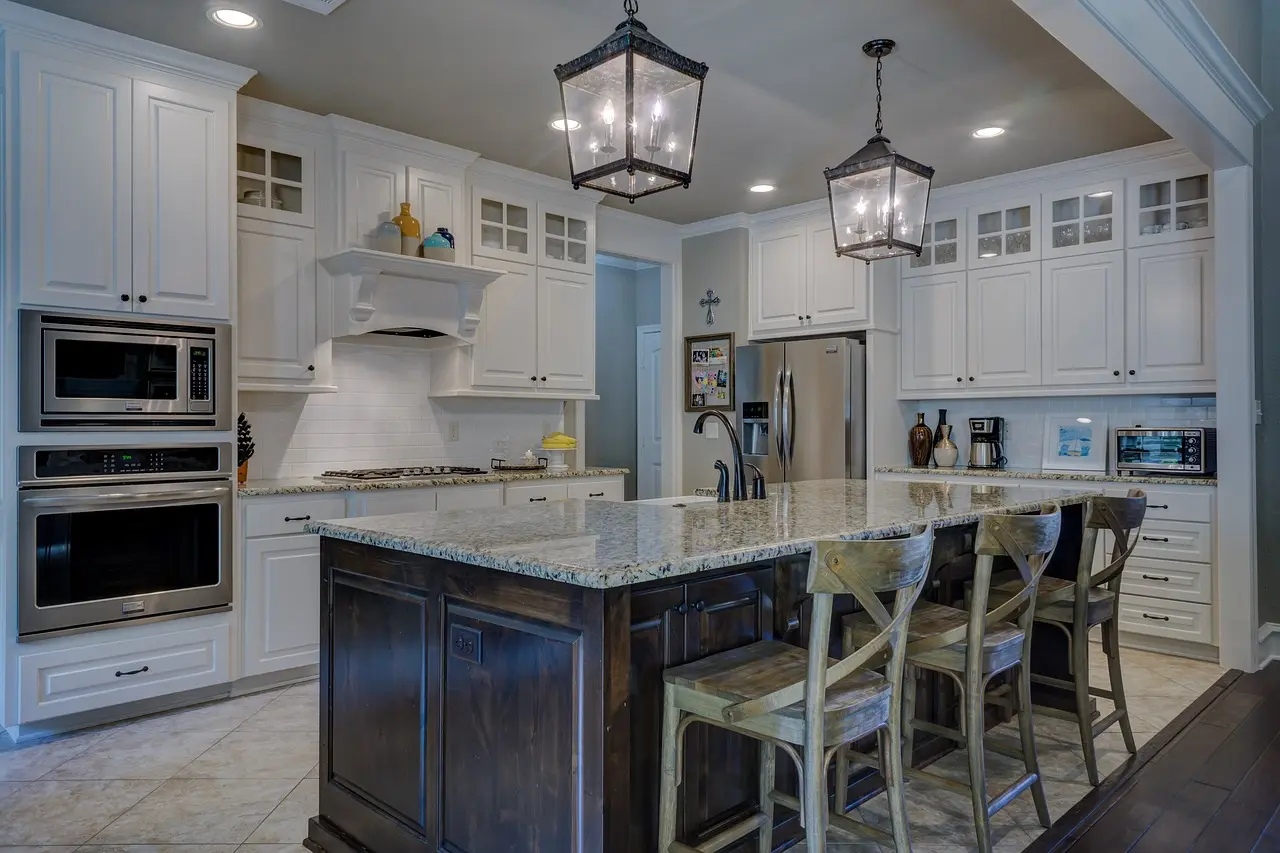
For most cabinet shipments, the price depends less on the “cabinet” label and more on how many cartons or pallets you move, how large they are, and which freight mode you choose. Small component orders may ship for $150 to $400 by LTL freight, while full kitchen orders often land in the $600 to $2,500+ range once packing and delivery charges are included.
Typical price ranges by shipping mode
Parcel works for small hardware boxes and a few flat-packed parts. LTL freight is the normal choice for multiple cabinet cartons or palletized loads. Full truckload and white-glove delivery cost more because you pay for dedicated capacity or inside handling, not just linehaul transport.
Two similar quotes can differ a lot because one quote may include palletizing, liftgate service, residential delivery, and declared value coverage, while another excludes them. The cheapest linehaul rate is not the same thing as the lowest landed cost.
What counts toward landed cost
Landed cost includes the freight charge, packaging materials, handling labor, terminal or accessorial fees, insurance or declared value charges, and any replacement parts if damage occurs. For cabinets, those hidden costs often matter as much as the base freight rate.
Short answer on cabinet price tiers
Cabinet purchase price and freight price move together because heavy or oversized units cost more to handle. Fully custom cabinetry commonly runs $500 to $1,200 per linear foot installed, and premium walnut, inset doors, and integrated appliance panels can push costs to $1,200 to $1,800 and up. A typical kitchen with 20 to 25 linear feet plans on roughly $18,000 to $34,000.
What drives cabinet shipping cost the most?
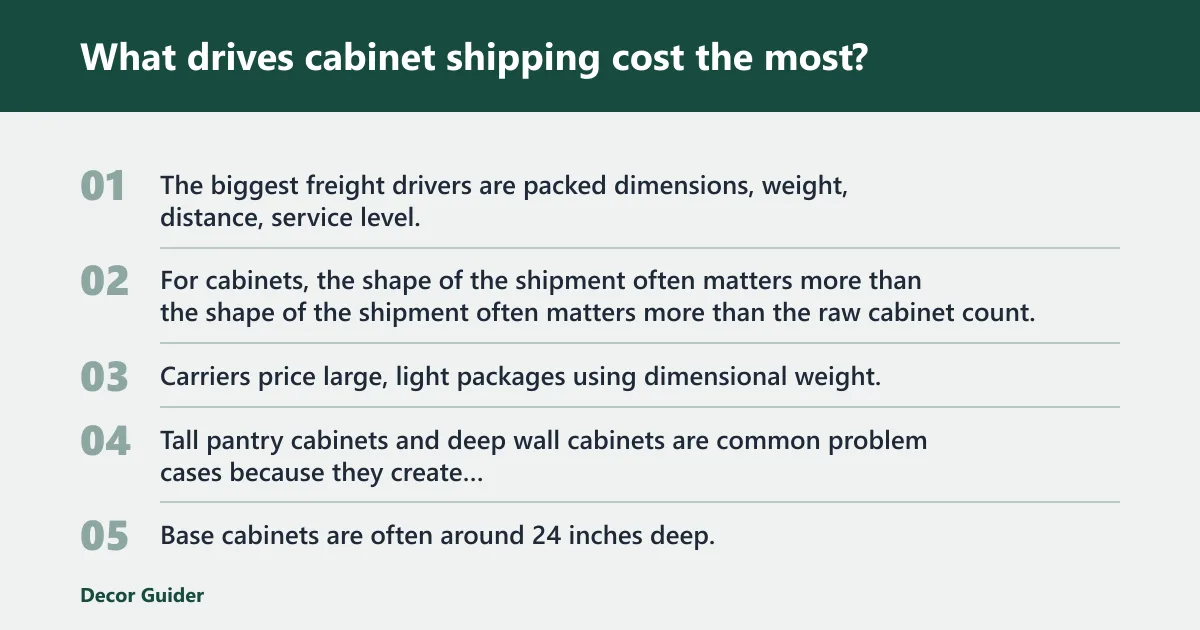
The biggest freight drivers are packed dimensions, weight, distance, service level, and accessorial charges. For cabinets, the shape of the shipment often matters more than the raw cabinet count, because bulky cartons can trigger dimensional pricing, oversize handling, or pallet requirements even when they are not especially heavy.
Cabinet dimensions and dimensional weight
Carriers price large, light packages using dimensional weight, which means a bulky box can cost more than its actual scale weight suggests. Tall pantry cabinets and deep wall cabinets are common problem cases because they create long, hard-to-stack cartons that occupy more freight space.
Typical cabinet sizes help explain why. Base cabinets are often around 24 inches deep, wall cabinets are commonly around 12 inches deep, and pantry cabinets can be quite tall, sometimes around 84 inches or more. Once a carton grows beyond standard parcel limits, LTL freight usually becomes the practical option.
Weight, distance, and delivery speed
Longer lanes cost more. Faster service also costs more. Expedited freight cuts transit time, but it usually raises the quote because the carrier has less routing flexibility and may charge more for priority handling or tight dock appointments.
Liftgate, residential delivery, and other accessorials
Liftgate service, home delivery, pickup from a limited-access site, inside delivery, and appointment scheduling can all add to the bill. Cabinets often ship to homes, remodel sites, or small warehouses where a dock is unavailable, so accessorials are common rather than exceptional.
Is it cheaper to ship cabinets assembled or flat packed?
Flat-packed cabinets are usually cheaper to ship because they take up less volume, stack better on pallets, and reduce the chance of freight oversize charges. Assembled cabinets can be more expensive to ship, but they may reduce on-site labor and lower the risk of missing parts if the manufacturer controls packing tightly.
Assembled cabinets
Assembled cabinets are bulky, more fragile at the corners, and harder to protect around doors and finished ends. They also create more void space in a carton or crate, which can inflate dimensional cost.
Flat-pack and knock-down cabinets
Flat-pack and knock-down formats separate panels, hardware, and fronts into compact cartons. That cuts freight volume, but it shifts risk to the packing stage. If the parts are not separated and labeled well, hardware loss and finish scuffs become more likely.
When partial disassembly lowers cost
Partial disassembly often makes sense for large pantry units, pre-assembled base cabinets with removable doors, or orders going by LTL freight. Removing doors, drawer boxes, and loose shelves can shrink the cube enough to avoid oversize pricing and reduce damage to hinges and finished surfaces.
Which shipping mode is cheapest for kitchen cabinets?
The cheapest usable mode depends on size. Parcel is cheapest for small parts, LTL freight is cheapest for most cabinet orders, full truckload fits very large projects, and white-glove delivery is the most expensive because it includes more handling. For cabinets, the lowest base rate is not always the lowest total cost.
Parcel for small components
Use parcel only for small hardware kits, replacement fronts, or a few compact flat-pack parts. Once boxes get large or heavy, parcel dimensional weight can jump quickly and make the bill worse than freight.
LTL freight for most cabinet orders
LTL freight is usually the right balance for a kitchen set, especially when the order can be palletized. Carriers can move one or more pallets with standard freight equipment, and that keeps the cost lower than dedicated truck service for many shipments.
Full truckload and white-glove delivery
Full truckload makes sense for large remodels, multi-unit orders, or fragile custom cabinetry that needs dedicated space. White-glove or inside delivery suits high-value installs, but it adds handling and labor charges. It is the most protective option, not the cheapest.
How do you pack kitchen cabinets for shipping?
Pack cabinets to prevent corner damage, finish scuffs, and hardware loss before they reach the carrier. Use double-wall boxes for smaller parts, protect edges and corners, keep moving pieces from rubbing, and secure the load to a pallet or crate so it can survive transit and terminal handling.
Double-wall boxes, corner protectors, and edge guards
Double-wall boxes resist crush damage better than single-wall cartons. Use corner protectors, foam or cardboard edge guards, and stretch wrap to keep cabinet faces, ends, and toe kicks from rubbing against each other or against the crate wall.
A common first-timer mistake is taping a loose door to a cabinet face and calling it protected. That still allows hinge stress, finish rub, and corner chipping when the load shifts.
Palletizing versus crating
Palletizing works for many stock and semi-custom orders because it keeps cartons together and easier to move with forklifts or pallet jacks. Crating is better for high-value custom units, fragile finishes, or loads with awkward shapes that need rigid side protection.
Protecting doors, hinges, drawer boxes, and finished ends
Doors and drawer fronts need separation so they do not scuff each other. Hinges should be immobilized or removed if the cabinet is shipping flat packed. Finished ends need extra padding because they often take the first impact at the pallet corners and crate edges.
What size box or crate do kitchen cabinets need?
Cabinet packaging should fit the form factor without leaving enough void space for movement. Base cabinets may fit on standard pallets with cartons sized around the cabinet footprint, wall cabinets usually need shallower boxes, and tall pantry cabinets often need custom crates because their height pushes them into oversize freight territory.
Base cabinet, wall cabinet, and pantry cabinet examples
A 30-inch base cabinet can often travel in a reinforced carton or on a palletized footprint if the doors are removed and protected separately. A 36-inch wall cabinet often ships more efficiently when packed flat and stacked with separators. A pantry cabinet near 84 inches high may need a crate or a custom pallet build.
Oversize thresholds and dimensional weight
Once a package exceeds common parcel limits, carriers may reclassify it or add oversize fees. Dimensional weight also applies when the box is large relative to its actual weight, which is why big but light cabinet boxes can still ship expensive.
How to measure packed dimensions before quoting
- Measure the longest side of the packed unit.
- Measure width and depth after padding, edge guards, and outer carton allowance.
- Add pallet height if the cabinet rides on a pallet.
- Record total weight with hardware and packing materials included.
- Quote the shipment using the packed, not bare, dimensions.
How do insurance and claims work for cabinet shipping?
Cabinet shipping claims depend on declared value, carrier liability, and proof of condition before pickup. Standard carrier liability may not cover full replacement cost, especially for finish damage or missing parts, so documentation matters. Photograph everything before the freight leaves the dock.
Declared value versus carrier liability
Declared value is not the same as full insurance. Carrier liability is often limited by freight class, paperwork, and claim rules. If the shipment is expensive or custom, declared value coverage or third-party cargo insurance may be worth the extra cost.
Photo documentation before pickup
Take clear photos of each cabinet face, each carton, pallet corners, labels, and any pre-existing marks before pickup. Keep photos that show the load condition after wrapping and again at handoff. Those images support both damage claims and shortage claims.
What to save if a claim is needed
Save the bill of lading, packing list, delivery receipt, inspection notes, photos, and replacement invoices. If the carrier asks for proof, incomplete paperwork can delay or weaken the claim.
Shipment-cost matrix: cabinet type, packing level, and freight method

This matrix shows realistic landed-cost ranges by form factor, packed size, mode, and protection level. The ranges assume domestic U.S. freight, typical accessorials for cabinet shipments, and packed dimensions rather than bare cabinet dimensions. Bigger and more fragile loads move the quote upward quickly.
| Cabinet type | Quantity | Packed dimensions | Freight mode | Protection level | Realistic landed-cost range |
|---|---|---|---|---|---|
| Flat-pack stock wall cabinets | 2 to 4 cartons | 24 x 18 x 8 in each | Parcel | Double-wall box, corner pads | $150 to $300 |
| Assembled stock base cabinet | 1 to 2 units | 30 x 24 x 36 in on pallet | LTL freight | Stretch wrap, edge guards, pallet | $220 to $500 |
| Semi-custom wall and base set | 6 to 10 cabinets | One or two pallets, 48 x 40 x 48 in each | LTL freight | Palletized, foam corners, liftgate | $600 to $1,200 |
| Custom pantry cabinet | 1 tall unit | 30 x 24 x 90 in in crate | LTL freight | Crate, internal blocking, finish wrap | $450 to $950 |
| Full kitchen, assembled mixed set | 12 to 18 cabinets | 3 to 5 pallets, mixed sizes | Full truckload or LTL | Crated high-value parts, palletized remainder | $1,200 to $2,500+ |
| Premium custom inset set with appliance panels | Large order | Multiple oversized crates | White-glove or truckload | Crate, inside delivery, appointment | $2,000 to $4,500+ |
Damage-risk checklist by packaging level
- Low protection: single-wall cartons, loose hardware, no corner guards, no pallet.
- Medium protection: double-wall cartons, edge guards, stretch wrap, palletized load.
- High protection: internal blocking, crate, separated doors and drawers, labeled hardware packs.
- Highest protection: crated shipment, pallet base, inside delivery, photo log, declared value coverage.
Which options cut total landed cost the most
For many orders, the best savings come from flat-packing removable parts, palletizing the rest, and avoiding unnecessary inside delivery. White-glove service can still be the right choice for premium finishes or tight access, but it should be chosen for risk control, not because it looks cheaper on the front end.
How do you decide the cheapest usable shipping option?
Start with the cabinet form factor, then choose the smallest mode that still protects the finish. Flat-pack parts often ship best by parcel or LTL, assembled cabinets usually move by LTL, and tall or high-value sets may justify crating or full truckload. The goal is low damage risk, not the lowest sticker rate.
Short decision path
- Measure packed size, not bare cabinet size.
- Separate small parts from large cabinet boxes.
- Use parcel only for compact cartons.
- Use LTL freight for palletized cabinet loads.
- Choose crating or white-glove only when the finish value or access problem justifies it.
Say your order includes four 30-inch wall cabinets and one 84-inch pantry cabinet. The wall cabinets may ship economically on one pallet, while the pantry unit may need a crate because its height pushes it into oversize handling. Splitting the load can lower damage risk and avoid paying premium handling on every piece.
What about stock, semi-custom, custom, and flat-pack cabinets?
Stock cabinets usually ship cheapest because their sizes are standardized and their packaging is easier to repeat. Semi-custom cabinets often cost more to ship because of mixed dimensions and more finish choices. Custom cabinetry can cost the most because each carton or crate may need a unique layout, especially with inset doors or integrated panels.
How cabinet construction changes shipping cost
Flat-pack cabinets are easier to cube efficiently. Assembled cabinets are faster to install but harder to protect. Stock lines are predictable. Semi-custom and custom builds often need more labor in packing, and that labor becomes part of the freight budget.
Installation alone commonly represents 25 to 40 percent of the total project cost, so shipment choices should be weighed against on-site labor and replacement risk. White oak adds roughly 15 to 25 percent to cabinet cost, and inset doors add 20 to 30 percent over overlay doors. Those upgrades usually deserve better packing, too.
How long does it take to ship kitchen cabinets?
Transit time is usually short compared with production time. Standard freight may take a few days to a week once the order is ready, but cabinet projects often wait on fabrication and packing. Plan on 6 to 16 weeks from approved drawings to installation, with freight timing fitting inside that wider schedule.
Delivery timing and lead time
Stock orders can move faster if they are already built. Semi-custom and custom orders usually spend more time in production, then ship by the most efficient freight mode available. If you need inside delivery or a liftgate, add time for appointment scheduling.
Frequently asked questions
How much does it cost to ship kitchen cabinets?
Small boxed cabinet parts may ship for about $150 to $400 by LTL freight, while full kitchen orders often run $600 to $2,500+ once palletizing, accessorials, and delivery service are included. Flat-pack loads usually cost less than assembled loads because they take up less freight space.
What is the cheapest way to ship kitchen cabinets?
The cheapest usable option is usually palletized LTL freight for larger orders, or parcel for very small component boxes. Flat-pack formats cut volume and can avoid oversize fees. Cheap linehaul alone is not enough; you also need enough protection to avoid finish damage and claim delays.
How do you pack kitchen cabinets for shipping?
Use double-wall boxes for smaller parts, then add corner protectors, foam or cardboard edge guards, stretch wrap, and a pallet or crate. Keep doors, drawer boxes, and hardware from rubbing. Label each box clearly so missing parts do not slow the install.
Is it cheaper to ship cabinets assembled or flat packed?
Flat-packed cabinets are usually cheaper to ship because they reduce cube, stack better, and lower the chance of oversize handling. Assembled cabinets can cost more in freight but may save labor at delivery. For tall or fragile units, partial disassembly often gives the best balance.
What size box or crate do kitchen cabinets need?
Base cabinets often fit on a standard pallet with a reinforced carton, wall cabinets usually need shallow cartons, and pantry cabinets often need custom crates because of their height. Packed dimensions should include all padding, blocking, and pallet height before you ask for a quote.
Do kitchen cabinets need special handling in transit?
Yes. Doors, hinges, finished ends, and drawer boxes are common failure points, and corner chipping happens fast when a load shifts. Cabinets often need palletizing, edge protection, and sometimes crating. White-glove or inside delivery is worth considering for premium finishes or difficult access.
Products related to this article
Sponsored / affiliate links. As an Amazon Associate I earn from qualifying purchases. I may earn additional commission from eligible campaigns.