How Much Does It Cost to Ship a Coffee Table? Prices
Shipping a coffee table is often cheaper by parcel if it’s flat-pack or under parcel limits; oversized, fully assembled tables often move to freight, where costs are higher and packaging size can affect the service tier. I’ve seen a cheap shipment turn into dimensional-weight charges, damage claims, or a freight bill nobody budgeted for, simply because the carton was a little too deep. This guide breaks down parcel vs freight, packing choices, and the price shifts sellers, movers, and buyers should expect.
This guide is part of our Shipping costs and USPS postage rates series.
How much does it cost to ship a coffee table?
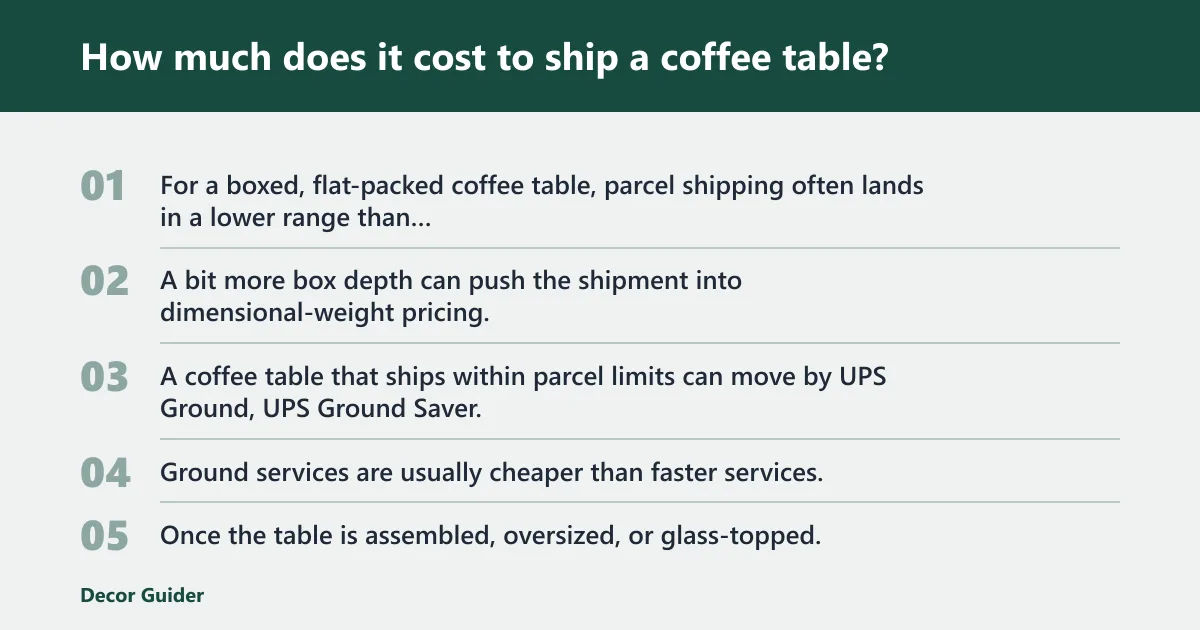


For a boxed, flat-packed coffee table, parcel shipping often lands in a lower range than freight, but the exact quote depends on origin ZIP, destination ZIP, service speed, and packed size. A bit more box depth can push the shipment into dimensional-weight pricing, which can raise the cost noticeably.
Typical price ranges by parcel and freight
A coffee table that ships within parcel limits can move by UPS Ground, UPS Ground Saver, FedEx Ground Economy, or UPS 3Day Select. Ground services are usually cheaper than faster services, and business rates can differ from retail rates. Once the table is assembled, oversized, or glass-topped, freight often becomes the more realistic lane.
What pushes a quote up fast
The fastest quote jumps usually come from box depth, not miles. A deeper carton raises dimensional weight, and a longer zone can amplify that jump. Fragile surfaces, weak corner protection, or a packed shape that no longer fits parcel rules can also shift the shipment into freight pricing.
Why packed size can matter more than packed weight
Carriers rate by the greater of scale weight and dimensional weight. That means a heavy box can still price as though it were heavier if the carton is bulky. For coffee tables, a wide but shallow pack is often cheaper than a slightly deeper one that triggers a higher billable weight.
📊 A flat-packed coffee table can be roughly 46 × 28 × 8 inches. Source: How much does it cost to ship a coffee table?.
What box size do I need to ship a coffee table?
A flat-packed coffee table can be roughly 46 × 28 × 8 inches, and the guide’s typical boxed size is about 46 × 28 × 8 in once boxed. Assembled tables usually need a larger carton or custom build-up, and the packed dimensions often matter more than the raw table size when a carrier prices the job.
Assembled vs flat-packed dimensions
When legs are removed, the top can sit flatter and the carton stays shorter. That keeps the shipment inside parcel rules more often. A fully assembled coffee table usually needs a taller box, which can increase the billable weight and make the shipment more likely to move by freight.
How leg removal changes the carton
Removing the legs usually lowers the bill because it cuts box depth and lets the table pack in a tighter rectangle. The packed weight is typically 35–55 lb when legs are removed. If the legs stay on, the box often grows enough to jump into a higher dimensional-weight band.
When a deeper box triggers dimensional-weight pricing
Even a modest depth increase can matter. A box that gets noticeably deeper may look harmless on paper, yet it can raise the billable weight enough to change the service tier. Padding should protect the table, but padding that adds unnecessary depth can become expensive padding.
How dimensional weight changes the bill
Dimensional weight is the billable weight used when a package is bulky for its actual mass. Carriers compare actual weight with dimensional weight and charge the higher number. For coffee tables, the carton footprint and depth can matter more than the scale reading if the piece is light but wide.
Carrier divisor and billable weight
Carriers use a divisor in the dimensional-weight formula, then round to the next billable step. The practical result is simple: larger boxes charge more, even when the table inside is not heavy. That is why a carefully packed 62 lb shipment can still be priced above its scale weight.
Actual weight vs dimensional weight
Actual weight is the weight on the scale. Dimensional weight is based on the carton’s size. The shipping label uses the greater of the two, so a lighter table in a deep box can cost more than a heavier table in a flat pack. A few extra inches often matter more than another layer of foam.
Why a few extra inches can cost more than padding does
Padding is useful when it protects the finish without adding unnecessary bulk. But thick pads, oversized corner blocks, or too much void fill can add box depth fast. That can move the parcel into a higher price band, especially on cross-country routes where dimensional weight has more room to hurt.
Worked shipping scenarios for three common coffee tables
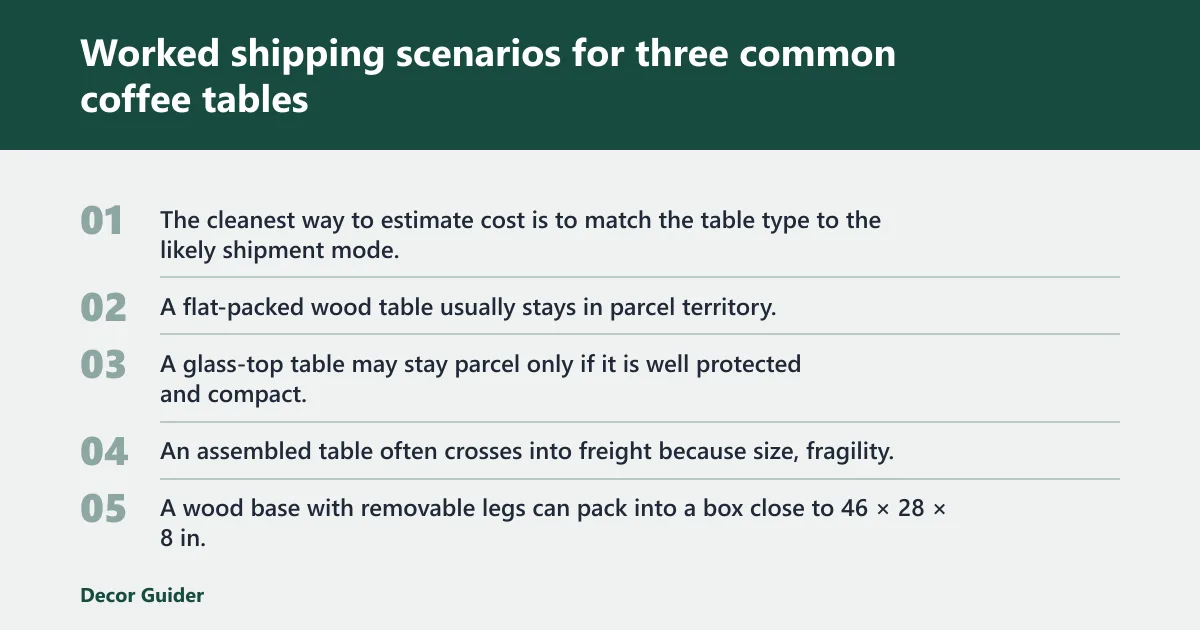
The cleanest way to estimate cost is to match the table type to the likely shipment mode. A flat-packed wood table usually stays in parcel territory. A glass-top table may stay parcel only if it is well protected and compact. An assembled table often crosses into freight because size, fragility, or both become the rate driver.
| Scenario | Likely packed form | Likely shipping mode | Billable-weight risk | Packing changes that can alter price |
|---|---|---|---|---|
| Flat-packed wood table | About 46 × 28 × 8 in; 35–55 lb when legs are removed | Parcel: UPS Ground, UPS Ground Saver, FedEx Ground Economy | Moderate if box depth creeps up | Remove legs, bag hardware, keep the top flat, use foam sheet plus rigid board |
| Glass-top table | Often wider or more heavily protected; may need a second carton | Parcel only if compact and well braced; freight if fragile or oversized | High if the protective carton is deep | Double-armored corners, rigid board, extra edge protection, crate if glass is exposed |
| Assembled table | Large, awkward, and often taller than parcel limits | Freight or special handling | Very high because the carton grows quickly | Disassemble if possible; otherwise use edge crate protection and pallet handling |
Flat-packed wood table: likely parcel case
This is the most predictable case. A wood base with removable legs can pack into a box close to 46 × 28 × 8 in, and that shape is usually friendly to parcel carriers. If the route is long, the service speed rises, or the carton gets thicker, the same table can still move from a modest quote to a noticeably higher one.
Glass-top table: higher damage risk and possible freight case
Glass is the trouble point. A glass top can ship as a parcel if it is well cushioned and the pack remains compact, but broken-glass claims are common when corners are exposed or the carton flexes. Once the protective build gets bulky, freight may make more sense than forcing a fragile panel through a standard parcel network.
Assembled table: when parcel stops making sense
An assembled table usually means more air around the item, more corner protection, and a taller carton. That is where parcel pricing starts to fail. If the table cannot be disassembled without damage, freight may be the cleaner option because the box can ride on a pallet instead of being tossed through parcel handling.
When does a coffee table need freight shipping?
A coffee table belongs in freight when assembled or with a glass top. Oversized slabs, fragile stone-like tops, and awkward base shapes also push a shipment out of parcel territory. If the carton becomes too large, too heavy, or too easy to damage, freight is often the safer and cheaper choice after claims are considered.
Oversized or fragile trigger points
Three common trigger points stand out: a large assembled footprint, a glass top that needs rigid face protection, and a base that cannot be compacted by removing legs. Any one of those can turn a normal parcel quote into a freight quote. If all three appear together, parcel usually stops making sense.
Edge crate protection and pallet use
Freight shipments are usually built with edge crate protection, rigid corners, and pallet support so the table is not bearing the abuse of parcel sorting. That extra build raises packing cost, but it also lowers breakage risk on long routes. For antiques and heirloom pieces, that trade is often worth making.
What parcel networks will usually refuse
Parcel networks are poor matches for oversized assembled tables, highly fragile glass tops, and cartons that cannot survive conveyor handling. If a quote requires an unusually deep box or a shape that bulges in the middle, the package may still be accepted but priced as though it were much heavier than the scale weight suggests.
How do I pack a coffee table so the quote stays low?
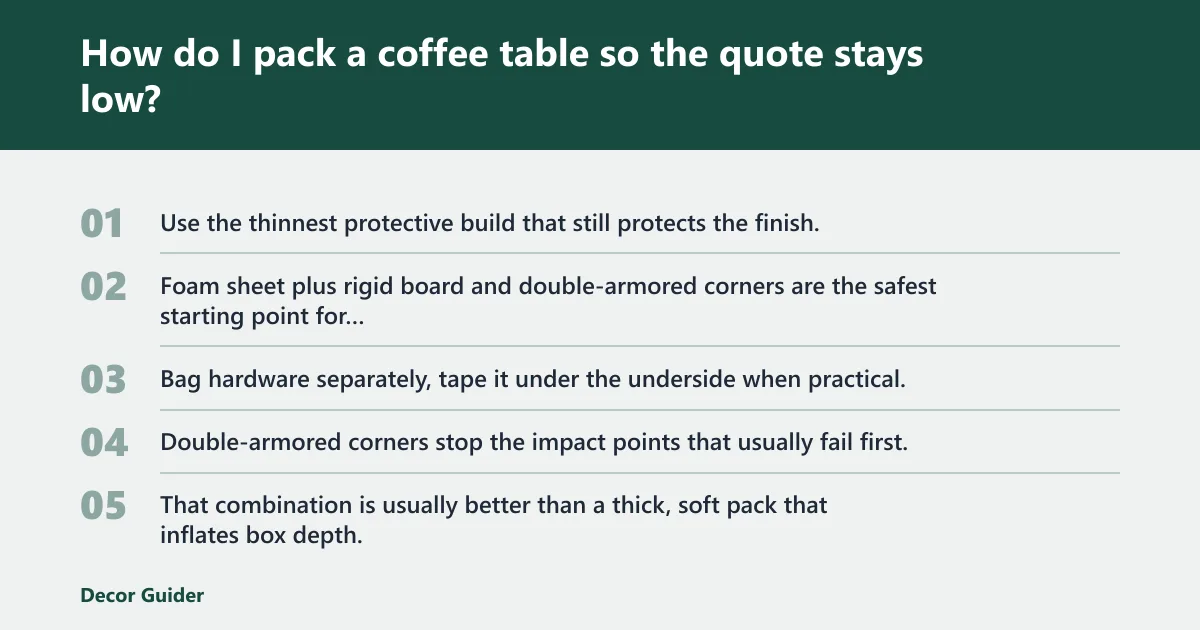
Use the thinnest protective build that still protects the finish. Foam sheet plus rigid board and double-armored corners are the safest starting point for most wood tables. Bag hardware separately, tape it under the underside when practical, and keep the carton flat enough that you do not pay for empty space.
Foam sheet, rigid board, and corner protection
Foam sheet cushions the surface. Rigid board spreads pressure. Double-armored corners stop the impact points that usually fail first. That combination is usually better than a thick, soft pack that inflates box depth. For wood tops, the goal is surface protection without turning the carton into a dimensional-weight penalty.
Bagging hardware and taping it under the underside
Loose screws and brackets create scratches and rattle damage. Put them in a labeled hardware bag, then tape the bag under the underside or attach it to a leg bundle if the table is disassembled. That keeps small parts with the shipment and prevents the extra filler that often makes cartons deeper than they need to be.
Protecting wood finishes and glass tops
For wood, a clean wrap matters more than a heavy wrap. Keep abrasive tape off the finish, and avoid packing material that can imprint into lacquer or veneer. For glass, add rigid face protection on both sides and keep the corners overbuilt. A cracked corner usually costs more than the packing upgrade that would have prevented it.
Frequently asked questions
How much does it cost to ship a coffee table?
Many flat-packed coffee tables can ship by parcel at a lower cost when the box stays compact and the route is ordinary. Fully assembled or glass-top tables often move into freight, where costs can be significantly higher and vary with size, packaging, and service level. ZIP codes and box depth change the quote quickly.
What box size do I need to ship a coffee table?
A flat-packed coffee table can be roughly 46 × 28 × 8 inches, and that is close to the guide’s typical boxed size. If the legs stay on, the carton usually grows taller and the rate often rises. Aim for the smallest box that still protects corners and finish.
How much does a coffee table weigh packed for shipping?
When legs are removed, the packed weight is typically 35–55 lb. A real example used 49 × 28 × 7 in at 62 lb. The scale number matters, but the carton’s size can still control the bill if dimensional weight is higher than the actual weight.
Can I ship a glass-top coffee table as a parcel?
Sometimes, yes, if the glass is tightly protected and the carton stays within parcel limits. But glass tops are brittle, and a damaged corner can ruin the piece. If the pack becomes bulky or the top needs crate-level protection, freight is usually the safer lane.
What is the cheapest way to ship a coffee table?
The cheapest option is usually a flat-packed parcel shipment with the legs removed, a shallow box, and a route that stays within ground service. UPS Ground, UPS Ground Saver, and FedEx Ground Economy are often lower than faster services. Entering the origin and destination ZIP codes into a calculator is still the best way to confirm.
Should coffee table legs be removed before shipping?
Yes, if the design allows it without weakening the piece. Removing the legs usually lowers the carton depth, which can reduce dimensional weight and keep the shipment in parcel territory. Bag the hardware, protect the leg ends, and keep the underside taped and labeled so reassembly is simple.
How much does it cost to ship a side table?
A side table usually costs less than a coffee table because it is smaller and easier to box. Many side tables stay inside light parcel pricing if the base separates and the top packs flat. Glass or ornate bases can still push the rate up, but the threshold is lower than for a coffee table.
Products related to this article
Sponsored / affiliate links. As an Amazon Associate I earn from qualifying purchases. I may earn additional commission from eligible campaigns.