How to Strap Down Outdoor Furniture for Storage
Use about two to four UV-resistant straps per furniture group. Tighten them to a fixed anchor, and add padding wherever webbing touches metal, wicker, or painted surfaces. Poor strapping lets wind lift pieces, scrape finishes, bend frames, and turn stored patio furniture into a hazard. This guide covers strap types, anchor choices, and material-specific steps for how to strap down outdoor furniture for storage.
Outdoor storage restraints table


| Furniture type | Safest strap type | Anchor point | Tension level | Common failure risk |
|---|---|---|---|---|
| Stackable chairs | Ratchet strap with soft edge padding | Deck post, wall point, or storage rack | Snug and immobile; no crush on frames | Side slide, strap rub on armrests, chair nesting shift |
| Chaise lounge | Ratchet strap, preferably with retractable take-up | Ground anchor or fixed wall point | Firm hold at the base and midsection | Uplift at the backrest, twisting, frame scuffing |
| Table | Ratchet strap | Immovable post, rack, or wall point | Secure legs and prevent racking | Leg splay, slide-out, corner impact |
| Sofa | Ratchet strap with padding at contact points | Fixed wall point or deck post | Firm enough to stop movement without frame bend | Frame twist, cushion shift, abrasion on coated metal or wicker |
| Covered set | Ratchet strap for the furniture, bungee cord only for the cover hem | Anchored to posts, rack, or ground point | Furniture fixed; cover retained without crushing the shape | Wind lift under the cover, seam stress, trapped condensation |
| Light side chair or soft goods bundle | Bungee cord for light retention only | Short run to a fixed point | Light hold, not structural restraint | Stretch rebound, poor hold in gusts, load slip |
What strap type should you use?
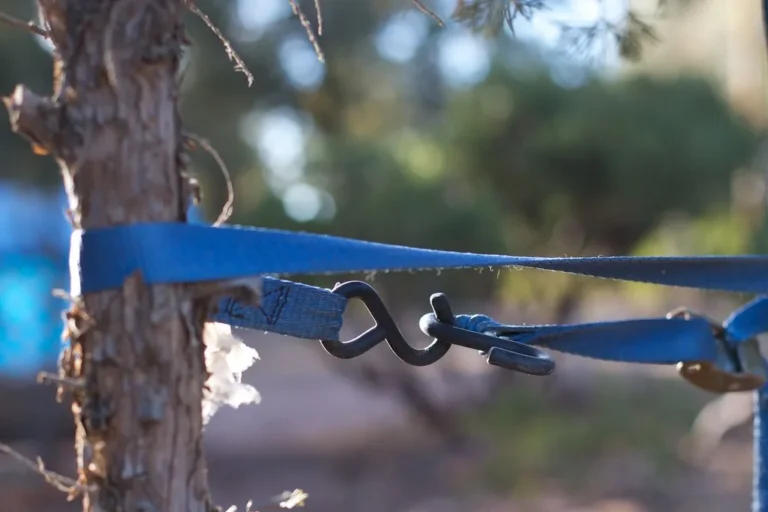
Ratchet straps are the right choice for firm tension on heavy or awkward pieces. Bungee cords work for light holding and cover retention, but they are less secure than ratchet straps and should not anchor heavy loads. Retractable versions are useful when you want cleaner take-up and less loose webbing.
Use ratchet straps for the furniture itself
Use ratchet straps when you need to stop wind lift, slide-out, or rotation. They suit outdoor furniture materials such as polyrattan, aluminium, steel, acacia, and eucalyptus, but do not crush frames or over-tighten on resin wicker, painted metal, or timber joints. Firm restraint is enough.
Use bungee cords only for light retention
Bungee cords can keep a cover hem from fluttering or hold a cushion bundle together. They should not be the main restraint for a chair, sofa, table, or stacked set. Because the cord stretches, a gust can move the load before the tension rises enough to resist it.
Suppose a 3-seat sofa sits on a balcony with a cover over it. A ratchet strap can hold the sofa to the railing post, while a short bungee can only help the cover stay seated at the hem. If the bungee is doing the main holding, the setup is under-secured.
When retractable straps help
Retractable strap options reduce slack and help keep excess webbing from whipping in the wind. That matters near powder-coated frames and resin wicker, where a loose strap tail can rub through a finish over time. Keep the take-up path short and direct.
How do you anchor patio furniture safely?
Anchor to immovable points such as deck posts, ground anchors, wall points, storage racks, or other fixed structures. Avoid twisting the strap path, because a twisted strap loads unevenly and can cut into edges. Larger pieces need multiple tie points so one gust does not shift the entire set.
Choose fixed points that cannot move
Deck posts, wall studs behind a storage rack, ground anchors, and heavy shelving frames are generally more secure anchors than loose railings or movable bins. A deck box may help with accessories, but it is not always a dependable anchor unless it is fixed and heavy enough not to slide.
Route straps to prevent abrasion
Run the strap over broad, stable contact areas. Avoid sharp corners, hinge points, and woven edges. On resin wicker, powder-coated steel, and vinyl straps, a narrow strap can wear a line where it crosses the frame, especially if the furniture rocks under gust load.
Use multiple tie points on larger furniture
A sofa, long table, or chaise lounge usually needs more than one anchor. One strap can stop sliding while another stops uplift or twist. For a stack of chairs, one lower strap can hold the nest together and a second strap can keep the stack from walking sideways.
A common first-timer mistake is strapping only the top rail of a chair stack. The stack then leans, the lower legs skate on the floor, and the whole bundle can tip during a crosswind. A lower strap, anchored low, reduces that slide-out risk.
How do you secure different furniture shapes?
Shape matters because wind finds gaps. Flat tables want anti-slide restraint, chaise lounges need uplift control at the raised section, and stackable chairs need compression across the stack. Match the method to the furniture shape, the frame material, and the available anchor point.
Stackable chairs
Stack chairs on a level surface, align the legs, and pass one strap low around the stack and one higher if the stack is tall. Place padding between the strap and any resin wicker, armrest, or powder-coated rail. The goal is to stop the stack from spreading or drifting, not to squeeze it flat.
Chaise lounges
For a chaise lounge, secure the base first, then add a second strap near the backrest if the seat can lift in the wind. Keep the strap off the recline mechanism and off sharp frame bends. If the chaise has wheels, block the wheels or immobilize them before strapping.
Tables and sofas
On tables, strap across the legs or lower frame, not across a glass or thin top edge. On sofas, place the strap where the frame is strongest, usually near the lower rails, and add padding where the webbing crosses coated metal or wicker weave. If cushions remain on the sofa, compress them lightly, not hard.
Covered pieces
A furniture cover should not carry the whole load. The furniture needs its own restraint first, then the cover needs wind retention. If the cover is fully waterproof, leave room for ventilation because trapped condensation can collect under it. Size the cover for chair backs, arms, knobs, and other protrusions.
Furniture cover retention
Use grommets at fastener points, then pair them with straps or tie-down cords so wind cannot lift the hem. Grommets reduce tearing at the attachment holes and give the strap a cleaner load path. A cover that is too tight on protrusions will wear at seams faster than one with proper clearance.
Grommets and straps work together
Grommets reinforce the spots where the cover is tied down. They are useful when the cover needs to stay on through gusts, especially on balconies, decks, and exposed patios. If the cover has no grommets, a strap may chafe the hem or pull the fabric apart at a weak point.
Watch for condensation under waterproof covers
Fully waterproof covers can trap moisture underneath. That matters in long storage, because damp fabric can linger against metal or wood and create a stale pocket under the cover. A cover that sheds rain well still needs enough airflow and the right size so it does not billow like a sail.
Protect seams and contact edges
Keep strap edges away from stitched seams, vinyl strap runs, and the corners of woven furniture. If a strap crosses the cover, use a broad, padded path and avoid forcing it over sharp hardware. The common failures here are seam wear, hem lift, and a strap that saws against the fabric in wind.
Material-specific strapping risks
Different materials fail in different ways under tension. Polyrattan and resin wicker can flatten or scuff. Aluminium dents less easily but can still get strap wear on coating. Steel adds sturdiness but can mark if the strap shifts. Acacia and eucalyptus need restraint that avoids crushing joints or bruising edges.
Polyrattan and resin wicker
Polyrattan is often chosen for moisture and UV resistance, but the weave can still abrade where a strap rubs repeatedly. Use padding or a soft cloth sleeve under the strap. Do not cinch so tightly that the weave distorts, especially at corners and armrests.
Aluminium and steel frames
Aluminium frames are easy to move, which helps during storage, but they still need a stable anchor so wind cannot slide them. Steel-framed patio furniture adds sturdiness, yet the coating can still wear if the strap moves. Keep the webbing flat and check for paint scuff marks after the first gusty day.
Acacia and eucalyptus
Wooden frames need firm but moderate tension. Too much force can mark the surface or stress joinery. Strap across the strongest sections of the frame, not across decorative slats. If the furniture has a fresh finish, add a soft barrier where the strap meets the wood.
Vinyl straps and cushions
Vinyl straps and cushion covers can deform under concentrated pressure. Use a wider strap path and do not bury the cushion stack under a hard pull. Cushions and accessories should be stored separately when possible, using a box or shelf so the furniture restraint does not have to hold soft items in place.
How should you store accessories and extras?
Store cushions, small parts, and loose accessories in storage boxes or on outdoor shelving units so they do not become windblown. Wheeled storage boxes are useful when you need to move items into a garage, shed, or covered corner. Vertical shelving helps keep small pieces organized and off the floor.
Storage boxes for cushions and small parts
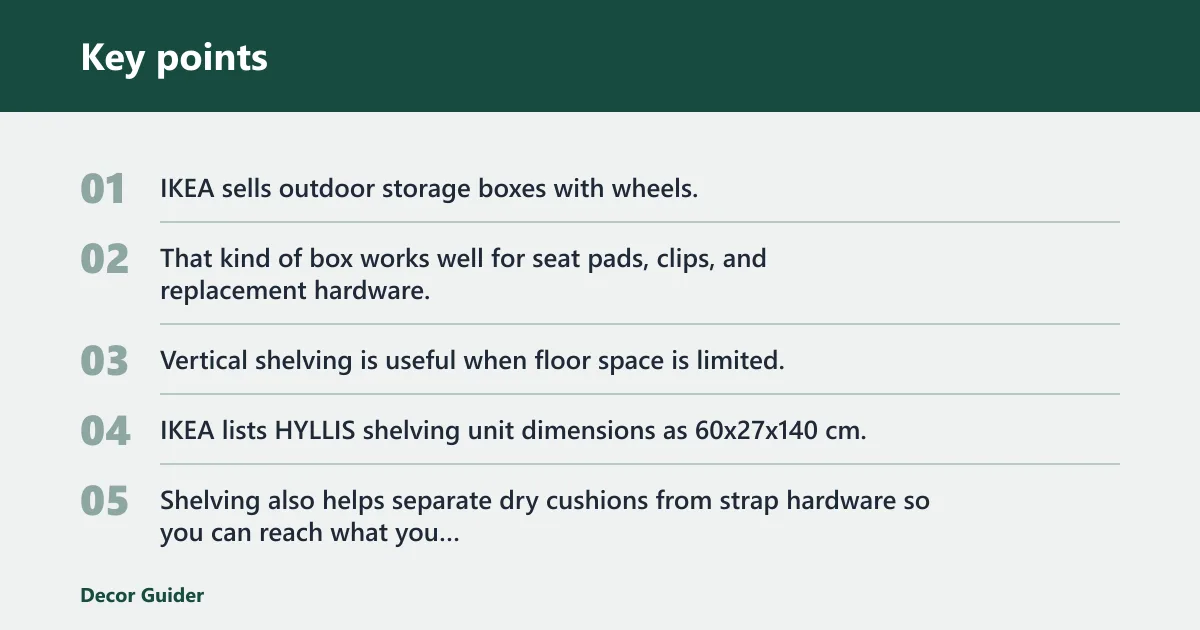
IKEA sells outdoor storage boxes with wheels, and some storage is described for indoor/outdoor use. That kind of box works well for seat pads, clips, and replacement hardware, as long as the lid closes securely and the box stays out of standing water. Keep cushions dry before boxing them.
Outdoor shelving units for vertical storage
Vertical shelving is useful when floor space is limited. IKEA lists HYLLIS shelving unit dimensions as 60x27x140 cm, which gives a compact footprint for small accessories. Shelving also helps separate dry cushions from strap hardware so you can reach what you need without untying the furniture.
Deck box and rack setup options
A deck box can hold accessories, but a storage rack is often a better anchor because it is built to receive lateral force. A fixed rack can also support a strap line for stacked chairs or folded tables. If the box is movable, do not rely on it as the only restraint point.
Say your balcony has one chair set, a small storage box, and no shed. You can strap the chairs to the railing posts, put cushions in the wheeled box, and keep the box lid latched. That setup limits wind lift without loading the box as the anchor for the furniture.
How do you store outdoor furniture outside over winter?
Keep it restrained, raised off wet ground where possible, and protected from direct wind paths. Outdoor winter storage works best when the furniture is tied to fixed points, the cover can breathe enough to avoid heavy condensation, and the straps are checked after the first storm rather than left untouched all season.
Down outdoor furniture decision matrix
| Storage setup | Best restraint approach | Key risk to control | Extra note |
|---|---|---|---|
| Garage | Strap to wall points or shelving frame | Slide-out on a smooth floor | Keep cushions separate in boxes |
| Shed | Ratchet straps to studs or racks | Rubbing on frame edges | Leave walking room so straps can be checked |
| Balcony | Short strap runs to railing posts or fixed wall points | Uplift from crosswind | Avoid overloading the railing with twisting force |
| Deck | Anchor to deck posts or ground anchors | Movement from exposed gusts | Pad any painted or coated contact area |
| Outdoor shed | Multiple tie points to fixed interior structure | Condensation and abrasion | Use covers with grommets and room for air flow |
A simple strapping method for irregular shapes
- Clean and dry the furniture so dirt does not grind into the finish. JYSK advises soft cloth or sponge with warm water and mild soap for most outdoor furniture, and mesh or textiline seating should be rinsed and dried completely.
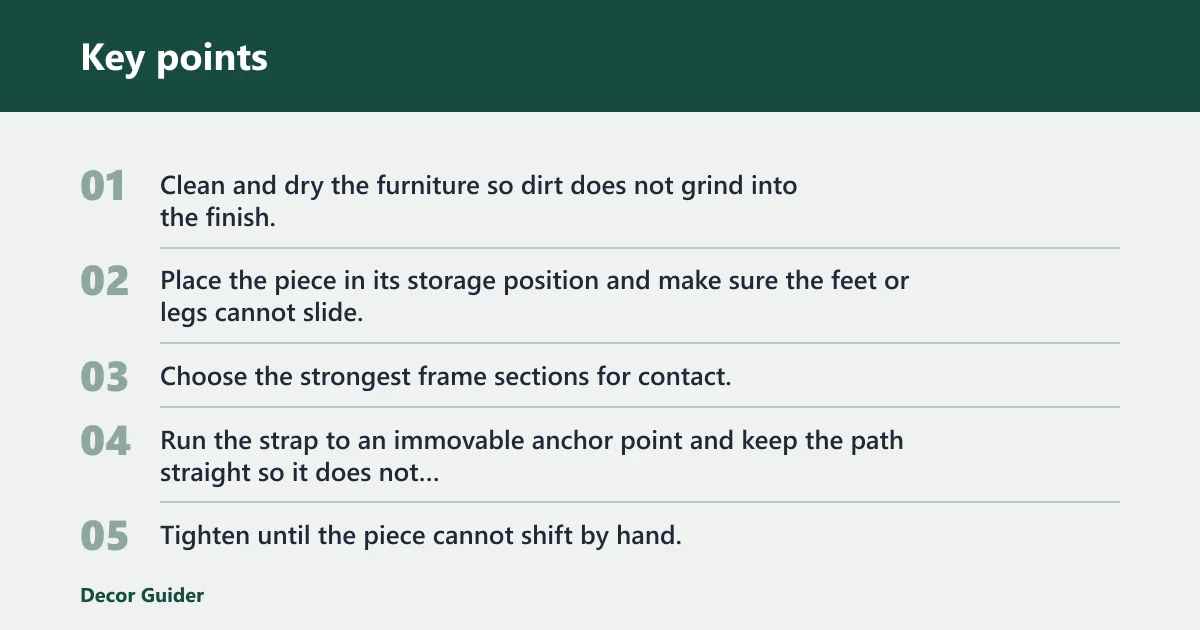
- Place the piece in its storage position and make sure the feet or legs cannot slide.
- Choose the strongest frame sections for contact, then add padding where the strap touches metal, wicker, vinyl, or paint.
- Run the strap to an immovable anchor point and keep the path straight so it does not twist.
- Tighten until the piece cannot shift by hand, then stop before the frame bends or the surface compresses.
- Check the strap tail, buckle, and contact points after the first gust or storm.
How do you strap down outdoor furniture for storage?
Place the furniture in its storage position, choose a fixed anchor, and run about two to four UV-resistant straps across the strongest frame points. Tighten until the piece cannot move by hand, then add padding where the webbing contacts metal, wicker, painted surfaces, or cover seams. Recheck after wind.
Frequently asked questions
Should I use ratchet straps or bungee cords for patio furniture?
Ratchet straps are the safer choice for the furniture itself because they give firm tension and hold shape under gust load. Bungee cords are better for light retention, cover hems, or soft goods. If the load is heavy, irregular, or likely to catch wind, use ratchet straps instead.
Do outdoor furniture straps need to be tight or just snug?
They should be firm, not crushing. The goal is to stop movement, twist, and uplift without bending frames or marking surfaces. If you can rock the piece by hand, it is too loose. If the frame bows or the weave flattens hard, it is too tight.
How do I keep patio furniture from blowing away in storage?
Use fixed anchor points, not loose objects, and strap the furniture low enough to stop slide-out as well as uplift. Larger pieces need more than one tie point. Covers should be retained separately with grommets or light cords so they do not act like sails.
What is the best way to secure stacked outdoor chairs?
Align the stack on a flat surface, then use one strap low around the legs and one higher if needed to prevent spread. Add padding at strap contact points to protect resin wicker, powder-coated rails, or vinyl straps. The lower strap is key for preventing sideways drift.
Can I strap furniture to a deck box or storage rack?
A storage rack is usually the better anchor because it is fixed and built to handle load. A deck box can hold accessories, but only use it as an anchor if it cannot slide, tip, or flex under tension. The anchor should stay immovable when the wind pulls.
How do I replace straps on outdoor furniture?
Remove the worn strap, inspect the frame holes or attachment points, and install replacement webbing or tie-down hardware that matches the original load path. If the old strap was frayed, add padding or grommet reinforcement where needed. Swap out hardware when the buckle, stitching, or anchor point shows wear.
Products related to this article
Sponsored / affiliate links. As an Amazon Associate I earn from qualifying purchases. I may earn additional commission from eligible campaigns.