Best Tie Down Straps for Securing Appliances in 2026: Based on Specs and Reviews
A common choice for securing appliances is a 1- to 2-inch polyester ratchet strap with non-marring hooks or soft loops, a working load limit of about 3 times the appliance weight, and padded contact points. Bad strap choice can dent cabinets, slip off anchor points, or tip a refrigerator or range in transit. This guide compares strap types, hardware, ratings, and finish-safe options for appliance moves.
Top pick: ratchet tie down straps for most heavy appliances
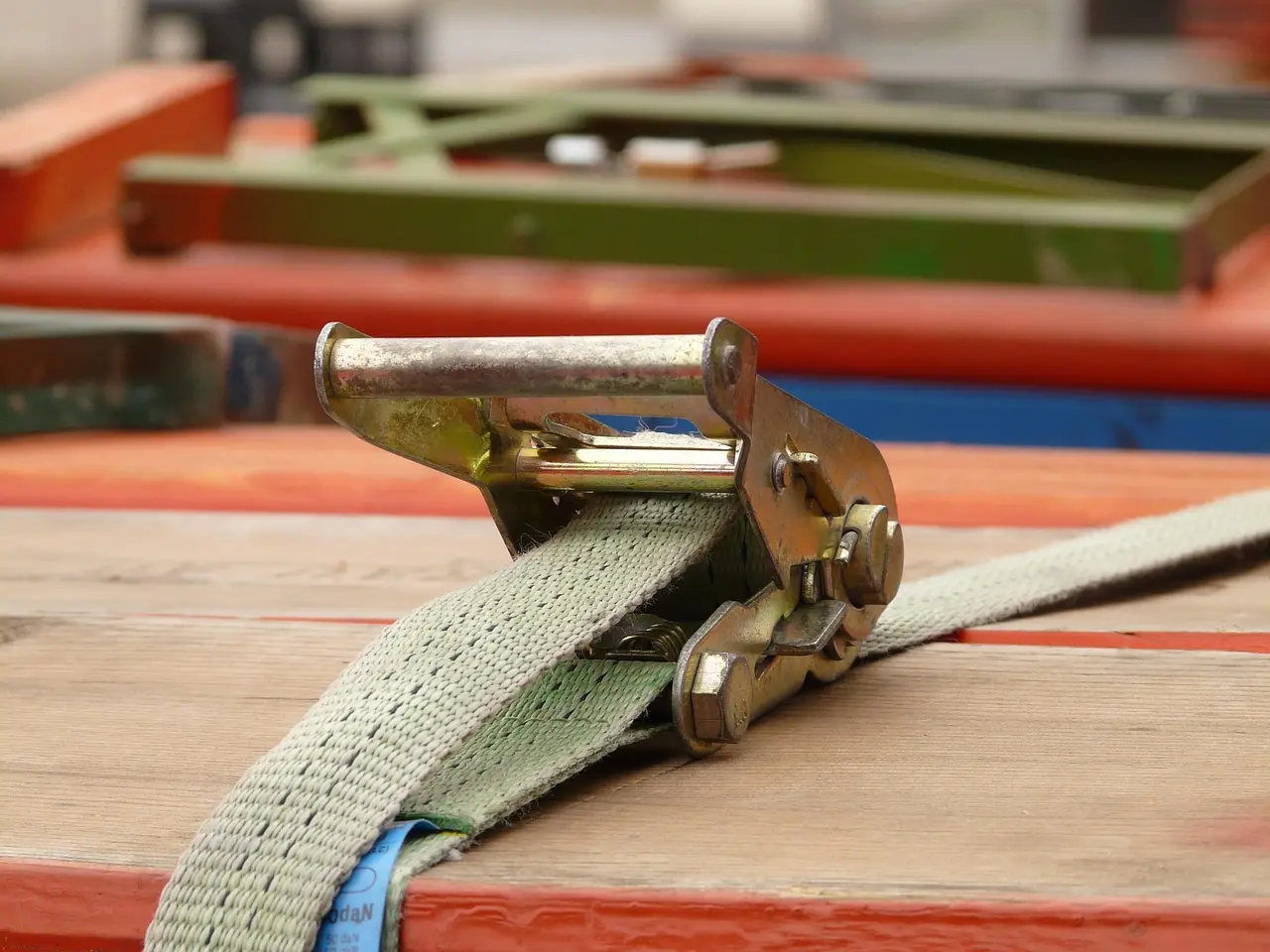
Ratchet tie down straps are the default choice for refrigerators, washers, ranges, and other heavy appliances because they let you add controlled tension without relying on stretch. Popular Mechanics says ratchet straps are the most secure way to tie down heavy loads and work for roof racks, trailers, and truck beds.
That control matters more than raw break strength alone. A light strap can slip or snap under road vibration; a tight strap can crush a finish or deform a panel if you over-tighten it.
Quick comparison
| Product | Badge | Best for | Price | ||
|---|---|---|---|---|---|
 |
Jack Boss Ratchet Tie Down Straps Set,1500 lbs BreakJack Boss | Our pick | 1" x 15′ · 1500 lbs break strength · Jack Boss | $19.99
Price as of 20 Oct 2026
|
View |
 |
XSTRAP STANDARD 8-PK Ratchet Tie Down Straps, 1" x 10FTXSTRAP STANDARD | Budget pick | 1" x 10FT · 900 Lbs break strength · 8-Pack | $26.89
Price as of 20 Oct 2026
|
View |
 |
2" x 15 FT E-Track Ratchet Straps (10-Pack) – Heavy DutyBANJEYSTRAPS | Upgrade pick | 2" x 15 FT · 4500 lbs break strength · 10-Pack | $59.99
Price as of 20 Oct 2026
|
View |
Use the comparison table to match strap type, hardware, and length to the appliance and vehicle. The safest choice is the one that matches the anchor points, protects the finish, and holds the load without crushing it.
How we chose
This guide uses appliance-safe criteria, not general cargo hype. The comparison focuses on finish protection, anchor fit, and control of the load.
It also checks working load limit against appliance weight, then filters for practical hardware such as coated S-hooks, double J hooks, and soft loops. Finally, it looks at vehicle setup, because a pickup bed, enclosed trailer, and moving van do not need the same strap length or anchor style.
Why working load limit matters more than break strength alone
Break strength is the point where a strap may fail in a straight pull test. Working load limit is the safer number for actual use, because it reflects the load the strap is meant to carry in service. For heavy appliances, shop by working load limit first, then confirm the break strength gives a comfortable margin.
Competitor pages often list break strength from 900 lb to 10,000 lb, but that number alone does not tell you whether the strap is sized for the job. STANLEY S9500 straps, for example, are listed with a 300 lb working load and 900 lb break strength, while Rhino USA 1-inch straps are sold as a 4-pack with 1,823lb break strength.
Hardware and length checks for truck, trailer, and van use
Use the anchor points that actually exist on your vehicle: E-track, D-rings, trailer rings, bed anchors, or factory cargo loops. Double J hooks fit universal anchor points such as E-track rings and D-rings, while safety S-hooks are common on moving strap sets and help reduce slipping and scratching when coated or locking versions are used.
Length should match the span between the appliance and the anchor. Common strap lengths include about 8, 10, 12, 15, 20, and 33 feet, but the right choice depends on vehicle width, anchor placement, and whether you need to wrap around the appliance with a soft loop.
Appliance securement matrix
| Appliance | Recommended strap width | Hook type | Soft loop or padding need | Anchor point | Common failure risk |
|---|---|---|---|---|---|
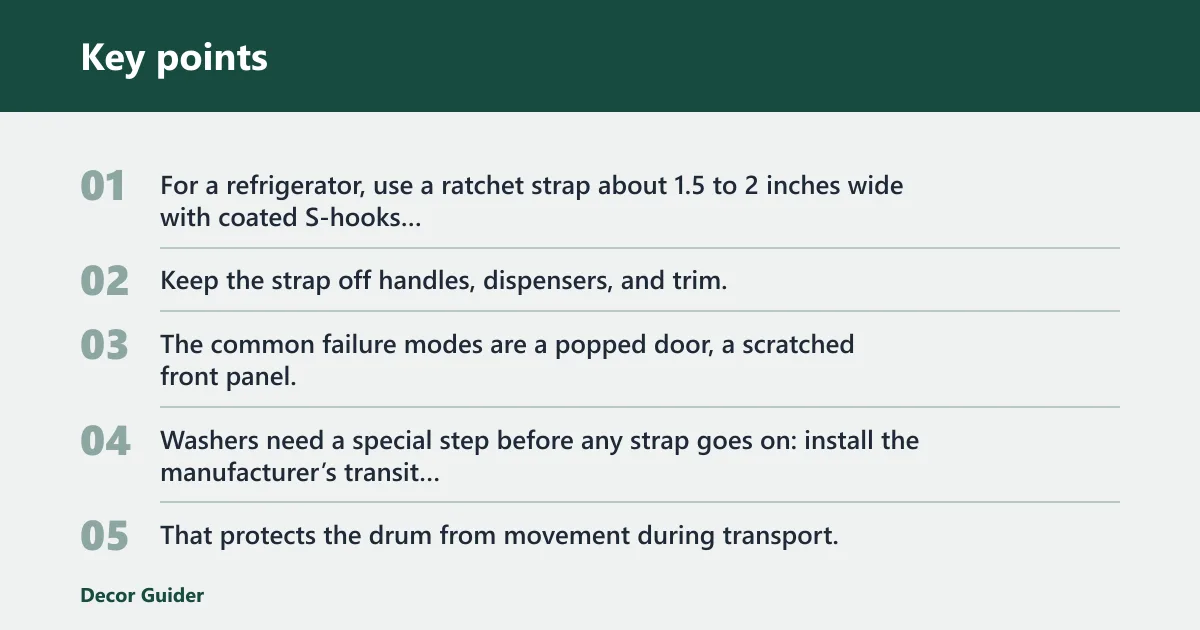
| Refrigerator | 1.6 to 2 inch | Coated S-hook or double J hook | Yes, use soft loops and moving blankets | Truck bed anchor, trailer ring, or E-track | Door pop-open, dented panels, strap slip on smooth finish |
| Washer | 1.6 to 2 inch | Double J hook preferred | Yes, plus corner padding | D-rings or E-track on a trailer or van | Drum damage if shipping bolts are omitted, shell dents, strap creep |
| Dryer | 1 to 1.6 inch | Coated S-hook | Yes, especially on painted or stainless faces | Bed anchors, van rings, or trailer points | Front-panel scratches, door opening, hose or cord snags |
| Dishwasher | 1 to 1.6 inch | Coated S-hook or soft-loop setup | Yes, low-profile padding is important | Close anchors that keep the load upright | Face-panel scuffs, frame twist, door latch pressure |
| Range | 1.6 to 2 inch | Double J hook or coated S-hook | Yes, around the cabinet body, not the handle | Heavy-duty trailer or truck anchors | Oven-door opening, enamel scratches, tipped load |
Refrigerator: strap width, hook type, and door protection
For a refrigerator, use a ratchet strap about 1.5 to 2 inches wide with coated S-hooks or double J hooks, and wrap the body with soft loops or blankets before tensioning. Keep the strap off handles, dispensers, and trim. The common failure modes are a popped door, a scratched front panel, or a strap that slides down a slick cabinet face.
Washer: transit bolts, strap setup, and drum protection
Washers need a special step before any strap goes on: install the manufacturer’s transit or shipping bolts if the model requires them. That protects the drum from movement during transport. Then add a strap around the cabinet body, not across controls or the lid, with enough padding to prevent metal-on-metal contact.
A common first-timer mistake is to cinch a washer tightly and skip the shipping bolts because the tub seems still when the door is closed. The road can change that quickly, and the result can be internal drum damage even if the outside looks fine.
Dryer: keeping doors shut and panels unmarked
Dryers usually do not need transit bolts, but they do need the door secured so it cannot swing open in transit. A 1- to 1.6-inch strap is often enough if the anchor spacing is close and the load is light enough, though larger units or longer spans justify a wider strap. Protect the front panel with a moving blanket or soft loop where the strap crosses the cabinet.
Dishwasher: low-profile padding and strap placement
Dishwashers are narrow, light enough to shift under braking, and easy to scratch because the front panel sits close to the body. Use low-profile padding and keep the strap low and centered so it does not pull on the door or top controls. The main risk is a dented frame or a latch that opens under vibration.
Range: oven door security and finish-safe contact points
Ranges need finish-safe contact points because enamel and stainless show marks quickly. Keep the strap around the cabinet body, not the oven door handle. Use a 1.6- to 2-inch strap when the range is heavy or the route is rough, and block the door so it cannot swing during loading.
Which strap type is best for your appliance?
Ratchet straps are the best match for most heavy appliances because they give you the most controllable tension and a firmer hold than lighter strap styles. Retractable ratchet straps can be useful when storage space is tight or setup speed matters. Cam buckle straps are easier to use, but they are better for lighter cargo than for major appliances.
Ratchet tie down straps: best for heavy loads
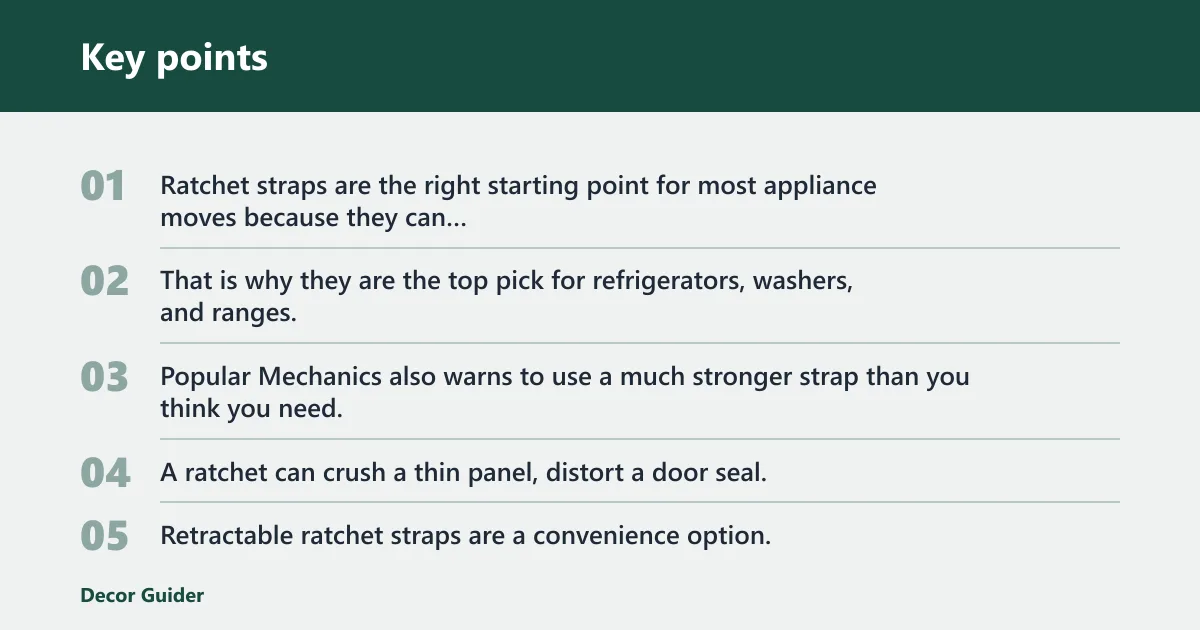
Ratchet straps are the right starting point for most appliance moves because they can hold tension through bumps, turns, and braking. That is why they are the top pick for refrigerators, washers, and ranges. Popular Mechanics also warns to use a much stronger strap than you think you need, which is sound advice when the load is heavy and the finish is easy to damage.
The drawback is over-tightening. A ratchet can crush a thin panel, distort a door seal, or leave a mark where the webbing crosses the appliance if you skip padding.
Retractable ratchet straps: faster setup and storage
Retractable ratchet straps are a convenience option, especially for homeowners who want less loose webbing after the move. They are sold in 1 inch x 10 feet and 2 inch x 10 feet formats, which makes them handy for quicker jobs and cleaner storage. They still need the same care with finish protection and anchor choice.
The drawback is that the fixed length can be limiting for larger appliances or wider vehicles. If your anchor points sit far apart, a standard ratchet strap is often easier to fit.
Cam buckle straps: lighter-duty only
Cam buckle straps are easier to tension by hand, which makes them a practical choice for lighter cargo. Popular Mechanics places lashing straps in the lighter-duty category, and a similar rule applies here: if the appliance is small, the route is short, and the load is not heavy, a cam buckle may be enough. For most full-size refrigerators or washers, it is the weaker choice.
The drawback is simple. A cam buckle does not give the same tension control or holding security as a ratchet when the load is heavy.
What hardware should you choose?
Hook style matters almost as much as strap width. The wrong hook can slip off an anchor, scrape a finish, or force you into a poor angle that invites movement. Match the hook to the anchor, then use padding where the strap touches the appliance.
Safety S-hooks and when coated or locking versions help
Safety S-hooks appear on several top-ranked strap products because they are simple and fast to use. Coated or locking versions are helpful when you want less metal exposure on painted or stainless surfaces, or when the anchor point has enough room that a standard open hook could shift.
The drawback is that a basic S-hook can slip if the anchor is slick, angled, or too small.
Double J hooks for E-track rings and D-rings
Double J hooks are designed for universal anchor points, including E-track rings and D-rings. They are a strong fit for heavier appliance loads in enclosed trailers, cargo vans, and some pickup beds. Cilfo also lists a 10,000 lb break strength double J hook strap, which shows how common this hook style is in heavier cargo setups.
The drawback is that the hook only works well when the anchor hardware matches it. If the anchor is too small, too shallow, or badly placed, the strap angle suffers.
Soft loops and edge protection for painted or stainless finishes
Soft loops create a non-marring contact point between the strap and the appliance, which is useful on painted sides, stainless fronts, and other finishes that scratch easily. FORTEM includes four soft loops in its 15-foot by 1-inch strap set, which is the kind of accessory that helps when you need more protection than a bare hook can offer.
The drawback is that a soft loop is not a cure for a weak anchor. It protects the finish, but it does not fix a bad tie point.
What length, width, and rating do you need?
The right size depends on both the appliance and the vehicle. A pickup bed often needs shorter straps than a box truck or trailer, while a moving van may need longer webbing to reach sidewall or E-track anchors. The goal is a strap that tightens cleanly without a long tail of extra webbing.
Width guide: 1 inch, 1.6 inch, or 2 inch
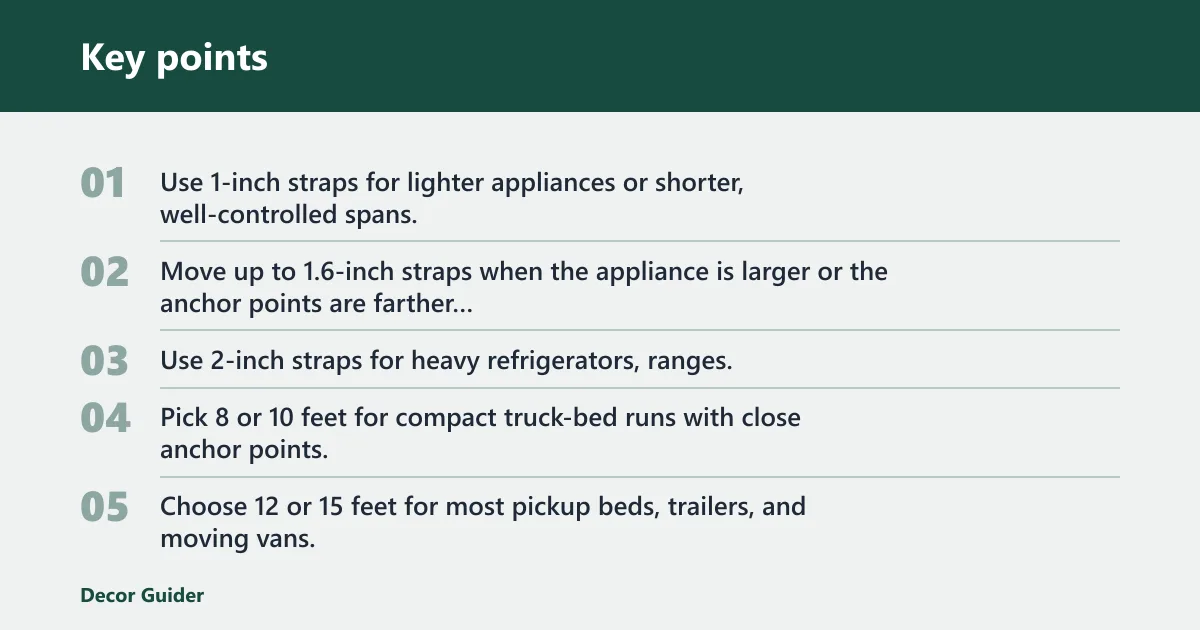
Use 1-inch straps for lighter appliances or shorter, well-controlled spans, especially when the finish is the bigger concern. Move up to 1.6-inch straps when the appliance is larger or the anchor points are farther apart. Use 2-inch straps for heavy refrigerators, ranges, and washer moves where extra holding security is worth the added stiffness.
Length guide: 8, 10, 12, 15, 20, or 33 feet
Pick 8 or 10 feet for compact truck-bed runs with close anchor points. Choose 12 or 15 feet for most pickup beds, trailers, and moving vans. Step up to 20 feet or 33 feet when the anchor point is farther away, such as a wider trailer, deeper cargo van, or a setup where you need to route around blankets and soft loops.
Rhino USA retractable straps are listed in a 1 inch by 10 feet format, which suits shorter runs. FORTEM’s 15-foot by 1-inch format is a better fit when you need more reach without jumping to a very long strap.
Break strength vs working load limit, explained plainly
Do not shop by break strength alone. It is a failure number, not a safe-use number. Working load limit is the figure that should guide the purchase, especially for heavy appliances.
Rhino USA 1-inch straps are sold as a 4-pack with 1,823lb break strength, Jack Boss lists 1500 lbs break strength on a 1 inch by 15 foot set, AUGO ratchet straps are listed at 2,200 lb break strength, and Cilfo includes a Cartman lashing strap rated up to 600 pounds. Those numbers show the spread in the market, but the safe choice still depends on the appliance, the anchor, and the route.
Which one should you buy?
If you are moving a refrigerator, washer, or range, start with a ratchet strap set that has coated hooks or soft loops and enough length for your vehicle. If you need faster storage and shorter runs, retractable ratchet straps are convenient. If the load is light and the route is short, a cam buckle strap can work, but it should not be the default for major appliances.
For the three products here, Jack Boss is the most appliance-friendly all-around pick because it combines 1 inch by 15 foot straps, coated S-hooks, and soft loops. Rhino USA is the better choice when you want a shorter 1-inch setup with a stronger listed break strength in a 4-pack. BANJEYSTRAPS is the best fit when you are securing heavy items in an enclosed trailer or cargo van with E-track anchors.
Jack Boss 1-inch 15-foot straps: best for mixed appliance moves
- Features 1 inch by 15 foot durable polyester straps
- Includes padded handles and coated S hooks
- Provides 1500 lbs max break strength capacity
Jack Boss fits homeowners who want one set that can handle moving blankets, appliance bodies, and different anchor distances without jumping to a bulky 2-inch strap. The 1 inch by 15 foot length is practical for pickup beds and many trailer setups, and the included soft loops and coated S-hooks help reduce finish damage.
The drawback is that 1 inch webbing is not the stiffest option for the heaviest ranges or large refrigerators on rough routes. For bigger appliances, you may want a wider strap or a higher working load limit than this listing provides.
XSTRAP STANDARD 10-foot ratchet straps: best for shorter runs
- Comes as an 8-pack set for securing multiple loads
- Includes coated S-hooks for scratch protection
- Features a ratchet handle and quick release mechanism
XSTRAP STANDARD is a compact choice for lighter appliance moves, quick van loading, or situations where the anchor points sit close to the load. The 1 inch by 10 foot format is easy to store, and the coated S-hooks help reduce scratching when used carefully around a dryer or smaller refrigerator.
The drawback is the 900 lb break strength. That is on the light side for major appliances, so this set is better for smaller machines, accessory loads, or short and controlled moves than for the heaviest refrigerator or washer jobs.
BANJEYSTRAPS 2-inch E-track straps: best for trailer and van anchors
- Heavy-duty 4500 lbs break strength per strap
- Designed with specialized E-track fittings
- Weather-resistant UV-resistant polyester webbing
BANJEYSTRAPS is the strongest anchor-match option in this group for enclosed trailers and cargo vans with E-track. The 2 inch by 15 foot size, 4500 lbs break strength, and E-track fittings make it a logical fit when you want a wider strap and hardware that locks into common cargo systems.
The drawback is that it is more strap than many homeowners need for a simple pickup-bed move. It is also best suited to E-track, so it is less flexible if your vehicle uses D-rings or basic bed anchors instead.
How to secure appliances more safely
- Empty the appliance and remove loose shelves, racks, trays, and cords.
- Close and tape doors only if the manufacturer allows it; do not tape over vents, seals, or controls.
- Install washer transit or shipping bolts when the model requires them.
- Wrap the appliance in a moving blanket or use soft loops where the strap will touch the body.
- Choose an anchor point that matches the hook type, such as D-rings or E-track rings.
- Run the strap around the cabinet body, not around handles, knobs, or fragile trim.
- Tighten until the appliance cannot shift, then stop before the finish begins to deform.
- Check the strap after the first few miles, then again after any hard braking or rough road section.
Suppose a 36-inch refrigerator is riding in a pickup bed with tie points on the bed walls. A 2-inch ratchet strap with a soft loop and a moving blanket gives you more control than a thin cam buckle strap, and it reduces the chance that the strap slides on the smooth door panel.
Picture a washer loaded into a box truck without its transit bolts. Even a tight strap cannot stop the drum from moving internally, so the safe move is to stop, install the bolts if required, and then secure the cabinet.
Frequently asked questions
What are the best tie down straps for securing appliances?
The best tie down straps for securing appliances are polyester ratchet straps in the 1- to 2-inch range with a working load limit that matches the load and hardware that protects the finish. For most heavy appliances, use coated hooks or soft loops, then match the strap length to the vehicle and anchor spacing.
Are ratchet straps safe for moving a refrigerator or washer?
Yes, ratchet straps are generally the safest strap type for heavy refrigerators and washers when used with the right anchors and padding. For washers, install the manufacturer’s transit or shipping bolts if required first. For both appliances, avoid overtightening and keep the strap off fragile handles or trim.
What strap length do I need for appliances in a truck?
Use 8 or 10 feet for short pickup-bed spans, 12 or 15 feet for many truck and trailer setups, and 20 or 33 feet when the anchors sit farther away in a larger van or trailer. The right length should allow a clean wrap and a ratchet that still has room to tension properly.
Should I use S-hooks or double J hooks for appliance moving?
Use S-hooks when you want a simple connection and the anchor point is compatible, especially if the hook is coated or locking. Use double J hooks when you need a better fit on E-track rings or D-rings. For heavier appliances, double J hooks often give a more secure match to the anchor.
What break strength is enough to secure heavy appliances?
Break strength should be comfortably higher than the appliance load, but it is not the same as working load limit. For heavy appliances, choose a strap with a strong safety margin and check the working load limit first. Popular pages commonly range from 900 lb to 10,000 lb break strength, but the safer number is the working load limit.
How do I keep straps from scratching appliances?
Use soft loops, coated hooks, or a moving blanket wherever the strap touches the appliance. Keep the webbing off polished stainless, enamel corners, and sharp edges. Also avoid anchoring to handles, because handles can bend, detach, or mark the finish when the load shifts.
Products related to this article
Sponsored / affiliate links. As an Amazon Associate I earn from qualifying purchases. I may earn additional commission from eligible campaigns.
 Ryetvok 30 Pcs Heavy‑Duty Hook‑and‑Loop Tape Strips, Adhesive Hook‑and‑Loop Circles, Heat Resistant & Waterproof Mounting Dots for Picture Hanging, Indoor & Outdoor Use, 1.95 Inch
 Golden Home Essentials XXXL Heavy Duty Couch Support for Sagging Cushions - 30in x 68in Extra Wide Sofa Cushion Board - 0.4in Saggy Cushion for Seat Support